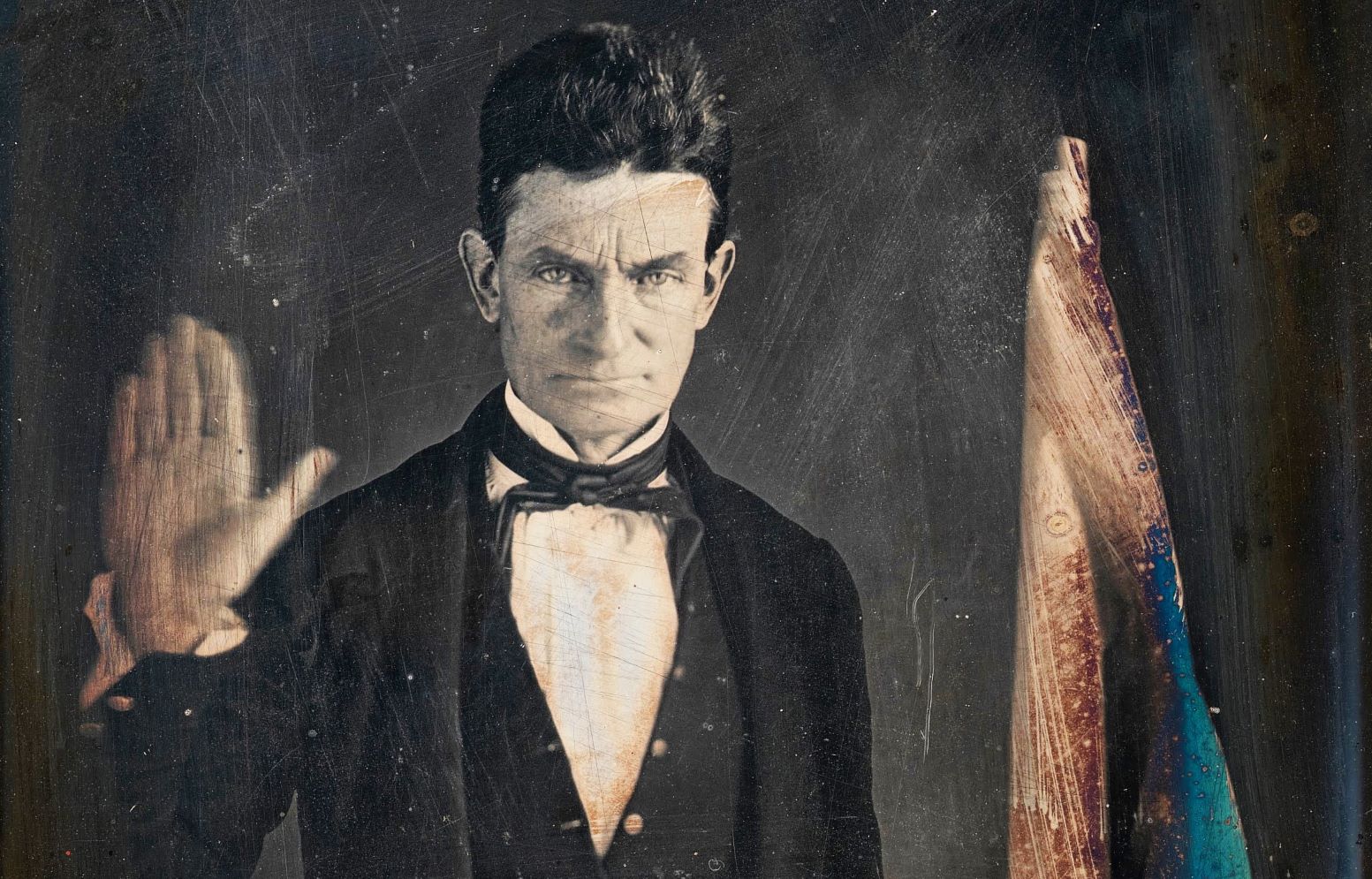
To paraphrase Louis Decaro–to go down the road of U.S. history you will find John Brown in the middle of it; you can either go around him to the right or to the left–but you must go around John Brown. Here, Albert Weisbord uses Brown as a challenge to the politics of Popular Front and of U.S. exceptionalism dominant in the mid-1930s.
‘John Brown: Revolutionist’ by Albert Weisbord and from Class Struggle (C.L.S.). Vol. 6 No. 8. December, 1936.
The various Communist groups in this country like to prattle of the wonderful revolutionary heritage that we have here in America. There is the American Revolution, the American Civil War, the Committees of Correspondence, the Declaration of Independence; then there is Jefferson, Lincoln and all the founding father, etc., etc. It is significant that these pseudo-revolutionary groups select for their forbears not the real revolutionists such as the Shays, the Veseys, the John Browns, but the men who bitterly hated these genuine champions of the people of their time and who today are praised in the most reactionary circles of the land. The heroes of the Communist Party and similar groups were the slave-holders and lynchers of the people of their day.
The Communist League of Struggle also believes that America is rich with revolutionary traditions, but we pick for our forbears not the idols of the Daughters of the American Revolution and the American Legion, but the leaders of the rebellions of the slaves, of the oppressed farmers and toilers of the land who gave their lives that the toilers might be free. And ace-high among all the champions of the enslaved and oppressed in this country stands John Brown. His life is a tremendous inspiration for every American of the 20th century who wants to free the wage-slaves of his time.
The American people have not given birth to many John Browns. Among the Negroes there have been many leaders of slave rebellions who have covered themselves with glory and have provided the traditions upon which the Communist movement must rest. But the white people have produced very few such heroes. It is true that there were considerable number of people who wanted to see the slave freed, but for the most part they did nothing about it, or if they did act, it was with the motive of sending the Negroes back to Africa, or of ending miscegenation among the white and black races, or of removing a competitor whose work was destroying free labor, and so on. Very few of those who argued for the freeing of the slaves did so because they considered the Negroes their brothers, equal to them in every respect and worthy of their love and loyalty, John Brown stands head and shoulders above all of them in this respect.
Contrast John Brown with Abraham Lincoln, for example. Lincoln declared he would like to see slavery ended but he refused to criticize his “southern brothers” (the plantation owners) for being so slow to waking up to their own true interests. Lincoln was the bitter enemy of all of the abolitionists, and especially for the type represented by John Brown. The desire to end slavery was a mere platonic sentiment with Lincoln and nothing else. It was only after the Dred Scott Decision, when slavery was permitted to thrive everywhere even in the North, that Lincoln felt some action should be taken gradually to curb the extension of slavery.
Lincoln was an ardent advocate of shipping all the freed Negroes out of the country and back to Africa. He was opposed to the extension of slavery because this would mean the extension of illicit sexual intercourse between white and black,—in his eyes, a deadly sin against nature. If such were the reactionary views of a Lincoln one can imagine the character of the ideals of the other moderate liberals of the day, who now and then thought it fashionable to express views against slavery and to sigh against its extension.
Even within the Abolitionist ranks, there were few that were of the caliber of John Brown. Most were petty-bourgeois religionists of the type of Garrison. Garrison was violently opposed to using any violence in freeing the slaves and denounced John Brown as an insane criminal after the Harper’s Ferry Raid. On the other hand, when John Brown was in Boston he never went to the Liberator office and in after years, now and then, he dropped words of contempt for the “non-resistants”.
John Brown represented the extreme left wing of the actionists of the abolitionist movement. He was one of the leaders in the physical resistance of Kansas to the hooligans of slavery who came in to capture the territory for the chivalrous institution of the South. But even among the men of action who took guns in their hands to drive out the slave holders, John Brown stood apart. In his letters to his wife, Brown points out clearly that the Northerners of Kansas had absolutely no interest of the Negro at heart and hated him as much, in their way, as the Southern whites did. The Northerners of Kansas were fighting not to free the slaves but to drive the Negroes out of Kansas and to restrict slavery to the South; they had no special quarrel with Southern slavery. They were interested in barring slave competition; they were not interested in the slave. None of them would call the Negro his brother.
It is well to bear in mind, in this connection, that even today in the ranks of labor and among the fake Communists, even when they take the Negroes into their ranks and smile and touch them with their fingers, it is not in the sense that they can learn from the Negro, that the Negro is truly their comrade; but rather from the narrow point of view that the Negro, if he is not taken in, will scab on the others. Or, to use the phraseology of the Stalinists: “There is a race between the proletarian forces and the bourgeoisie as to who will win the Negro. That proletariat must do so for otherwise it will be unable to overthrow capitalism. At all costs the Negro must be wrenched away from the capitalist class.” In all this argumentation, the basis is always the welfare of the white workers and the reasons why the Negro should be won are negative. Never is the plain basic truth given that the Negroes are brothers of the white and all must stick together as closely as possible, that they must live together, sleep together, intermarry together as brothers all of one kind. This is too much for the chauvinist white workers of the camp of the fake Communists.
John Brown was the only white leader ever to give his life for the Negro people in physical struggle for their liberation from slavery. All the others either merely talked, or when they fought, it was for themselves and only incidentally for solidarity with the Negro slaves. Nor need we stop with the days of slavery. We can go further and say that up to this day John Brown stands alone in this respect. More glory to his name.
II
Once having determined to give his live to free the slaves, John Brown seriously devoted himself to his task. He became a man with one purpose. From 1839 to 1859, for twenty solid years, he prepared himself for his work. He became the first professional revolutionist this country had ever seen and remains today the leading insurrectionist of America.
There is a silly idea that John Brown hastily concocted his raid on the U.S. arsenal at Harper’s Ferry and that his whole plan was but the fantastic vagary of a cracked adventurer. This is the slander of the bourgeoisie who defame Brown in proportion as they inflate Lincoln. And this line has been followed by the speakers of the Communist Party who only recently at a forum in Chicago declared that “John Brown did more harm than good!”
John Brown was no bewildered youth or intellectual of the stripe that fills the Communist Party today, who enter for a year or two and then disappear. John Brown was a mature man, the father of a large family, all the members of which rallied closely around him in his battle. The plans of Brown were solid and carried out over a long period of years.
The first thing he did was to study the census returns and work out a complete map of the distribution of the Negroes and the routes of the underground railway. His close friend that wonderfully heroic Negro woman, Harriet Tubman, who supported his plan, had personally led over three hundred blacks to freedom, not one of who was ever lost while in her charge. A reward of $10,000 for her, dead or alive, was offered, but she was never taken. Repeatedly John Brown went into the work himself and delivered Negro slaves from bondage of their Southern masters. He was no bureaucrat who like the Stalinists today is always telling the workers what to do while doing nothing himself. In this respect, John Brown was a model revolutionist and genuine leader; he never told others to do what he himself had not done and would not do again. He became thoroughly tested in the course of many years of physical struggle with the institution of slavery.
John Brown went about his work of aiding slaves to freedom with a cool head and brave heart. He trained the men under him to kill all who would arrest them and urged the slaves to fight to a finish any one who would lay hands on them to bring them back to slavery. He went so far as to work out a manual of rules of action in this respect and when in 1850 he organized his League of Gileadites to aid in the freeing of the fugitive slaves, he made the members take a pledge to live up to these rules. It was plain that John Brown meant business.
All this, however, was but a dress rehearsal for larger plans that would lead to a great slave uprising. John Brown was thoroughly familiar with the Negro slave revolts that had taken place. The insurrections of Issac, of Denmark Vesey, of Nat Turner and those that had taken place in the Cumberland region in South Carolina, Virginia, and Tennessee were well known to him. He had also gone into the history of the organized insurrections in Haiti and Jamaica. In fact, in order to perfect himself in the art of fighting, he went abroad to Europe to study the art of guerrilla fighting on its own terrain and brought back with him a comrade, one Forbes, who was to write out for him a complete manual of guerrilla warfare and civil war fighting.
The plans of John Brown were audacious enough. They included the invasion of the South by a band of men who would arm the slaves, kill all slaveholders who resisted and literally burn up the institution of slavery forever. It may be imagined that this was a totally crack-brained idea, but after all it was not John Brown who first conceived of the idea of a slave rebellion, but the Negroes themselves. They had repeatedly made very serious threats to the ruling class of the South. Brown felt deeply that were he to get even a small victory over the reactionary forces in the beginning that large numbers of slaves would rally to his cause. And as we shall see at the Harper’s Ferry raid itself, this was no illusion. The Negroes of the South were desperate enough to take part in any rebellion that offered any hope whatever to them. Brown’s rebellion in his opinion did not have to be successful in itself; all that it had to do was to demonstrate that the slaves meant to fight for their freedom to the death and at the first opportunity would tear their masters to pieces. This would have been enough to set in motion a train of events that would put an end to slavery. There was needed some pioneer to show the way. John Brown was that pioneer.
In order to get his band together John Brown next decided to spend all the time possible among the Negroes and those abolitionists who would follow him in his action. To get close to the Negro people, he moved his family to the far northern part of New York State in the wilds of the Adirondacks where a philanthropist had offered free land to the Negroes who wanted to rehabilitate themselves there. Brown thought that by living among these Negroes he could win a few of them for his cause. So he sold out his wares and moved to the far reaches of North Elba, he and his family. John Brown, you see, was ready to back up his opinions with his life. And his family bravely followed him everywhere.
In the meantime, the sharpening of events in the United States itself compelled Brown to modify his plans. The U.S. Congress decided to adopt the policy of “squatter sovereignty” regarding the territory west of the Mississippi River and thus there began a great race between the North and the South as to who would populate Kansas and Nebraska the most. It had been planned originally that Nebraska would go to the North and Kansas to the South. But the Abolitionists began to bestir themselves to send in large bodies of farmers into the State to win it against slavery. On the appeal of the abolitionists, John Brown “Osawatomie Brown”, became the most feared and hated man the South knew.
It was now time for Brown to carry out his grand plan. First he had to try to win as many Negroes as possible to enter his ranks. This was an extremely difficult thing to accomplish. The center of the freed Negroes was in Canada and there he went to hold a secret convention with the freedmen and to win them over to invade the South. He needed them not so much as fighters, as to train the slaves, to organize them and win their confidence for the desperate struggles ahead. In Canada he was able to win the sympathy of the leading Negroes. They organized a Black Phalanx and pledged themselves to go with him. Unfortunately the plans miscarried that year and they became discouraged. The actual raid finally took place too suddenly for them to join Brown; some of the leaders like Frederick Douglass backed down; others like Harriet Tubman became ill at the crucial moment and so John Brown had to start his invasion with the small band of twenty two persons.
The plans for the raid on Harper’s Ferry were carefully laid. Arms and pikes were hid in a farm house near by and the men spent some months scouting around and preparing for the event. Among the twenty two men, seven were Negroes: Osborne P. Anderson, Shields Green, Dangerfield Newby, John A. Copeland, Lewis S. Leary, John Anderson and Jeremiah Anderson. Others were on the way or had promised to be there. These Negroes were all tested men; some of them, like Shields Green, were of the stuff heroes are made of. Dangerfield Newby was to be the first to give his life for the cause.
The place had been carefully selected. It was at the foothills of the Cumberland mountains, the mountains which furnished the road deep into the slave territory of the South, which was the center of fugitive slave activity and where guerrilla warfare could be best carried out. For it was not the intention of Brown to win the arsenal at Harper’s Ferry and then turn North,—no, it was his intention to strike deeper and deeper into the South like Spartacus of Rome, winning and training his army as he went. He would cut a wide swathe through the south and that would tear its heart out. Here was the plan. But for this arms were needed and Harper’s Ferry was the place to get them.
How well Brown calculated on the support of the Negroes can been seen after the raid took place and his men had gone to the neighboring plantations to free the slaves. The slaves were immediately given arms and in the course of the fighting with the crack troops of the U.S. government under Robert E. Lee, these Negro slaves gave a very good account of themselves.
III
At his trial John Brown behaved like a model revolutionist. Not for one moment did he allow his accusers to take the offensive, but constantly charged them with being the murderers and thieves that they were and warned them that their time was nigh and that the toilers of America meant to deal with the institution of slavery with an ax that would cost the lives of the tiny handful of slave holders of the country. To hush him up, the authorities rushed through the trial as fast as they could and hung him together with the others they caught. But the deed was done. The way had been shown. With a great cry of rage, frantic with fear, the southern slave holders now feverishly hastened to break from the union. The die was cast, the civil war was on and despite Abraham Lincoln’s express orders, the famous song “John Brown’s body lies a moldering in the grave, but his soul goes marching on” became the song of inspiration for the Grand Army of the Republic.
Such is the glorious story of John Brown. What lessons can we learn of his life and work? John Brown won his leadership not by bureaucratic means but by his sober work in the field. Like a true American, he was a man of direct action. His talk was straight and to the point. He was honest through and through.
Second, John Brown made his life work the profession of insurrection. He studied all that was available on the subject of actual fighting. This the leaders of the Communist movement should do today. John Brown was no sniveling legalist. He had no illusion about the nature of civil war and what he began he meant to carry through to the end. Today, however, the profession of proletarian revolutionist is far more complex than in Brown’s day. Different methods have to be used. Today it is not necessity to organize the iron battalions of a new class, a class that John Brown did not well know, the modern proletariat. There is now needed not only a knowledge of military science, but a social science as well. And yet John Brown’s knowledge of American society was by no means to be underestimated. The fact that the Civil War broke out so soon after his raid shows how close he was to the hub of things. He did what the proletarian revolutionist has yet to do—live closely in touch with the American Negro. He understood better than anyone that the Negro problem was the heart of the social problem in this country. His whole life was one of flaming solidarity and brotherhood with the Negro toilers. Here is a lesson for all of us to learn today.
Third, the story of John Brown teaches us that the real fighters will come from the native stock of practical bent and not from the foreign born theoreticians who stand aloof from the struggle. In Brown’s day there were German socialist immigrants who pretended to know all about revolution, social science and even Marxism, and yet who stood aloof from the fight to free the slaves on the pretense that the proletarians were also slaves, wage-slaves, and their duty was to the proletariat first of all, and they had not time with “N***s”. What a pitiful role the immigrant “communists” of that day actually played in America! We have to learn this lesson, too, from the social struggles of their times.
Finally, Brown’s life shows us that the way to begin is—to begin. Once the social relations have reached an extraordinary intensity and are on the verge of breaking, once the problems have reached such acuteness that they can only be solved by armed struggle on the order of the day, then even a small group of determined men can precipitate the events that will shake society to its foundations. That is then the time to change the weapon of criticism, the polemic and debate, for the criticism of weapons, the ax, the pike, the gun. John Brown is the great American Blanquist of his time; he is the spiritual father of genuine revolutionary Communism today.
When we come to look back upon the history of this country just prior to the Civil War and ask ourselves what should a revolutionist have done, we must answer that in spite of his mistakes, John Brown and only John Brown, was right.
The Communist League of Struggle was formed in March, 1931 by C.P. veterans Albert Weisbord, Vera Buch, Sam Fisher and co-thinkers after briefly being members of the Communist League of America led by James P. Cannon. In addition to leaflets and pamphlets, the C.L.S. had a mostly monthly magazine, Class Struggle, and issued a shipyard workers shop paper,The Red Dreadnaught. Always a small organization, the C.L.S. did not grow in the 1930s and disbanded in 1937.
 Revolution's Newsstand