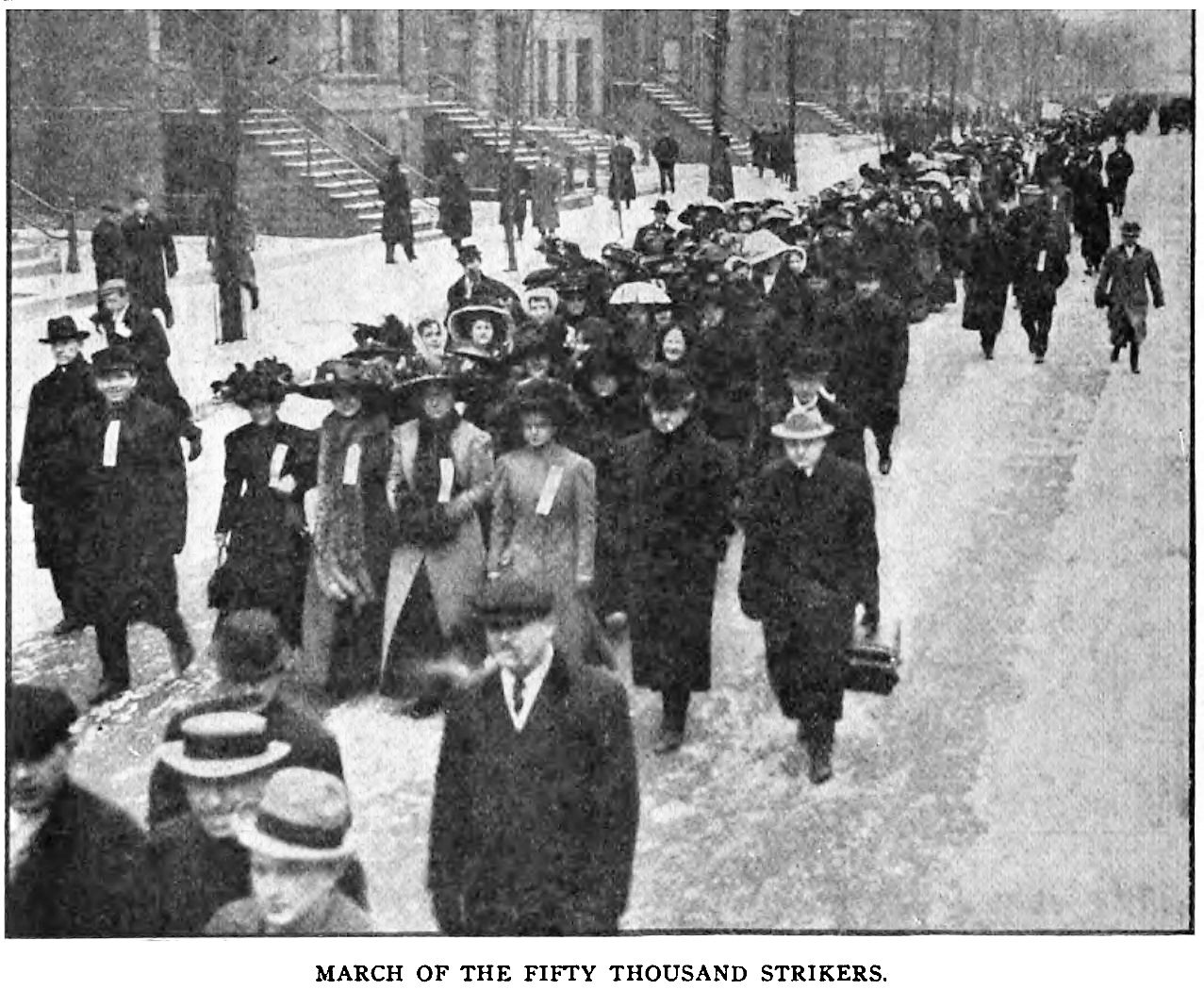
A transformative strike that kick started the unionization of an industry. A former garment worker and union leader, Theresa Malkiel writes on the epic strike of 40,000 garment workers, largely Jewish immigrants like herself, against Hart, Schaffner and Marx in the fall and winter of 1910-11.
‘The Garment-Workers’ Strike’ by Theresa Malkiel from the Chicago Daily Socialist. Vol. 5 No. 4. October 29, 1910.
At this moment the eyes of our Jewish comrades are centered upon the bitter struggle between the Garment Workers of Chicago and their bosses. Blood is being spilled daily. The police of that great city are ordered to shoot at random and all because a number of hard-working, half-starved men and women, or an army of braves have left the work bench and gone out into the open to argue it out with their bosses–the enemy whose unbearable oppression they could no longer stand.
The world looks on at the struggle and wonders how it is that these toil-worn faces, emaciated bodies, these uncultured minds could still display such eagerness to sacrifice themselves for the present, to cast aside all thought about the consequences of a prolonged strike, to bury it all in the wonderful devotion to the cause of organized labor.
“A bunch of stubborn mules, too lazy to work,” says Bome. “Impudent foreigners who don’t know how to appreciate their betters,” say others.
But it is not so. The people who have themselves worked and suffered understand that no working man or woman would ever leave their shop unless compelled by unbearable conditions to do so. It is not an easy matter for foreigners, men with families; men who do not know the language and are constantly hooted and laughed at by the native Americans. It is not an easy matter for these people to go out penniless into the dark unknown. The strikers, too, have human hearts beating in their emaciated bodies. They, too, love their dear ones whose welfare is all and all to them. It is not easy for the poor garment worker to see his child hungry and half-naked.
The people who have never worked, never known what real hardships mean, those who have never touched the hard work bench, have never been paid starvation wages, have never been made to work long past night-fall made to pay for every little discrepancy, made to bow to the persecutions of an impudent foreman, those people cannot know that the garment workers of Chicago, as well as the garment worker elsewhere, went on strike because they could not stand their suffering any longer.
They do not know that the garment workers have been leading an existence worse than that of the savage. They do not know that the garment workers are pale and stooped, and under-grown because their bodies have at last become diseased. Diseased because of the squalid surroundings, the filthy crowded rooms recking with vermin and surcharged with the foulest odors, the meager, unnourishing food and the long hours of labor.
This outside world and its inhabitants do not know, or do not want to know that it is just because of the great love he bears his family that the garment worker is ready to brave this present suffering. He has been on the downward path all along until he no longer dares to look the future in the eyes. He no longer dares to think what awaits this growing generation, this flesh of his flesh and bone of his bone. He has almost lost all hope of being able to uplift his growing family.
The garment worker is fighting so desperately because he considers the present struggle his last chance before going under altogether. The terrible yoke of wage slavery did not knock him out altogether. The Jew cannot be conquered so easily. He has been on the job for over two thousand years, ever and again raising his beaten head, stretching out his clipped wings and once again displaying the old courage, the long acquired power of resistance, the great desire for independence.
The spark of rebellion within him has flickered up anew. The garment worker of Chicago, as well as the garment worker elsewhere, has at last realized that he must act together with his fellow workingmen if they are all to become masters of the situation. They know that the situation as they find it today is more than grave. Their opponents are strong in worldly possessions, they do not have to starve while the factories are idle. The government, the police, the military, the judiciary, are at their disposal ready to back them up in case of necessity to beat down the strikers.
This is just the very reason why the latter stand so firmly for the recognition of the union–at the present the union alone affords them protection, voices their protest against this living hell in which they have been dragging on their miserable existence, their intention to put a stop to this steady devouring of their very flesh. The union acts as the mouthpiece of the oppressed, the hungry, the downtrodden. It is a step towards further progress, an instrument through which the workers hope to better their condition.
But even in this hour of great distress we want to remind the garment workers and all other organized workers that the union is only one of the means to the ultimate goal. It is their economic representative: it has taken up their immediate battle and even if it does achieve the increase of pay and shortening of hours this evident success should not crush in the workers the divine spirit of unrest, of desire for betterment. They should employ the granted hour of freedom in trying to understand the principle of Socialism, through which they will eventually rid themselves of the tyranny of the employing classes. It is the political factor in this country that is in a way largely responsible for the economic dependence. And it is to this political factor that organized labor must turn its attention.
The garment workers’ strike is just, they have with them the sympathy, moral and financial support of the entire labor world. All credit is due them for standing by the union, but as it was said above they should not stop at that alone, they must strike at the ballot box as well. Let the garment workers as well as all other organized workers send forth their protest against the terrible outrages enacted against the garment workers at Chicago. Let them make an effort and send their own men into the halls of Congress there to proclaim in the face of the whole nation, the demand for better, more human conditions for the workers of the world garment workers of Chicago reply to the brutality of the police by casting your vote for the Socialist candidates on election day.
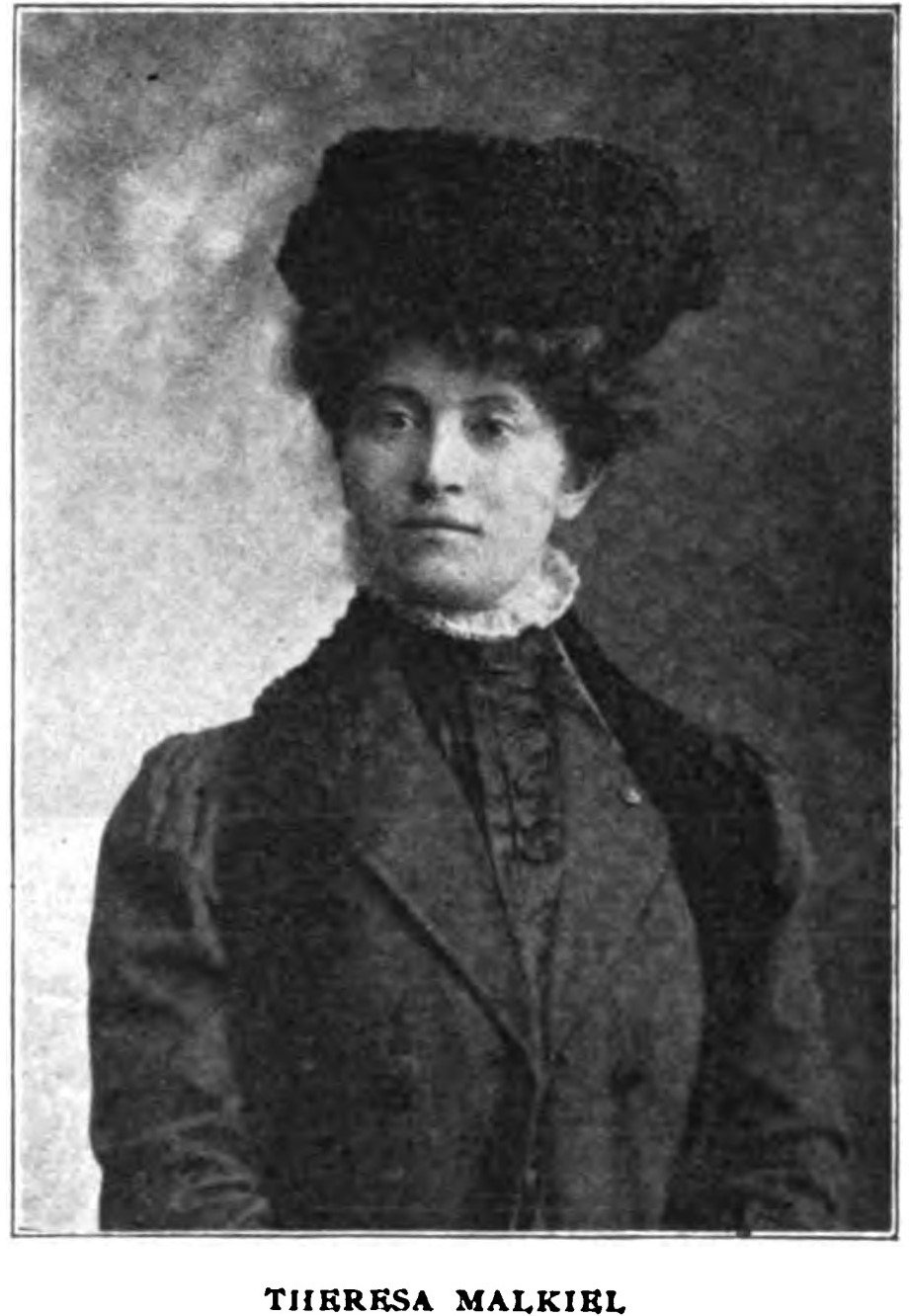
Theresa Malkiel (1874-1949) Theresa Serber was an American born in Ukraine into a large Jewish family. In 1891 the Serber family emigrated to New York City’s Lower East Side where a teenage Theresa found work, like so many Jewish women of her generation, in a garment factory. Still a teen, she joined the Russian Workingmen’s Club and in n 1892 she began her organizer’s life helping to found the Infant Cloakmaker’s Union of New York, becoming its first president. In 1893 she joined the Socialist Labor Party and representing her union in the Socialist Trade and Labor Alliance. In 1899, Theresa joined the ‘Kangaroos’ opposed to Daniel De Leon’s leadership and became a founding member of Socialist Party of America, and the first working class women to rise to leadership of the Party. In 1905, Malkiel organized the Women’s Progressive Society of Yonkers, a branch of the Socialist Women’s Society of New York. The ‘separatism’ of the Society was opposed by the male leadership. Malkiel was one of the best-known women Socialist writers of the ‘Debsian era’ with articles in many union, labor, feminist and socialist publications. Malkiel was elected to the Woman’s National Committee of the Socialist party in 1909 and led the establishment of Woman’s Day, starting on February 28, 1909, which would inspire International Women’s Day. That year also saw the epic New York City shirtwaist strike in which she would play a leading role with the Women’s Trade Union League. In 1910, Malkiel’s most lasting work, The Diary of a Shirtwaist Striker, a fictionalized account of the shirtwaist strike was published and widely read. Malkiel also helped to raise the question of race in the Party, challenging the Socialist’s internal segregation and racism and writing a scathing report on the life of the Party after a 1911 speaking tour through the South. A leading Socialist campaigner for the vote, in 1914, she headed the Socialist Suffrage Campaign of New York and was on its National Executive Committee to travel across the country campaigning for suffrage. Malkiel stayed with the Part during the disastrous 1919 splits, and ran for State office in 1920. Her partner was leading Socialist solicitor Leon A. Malkiel. Although Theresa was able to move from a life of factory work, she remained committed to workers organizing and education, leading immigrant and adult classes for workers in Yonkers for the remaining decades of her life.
The Chicago Socialist, sometimes daily sometimes weekly, was published from 1902 until 1912 as the paper of the Chicago Socialist Party. The roots of the paper lie with Workers Call, published from 1899 as a Socialist Labor Party publication, becoming a voice of the Springfield Social Democratic Party after splitting with De Leon in July, 1901. It became the Chicago Socialist Party paper with the SDP’s adherence and changed its name to the Chicago Socialist in March, 1902. In 1906 it became a daily and published until 1912 by Local Cook County of the Socialist Party and was edited by A.M. Simons if the International Socialist Review. A cornucopia of historical information on the Chicago workers movements lies within its pages.
PDF of full issue: https://www.marxists.org/history/usa/pubs/chicago-daily-socialist/1910/101029-chicagodailysocialist-v05n004-campaignedition.pdf
 Revolution's Newsstand