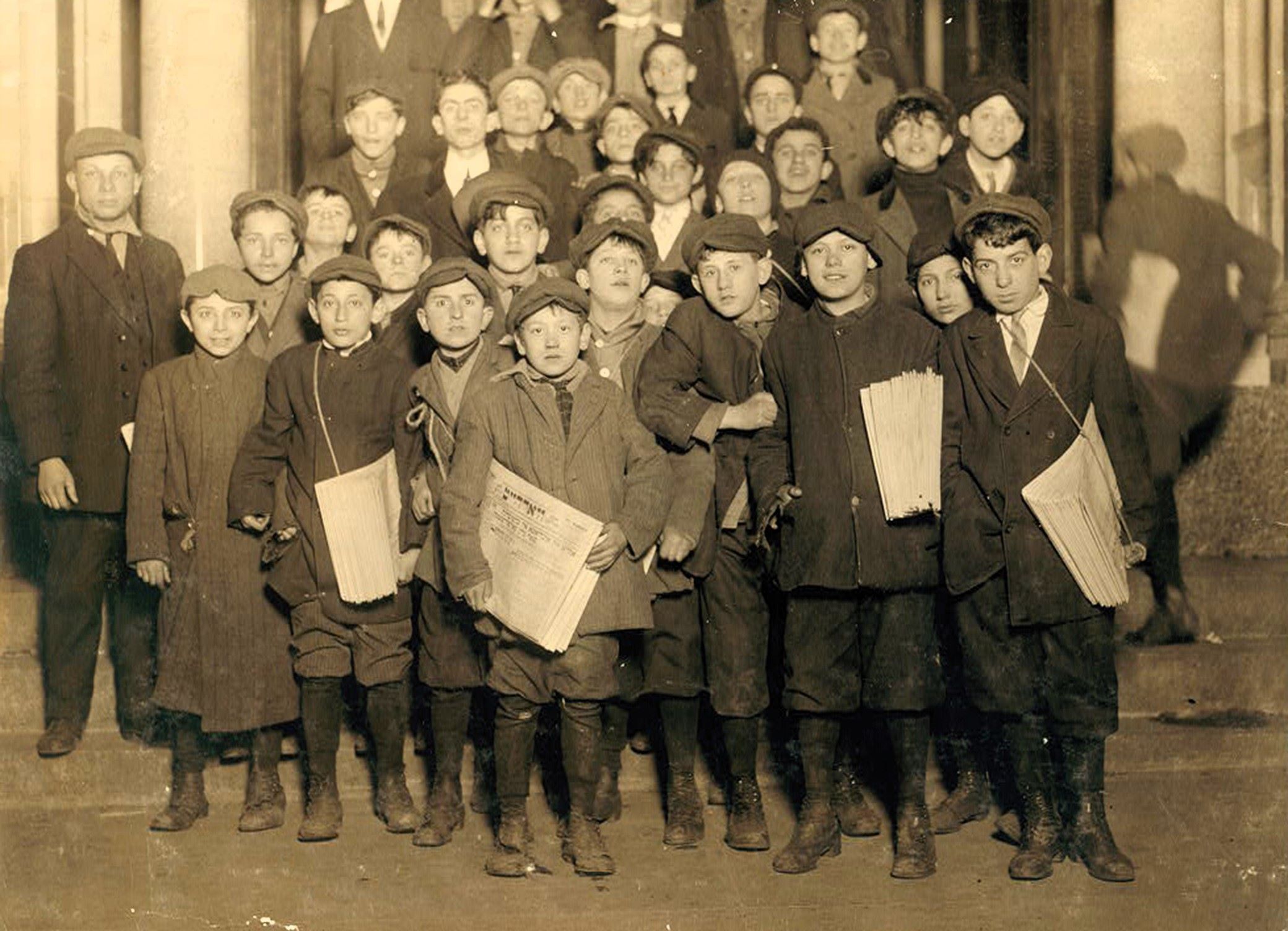
The Socialist Party holds a conference to consolidate the growing movement in New York City’s Lower East Side, which would become a stronghold of the Party for a generation.
‘Great Socialist Revival on Jewish East Side’ from The Worker (New York). Vol. 14 No. 18. July 31, 1904.
Conference of Societies Launches Energetic and Systematic Campaign–Joseph Barondess Nominated for Congress–B. Felgenbaum Chosen as Organizer.
A very inspiring revival of the Socialist political movement is now taking place among the Jewish workers on the lower East Side.
Preliminary to this revival there was for some time a mushroom-like growth of various progressive societies. Young men and women organized into beneficial and educational clubs–the natives of some city or district in the old country generally uniting in one society–and all of these organizations gradually developed a more and more radical spirit. Many of them became affiliated with the “Arbeiter Ring” or Workingmen’s Circle, the Jewish sick and death benefit organization, which thus had a phenomenal growth.
For a long time the old party “war horses” attached but little importance to these organizations. While recognizing that, being based on the benefit system, they had a greater stability than our party branches and purely propaganda clubs on the East Side have had, which so often grew up suddenly and as suddenly perished, yet many of the old Socialists doubted the seriousness of their professions of radical principles.
But this pessimistic view seems not to have been well founded. Upon a call from the party comrades in conjunction with the Jewish daily “Forward”–which paper is now energetically supporting the party–about forty societies, with an aggregate membership of 4,000 persons, sent delegates to a campaign conference.
The meetings of this conference have been very enthusiastic. And the enthusiasm is of a reliable sort, because it emanates from societies that are certainly here to stay. It became manifest that there is a good superstructure of principle on a solid material foundation.
The first act of the conference was to vote to engage a staunch party man as an organizer for the First Agitation. District, for the express purpose of building up the party organization in the Jewish quarter, the conference undertaking to pay the organizer’s salary of $15 a week through the campaign. B. Feigenbaum was chosen for this work.
This awakening enthusiasm for organized party Socialism, not merely for vague radicalism, is not confined to the conference, which merely reflects the spirit now prevailing in the ranks of the Jewish proletariat. Socialism is in the air.
There are optimists who predict that the first Congressional victory to be gained by the Social Democratic Party will be here in the Ninth District in this campaign. Others say, ‘Let us rather work and deserve victory and leave room for joyful surprise but not for disappointment.’
One thing is sure, activity will not be wanting. The army of house-to-house propagandists is being organized, with captains and lieutenants in every assembly and election district. Every voter will be reached by systematic work and the propaganda will be in constant touch with the needs of the day.
At the last meeting of the conference, held on July 21 at 209 E. Broadway, the hall was packed with delegates and onlookers. The enthusiasm was such as simply compelled Joseph Barondess, in spite of his earnest plea to be excused, to accept the Congressional nomination.
The campaign is now in full swing and hopes are as bright as the recent developments are surprising.
East Side comrades should watch the “Forward” for announcement of meetings to form neighborhood companies of workers, and should respond to a man.
The Worker, and its predecessor The People, emerged from the 1899 split in the Socialist Labor Party of America led by Henry Slobodin and Morris Hillquit, who published their own edition of the SLP’s paper in Springfield, Massachusetts. Their ‘The People’ had the same banner, format, and numbering as their rival De Leon’s. The new group emerged as the Social Democratic Party and with a Chicago group of the same name these two Social Democratic Parties would become the Socialist Party of America at a 1901 conference. That same year the paper’s name was changed from The People to The Worker with publishing moved to New York City. The Worker continued as a weekly until December 1908 when it was folded into the socialist daily, The New York Call.
PDF of full issue: https://www.marxists.org/history/usa/pubs/the-people-the-worker/040731-worker-v14n18.pdf
 Revolution's Newsstand