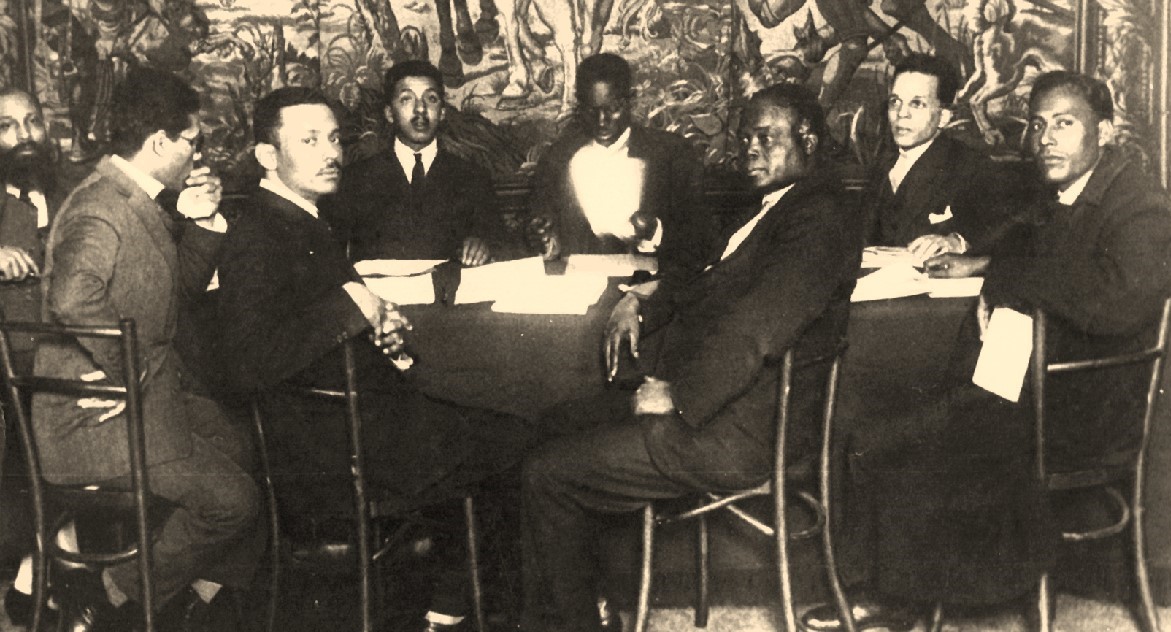
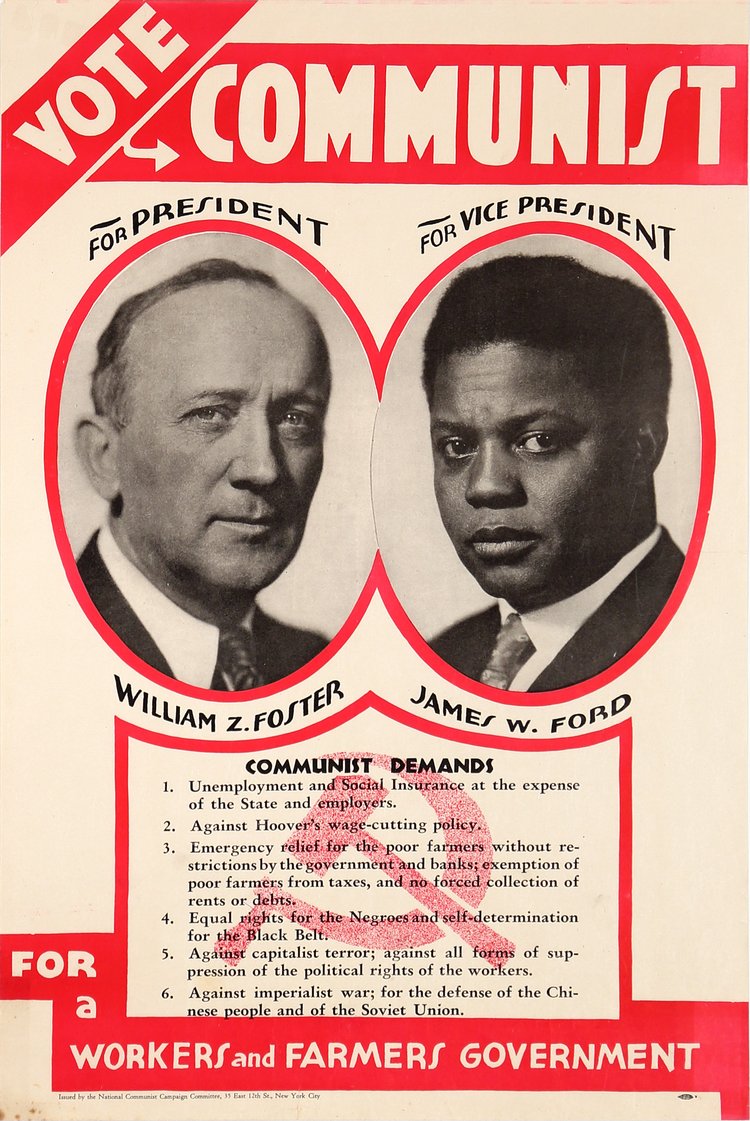
James W. Ford’s report as member of the Executive Committee of the League Against Imperialism to its 2nd international conference held at Frankfurt am Main in the summer of 1929. Covering the position of Black labor in international capitalism, conditions in Africa and the diaspora, and general and specific programs of action.
‘The Negro and the Struggle Against Imperialism’ by James W. Ford from The Communist. Vol. 9 No. 1. January, 1930.
I. GENERAL STATEMENT
THE so-called Negro “problem” has been consistently misstated for so long that a survey of it is needed, especially with regards to the Negro under imperialism. We are in the period of the general decay of capitalism; sharpening of antagonisms are producing a real serious crisis in capitalism and imperialism which really characterizes capitalism at the present time. This period is of tremendous significance to the international working class and oppressed peoples and is of very great importance to the Negro people themselves. The future history of the Negro in the struggles for liberation, for political, social and economic advancement depends immeasurably upon how they estimate the present period of imperialism, the concrete organization tasks they put before themselves in order to achieve these things and the unity they establish with the international struggle against imperialism. Indeed, the Negro people are passing through one of the most important periods of struggle for liberation. We have already seen the great struggles of the Chinese workers and peasants; we see rising waves of revolt and struggle in India; we are witnessing great waves of revolt in the working class and proletariat in the home lands of imperialism.
IMPERIALISM AND THE NEGROES
For our purpose in dealing with the special question of the Negro, imperialism is that stage of capitalism when the whole globe has been divided and distributed amongst a few of the greatest capitalists powers, and especially the territory of Africa; and when there is going on amongst the Negroes of America class changes, the development of a Negro bourgeoisie which, subordinating itself to the big white bourgeoisie, causes a more intense exploitation of the Negro toiling masses of America. Imperialism nurses and stimulates racial hatreds by means of racial oppression.
WORLD WAR AWAKENS NEGROES
During the imperialist war of 1914-18 hundreds of thousands of Negroes were brought into direct contact with western customs and culture; millions of Negroes were brought from the agricultural and peasant regions of the southern part of the U.S.A. into the industries of the north and became a fixed part of the industrial proletariat of America. At the same time imperialism has carried industrial development into the colonies of Africa and is producing, though small, yet a substantial proletariat, especially in South Africa.
Already the post-war period has given rise to class-consciousness and organized revolt of Negro toilers against imperialism. But in order to understand this new period of the Negro’s struggle it is necessary to understand the old periods of capitalist exploitation and oppression of the Negroes.
MODERN IMPERIALISM AND THE NEGROES
The process of the economic and political enslavement of the Negro peoples has extended over a period of 300 years and may be divided into three stages.
1. The classical period—the period of merchant-capitalism which stood everywhere for a system of snatching slaves, marked the birth of the notorious African slave trade. This was the time when the Portuguese, the Dutch and the British were at the high tide of their business of dealing in slaves. It is estimated that over a hundred million Negroes were torn from Africa during the course of three hundred years. Fabulous fortunes were made on the slave traffic. It is estimated that profits ranged from one hundred per cent to one hundred and fifty per cent. In the early colonial days in Massachusetts the rum-slave traffic was paying one hundred per cent profit. The average price of slaves were: in 1840, $325; in 1850, $360; in 1860, $500. It was on slave traffic profits, including the rape of India, that England was able to lay the basis of the British Empire; as well it was of tremendous profit to America. Thus capitalist exploitation and profits were at the very basis of the beginning of the enslavement of the Negro people.
2. The second period—the period of industrial-capitalism marked the beginning of the territorial division of Africa, and the capitalist exploitation of its natural resources through the exploitation of the labor power of the natives. At the same time, because the slave traffic and this method of securing labor supply became too costly and wasteful, this period marked the liquidation of the “legal” slave traffic. ‘This stage marked not only the period for supplying the primary resources of the growing manufacturing enterprises of England but as well marked the period in America when the slave traffic gave away to the intense plantation exploitation of the Negro slaves as the main source of profits, and laid the basis of the present might and wealth of American imperialism. Over seventy-five million bales of cotton were produced in America from 1826 to the opening of the Civil War, and from the close of the Civil War to 1884, over fifteen million bales. Thus the cessation of the slave traffic really increased and carried forward the profit-making of the previous period.
3. The third stage, and this is the period that we are most concerned with, is the epoch of imperialism and marks the completion of the partitioning of Africa and the complete enslavement of its people; it marks the period, in addition to the already intense exploitation of the Negroes by the big white bourgeoisie, of class demarcations amongst the Negroes themselves, in which the rising Negro bourgeoisie is hand in hand supporting the exploitation of the Negroes by the big white bourgeoisie; and the already extreme racial barriers continue the special exploitation of the Negroes, all of which mark the most intense exploitation of the Negroes.
POLICY OF IMPERIALISM
What is the present policy of imperialism with regards to the Negro peoples? Whereas in early history of India, England followed a policy which uprooted and tore down old customs and institutions and feudal systems which amounted to a social revolution, in Africa, excepting possibly South Africa, British imperialism is following a policy of maintaining the old customs and hindering the industrial development of the country as was done previously in India, and is ruling the country through native chiefs while she sucks profits from the territories, thus degrading and perpetually carrying on a policy which hinders the advancement of the toiling masses of Africa.
French imperialism, while tearing down old customs, is at the same time in actuality exterminating whole territories of the population.
The policy of imperialism is, in actuality, a policy of retarding the industrial development of the country, a policy which results in retarding and hindering the advancement of the African people, and standing in contrast to it is the agrarian policy—the policy of maintaining Africa as the “countryside” for the European imperialists, as the leading source of raw materials, as market centers, as centers for surplus investments of capital accumulations gained through the exploitations of the workers in the home countries. The latter of these conditions, i.e., as sources of raw materials, as market centers and as centers for surplus capital accumulation, is leading to intense rivalries and contradictions amongst the imperialists themselves, and is the determining factor leading to another war.
INDUSTRIALIZATION IN AFRICA
This does not mean that industrialization is not taking place in Africa, on the contrary, great amounts of capital is going in one form or another toward the development of industries in Africa, from British, French, American and Belgian sources.
As a result of these imperialist interests in Africa, tremendous industrial developments are going on—the building of railroads, the developing of mines, steel mills, etc. The chief industries in the Belgian Congo (extraction of copper, gold, diamonds, silver) have in the last few years trebled their output—the following are the production figures: Copper in 1921 31,000 tons, in 1926 82,000 tons; diamonds in 1921 157,896 carats, in 1926 1,114,383 carats; gold in 1921 2,228 kilog., in 1926 3,645 kilog. For exports: 126,210 tons in 1923, in 1926 203,000 tons; imports: 330,000 tons in 1923, in 1926 666,000 tons.
In South Africa gold, coal, lead, zinc, etc., have taken tremendous strides. Production has reached tremendous figures, involving also much labor. Take the figures: Gold production in 1927 was 10,299,200 ounces, valued at £43,685,300. Lead in Rhodesia in 1927, the production was 5,857 tons, and in the first quarter of 1928, 1,495 tons. Copper in Tanganyika, in December, 1927, showed 9,300 tons, and in the first quarter of 1928, 37,600 tons.
Rhodesia produces the cheapest zinc in the world, with one plant producing at the rate of 18,500 tons per year.
The report of the Union mines of Haut-Katauga, Belgian Congo, showed a production of 1,730,000 tons of copper for 1927. The report also showed a business total of 410,025,734 francs, and a profit of 140,297,877 francs. This is the production of copper, tin, radium, cobalt, uranium.
At Pretoria, South Africa, a large steel mill is under construction.
LIBERIA—Firestone, a U.S.A. rubber concern, has entered Liberia; 30,000 acres are planted with 6,000,900 rubber trees; 10,000 natives are at work who receive less than 30 cents a day.
The Native Populations (Proletariat), South Africa
The overwhelming majority of the South African population is native and colored (about five and one-half million native and colored people and one and a half million white). ‘The Negroes constitute the majority of the working class. Let us take the figures.
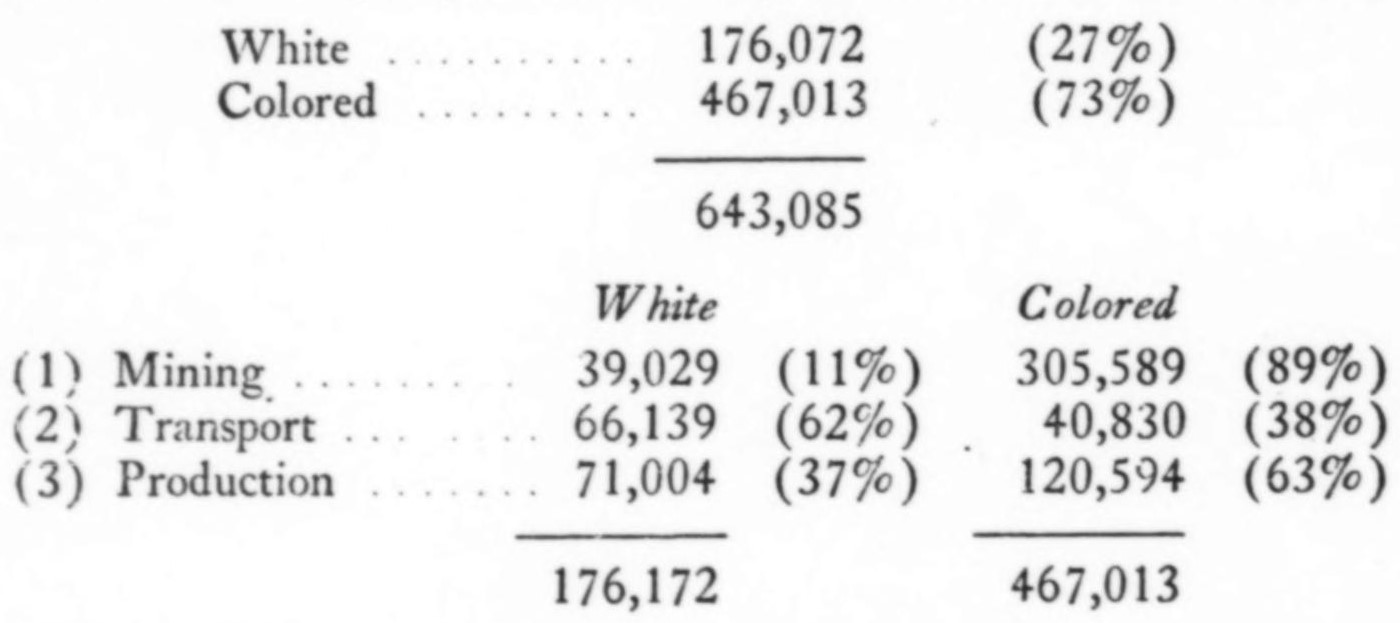
In the Belgian Congo in 1929 in the gold, copper and diamond mines there were 31,655 native workers, in 1926 there were 61,182. In the Union mines of Catagu there were 16,448 natives workers.
AGRICULTURE
Here again South Africa is typical. The native and colored population may be divided as follows:
(1) Natives on their own tribal lands (reserves) 51%
(2) Detribalize natives on European-owned land 34%
(3) Native workers in mines and city areas 14%
In 1910 the agricultural export of South Africa was £9,500,000, in 1927 it was £22,000,000; in 1910 the agricultural export was 18% of the total exports, in 1927 it was 32%, this in face of the increase of gold export for the same year, of from £32,000,000 to £42,000.000.
The number of dairy factories in South Africa increased during the period of 1915-25 from 59 to 124. In Sierra Leone, Nigeria, Liberia and in the whole West Coast of Africa are vast agricultural developments.
In South Africa the native reserves form only one-eighth of the total land of the union, and natives are not allowed to purchase land outside the reserves. Certain areas of crown land which it was once suggested might be added to the reserves are being alienated to the whites, for example, large areas in the Northern Transwaal which was suitable for cotton growing. The existing reserves are hopelessly inadequate for the needs of the present population, and large number of natives are compelled for this reason and also by taxation and pressure of the chief (who act as government agents) to go out to work in the white areas. At any moment over one-third of the adult male population of the reserves is away at work in the towns or on the white farms.
Political Situation in South Africa
The native population has (in South Africa) no electoral rights (with the exception of the Cape province), the power of the state has been monopolized by the white bourgeoisie which has at its disposal the armed white forces. The white bourgeoisie, chiefly the Boers, defeated by the arms of British imperialism at the close of the last century, had for a long time carried on a dispute with British capital. But as much as the process of capitalist development goes on in the country, the interests of the South African bourgeoisie are becoming more and more blended with the interests of British financial and industrial capital, and the white South African bourgeoisie is becoming more and more inclined to compromise with British imperialism, forming together with the latter an united front of whites for the exploitation of the native population.
In West Africa and other parts we have practically the same situation. The rule of the imperialists by indirect methods through native chiefs with the overwhelming population without any political expression. In French Africa they rule by iron hand of the army and constabularies as well as in the Belgian Congo and Portuguese Africa.
AMERICA AND THE WEST INDIES
America
In America there are upward of 12,000,000 Negroes, of which two-thirds are peasants and agricultural workers living in the South. During and since the world war there was a great migration of Negroes from the South into the industries of the North, which created an industrial proletariat.
The general outline of the economic and industrial development in America is fairly well known to us all. The general situation of the Negro worker and the Negro peasant cannot be separated from that of the white and other workers and peasants of America. There are, however, some very special and characteristic features of the Negro’s exploitation and conditions under imperialism in America that must be considered by us.
Eighty-six per cent of the Negro population live in the South; of this number 74% reside in the rural districts and depend upon agriculture for a livelihood. Approximately one-half of these rural dwellers live in the so-called black belt where they constitute more than 50% of the population. The great mass of Negroes are subjected to the most ruthless form of exploitation and persecution. American imperialism utilizes peonage, share cropping, landlordism, etc., for the super-exploitation of the Negroes and for super-profits. In order to perpetuate this super-exploitation there has grown up, and constantly aggravated, a system of political inequality, lynching, segregation, “jim-crowism,” etc.
The American imperialists faced with the growing revolt in the ranks of the great mass of the Negro workers and peasants, either must see these revolts grow in size and momentum or try to hamper them by granting concessions and even assisting the development of a Negro bourgeoisie. Rockefeller and Julius Rosenwald of Chicago were supporting Negro business organizations. Rockefeller has recently organized a bank for Negroes in New York.
Besides the Negroes themselves are feverishly building big business enterprises, in Chicago, New York, North Carolina, and throughout the country. Thus the lot of the great masses of Negro workers and peasants is becoming doubly hard, the exploitation is like a double edged sword. They have no political rights in the South where the great bulk of the Negroes live.
West Indies
The West Indies are typically an agricultural country. It is the biggest market place for the export of goods from America than any of the Latin and Central American countries. The whole of Haiti is under the iron hand of American marines. The Independence of Haiti, gained by the overthrow of the French domination during the Haitian Revolution, has been completely nullified by the American marines; the people are garrotted and ruled, in addition to the marines, by a fake illegal president who is nothing but a tool of American imperialism. ‘The country, in spite of its natural richness, is in poverty, the like of which has never been seen since the days before the Haitian Revolution.
Forced Labor
Special attention must be given to this question. We have from the pen of a French journalist the picture of the effects of forced labor in Equatorial Africa. He tells of how the natives in building the Ocean-Congo railroad work with only pick and shovel and without the aid of mechanical devices and transport; how they have to carry building material hundreds of miles; how they must work ten and twelve hours a day at a stretch, half starved, almost naked, without shelter or other protection from the change of the weather; how they die like flies. For every kilometer of railroad laid down the toll is 200 deaths; already 17,000 Negroes have perished in laying the railroad. In forty years that France has ruled the Congo the population has gone down 75% principally from the effects of forced labor.
Mozambique Treaty
This treaty allows the Rand mine owners of South Africa to recruit native labor in Portuguese East Africa for certain definite considerations at the rate of 75,000 natives per year for period of 18 months. Many natives have died in making the long trips because of the change in climate, because of inadequate facilities of transportation and protection on the way; half of the native’s wage is retained until his return at the end of his contract period. Portuguese Negroes indentured in this way find themselves in extremely bad conditions. All articles taken out of South Africa are heavily taxed, workers have to pay additional fees if their passports are prolonged.
West Africa
In West Africa railroads and bridges are built by forced labor. In Portuguese West Africa, in British South West Africa floggings and vagrancy is resorted to to force the natives to work. In certain sections boys 14 years of age are forced to labor. In other sections taxation is resorted to, whereby able bodied men are conscripted for periods of 6 days at a time.
West Indies
Here we find the same kind of “community” improvement resorted to; natives at the point of U.S. marine bayonets are forced to build roads without compensations; natives are conscripted for work on the Cuban sugar plantations.
Southern U.S.A.
In the southern part of the U.S.A. facts come to light daily of the existence of peonage by which Negroes are worked on the plantations of the South as forced laborers, in some cases Negroes have been discovered, who have been in this bondage since the Civil War, not knowing even that bond slavery had ended with the Civil War. Recently reports have come out in which the police forces of Florida are forcing Negroes to build roads without pay. Negro convicts are leased to mine owners and plantation owners in the South.
II. The Tasks and Tactics in the Struggle Against Imperialism
1. The toiling masses of Negroes throughout the world can see no hope for rectifying their conditions under imperialism, indeed there is no hope, not the slightest chance. The Negro toiling masses must look forward to mobilizing their forces for a joint struggle against imperialism, for independence and self-rule.
INDEPENDENCE, SELF-RULE AND SELF-DETERMINATION
South Africa
The inception of Negro reformism, as a result of the corruptionist policy of the white bourgeoisie, constitutes the characteristic fact of the present political situation in South Africa.
The united front of the British and South African white bourgeoisie against the toiling Negro population, backed by the white and Negro reformists, creates the possibility for uniting the white and black proletariat and the landless black peasantry for a struggle against British imperialism, against the white bourgeoisie and against the white and black reformist leaders.
South Africa is a black country, the majority of its population is black and so is the majority of the workers and peasants. The basis of the South African question is the black peasantry whose land has been expropriated by the white exploiting minority. Seven-eights of the land is owned by the whites. Hence, the national question lies at the foundation of the struggle against imperialism in South Africa. The black peasantry constitutes the basic moving force of the revolution in alliance with and under the leadership of the working class, under the central slogan: An independent native South African Republic based upon the workers’ and peasants’ organization with full safeguard and equal rights for all national minorities.
America
In America the main struggle as we have seen from the foregoing centers around the fact that the Negroes are bound down by means of political, economic and social inequalities. The Negro agricultural laborers and the tenant farmers feel most the pressure of white persecution and exploitation. Thus, the agrarian problem lies at the root of any Negro liberation movement in America. Under the leadership of the proletariat, the Negro peasants of America will be able to participate in the joint struggle with all other workers against imperialism. In the Southern part of the U.S.A., on the “Black Belt,” where they constitute the majority of the population, the Negro has the right of self-determination.
We must carry on a relentless struggle against the terrorism of the fascist Ku-Klux-Klan, the American Legion; against mob violence and lynch law; against all forms of racial chauvinism, all forms of racial discrimination and segregation.
West Africa
There must be complete national independence for all the colonies of West Africa (Sierra Leone, Gold Coast, Gambia and Nigeria).
Liberia
The complete independence of Liberia and the immediate withdrawal of American imperialist agents from Liberian territory.
Belgian Congo
The independence of the Belgian Congo.
Abyssinia
The unqualified independence of Abyssinia; the abrogation of all treaties that provide for the partitioning of Abyssinia.
Haiti
The complete sovereignty and independence of Haiti; the cancellation of all debts and the restoration of the customs; the abrogation of all treaties which are directed towards the political and economic subjugation of Haiti.
Jamaica
The complete separation of Jamaica from the British imperialist empire.
Central American Countries
For all the Central American countries we must demand for the Negro subjects full and complete political, economic and social equality.
East Africa
For all the colonies of British East Africa we must struggle for:
1. The British evacuation of the Colonies.
2. The return of expropriated territory of the natives.
3. The abolition of “Curce system” and forced labor.
Equal pay for equal work.
An eight-hour day.
Against forced labor.
For labor legislation.
Protection for women and youth.
Freedom of Trade Unions.
Against class collaboration.
Against racial barriers in Trade Union.
Organization of special Unions of Negro workers where white Unions bar Negroes.
Against white terrorism—the organization of defence corps.
Adequate housing and social conditions.
Organization of agricultural workers.
Against confiscation of peasant lands and communals, poll tax and hut tax.
For equal civil rights.
Struggle Against War
The Negro workers of the U.S.A. must concentrate their forces in the unions of the Trade Union Unity League; its special Trade Union Department for Negro workers is organized to deal with the special problems of the Negro workers and struggle for their admittance into all unions of white workers in America upon an equal basis.
Non-European Federation of South Africa must strengthen its forces and build their organizations; they must extend their influence among the agricultural workers, they must penetrate and organize the big basic mining industry, they must struggle to build a strong revolutionary movement in South Africa based on all the workers and peasants regardless to race or color. They must struggle against the Amsterdam International and reformism whether it is represented by Kadalie or whether by Ballinger of the General Council of England.
III. LIBERATION MOVEMENT
The liberation movements of the Negro masses take different form in different sections. The essential characteristic of Negro Liberation movements must be that the central question is the question of relationship to the Negro masses, and must be based upon the great bulk of the Negro population, their demands, their specific and special demands. Liberation movements cannot hope to be successful unless they have this characteristic. Liberation movements cannot go far, cannot play a final role in the liberation of the Negroes representing partial, middle class demands. If the middle class and intellectuals wish to serve in the liberation of the masses they must be organizers and servants of the masses. The liberation movements also demand programs that offer the masses real assistance in their desperate needs and conditions. The liberation movement must be a struggle towards social liberation. Social liberation like economic liberation must lead towards self-determination, towards the elimination of all of those social fetters that are confining the Negro masses to narrow and limited paths, into “ghetto” life, into isolation whereby they can be more easily exploited, into places of oppression, into narrow political surroundings. All of these demands means, in actuality, a struggle for separation from imperialist domination; for imperialist foster these conditions for the specific reasons of oppression and exploitation.
A PROGRAM
Here we cannot outline any detailed program. Such must require a more careful study according to conditions; we cannot outline any one program that would serve the Negro people identically throughout the world. We can merely point out a general direction:
a) The Land Question
1.The expropriation of land formerly held by Negroes.
2. The abolition of all taxes, such as poll taxes and hut taxes.
3. Support for agriculture such as seed, implements, stock, credits, etc.
4. Repeal of Land Acts.
5. The establishment of agrarian organizations of poor peasants and the formation of farm laborers’ unions.
b) Civil Rights.
1. Freedom of speech, assembly, press, etc.
2. Abolition of pass law.
3. Evacuation of imperialist soldiers and marines from the lands of Negroes.
4. Abolition of peonage.
5. Abolition of jim-crow laws and segregation.
6. Universal suffrage.
7. Abolition of caste systems and racial divisions.
c) Taxation.
The abolition of all forms of taxation that have as their purpose the enslavement and placing of great burdens of debts upon the working population, including loans, custom regulations in the hands of the imperialists; the weighing down of the people with great revenue taxes.
d) Education.
The elimination of illiteracy; the establishment of free universal education.
e) Social conditions.
The elimination of ghetto life and living conditions; the elimination of congestion that is detriment to health; proper hospitalization for children and especially for women in pregnancy, free hospitals and free dispensaries.
f) Labor conditions.
Establishment of labor inspection laws; abolition of child labor; establishment of full trade union rights.
FORM OF ORGANIZATION
These are only partial demands that must be enlarged upon. The form or organization must be such that it includes all sections of the Negro working population, and student groups, young workers, intellectuals, middle classes, etc.
These two programs—Trade Union and Liberation—are very closely and indistinguishably connected with the struggle for self-determination, for native republics, for separation from imperialism and capitalism and as a result are direct blows centered at the very heart of imperialism.
There are a number of journals with this name in the history of the movement. This ‘The Communist’ was the main theoretical journal of the Communist Party from 1927 until 1944. Its origins lie with the folding of The Liberator, Soviet Russia Pictorial, and Labor Herald together into Workers Monthly as the new unified Communist Party’s official cultural and discussion magazine in November, 1924. Workers Monthly became The Communist in March, 1927 and was also published monthly. The Communist contains the most thorough archive of the Communist Party’s positions and thinking during its run. The New Masses became the main cultural vehicle for the CP and the Communist, though it began with with more vibrancy and discussion, became increasingly an organ of Comintern and CP program. Over its run the tagline went from “A Theoretical Magazine for the Discussion of Revolutionary Problems” to “A Magazine of the Theory and Practice of Marxism-Leninism” to “A Marxist Magazine Devoted to Advancement of Democratic Thought and Action.” The aesthetic of the journal also changed dramatically over its years. Editors included Earl Browder, Alex Bittelman, Max Bedacht, and Bertram D. Wolfe.
PDF of full issue: https://www.marxists.org/history/usa/pubs/communist/v09n01-jan-1930-communist-mop-up.pdf
 Revolution's Newsstand