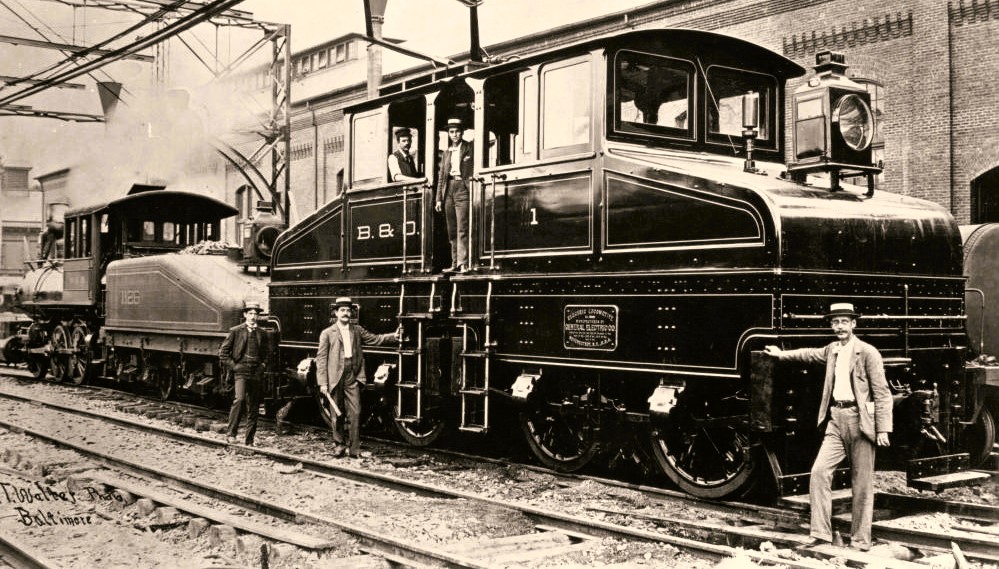
A train engineer looks at the transformation underway from steam to electric rail and warns his fellows that their times as ‘skilled’ workers is over.
‘To The Locomotive Engineer’ from The Weekly People. Vol. 17 No. 49. February 29, 1908.
Hark Ye, and keep abreast with the times.
A transportation worker is one engaged in the business of transporting passengers and goods. Among those engaged in the industry are locomotive engineers and firemen, hostlers, wipers, roundhouse mechanics, switchmen, depot men, car cleaners, conductors, brakemen, porters, trackmen, construction men and all others engaged at a stated wage.
Economically, all the transportation workers are wage slaves. They are depending on the wages they receive in order to live and propagate their kind, that is, bring into the world and feed and clothe their offspring. For their labor they receive a very small portion of the amount of the wealth they produce just barely enough to exist, as was said, and the tendency is to make that little less.
The proud and haughty locomotive runner, who, by working long hours every day and who in time must quit on account of either poor eyesight or through his kidneys being jolted to any part of his anatomy but where they should be, has, when he is sent to the human scrap heap, but very little of the $100 or $150 per month he had been receiving for a few years. Not for long, for he had been firing for a long time before he was even appointed “extra” runner, and then he was subject to call at any time of the day or night.

After becoming a “regular” he had long and tedious freight hauls more than twelve times a month, when a bed was a luxury. The freight engineer thinks nothing of being out twenty-four to thirty-six hours on some of the Western Pennsylvania lines, and yet he is a union man and has a strong organization.
The steam locomotive is becoming a machine of the past. Electricity as a motive power is becoming better known to scientists every day. When the electric locomotives were run in the B. & O. tunnel at Baltimore the death knell of the locomotive “runner” as such was sounded.
These machines were driven by direct current motors. The single phase machine was not known at that time, or rather it had not been perfected. The argument against the electric engine at that time was that the excessive cost of copper precluded the possibility of long electric traction hauls, and the point was well taken, for not alone the cost of copper wire but sub-stations for the purpose of converting the current from alternating to direct, but that is all changed now.
Current is now generated at a high voltage at the power station, and is “strapped down” to a lower voltage by the use of a transformer carried on the motor car, entirely doing away with high copper charges, sub-stations (except in a few instances), converting machinery, etc.
The steam locomotive has seen its day; it necessarily follows the locomotive runner becomes unnecessary. While it might be argued that the steam locomotive is necessary on steep. grades in mountainous districts, it may be said in passing that this country, contains greater plains area than it does mountainous, but no one can deny that when the steam lines that have changed over to electric power, that they displaced the firemen altogether and reduced the wages of the “runners,” who were appointed motormen.
The locomotive engineer requires some knowledge to operate his machine so as to get the most out of it. At the best a locomotive is a very inefficient piece of apparatus, while the electric motor shows–in large sizes–an efficiency of perhaps 90 per cent.
Capitalists are spending thousands of dollars on experiments alone, so it can be safely said, as has been said, that the steam locomotive has had its day. Men will be required to operate the electric trains, one man in the cab, not two. What knowledge does he require? The amount that he can acquire in six weeks’ time, if he is of ordinary, intelligence. His knowledge of the road is of greater importance than his knowledge of the mechanism of his car, though in the trial of Vice-President Smith of the New York Central Railroad, the motorman of a train that was ditched at a curve stated he’d only been over the road four times before he was made “runner” of an electric express train. So we see that even a close acquaintance with the roadbed, curves or bridges is not very essential.
In short, labor that is practically unskilled will be employed to take the place of the steam locomotive “runners.”
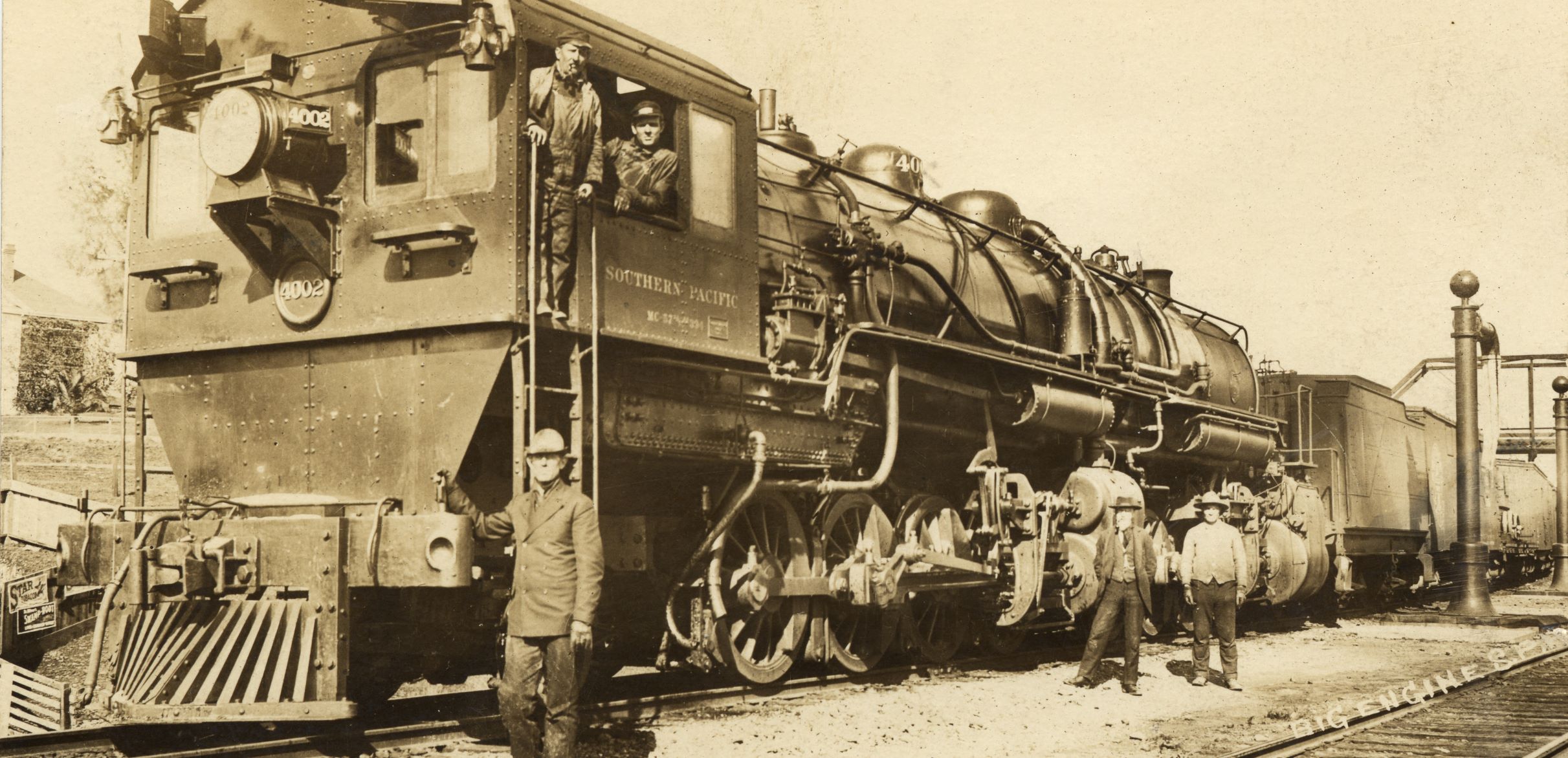
The locomotive “runner” must take a day off occasionally and spend the time considering his future, for just so soon as a road is changed over the engineers become members of the unskilled class–the common laboring class, as the lordly skilled men dub their brothers.
Let us see what happened to the engineers of the “L” roads in New York when the Manhattan Company “changed over.” They were broken in as motormen, but conditions became intolerable, and a strike was declared. The Brotherhood, or rather, the officers, kicked them out bag and baggage for striking without orders, told them they were not engineers anyway, and their places were taken by scabs who were “broken in” as motormen of six and seven-car trains after making a trip or two over the road. Your time is coming, whether you are running a way freight, an accommodation, or a limited. Whether you are working on the Eastern, Central or Western railroads, the time is close at hand when you must either take up the controller handle for the throttle at lower pay, or get out of the railroad business.
It remains with you whether you’ll be dumped, like a lot of broken parts. on the scrap heap or not. Your salvation lies in Industrial Unionism as exemplified by the only class-conscious labor organization the Industrial Workers of the World.
You must learn all you can of this union, for your salvation lies, I repeat, in combining with your fellow workers against the conditions which you will shortly find are intolerable, which have proven in so many instances intolerable to your fellows.
Industrial Unionism teaches that the workers employed in an industry must combine. The Consolidated road, for example, is a combination of many lines. You must combine too. In every city you will find either a local of the Industrial Workers of the World or along your division you will find a member. Secure from him, or write to the head- quarters of the union at Chicago for information regarding the organization. The I.W.W. is an economic organization, but it recognizes the fact that political action is necessary if the workers would be free. The Socialist Labor Party is the only class-conscious political organization in the United States to-day. The Party backs up the economic I.W.W. The literature of the Party is valuable to one seeking the light. The Party organ, “The People,” is a very “good brush with which to sweep the cobwebs from the brains” of yourself and your fellows. Secure a copy. Read it. It may tell you Labor produces all wealth, and that Labor is entitled to all the wealth produced.
You may read that only by combining with the firemen, mechanics, laborers, conductors and trainmen in general, will yours or any other organization be worth a tinker’s curse to Labor.
Providence, R.I.
New York Labor News Publishing belonged to the Socialist Labor Party and produced books, pamphlets and The People. The People was the official paper of the Socialist Labor Party of America (SLP), established in New York City in 1891 as a weekly. The New York SLP, and The People, were dominated Daniel DeLeon and his supporters, the dominant ideological leader of the SLP from the 1890s until the time of his death. The People became a daily in 1900. It’s first editor was the French socialist Lucien Sanial who was quickly replaced by DeLeon who held the position until his death in 1914. After De Leon’s death the editor of The People became Edmund Seidel, who favored unity with the Socialist Party. He was replaced in 1918 by Olive M. Johnson, who held the post until 1938.
PDF of full issue: https://www.marxists.org/history/usa/pubs/the-people-slp/080229-weeklypeople-v17n49.pdf
 Revolution's Newsstand