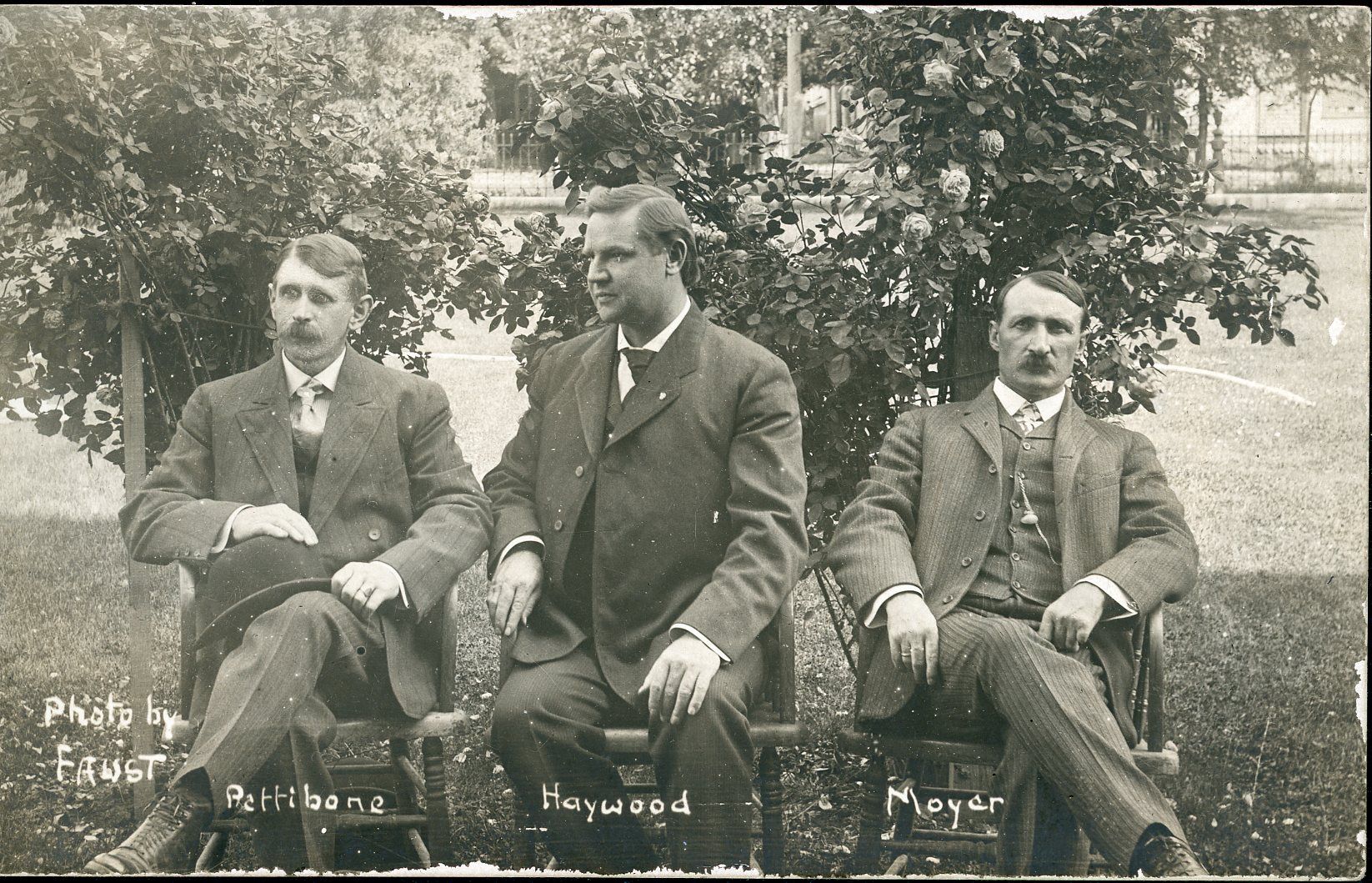
Emma Goldman on William D. Haywood’s co-defendant, the Western Federation of Miners leader George Pettibone who died from cancer shortly after his acquittal.
‘George Pettibone’ by Emma Goldman from Mother Earth. Vol. 3 No. 6. August, 1908.
OF all the interesting figures it has been my good fortune to meet on my tour, that of Pettibone looms up like a star upon the firmament.
He died a few days ago at Denver, his home, from the effects of an operation for cancer.
Like all people who had witnessed from a distance Mammon’s attempt and failure to slaughter three men on the block in that great social drama of the West, I knew little of Pettibone except that his great cheer and humor had never left him during the entire year of suspense and waiting in the Idaho penitentiary. When I saw him at Los Angeles, thin and worn from great physical suffering, yet with a face full of hope and cheer, I could readily understand what an inspiration he must have been to his two comrades in prison.
Stricken at San Diego, Cal., with violent stomach trouble, he had to be removed to Los Angeles, where he was kept under constant care and absolute seclusion. But when he heard of my arrival, he sent a mutual friend to ask me to call, “because I had wanted so much to see you all these years,’ he said, when I held his feverish hand. On that day he had enjoyed his first nourishment in weeks: an orange. I can still see the beaming face and his great joy that he would soon be well enough to resume his post in the battle against Oppression and poverty.
He talked of many things. Of the judicial murder in Chicago, in 1887, that had proved a great factor in awakening his rebellious spirit, as it had in mine. He spoke of the events that were to furnish a second 11th of November, but instead had turned into a red-letter day for the labor forces in this country. He related many incidents of his experience with the bloodhounds, the Pinkertons, and how he used to make game of their ignorance and stupidity. He spoke of the authorities having attempted to induce him to turn against his comrades. “Just think of it! They appealed to my interests as a business man, and what chances I’d have to get free and become prosperous. How were these soul-and mind-impoverished creatures to know that I would have preferred death a thousand times rather than to hurt one hair of the other boys.”
Somehow it seemed to me that I had heard these big, loyal sentiments before. It was Albert Parsons, America’s revolutionary pioneer, who refused to sign away his comrades’ lives by securing clemency for himself. “Do you want me, the only American among the arrested, to free myself by tightening the noose around the necks of my comrades the more securely?” Parsons is reported to have said. He preferred to die with his brothers, even as Pettibone would have done.
The life of Parsons, claimed in 1887, paved the way for the liberation of Pettibone two decades later. Such is the inexorable price of progress.
Had Albert Parsons chosen his heir, he could not have selected a fitter personality than George Pettibone. His was a spirit all aglow with an intense fire against every form of tyranny; one that was at all times ready to stake everything for a great, liberating cause.
“I want so to get to Denver. I know I would grow well there. I do not really want life for its own sake, but to help the cause and those wo are making such a brave fight. It’s for that I crave life so.” And how he craved life! He clung to the hope of reaching Denver with every fibre of his being. That was three months ago. And now he is no more
The united efforts of greed and power to enact at Boise a second 11th of November have failed. But they were quite successful in undermining the health of Pettibone. When he was thrown in the bull-pen he was strong and vigorous. When he was rescued from the clutches of his jailers he was doomed to die from the cancer of the stomach.
There are not many Pettibones in this land of ours. But to know that he had lived, to have been able to grip his hand, to have looked into his firm yet tender face, is to have realized the great possibilities that the new dawn will witness in this country.
Mother Earth was an anarchist magazine begin in 1906 and first edited by Emma Goldman in New York City. Alexander Berkman, became editor in 1907 after his release from prison until 1915.The journal has a history in the Free Society publication which had moved from San Francisco to New York City. Goldman was again editor in 1915 as the magazine was opposed to US entry into World War One and was closed down as a violator of the Espionage Act in 1917 with Goldman and Berkman, who had begun editing The Blast, being deported in 1919.
PDF of full issue: https://archive.org/download/mother-earth/Mother%20Earth%20v03n06%20%281908-08%29%20%28-covers%20Harvard%20DSR%29.pdf
 Revolution's Newsstand