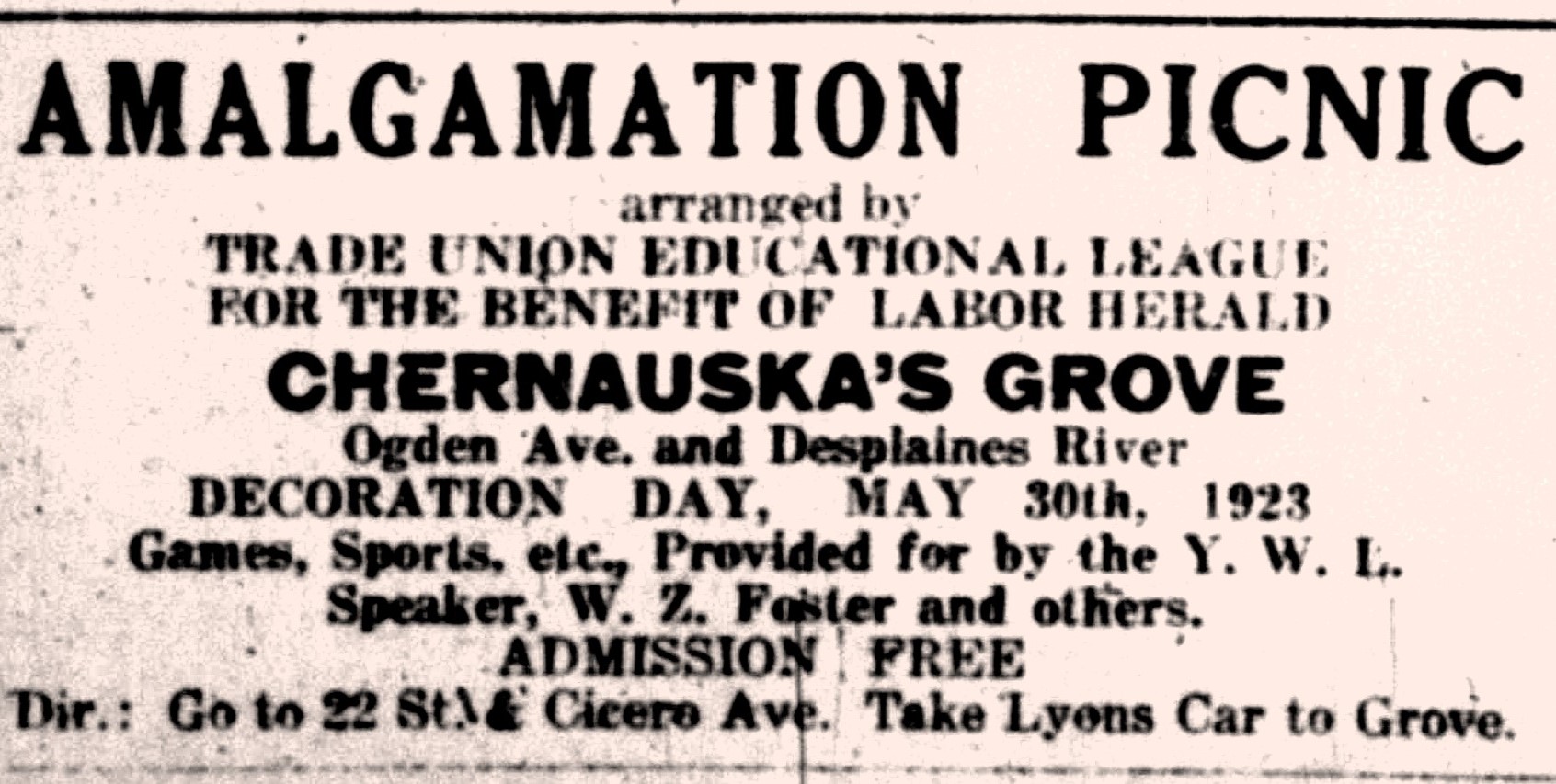
A valuable look at a class in retreat as William Z. Foster surveys the labor movement of the mid-1920s and two years of struggle by the T.U.E.L.
‘The Next Task of the Left Wing’ by William Z. Foster from Labor Herald. Vol. 3 No. 7. September, 1924.
WHEN the Trade Union Educational League began to take an active part in the labor movement, two and a half years ago, the immediate problem confronting it was twofold, (a) to organize the revolutionary elements within the trade unions, (b) to educate the organized masses to the necessity for a more revolutionary program, better leadership, and higher organization forms. The militants were scattered, unorganized, and inexperienced in nuclei work; it was necessary to unite them into a definite organization and to set them systematically to work in the unions. The masses were abysmally ignorant. It was necessary to teach them the first fundamentals of the left-wing revolutionary industrial program.
The League attacked this two-sided problem with great vigor. Rapidly it got results. Soon the militants in the various industries were brought into line and set to work. And, likewise, the masses responded splendidly to the left-wing propaganda. It is now an old story as to how the League, after only 18 months’ work, made its four chief immediate slogans of amalgamation, the labor party, recognition of Soviet Russia, and the organization of the unorganized, the leading issues be- fore the labor movement, and compelled the A. F. of L. Convention of last year to recognize them as such. Its propaganda campaign for amalgamation, coming right in the midst of the great “open shop” drive, was spectacularly successful, more than half of the entire labor movement being won over to a clear expression in favor of the consolidation of the multitude of antiquated trade unions into a few modernly formed industrial organizations. The League made good brilliantly upon its first task.
Democracy Abolished
Now it is confronted with another task, which inevitably grows out of its success with the first. This is the problem of registering the will of the aroused rank and file. The bureaucrats are not only hopelessly unprogressive themselves, but they set up the most desperate opposition to all progressive movements emanating from the rank and file. To break this resistance of the bureaucrats, and thus to open the way to real life and development in the unions, is the new task of the
Communist left-wing. The fate of the labor movement depends upon its accomplishment. In all countries where Red International militants are carrying on a struggle for revolutionary principles and programs in conservative trade unions, they have to contend with intense opposition from the reactionary leadership. But, in no country is this opposition more bitter and ruthless than in the United States. The American trade union bureaucracy, which is stupid and venal beyond compare, sticks at absolutely nothing in order to block the left-wing. Unhesitatingly and recklessly it completely abolishes democratic procedure in the unions, and even smashes these organizations, in order to prevent their falling into the control of the left-wing. Germany, Czecho-Slovakia and France, the Social-Democrats and renegade Syndicalists have warred desperately against the left-wing, but not even they have combatted the militants more cold-bloodedly, cynically, and brutally than the Gompers bureaucracy.
Cheated in Elections
Although the trade union bureaucrats have always been tyrannical and undemocratic towards their opposition, still they did make some show of giving such opposition its rights under the union laws-at least until the left-wing movement began to organize and function. So far as the lefts are concerned, they are considered practically as outlaws, with no union rights whatever. In union elections, for example, they can play no effective part. In many unions, such as the Fur Workers, Ladies’ Garment Workers, Miners, and others, they are ruthlessly denied the right even to place candidates in nomination. And, if in other unions they are allowed election candidates, these are shamelessly cheated in the voting.
Typical cases in point were the stealing of thousands of votes by Wm. H. Johnston in his contest against W.R. Knudsen for President of the Machinists’ Union; and another of many that might be cited, was the stealing of the election in District No. 5 of the Miners’ Union from the lefts by the reactionaries in control of the official machinery. Recently Cook, a left-winger, was elected General Secretary of the British Miners’ Union. Such a thing is unthinkable in an American trade union during present conditions. Under no circumstances would the bureaucrats have counted Cook’s votes. They would have robbed him of the election even if they had to destroy the union in doing so. Any American Communist who hopes to break the power of the Gompers bureaucrats by rank and file elections under the prevailing system, is indeed an optimist.
The trade union bureaucrats laugh at their unions’ laws when the left-wing members or policies are concerned. Recently, in the Railway Carmen’s Union, the general officers absolutely refused to submit to a vote of their rank and file the question of amalgamation, although the proposition had regularly received many times the required number of endorsements and they were duty bound to submit it to a vote without any qualifications. But they knew the proposition would be adopted, so they defeated it by the simple and unconstitutional expedient of suppressing it entirely. They practically defied the left-wing to do whatever it could about the matter.
Brutal expulsions and suspensions of revolutionary members, usually without trial and in violation of union constitutions, are so common in many unions as to excite little comment. Where active militants do come to the head of local organizations, the reactionary national officials arbitrarily remove them from office just as they see fit. Two flagrant cases in point were those of Alexander Howat in Kansas, and Jim MacLachlan in Nova Scotia, both leaders of big Miners’ Unions in their respective localities.
Rank and File Ignored
In their desperate efforts to balk the demands of the rank and file, who are aroused by the left-wing, the reactionary officials have success- fully hamstrung and rendered useless the regular system of trade union conventions. They either arbitrarily postpone or cancel these conventions, as was the case recently with the Railway Employees Department of the A. F. of L., the Blacksmiths, and the Boilermakers, or they so pack them with officials and delegates from fake unions, as in the Ladies’ Garment Workers’ Convention, that it is almost impossible to get any constructive legislation adopted by them.
If, however, the left-wing, overcoming these obstacles, does have a union convention adopt a progressive program, the officials blithely ignore it completely, realizing that they will not have to render an account of their stewardship until the next convention, two to five years hence. A case in point was the last convention of the Molders’ Union. Following the lead of the T.U.E.L. militants, the convention delegates voted in favor of amalgamation, the labor party and several other League propositions. But since then the officials have ignored them as wholly as though they had been rejected by the convention.
Likewise the Clerks and Maintenance of Way workers adopted amalgamation at their convention, yet their officials have bitterly fought against the amalgamation movement boldly and publicly. At last year’s convention of the A. F. of L., scores of delegates, in voting against amalgamation, the labor party, and other radical measures, brazenly violated the mandates of their unions, which had, under left-wing pressure, declared in favor of these measures.
At the recent Miners’ convention, where the left-wing was strong and aggressive, Lewis ruthlessly ignored hostile majorities several times and declared his own proposition carried. He frankly defied the delegates, assuring them that he was running the organization. He wound up by arbitrarily declaring adopted a report against Howat and by adjourning the convention right in the teeth of a three-fourths majority against him. This ignoring and open defiance of conventions is becoming common and orthodox.
Just as the trade union bureaucrats pay no attention to radical convention actions, so do they disregard the expressed wishes and demands of the lower units of their organizations. They openly scoff at the rank and file. On the railroads, the union officials totally ignore the fact that the bulk of their members militantly favor amalgamation and that 4,000 of their local unions have declared for the Minnesota Plan of consolidation. They have made not a single move in the direction of amalgamation. All they do in the matter is to denounce its advocates as Russian agents.
The same contempt for militant rank and file sentiment is shown in the clothing, printing, transport, and other industries. Similarly, Gompers has completely ignored the demand of 17 state conventions, 7 international unions, and innumerable local unions, that the A. F. of L. call conferences of the various craft organizations to amalgamate them into industrial unions.
The Next Task of the T.U.E.L.
The situation is extremely critical. The trade union movement is in the death grip of an officialdom almost totally unprogressive. The union leaders stand helpless before militant capitalism. Almost like snow in July, the unions are melting away in their hands, and they have not the gumption to do anything to remedy the situation. They lack the initiative, understanding, and sincerity to take the necessary steps to develop them into real fighting organizations. They will neither amalgamate the unions nor infuse them with a fighting spirit. They will not take in the great masses of unorganized.
And if they will not do these things of their own volition, neither will they do them upon the insistence of the rank and file. Their course is to stand pat with their antiquated system of unionism and to resist desperately all attempts to change it from below. break this reactionary resistance of the bureaucracy and to release the revolutionary forces of the rank and file, is the latest task of the T.U.E.L.
In these difficult days, with the unions bankrupt in leadership and weakened in morale and numbers from constant defeat, retreating steadily before the capitalist foes, vast numbers of workers become discouraged and quit the unions. To these workers the amalgamation movement shone like a beacon through the dark. It pointed the way to safety. They endorsed it. They passed resolutions for it time and again, until they got weary of doing so. But nothing happened. The hoped-for militant industrial unionism did not develop. The bureaucracy blocked it completely. Then, the workers, thousands of them, lost hope and frittered out of the unions, singly or in little fruitless secession movements. The T.U.E.L. has no part or sympathy with the desertions of these quitters. It goes not their path, which is the way to disintegration, demoralization, and further enslavement for the working class.
But there are fighting elements in the unions. They do not give up easily. They will not submit tamely to their treacherous leaders. In the railroad industry one hears these fighters everywhere talking about amalgamation from the bottom upward. They have seen the unions beaten disastrously, overwhelmingly, in the great 1922 shop mechanics’ strike, and they have striven earnestly two years to induce their officials to tighten up the line a little by amalgamating the unions. But these officials have done less than nothing, for they have always fought viciously against amalgamation. So now the rank and filers are saying that amalgamation from the top downward is a failure. They want to take the job in hand themselves.
Again, we find these fighters in the mining industry. It is they who are warring against the union tyrant Lewis. When he arbitrarily adjourned the last convention, they called it together again, condemned him and launched the big movement for a special convention to give Alexander Howat a square deal, and to oust Lewis. With such fighters the T.U.E.L. makes common cause. They are the material of which the revolution will be made.
The next task of the T.U.E.L. is to crack the hard shell of official opposition against the progressive movements now surging amongst the rank and file. The usurping bureaucrats must not be allowed to get away with the present outrageous flouting of the workers’ interests. The League must bring direct pressure to bear against them and, wherever possible, drive them from office, or, where this is not achieved, teach them obedience to the will of the progressive membership.
The League must rouse the fighting spirit of the masses and thus compel the consolidation of the unions, the organization of the unemployed, and the solution of the many other immediate problems confronting Labor in its desperate plight. The fate of the unions depends upon the success of this movement. If they go on much further in their present course, they will be hopelessly beaten by the militant employers. From the bureaucrats will come no progress.
The League must give organized expression to the revolutionary will of the membership. It must put into actual effect the demands of the rank and file. The era of passing resolutions, to have them thrown into the waste basket by sneering and stupid officials, is past; the era for action is at hand. The League succeeded in its first task of organizing the militants and bringing the program to the broad trade union masses. It will also succeed in its next task of breaking the arbitrary resistance of the stagnant and unprogressive bureaucracy and of giving concrete expression to the will of the rank and file.
The Labor Herald was the monthly publication of the Trade Union Educational League (TUEL), in immensely important link between the IWW of the 1910s and the CIO of the 1930s. It was begun by veteran labor organizer and Communist leader William Z. Foster in 1920 as an attempt to unite militants within various unions while continuing the industrial unionism tradition of the IWW, though it was opposed to “dual unionism” and favored the formation of a Labor Party. Although it would become financially supported by the Communist International and Communist Party of America, it remained autonomous, was a network and not a membership organization, and included many radicals outside the Communist Party. In 1924 Labor Herald was folded into Workers Monthly, an explicitly Party organ and in 1927 ‘Labor Unity’ became the organ of a now CP dominated TUEL. In 1929 and the turn towards Red Unions in the Third Period, TUEL was wound up and replaced by the Trade Union Unity League, a section of the Red International of Labor Unions (Profitern) and continued to publish Labor Unity until 1935. Labor Herald remains an important labor-orientated journal by revolutionaries in US left history and would be referenced by activists, along with TUEL, along after it’s heyday.
PDF of full issue: https://www.marxists.org/history/usa/pubs/laborherald/v3n07-sep-1924.pdf
 Revolution's Newsstand