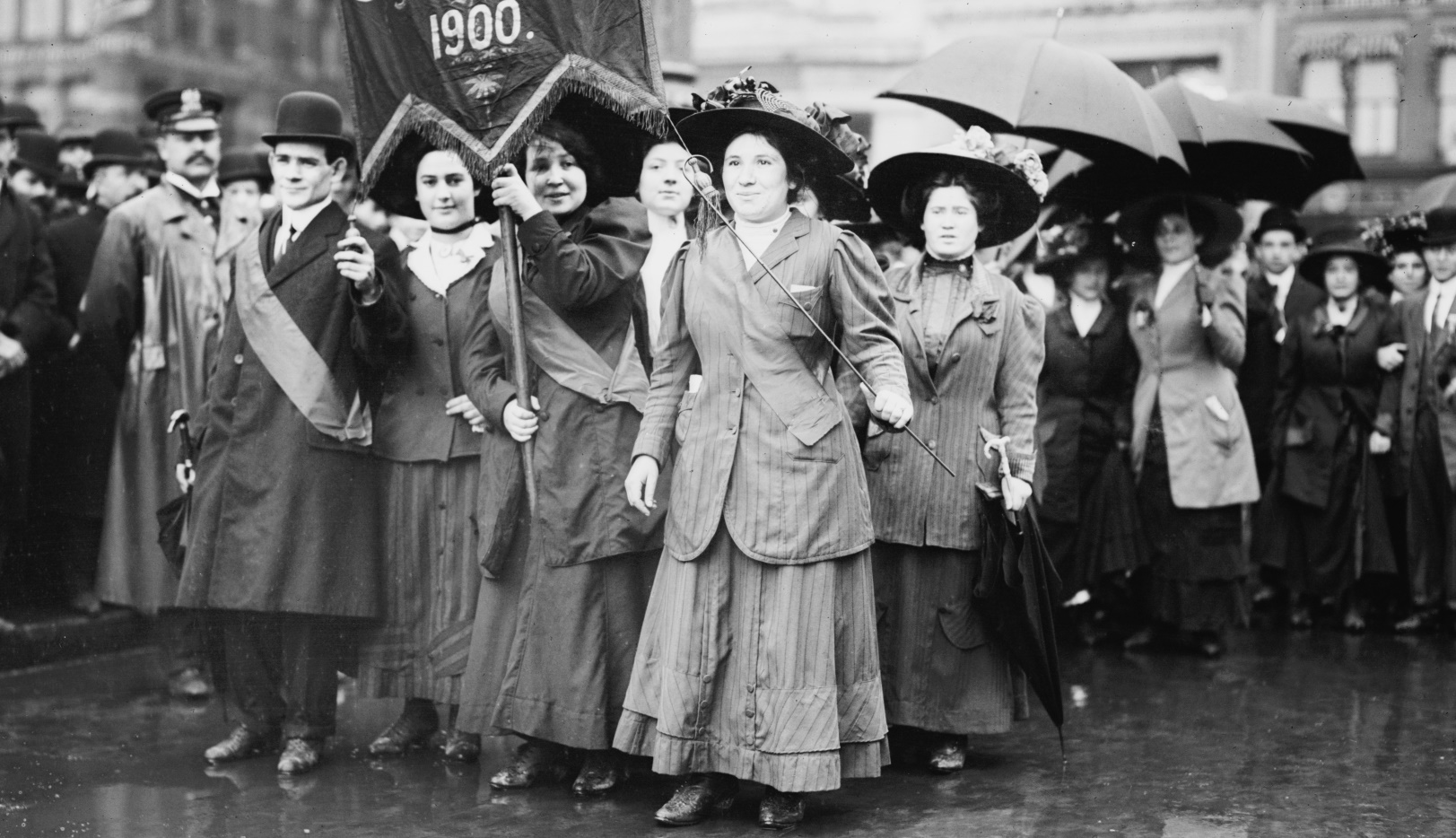
How to make meetings in a male-dominated organization welcoming to women and no longer dominated by men? As women in the Socialist Party organized and recruited, specific issues on the practice of the Party’s locals were confronted. A missive from Mila Tupper Maynard that every leftist today will be familiar with.
‘Women in the Socialist Locals’ by Mila Tupper Maynard from the New York Call. Vol. 2 No. 62. March 13, 1909.
“If you don’t see what you want. ask for it.” The women of the Socialist party have discovered that this is a good rule to follow. A year ago there had been almost no direct effort to interest the women and the number of women in the membership was accordingly small. There are still far fewer than there should be, but the increase has been marked.
The particular methods planned have scarcely been undertaken as yet, and still a great gain has been made. It has been a matter of concentrated attention–of asking for asking for what is wanted.
In Chicago the number of women in the party to-day is ten times the number that was on the rolls a year ago. In Kansas, under Caroline Lowe’s inspiration, we venture the increase has been equally great. Everywhere that special attention has been given the matter like results can be shown. Yet how slight has been the concentration of attention and effort compared with what might have been given had all locals realized the possibilities and importance of this part of organization. Let me suggest a few methods of procedure:
First–A special committee.
Each local should appoint a woman’s committee, whose duty should be to increase the interest and activity among the women. This should be composed of men alone in locals where there are no women members, of men and women where there are but few women, and entirely of women when there are an ample number. There are three chief lines of activity for such a committee:
First. To secure new members among the women who are already Socialists and others as fast as recruits are sufficiently interested and informed.
Second. To see that women are invited to join classes that are already in existence, or are organized into study classes by themselves. The separate classes will often be more practical because possible in the afternoon and because women can be led to express themselves more freely in such classes.
Third. To hold special propaganda meetings, either at regular intervals in the series held by the local, or on separate afternoons or evenings. These will give experience to the women members, and will interest and inform friends and sympathizers.
Dues.
It is common in many locals to ask of women members only the state and national dues, or ten cents a month. The spirit which prompts this concession all women will appreciate, but personally I object seriously to such a distinction. There is a suggestion of patronage about it I do not Ilke–a “half rate for children” implication most objectionable.

Yet there is a practical side to the custom not to be overlooked. When husband and wife are both members the double dues are often a burden. If sons and daughters in the same family are members, the tax becomes more than the average Socialist family purse can pay without severe sacrifice. The problem is real, but could it not be solved in another way? When two or more members pay dues from the same family purse, each of them should pay ten cents per month. This makes no discrimination on sex line, yet relieves the burden. It also encourages the membership among the young people, not yet self-sustaining.
Please think of this and if it is a sensible suggestion introduce a local by-law, or constitutional amendment to this effect at the first opportunity.
Separate Branches.
Sometimes separate woman’s branches have seemed necessary. They have often been the quickest way to Interest and educate the women, but I doubt if they are ever best in the long run. However, they are enormously better than no party membership at all. If separate meetings are desirable, do not fancy that this requires separate branches or non-party organizations. The same kind of meetings can be held under the auspices of the party, as one of the activities of the woman’s committee.
Character of Meetings.
“Women are not interested in the business meetings–they get disgusted and drop out.” This is one reason that is given for small membership among women. Then change the character of your meetings. Ten to one many men are also being disgusted and dropping out for the same reason. Men do not like the dirty headquarters, the stale tobacco smoke, and red-tape wrangling any better than women. All over the country business meetings are alienating members almost as fast as agitation gives them to the party. Once a month is often enough for the business meetings and actual working people will not long give up more than this to routine business.
If your meetings do not interest women, depend upon it, they do not interest anybody and should be reformed.
Let us be ready then for a long pull, a strong pull. and a bull altogether. If it meant no moral and social and educational gain, the mere financial side would be most important. Think how state and national dues would double up if we get on our lists the women who rightfully belong there to-day. This is no slight matter in itself–but the other gains would be tremendously greater. Let us try “intensive cultivation” awhile, as the farmers say. Let us till our own door yards for all they are worth, and we shall secure an atmosphere of zeal and intelligent interest which will be contagious.
Try it, everybody, and as a first step, get a woman’s committee to work in every local this very month.
The New York Call was the first English-language Socialist daily paper in New York City and the second in the US after the Chicago Daily Socialist. The paper was the center of the Socialist Party and under the influence of Morris Hillquit, Charles Ervin, Julius Gerber, and William Butscher. The paper was opposed to World War One, and, unsurprising given the era’s fluidity, ambivalent on the Russian Revolution even after the expulsion of the SP’s Left Wing. The paper is an invaluable resource for information on the city’s workers movement and history and one of the most important papers in the history of US socialism. The paper ran from 1908 until 1923.
PDF of full issue: https://www.marxists.org/history/usa/pubs/the-new-york-call/1909/090313-newyorkcall-v02w062.pdf
 Revolution's Newsstand