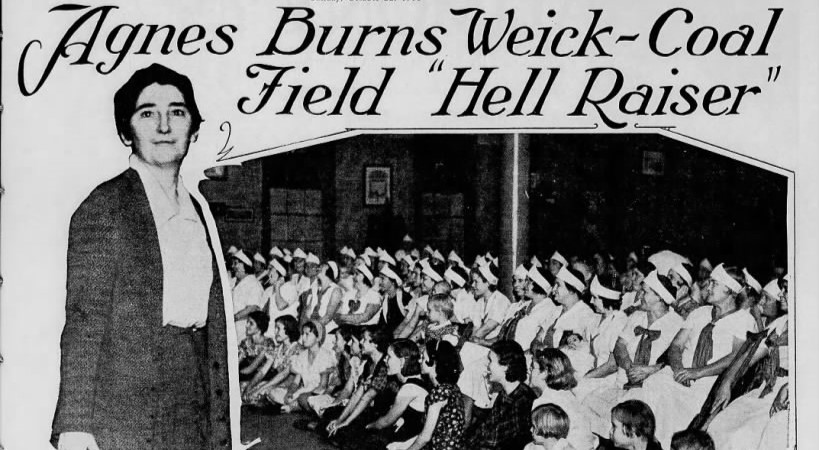
Miner-journalist on the Women’s Auxiliary of the Progressive Miners of America and its leader Agnes Burns Wieck.
‘P.M.A. Women Issue Record of Heroic Fight’ by Tom Tippett from Labor Action (A.W.P.). Vol. 1 No. 13. December 20, 1933.
THE coal miners’ women in Illinois have been making history during the past two years, since their men broke away from John L. Lewis’ union and started the dual Progressive Miners of America. Much of their activity was unknown outside the coal zone, and that is unfortunate, for what they did made perhaps the most inspiring news to labor in the depression years. Now the story appears in printed form in the First Annual Report of the Women’s Auxiliary to the new union, made to the second convention of the women in Springfield a week or so ago.
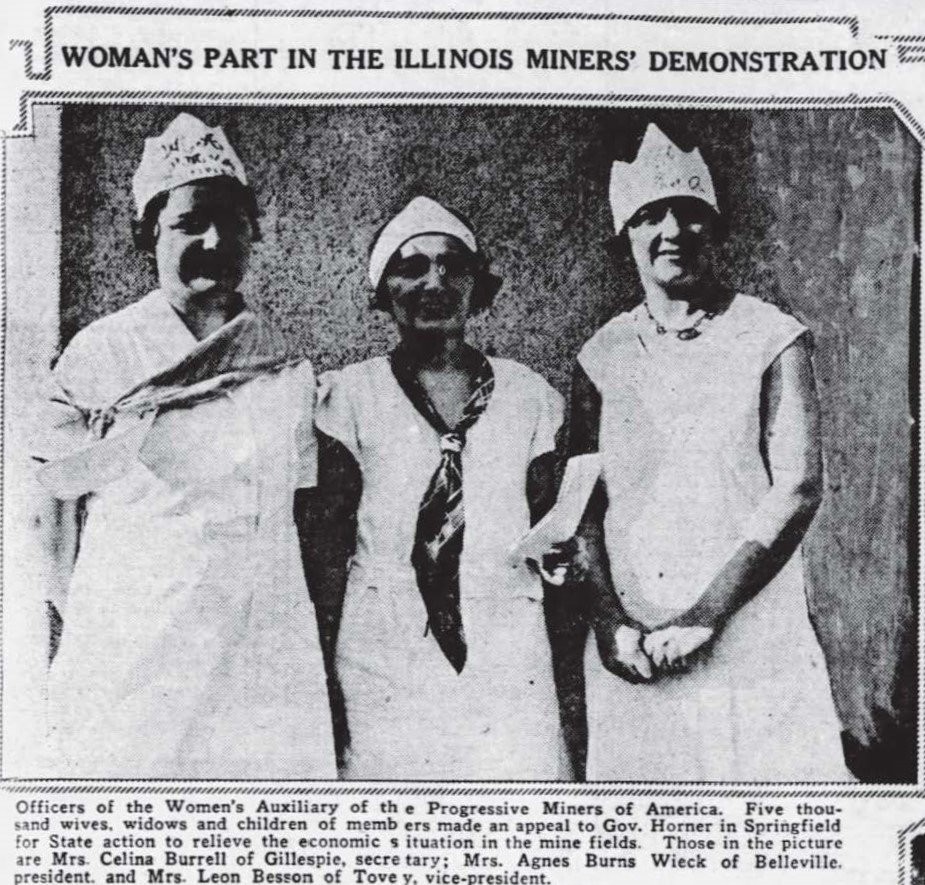
But it isn’t like a convention report at all. It is a pamphlet, cleverly illustrated and written as dramatically and is as moving as the actual drama itself was. The re- port is dedicated to the twelve men and one woman who lost their lives fighting to establish the new miners’ union. On the first page the thirteen martyred dead are named in a square set off in black. Following that is the history of the Women’s Auxiliary. And what a story it is! There are 20,000 women of the mines in the auxiliary. Each of them wears a class uniform, all of them participated in the auxiliary’s work, setting up strikers’ soup kitchens, making quilts to raffle for relief, producing labor plays, singing labor songs, conducting labor educational classes–but these women did not stop there.
They were on all the picket lines shivering in the dawn at the mine tipples, marching from one county to another in unemployment and strike demonstrations. Ten thousand of them went to the state capitol to demonstrate before the governor for civil rights in the coal camps. The women were clubbed, tear-gassed, insulted by thugs, thrown into jail and murdered by the forces opposing them in Illinois. And with it all they continued to march throughout the state singing as they went:
“It is we who plowed the prairies, built the cities where they trade.
Dug the mines and built the workshops, endless miles of railroad laid;
Now we stand outcast and starving, mid the wonders we have made,
But the Union makes us strong!”
The published report catches all the spirit and beauty of that marching, fighting, singing band of militant women, and because it does it’s bound to become one of the most important labor pamphlets to come out of the depression struggles. Agnes Burns Wieck headed the auxiliary in its first year. The report covers her administration and is signed by herself and her entire executive family. And thereby hangs a tale. Without Agnes Burns Wieck the auxiliary could not possibly have accomplished what it did. And if she never does another thing for labor she has justified her existence by the marvelous record of the past year.
Agnes Burns Wieck is a daughter of the mines, born and brought up in an Illinois coal camp. She left the coal field for college and several years organizing work for the American Federation of Labor. Returning to coal in Illinois she married Edward Wieck, a miner but also an intellectual and a radical. She had a son and settled down to the everyday business of bringing up a family. As her boy grew she wrote for the labor press, she took to the field on the soap box now and then and she kept informed. When the auxiliary was organized her great opportunity came. How well she handled it is told in her report.
In Illinois thousands and thousands of mine folk love her and revere her name in the same manner as they worship the memory of old Mother Jones. She is much like the older woman except she is better informed. She is still young, very attractive, very wise and as fearless as they come.
I said she was loved in Illinois. She is, but she is hated too. Not only by the coal operators, the old union and the state forces whom she was fighting, but also by the official family of the men’s new union which her auxiliary served so well. And that’s the tragedy of the new union in Illinois. The report under discussion will show to all who read it how unfortunate it was for the miners that the men’s organization was not blessed with a leadership which understood the social forces against which it was fighting, as well as the head of the women’s auxiliary did.
And if there is still a debate concerning the contribution to social progress of women and men, then this report from Illinois ought to perk the women up. Every woman–and man–in the labor movement should get a copy of Agnes Burns Wieck’s report and read it. Then if they commence to doubt, commence to wonder what can be done in these times with the American working class, they can take it out and read it again.
The pamphlet reviewed above sells for 10 cents and can be secured from Labor Action book service.
There are a number of periodicals with the name Labor Action in our history. This Labor Action was a bi-weekly newspaper published in 1933-34 by AJ Muste’s American Workers Party. The AWP grew from the Conference for Progressive Labor Action, founded in 1929, and Labor Action replaced the long-running CPLA magazine, Labor Age. Along with Muste, the AWP had activists and writers James Burnham and Art Preis. When the AWP fused with the Trotskyist Communist League of America in late 1934, their joint paper became The New Militant.
PDF of issue: https://www.marxists.org/history/etol/newspape/laboraction-cpla/v1n13-dec-20-1933-LA-Muste.pdf
 Revolution's Newsstand