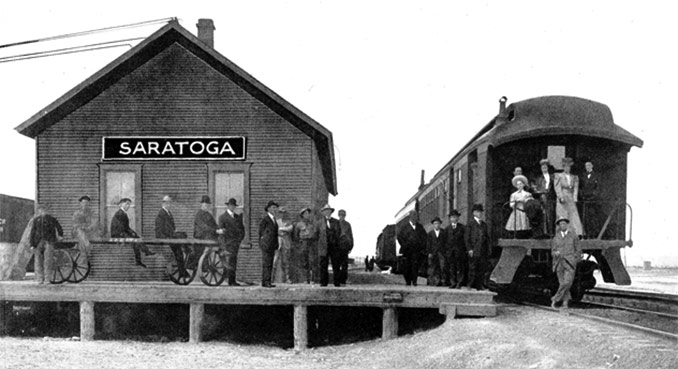
A proletarian spends the season at the formerly elite, now faded, Saratoga resort.
‘Decadent Saratoga’ by A Proletarian from The Weekly People. Vol. 11 No. 24. September 14, 1901.
Famous Resort Now a Respectable Middle-Class Place.
During the height of the season at Saratoga, one of the old time playgrounds of the capitalists, the race track and all the gambling resorts run by “respectable gamblers” were in full blast.
Speaking of racing, the following may be of interest to readers of THE PEOPLE who may have been foolish in speculating on the track: When: a man tells you horse racing is dishonest he is misinformed; when he tells you it is “straight goods,” he is equally, so. Like every phase of capitalism it must be made profitable. Just as the grocer’s clerk sands his master’s sugar so the jockey “pulls the horse.” When, however, the patrons of the grocer squeal too much some other hypocrite sets up a rival business with “pure sugar.” but makes his extra by selling limed eggs for fresh country ones. The large capitalist who owns a stable of racers, can well afford in his Pecksniffian way to decry the evils of the old race track.
The seasons at Saratoga have been gradually shortening in spite of its being one of the most beautiful watering places on this continent. Ask a native Saratogian the reason and he will undoubtedly say that there are so many other places of the same sort that people do not care to visit it as much as formerly.
Sporting men will tell you that the race track has been badly managed. A hotel man will say that the wave of reform of five years ago “has killed the place.” While there is some truth in all of the above opinions they are only superficial at best. To the keen eye of the Socialist the development of the tool of production and its private ownership plays as great a part in this place of amusement as though it were a factory town.
Previous to the civil war Saratoga was the only great watering place on this continent, and as its mineral waters possessed certain curative powers it was quite in the order of things that any one wo could raise the price would pay it a visit.
The Civil War for a time separated Yankeedom from the Tarheelers, and for several years afterward some of the “first families of Virginia,” etc. gave Saratoga the go-by. The codfish aristocracy of the North, who made their wealth by patriotically speculating in shoddy clothing and food for the United States of America, continued to patronize the place, and the bar room that formerly echoed the “by Gawd sah,” of the Carolina planters, now reverberated the “by Gosh” of the Northern grocer and butcher. The large capitalist of that period was satisfied with the palatial hotel because it was a new fad, and the summer villa had hardly been thought of, at least in sporty Saratoga. The retail groceryman and highly salaried superintendent enjoyed the hotel, because it was a curiosity. Since that period times have changed. The full- fledged capitalist has learned that he can better entertain his friends at a private residence owned by himself than to be jostled about in the vulgar crowd at the United States Congress Hall, or the Grand Union.

The retail dealers’ profit, owing to the warfare of competition, is now too small for him to spend more than a day in such a place, likewise the salary of the superintendent class has suffered some curtailment and he is driven to the smaller hotels and boarding houses, (the natives call them “cottages”) some of them should be labeled slum tenements, where the cost of table board is from $5.00-per week upward–lodgings per room from $3 up. Of course cheaper quarters can be found but no dog with respectable fleas on him could stand them.
I append an ideal bill of fare at the rate of $5.00. Breakfast: cold toast, sour biscuits, limed eggs, tough ends of beef steak, greasy potatoes and coffee that would disgrace the kind sold for three cents per cup on the Bowery. Dinner: soup made from odds and ends, some of which must have laid too long in the swill barrel. “Roast beef” of ordinary cheap boarding house variety, sour mashed potatoes; if you are early and have long arms you may get some sliced tomatoes, or lettuce, as the proprietor never buys enough to go round. Desert: pie of different varieties, which is about the only thing most persons can eat. Supper: bread and butter, mystery, weak tea with a small dish of poor berries or speckled peaches and cake. The reader may think this a bit of humor, but I am sure if he was forced as the writer of this article has been to spend six or seven weeks every season here at work he would find it no joke. One would think that these places furnish indigestible food on purpose to make the boarders drink large quantities of spring water to counteract their effect.
It is easily understood why such extortion is practised as the poor devils who rent lodgings and furnish meals must of necessity make their whole year’s income, viz., the expense of clothing and feeding their families and themselves for the entire year out of the skin and bones of the boarder for about six weeks and to pay (don’t drop dead) their taxes, for, strange as it may seem, most of these hash foundry proprietors and lodging-house keepers own a piece of private property valued at from twelve of fourteen hundred up to five or six thousand dollars. What a field for Kangaroo propaganda, for the bad Socialist would possibly attack these happy little homes, etc., etc., where the father and mother sleep in the woodshed or out-house and the children under the kitchen sink, or in an empty washtub during the busy season. Although no S.L.P. section is yet in this place. I have on many occasions conversed with honest working men and women on the subject of Socialism and S.L.P. tactics, and I firmly believe that the near future will add the name Section Saratoga to the galaxy of stars in the S.L.P.
A PROLETARIAN at Saratoga.
New York Labor News Publishing belonged to the Socialist Labor Party and produced books, pamphlets and The People. The People was the official paper of the Socialist Labor Party of America (SLP), established in New York City in 1891 as a weekly. The New York SLP, and The People, were dominated Daniel DeLeon and his supporters, the dominant ideological leader of the SLP from the 1890s until the time of his death. The People became a daily in 1900. It’s first editor was the French socialist Lucien Sanial who was quickly replaced by DeLeon who held the position until his death in 1914. After De Leon’s death the editor of The People became Edmund Seidel, who favored unity with the Socialist Party. He was replaced in 1918 by Olive M. Johnson, who held the post until 1938.
PDF of full issue: https://www.marxists.org/history/usa/pubs/the-people-slp/010914-weeklypeople-v11n24.pdf
 Revolution's Newsstand