
A portrait of the personality and work of wobbly organizer Ben Legere from Justus Ebert.
‘Benjamin J. Legere’ by Justus Ebert from Solidarity. Vol. 4 No. 8. February 15, 1913.
His Work at Lawrence, Mass., Re- viewed by One Who Knows It. Shall He be Victimized?
It is not generally known that Benjamin J. Legere was active at Lawrence in the defense of Ettor, Giovannitti and Caruso. He was in charge of the public speaking and agitation, which was a valuable part of the defense. As such he proved himself an able and untiring worker. It was he who mapped out the extensive tour of Miss Flynn and others and did so much to change public sentiment in Essex county in favor of the three men. This latter work had much to do with securing a jury that was disposed to decide for the working class and against the capitalist class.
Often Legere did this work entirely alone and in the face of great opposition. His method was to go into one of the cities or towns of the county, decide upon a meeting place, generally the city park or square, hire two boys to carry about plankboards announcing a meeting, and then go interview the newspapers and the authorities. In the evening he’d speak and organise a defense league In Newuryport, the birthplace and home of William Lloyd Garrison, Legere had succeeded in drawing a big crowd by these methods. The police interfered and tried to stop the meeting, when Legere, turning to the statue of Garrison, which adorned the public square, made a rousing appeal to the crowd in the name of the Liberator and in behalf of free speech and Ettor, Giovannitti and Caruso. The police backed down in the face of the indignation which ensued, and Legere succeeded in organizing one of the best defense leagues right there and then.
Legere pursued the same line of tactics throughout other New England places that be visited, for he was not active in Essex Co. alone, but in Massachusetts, Vermont and New Hampshire. In all three state be followed the same plan, overcoming not only the opposition of the authorities but also the apathy of wars labor factions. In Holyoke he carried on negotiations with the police, and overcame the hostility of opposing labor elements, with great patience and ingenuity. The result was not only a rousing open-air meeting then, but on other subsequent occasions.
Legere did much in addition to make the general strike proposition a great success. It was he who devised the general strike ballot. This was sent by him for distribution to all New England’s industrial towns, and given away before factory gates and at public meetings. The idea of a vote on a general strike in defense or three men, thus gathered, worried New. England’s capitalists. They did not appreciate the fact that their wage slaves, both organized and unorganized, were considering such a vote, with ballot in hand. The possibilities of this peaceful agitation to their profits was too great to contemplate without protest. So some Connecticut papers denounced the ballot, while the quiet, modest young man who devised it smiled his appreciation in the office of the Ettor-Giovannitti Defense League, in the Central Building at Lawrence.
To know this man and his methods is to admire both and to cease wondering why the textile capitalists of Little Falls want to jail him so badly. Legere is a quiet, sensible young man of medium height. He works without fuss or fury, pursuing his end noiselessly until achieved. He is patient, indefatigable and courageous. He often worked all night at Lawrence on his plans. And he was the only I.W.W. man in Lawrence who went to the City Hall “Citizens” meeting that launched the bloodthirsty “God and Country” agitation against the I.W.W. He came near paying dearly in physical pain for his hardihood, but he came out all right, thanks to his calmness under the circumstances.
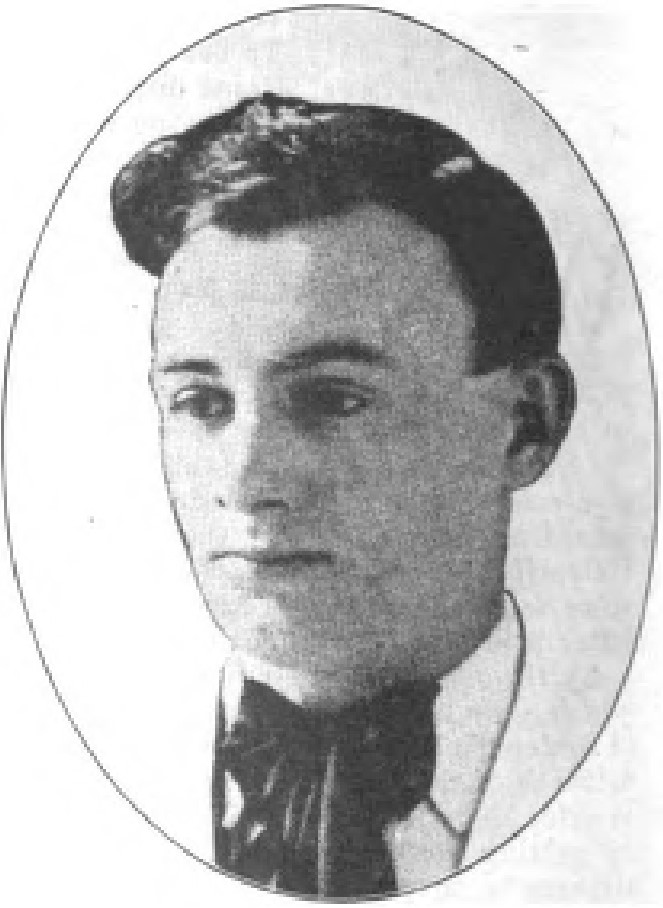
Legere, as his name indicates, is of French origin. He was born in this country, and is a New Englander. He came into the I.W.W. by way of the industrial socialist group at Bridgeport, Conn., and the Brotherhood of Machinists. Legere is a machinist, efficiency expert and playwright. In him, as in Giovannitti, the I.W.W has a literary man who is no milk and water sop, but a full-blooded revolutionist. Legere doesn’t say so himself, but it is evident to those familiar with the facts that he has sacrificed a profitable career, from a capitalist standpoint, for one of hardship and imprisonment for the working class. And he did it cheerfully. His letters from the jail breathe forth a spirit of optimism and courage that is inspiring. It shows that quiet little Legere is as sound, as sensible, and as brave as when we knew him at Lawrence.
As for the charges against Legere, the writer takes no stock in their truthfulness. Legere is not a gunman nor a slugger; he is a thinker, and attains his ends by the strategy of solidarity. We write of him because we know him personally. We also know George T. Vaughan in the same way; another worker among the workers; another native of Brooklyn, N.Y., like Joe Ettor.
We have written in praise of these two men, not to glorify them, as the christians do their God when worshipping him, but to make clear to the workers the calibre of the working men whom the capitalists are trying to railroad at Little Falls simply because they were true to the interests of the working class. No doubt all their fellow prisoners are of the same sterling, character, or else they wouldn’t be in the same danger.
What are the members of the working class going to do about it? Are they going to let these cases go practically by default, for want of funds to contest them? If not, rally to their aid. Hold meetings. Send all funds to Matilda Rabinowitz, Box 458, Little Falls, N.Y. Do for Legere and his companions what was done for Ettor, Giovannitti and Caruso. Make their liberation both a possibility and a fact. All together!
Brooklyn, N. Y.
JUSTUS EBERT.
The most widely read of I.W.W. newspapers, Solidarity was published by the Industrial Workers of the World from 1909 until 1917. First produced in New Castle, Pennsylvania, and born during the McKees Rocks strike, Solidarity later moved to Cleveland, Ohio until 1917 then spent its last months in Chicago. With a circulation of around 12,000 and a readership many times that, Solidarity was instrumental in defining the Wobbly world-view at the height of their influence in the working class. It was edited over its life by A.M. Stirton, H.A. Goff, Ben H. Williams, Ralph Chaplin who also provided much of the paper’s color, and others. Like nearly all the left press it fell victim to federal repression in 1917.
PDF of full issue: https://www.marxists.org/history/usa/pubs/solidarity-iww/1913/v04n08-w164-feb-15-1913-solidarity.pdf
 Revolution's Newsstand