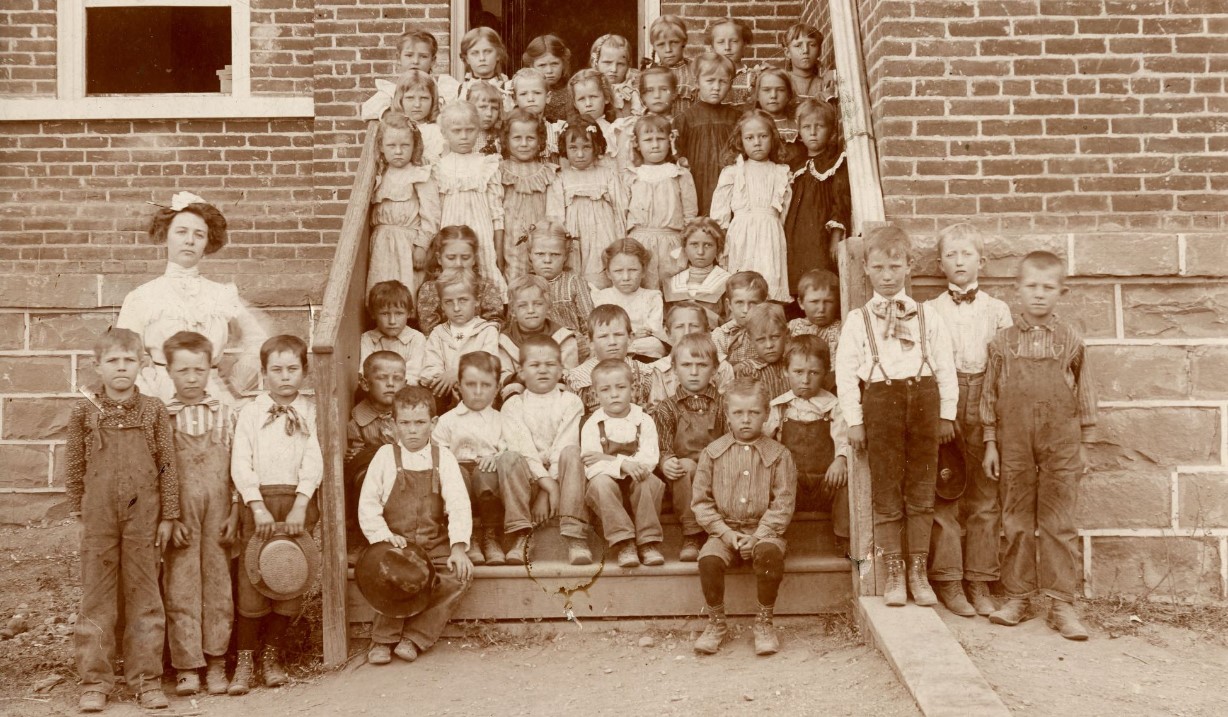
That we have public education at all is a product of workers’ demands and the class struggle.
‘Early Demands of the Workers for Education’ by Spencer Miller Jr. from Labor Age. Vol. 11 No. 4. April, 1922.
THE real beginnings of workers’ education in the United States are to be found not in the past few years, but in the first quarter of the nineteenth century. It was this period of American history which witnessed the extension of manhood suffrage, the opening of new western lands, the growth of the factory system and of towns, and ‘the consequent development of workers’ organizations. All of these economic and political developments emphasized to the workers the need for education.
The result was a concerted effort on the part of working class groups for public school education for their children and for themselves. As early as 1821, we find the Society of Mechanics and Tradesmen opening a school for apprentices in New York, and an apprentice library, available for members “who had experienced the want of information on many points connected even with their avocation.” Schools and libraries along similar lines were started in other industrial centers.
Effect of Ballot
During the next few years the activity and interest of the workers in regard to education increased in volume. The possession of the ballot further stimulated this interest. “The concept of universal free education as a powerful economic and social engine,” declared Professor Frank Carleton, “did not arise to a prominent place in the social consciousness until the wage-earner became an important factor in political life. A demand for free, tax-supported public schools appears where the workingmen have the ballot.”
In the city of Philadelphia in 1828, the workingmen’s associations were active in their demands for public education. The following year each candidate for the Pennsylvania State Legislature was asked to make formal declaration on a program for an “equal and general education for the State.” Two years later (1830), a committee of workingmen was appointed to investigate the status of education in the State, and after a five months’ survey submitted a report of considerable value.
At a general meeting of mechanics and workingmen in the city of New York during the winter of 1829, the agitation for education for workers took the form of the following resolution:
“Resolved, That next to life and liberty, we consider education the greatest blessing bestowed upon mankind.
“Resolved, That the public funds should be appropriated (to a reasonable extent) to the purpose of education upon a regular system that shall insure the opportunity to each individual obtaining a competent education before he shall have arrived at the age of maturity.”
The Case for Workers’ Education
Pamphleteers of that period set forth the case for workers’ education in language which must remind us of some of our contemporary writers. Thus we read in Seth Luther’s pamphlet on “The Education of Workingmen,” published in 18382, that “a large body of human beings are ruined by a neglect of education, rendered miserable in the extreme, and incapable of self-government.”
Through the New England States, and in many other industrial sections in the North, the wage-earners’ demand for free education spread rapidly, and led to the establishment within a few years of public schools in these States. Legislatures and legislators became responsive to the importance of this as an issue. In a letter to his constituency in Sangamon County, Illinois, Abra- © ham Lincoln wrote in 1832: “Upon the subject of education, not presuming to dictate any plan or system respecting it, I can only say. that I view it as the most important subject that we as a people can be engaged in.”
Parallel with this support of a free public school system, one may find accounts of the establishment of institutes for the education of adult workers. For example, a convention of Trade Societies was held in Philadelphia in 1839 for the express purpose of forming “Trade associations for the improvement of the moral and intellectual condition of mechanics.” At this same convention a resolution was adopted for the organization of a literary and scientific institute “for the diffusion of useful knowledge.”
The history, then, of this early period of the nineteenth century is a record not only of expressed desire of workers for education, but a record of accomplishment as well.
Labor Age was a left-labor monthly magazine with origins in Socialist Review, journal of the Intercollegiate Socialist Society. Published by the Labor Publication Society from 1921-1933 aligned with the League for Industrial Democracy of left-wing trade unionists across industries. During 1929-33 the magazine was affiliated with the Conference for Progressive Labor Action (CPLA) led by A. J. Muste. James Maurer, Harry W. Laidler, and Louis Budenz were also writers. The orientation of the magazine was industrial unionism, planning, nationalization, and was illustrated with photos and cartoons. With its stress on worker education, social unionism and rank and file activism, it is one of the essential journals of the radical US labor socialist movement of its time.
PDF of full issue: https://www.marxists.org/history/usa/pubs/laborage/v11n04-apr-1922-LA.pdf
 Revolution's Newsstand