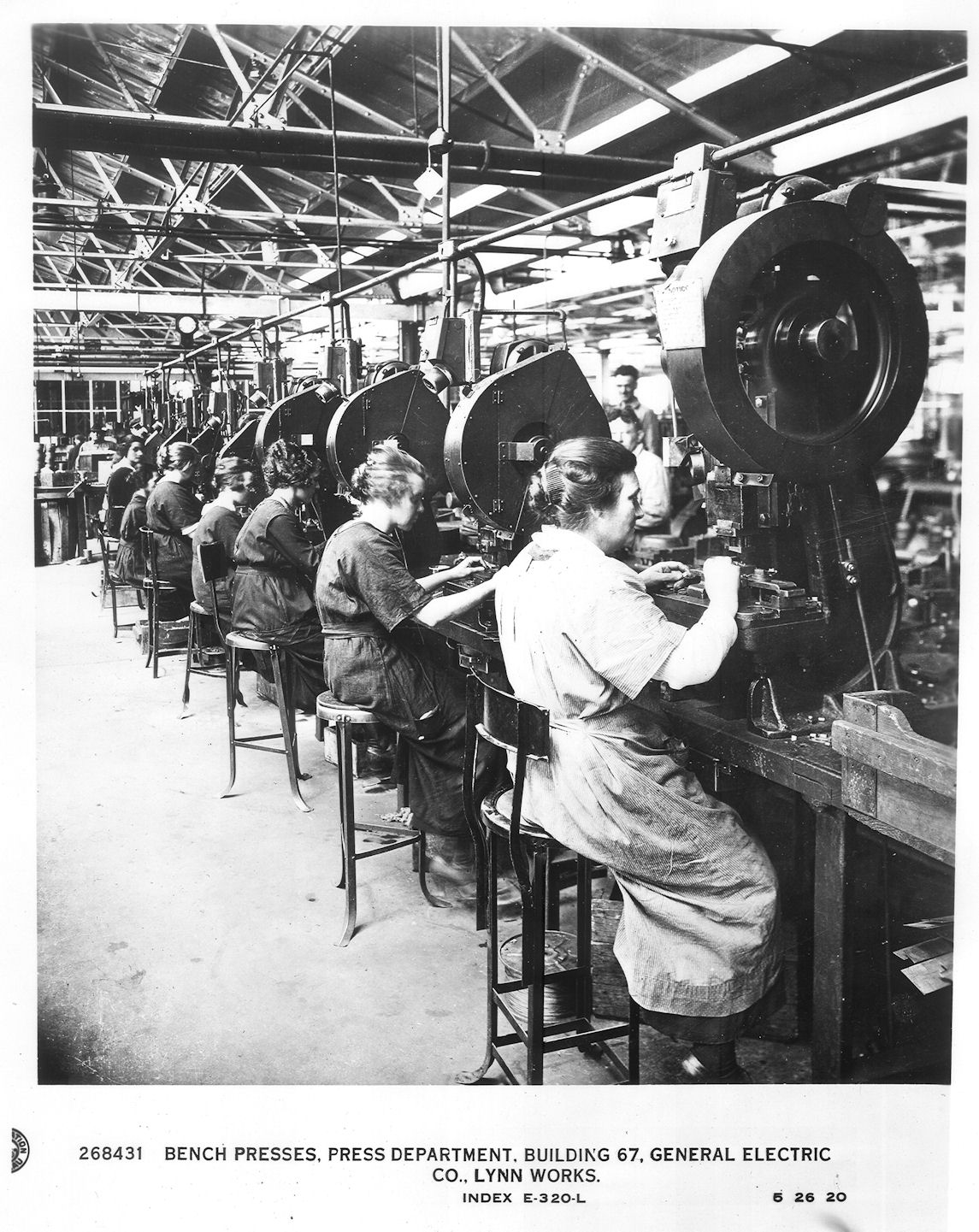
Issues in activating a Communist Party nucleus at the G.E. plant in Lynn, Massachusetts–later a stronghold of the U.E.
‘Forming a Shop Nucleus at General Electric’ by Sam Reed from Party Organizer (C.P.U.S.A. Internal Bulletin). Vol. 5 No. 2. February, 1932.
Experience in the Formation of a Shop Nucleus
Below are some interesting and valuable experiences on the establishment of a shop nucleus in a large metal shop District One (Boston). Last week I went to attend a unit buro meeting in one of the cities near Boston. The main point on the agenda at this meeting was the formation of a shop nucleus in the General Electric plant. This factory employs more than 4,000 workers. In “normal” times the same plant employs more than 8,000 workers. The conditions of the workers there are very bad. Most of them work one or two days a week, a few hours each day. The average is between $10 and $15 a week. There is terrific speed-up and rationalization in the shop work. Workers are being laid off right along.
At the unit buro meeting we had ten comrades present. This included the unit buro members, a district representative and four workers from the G.E. plant. Of the four, three were members of the Party and one very close sympathizer, the wife of a Party member. We opened the meeting with a short talk by the district representative on the importance of establishing shop nuclei in large factories, and the methods of carrying on shop nucleus work, with special reference to the particular conditions in the General Electric plant.
After the introductory talk, which pointed to various examples of other shop nuclei, how they function, and how their experiences could be applied to the G.E., the floor was thrown open for discussion to the comrades from the shop. None wanted to speak. After repeated requests by the chairman, the comrades finally began to talk. One after the other they pointed to the obstacles and difficulties, and consequently to the “uselessness” of attempting to do shop work in the plant. Again and again they tried to bring facts to prove that the workers in the shop are satisfied with the conditions, that the workers are clannish, anti-Soviet, that they are staunch patriots and religious fanatics. Other arguments brought forth were that our comrades are foreign born who speak English very poorly, that the workers call them “foreigners” and “Bolsheviks” and would not even listen to them. When we pointed out to our comrades from the shop, that a very large portion of the workers in the plant are Lithuanians, Polish, Russian, Italian, Greeks, Armenians, etc., the comrades came back with a counter-argument that these foreign born workers are reactionary, that they are scared, and besides that, they are satisfied with whatever wages they get. One comrade tried to convince the buro that since the workers get one or two days a week work, “there is no use talking to them about organization,” etc.
Only after a long detailed explanation to the comrades that work can be done in that shop, that we can overcome all obstacles, and that we can reach the various foreign born workers through our language press, through the fraternal club, through signature collections, thru personal talk, etc., did we succeed to some extent in convincing our comrades of the possibility and the advantages of working through a shop nucleus in the shop. We further pointed out to the comrades that the American workers can also be drawn in, if we use such methods as a shop paper, through the sale of the Daily Worker, through unemployed work, house to house canvassing, etc. Before the meeting adjourned, the one sympathizer present joined the Party, and we formed a shop nucleus with 6 comrades, 4 from the shop and 2 from the street unit.
I would summarize the experience and lessons of this meeting as follows:
1. We need in our Party a system of continuous clarification on methods of shop work, based on the experience of existing shop nuclei.
2. Every effort must be made to clarify our Party organizations on the method of connecting up the work of the organization and agit-prop departments in all of the Party work and political campaigns.
3. The Party must establish a system whereby the units take up for discussion events and conditions taking place in their own territory or in a given factory, where the unit has contacts and is concentrating on. The unit buro, in line with the perspective to establish shop organization in a given factory, shall carry on a conscious campaign of clarification among our members on how the unit as a whole, and each member in particular (regardless of whether he works in a shop, is a member of an organization in the neighborhood, whether one works among the unemployed, Negroes, etc.) can help in building up the shop nucleus. From time to time the unit buro should call in the comrades who work in the shop, or who are connected with work around the shop, to discuss with them their experiences, give them more guidance and suggest and help them in methods of work. We must stress, especially to our old comrades that work in the factory for the building of shop organization, is the basic work of the Party around which all other activities shall be carried on and subordinated to.
4. More use must be made of the experience of other shop nuclei. This can be done through the proper use of the Party Organizer by our units. It is not enough to order, say ten Party Organizers and sell them to some of the members. We must get every Party member to read and study the contents of the Party Organizer and The Communist. Special discussions in the unit should be arranged. These should link up the local shop problems.
5. A wider campaign must be carried on in the Party press, clarifying our Party members on the significance of shop work, on methods of building shop nuclei, and exchange of experience in shop nuclei.
The above measures must be undertaken and carried out, as they are prerequisites for the successful carrying out of our present quotas in the recruiting drive and the building of a mass Party.
SAM REED, District 1
The Party Organizer was the internal bulletin of the Communist Party published by its Central Committee beginning in 1927. First published irregularly, than bi-monthly, and then monthly, the Organizer was primarily meant for the Party’s unit, district, and shop organizers. The Organizer offers a much different view of the CP than the Daily Worker, including a much higher proportion of women writers than almost any other CP publication. Its pages are often full of the mundane problems of Party organizing, complaints about resources, debates over policy and personalities, as well as official numbers and information on Party campaigns, locals, organizations, and periodicals making the Party Organizer an important resource for the study and understanding of the Party in its most important years.
PDF of issue (large file): https://files.libcom.org/files/Party%20Organizer%205.pdf
 Revolution's Newsstand