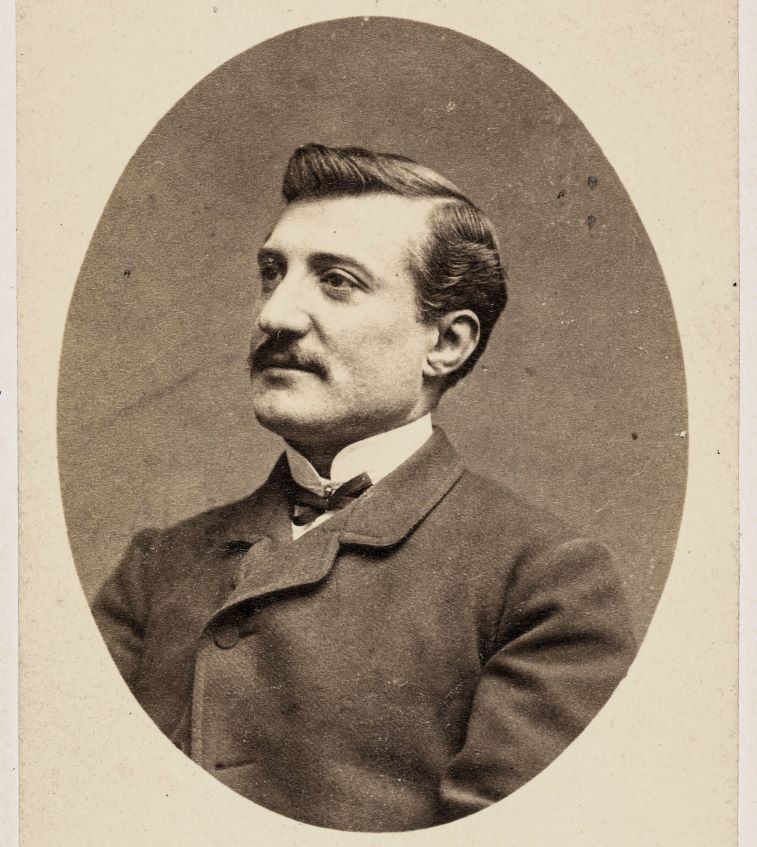
The death of Commune historian Prosper-Olivier Lissagaray in 1901.
‘One of the Old Guard’ from The Advance (San Francisco). No. 344. March 9, 1901.
Lissagaray, Historian of the Commune Passes Away at the Age of Sixty-two.
Lissagaray died after frightful agonies in the arms of his devoted wife and of Dr. Dupont. He had reached an age of sixty-two years.
The old Socialist had all the qualities essential to a good historian, and his temperament was that of a fighter.
He utilized the painful time of the exile for research in the libraries of London, that are so rich in documents of the French revolution. Nobody knew the men of 1789 better than he. He was on intimate terms with them. His most hasty work, such as newspaper articles, bear the stamp of inexhaustible learning.
He had inaugurated the gatherings in the Rue de la Paix, where the most eloquent men of letters and politicians could be heard. His essays on “Musset and Youth” brought him renown.
He was imprisoned for several months in Beauvais with the majority of the sentenced members of the International, because he published aggressive articles in the “Reforme,” of which he had become editor.
He followed Gambetta into the province, established the camp at Toulouse, fought in the army of the Loire up to the time of the cessation of hostilities, prorested in Bordeaux against the outrages to which Garibaldi was submitted. Finally, he took his place in the ranks of the Confederates which he left only on the Pere Lachaise after the last shot had been fired.
He was sentenced to exile. In London, where he was on familiar terms with Marx, he eked out a living by giving lessons and writing. There he wrote the first edition of the “History of the Paris Commune” and “Eight Days Behind the Barricades.”
Without fire, often without bread, Lissagaray brought this work of justification of the proletarian class to a successful close.
After the amnesty he founded the “Bataille.” His contributors were Jeffrin, John Labusquiere, Victor Marouck and Brousse. Later on came Arsene Crie and Emile Violard. Suppressed in 1887, the “Bataille” made its reappearance two years later and fought its well-known unremitting battle against the Boulangist Cesarism.
Vigorous and well-made, an indefatigable walker, always on the lookout for a fight and taking delight in danger, gifted with a superb memory, alert and full of life, this Basque might have aspired to glory. He was endowed with qualities that might have taken him to the highest positions, but a most disagreeable disposition spoiled all his admirable abilities and condemned him to isolation and inactivity.
He should have been one of the workers of the Revolution and he was only its defender.
In spite of all this, he served a good purpose, and his services may be measured by the hatred he inspired in the ranks of capitalism. He loathed above everything the military and the clergy. His devotion belonged to the republic and to the proletariat which he served faithfully.
From “Le Peuple,” Brussels.
Advance began as The Class Struggle, the official paper of Section San Francisco of Daniel De Leon’s Socialist Labor Party, launched as a weekly in 1896. In 1900 the paper was taken over by George B. Benham and allied with the Social Democratic Party (Springfield) Massachusetts, the name changed to Advance and Emil Liess as editor. The paper became the official organ of the Local San Francisco, of the Socialist Party of America when it was formed in 1901 and ran for another few years before financial difficulties closed its doors.
PDF of full issue: https://www.marxists.org/history/usa/pubs/class-struggle-advance/010309-advance-w344.pdf
 Revolution's Newsstand