The street-car strike was a feature of the class struggle and reached hundreds of cities and towns, resulting in many deaths. The strike in Indianapolis lasted a week, which saw intense conflict on that city’s streets; hundreds wounded and six dead.
‘The Street-Car War in Indianapolis’ by Bruce Rogers from International Socialist Review. Vol. 14 No. 6. December, 1913.
AFTER three days of hostilities, on this November 4th, election day in what promises to be one of the bloodiest and most beastly traction strikes in the history of class wars, the situation is completely in the hands of the so far victorious strikers.
The conflict is between the Indianapolis Terminal and Traction Company and its operating slaves, lately organized with the Amalgamated Association of Street and Electric Railway Employees, and has developed with a suddenness amounting to spontaneous action.
And this is Indianapolis, a city contemptuously known far and wide as a “scab farm,” and is the labor-hating David M. Parry’s very own.
In August the men on the Interurban lines made a pitiful effort which aborted in forty-eight hours—lost for lack of organization. The company grew more arrogant upon so readily whipping the men, back to work and its president, one Robert T. Todd, proudly boasted that the men could not be organized. But he had not counted upon the Indianapolis Socialists, who, at this juncture, lent their aid most efficiently to Organizer and Vice-President John J. Thorpe, by singling out individual motormen and conductors with whom they were acquainted and visiting with them.
By the last week in August things were in shape and a committee was sent to the company offices. Upon stating their “business and that the men had sent them, the superintendent exploded:
“So the men sent you, did they? Well, you get to hell out o’ here.” They then returned to the car barns and reported for their “runs,” but found their time checks and “never again” slips awaiting them.
The strike was called at eleven o’clock p. m., Friday, October 31st, and promptly at that hour the cars were run into the barns and abandoned. The attempt of the company to resume service next morning with thugs and strikebreakers imported as usual for the purpose, made it suddenly realize that the “men” had been organized. The cars reached the streets, were demolished by crowds, and there they stand on the fourth day of the strike. The unladylike strikers will not even allow them to be moved back to the barns. The strikebreakers were driven back to the company barns, where they remain, fed by the company, armed to the teeth and firing at any crowd that approaches. The fatalities resulting so far are one strikebreaker shot in” the frack of the head by a fellow thug firing at strikers, and John Brogan, a non-combatant, who was shot by a notorious local scab by the name of James Gorman.
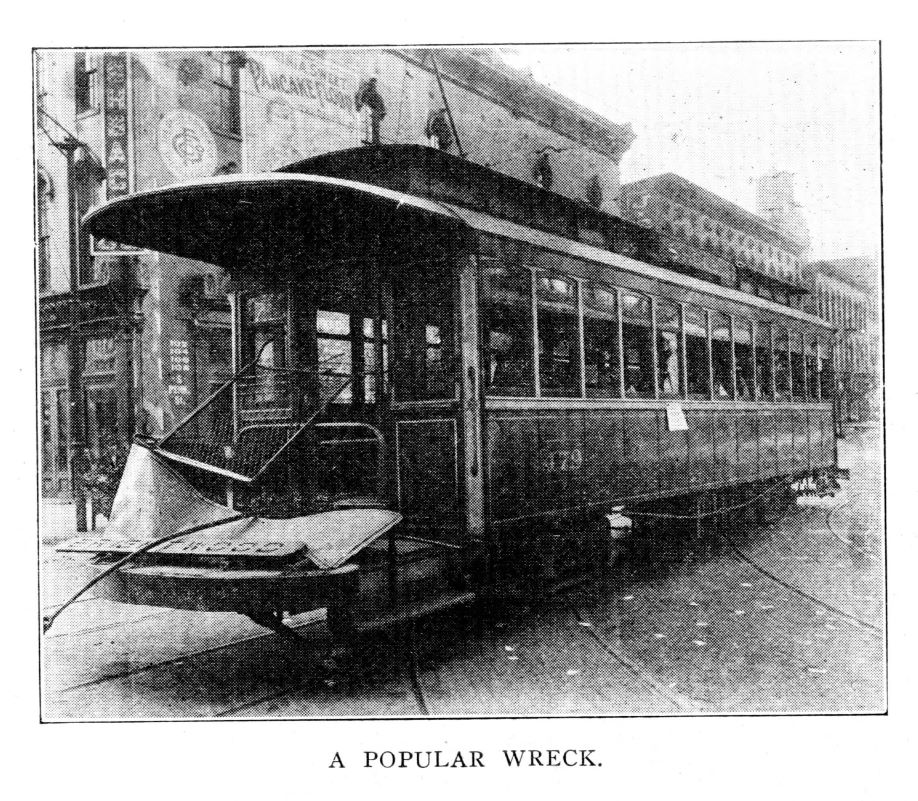
A street railway strike must always be swift and furious, carried on amid scenes of violence. Attempts to operate the cars of a struck service brings the hated scabs within close view of the strikers and their sympathizers, acting upon them as an insult and a slap in the face. In this one, just as in the great Columbus strike of Street Railway Employees, the policemen are refusing to ride with scabs and protect the cars, many of them resigning outright and others simply refusing to obey orders. Although it may be admitted that the people in sympathy with the strikers are making it dangerous to do so, still I think it wrong to assume that the police take this course out of cowardice.
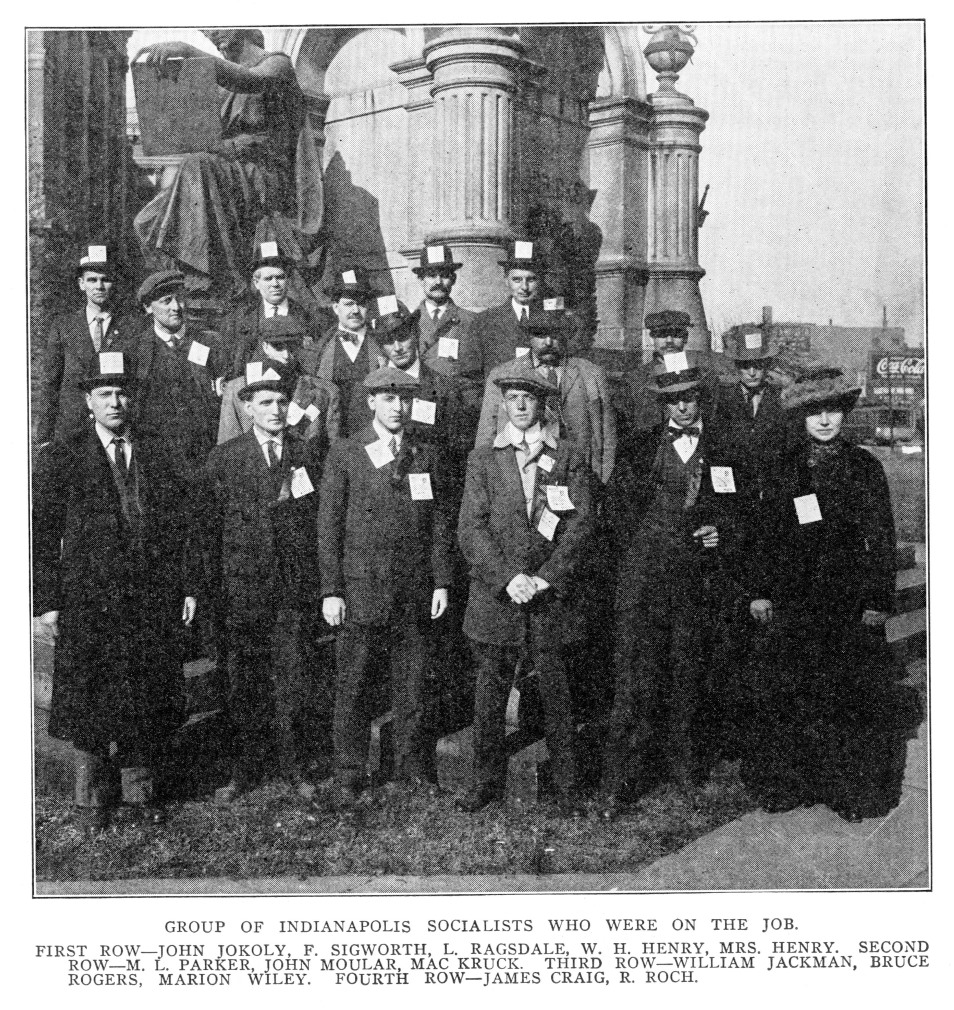
They are not unlike other “bulls” on that score, and I believe in this instance, are actuated by at least a feeling of class sympathy. At one of the many Socialist meetings being held, Comrade Zimmerman made a stirring appeal for class solidarity and two policemen who were present tore off their badges on the spot. So far the Governor has refused the corporation the use of troops to win the strike for them, probably for reasons that will be removed by the election, which, with the course the police are taking, leaves the company hog-tied by the strikers, with, on every hand, the sympathy and co-operation of other workers. This is especially true of the Indianapolis Socialists who, locally at least, are redeeming that portion of the party platform pledging it to organization on the economic field. The State Secretary, Comrade William Henry, his comrade wife and many active Socialists are to be seen among the strikers and in attendance at demonstration meetings. Hat cards and other devices bearing the legend, “We Walk,” are everywhere in evidence.
The Socialists having a special one: ‘WE WALK. VOTE FOR SOCIALISM, AND RIDE YOUR OWN CARS
In fact, the Socialists originated the “We Walk” card plan and are giving the strikers many valuable suggestions beside aid of a substantial character.
If comedy is ever wrung out of a tense crisis such as this, it is to be found in the consternation of prominent citizens and business men when they were summoned by the sheriff to act as deputies in suppressing the “disorders.” They had denounced the civil authorities and the sheriff retaliated by giving them the job. It scared them out of then boots when they were expected to do their own fighting and they are righteously outraged. The militia will undoubtedly be forthcoming with the passing of the election and this story would not be worth the writing if we did not point out the elements of failure and betrayal already appearing in this magnificent rebellion of the workers.
At the great demonstration held on the Court House lawn this afternoon, they suffered themselves to be addressed by their attorneys, a Catholic priest, a Jewish rabbi, and one plain parson. It was sickening to the heart of a revolutionist to note how the platitudes of this parasitic gentry were cheered to the echo by the rebelling slaves. Already their magnificent militant spirit has been denatured into a mere plea for arbitration and already their very leaders are taking up the coward refrain. It is simply appalling to see that arbitration is the most that is hoped for even at a moment when the slaves are completely victorious, and which, of course, means that in the end, the settlement will be made by their enemies and essentially barren of any substantial fruit to them.
The International Socialist Review (ISR) was published monthly in Chicago from 1900 until 1918 by Charles H. Kerr and critically loyal to the Socialist Party of America. It is one of the essential publications in U.S. left history. During the editorship of A.M. Simons it was largely theoretical and moderate. In 1908, Charles H. Kerr took over as editor with strong influence from Mary E Marcy. The magazine became the foremost proponent of the SP’s left wing growing to tens of thousands of subscribers. It remained revolutionary in outlook and anti-militarist during World War One. It liberally used photographs and images, with news, theory, arts and organizing in its pages. It articles, reports and essays are an invaluable record of the U.S. class struggle and the development of Marxism in the decades before the Soviet experience. It was closed down in government repression in 1918.
PDF of full issue: https://www.marxists.org/history/usa/pubs/isr/v14n06-dec-1913-ISR-riaz-ocr.pdf
 Revolution's Newsstand