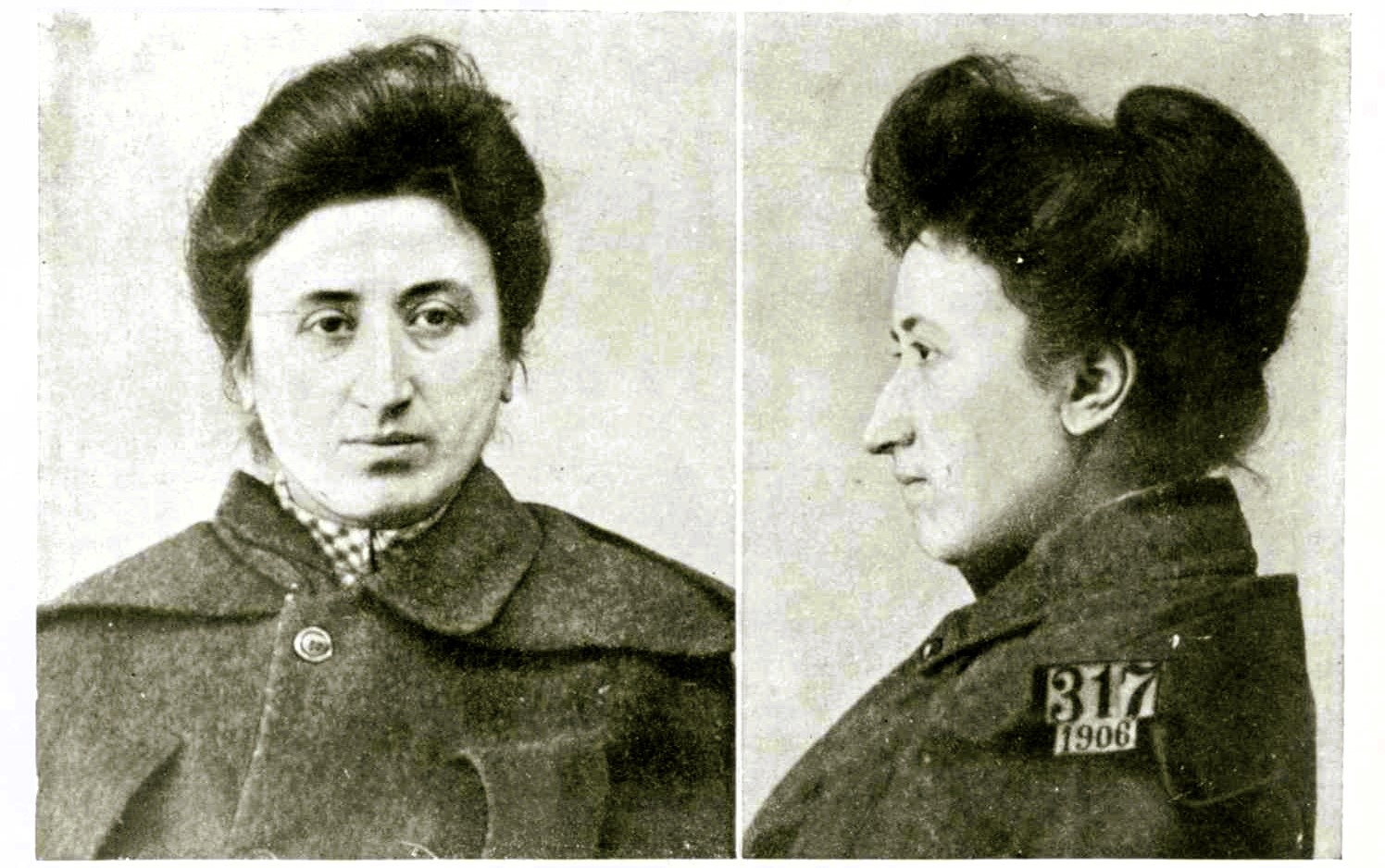
Emerging from Breslau prison on November 8, 1918, released by the end of the World War and the German Revolution, Rosa Luxemburg remembers her fellow prisoners. With all of her eloquence, she decries that the death penalty had yet to be abolished. After the murder of millions in the imperialist war, the most basic revolutionary demand was the preservation of life. Published in Die Rote Fahne on November 18, 1918.
‘Oh! How – German is this Revolution!’ by Rosa Luxemburg from Class Struggle. Vol. 3 No. 5. August, 1919.
(This article which appeared in the Red Flag of Berlin, the organ of the Spartacists of Germany, on the 18th of November, 1918, shows not only the fearless energy, but also the boundless goodness of heart of a great woman. Its contents may serve, moreover, as a fit weapon against the slanders with which unscrupulous opponents have tried to besmirch the memory of Rosa Luxemburg.)
For the political victims of the old regime of reaction we ask neither “amnesty” nor mercy. We demand the right of freedom, fight and revolution for those hundreds of true and faithful men and women who are languishing in jails and prisons because they dared to fight for liberty, for peace and for Socialism under the rule of the sword of the imperialistic criminals whose rule has now come to an end. They are all free. Once more we are standing, shoulder to shoulder, ready to do battle for our cause. But it was not the Scheidemann socialists with their partners of the bourgeoisie and Prince Max at the head, who freed us; the proletarian revolution itself rent asunder the gates of our dungeons.
But another category of unfortunate inmates in those dreary buildings has been completely forgotten. No one thinks of the thousands of pale, emaciated figures languishing in prisons and jails in expiation of common crimes and misdemeanors.
And yet, they too are the unfortunate victims of the infamous state of society against which the revolution was directed. They, too, many of them, are victims of the imperialistic war that intensified want and misery until they became unbearable torture, that awakened, by its brutal bestiality, the evil instincts that slumber in weak and degenerate natures.
Here, too, bourgeois class justice was the net through which rapacious sharks escaped with ease while it caught in its pitiless meshes every small, helpless minnow that ventured beyond the pale of capitalist law. Millionaire war-profiteers escaped, or were condemned to pay ridiculously inadequate fines. The small thieves were punished with draconian sentences.
On starvation rations, shivering with cold in cells that are practically unheated, in a state of hopeless mental depression from the horrors of four years of war, these stepchildren of society are waiting for mercy, for relief.
They wait in vain. As a good father to his country the last of the Hohenzollern forgot these unfortunates over the cares of mass-slaughter and the division of the spoils of war. During the past four years, since the fall of Louvaine, there has been no amnesty worthy of mention, not even on that highest holiday of German slaves, the “Emperor’s Birthday.”
It remains, therefore, for the proletarian revolution to lighten the dreary existence of life behind prison walls with a small ray of mercy, to shorten the severity of the imposed sentences, to uproot and discard the barbarian disciplinary system that still obtains – the system of corporal punishment, the system of the ball and chain, to improve, to the best of its ability, the treatment, the medical supervision, the food and the conditions of labor that prevail. It is a debt of honor! The existing penal system, breathing the spirit of brutal class-spirit and capitalist barbarism must be torn up by the roots. A fundamental system of prison-reform must be inaugurated immediately. To be sure, a truly free method of criminal treatment, one that is in every respect in harmony with the aims and the spirit of a socialist state of society can be erected only upon the foundations of a new industrial and social order. For, in the last analysis, crimes as well as their punishment are but the outgrowth of the prevailing social conditions. But one decisive measure can be carried out immediately; capital punishment, that greatest blot upon the reactionary penal code of imperialistic Germany must disappear. Why do they hesitate in the Workmen’s and Soldiers’ government! Ledebour, Däumig, Barth, did the noble Baccaria who, more than two hundred years ago denounced the shame of the death-penalty in all civilized languages, not live for you? You have no time, have a thousand cares, difficulties, problems, that wait upon your attention. Undoubtedly! But take your watches into your hands. See how much time it will take to part your lips, and to say: Capital punishment is hereby abolished. Or is it possible that there could be a long debate among you upon this question? Would you, in questions of such fundamental importance wrap up the issue in the long trailing gown of formalities, of consideration of competencies and authorities and all the fuss and trash of by-gone days?
OH! how – German is this German revolution! How sober, how pedantic, how without boyancy, without glory, without highness! The forgotten question of capital punishment is only one small individual phase. But how such small matters betray the inner spirit that animates the whole!

Take the history of the great French Revolution. Take, if you will, the dry Mignet! Can you read it without throbbing pulse and fevered brow? Can you lay it down, once you have begun to read, before you have heard the last mighty chord of that marvellous occurrence die away? It is like a gigantic Beethoven symphony, a wild storm, on the ocean of the ages, great, marvellous, in its errors as in its achievements, in its victories as in its failures, in its first naive effervescence as in its last dying sob. And now, with us here in Germany? At every step, in large things and in small, we feel it: they are still the told, faithful comrades of the old, dead and buried Social Democracy, to whom that little membership card is everything, and the human being, the spirit nothing. Let us not forget – world-history cannot be made without mental greatness, without moral pathos, without largeness of gesture. When we left those hospitable walls where we were recently forced to spend our time, Liebknecht and I promised our companions in misery – he to his shaven prison mates and I to my poor dear prostitutes and thieves among whom I had spent three and a half years – we promised them, by all that was holy to us, as they looked after us with longing, sorrowful eyes: we will not forget you!
We demand of the executive Council of the Workmen’s and Soldier’s Council of Germany immediate amelioration of the conditions of all prisoners in all penal institutions of Germany!
We demand the abolition of capital punishment from the German penal code.
In the four years of imperialistic mass murder blood has flown in rivers. Now every drop of that precious fluid must be preserved, with veneration, in crystal vessels. Unfettered revolutionary energy and big-hearted humanity – these alone are the breath and the life of Socialism. A world must be overthrown, but every tear that is needlessly shed is a reproach; he who, while hastening to important duties, out of gross heedlessness crushes a poor worm, commits a crime.
The Class Struggle and The Socialist Publication Society produced some of the earliest US versions of the revolutionary texts of First World War and the upheavals that followed. A project of Louis Fraina’s, the Society also published The Class Struggle. The Class Struggle is considered the first pro-Bolshevik journal in the United States and began in the aftermath of Russia’s February Revolution. A bi-monthly published between May 1917 and November 1919 in New York City by the Socialist Publication Society, its original editors were Ludwig Lore, Louis B. Boudin, and Louis C. Fraina. The Class Struggle became the primary English-language paper of the Socialist Party’s left wing and emerging Communist movement. Its last issue was published by the Communist Labor Party of America. ‘In the two years of its existence thus far, this magazine has presented the best interpretations of world events from the pens of American and Foreign Socialists. Among those who have contributed articles to its pages are: Nikolai Lenin, Leon Trotzky, Franz Mehring, Karl Liebknecht, Rosa Luxemburg, Lunacharsky, Bukharin, Hoglund, Karl Island, Friedrich Adler, and many others. The pages of this magazine will continue to print only the best and most class-conscious socialist material, and should be read by all who wish to be in contact with the living thought of the most uncompromising section of the Socialist Party.’
PDF of full issue: https://www.marxists.org/history/usa/pubs/class-struggle/v3n4nov1919.pdf
 Revolution's Newsstand