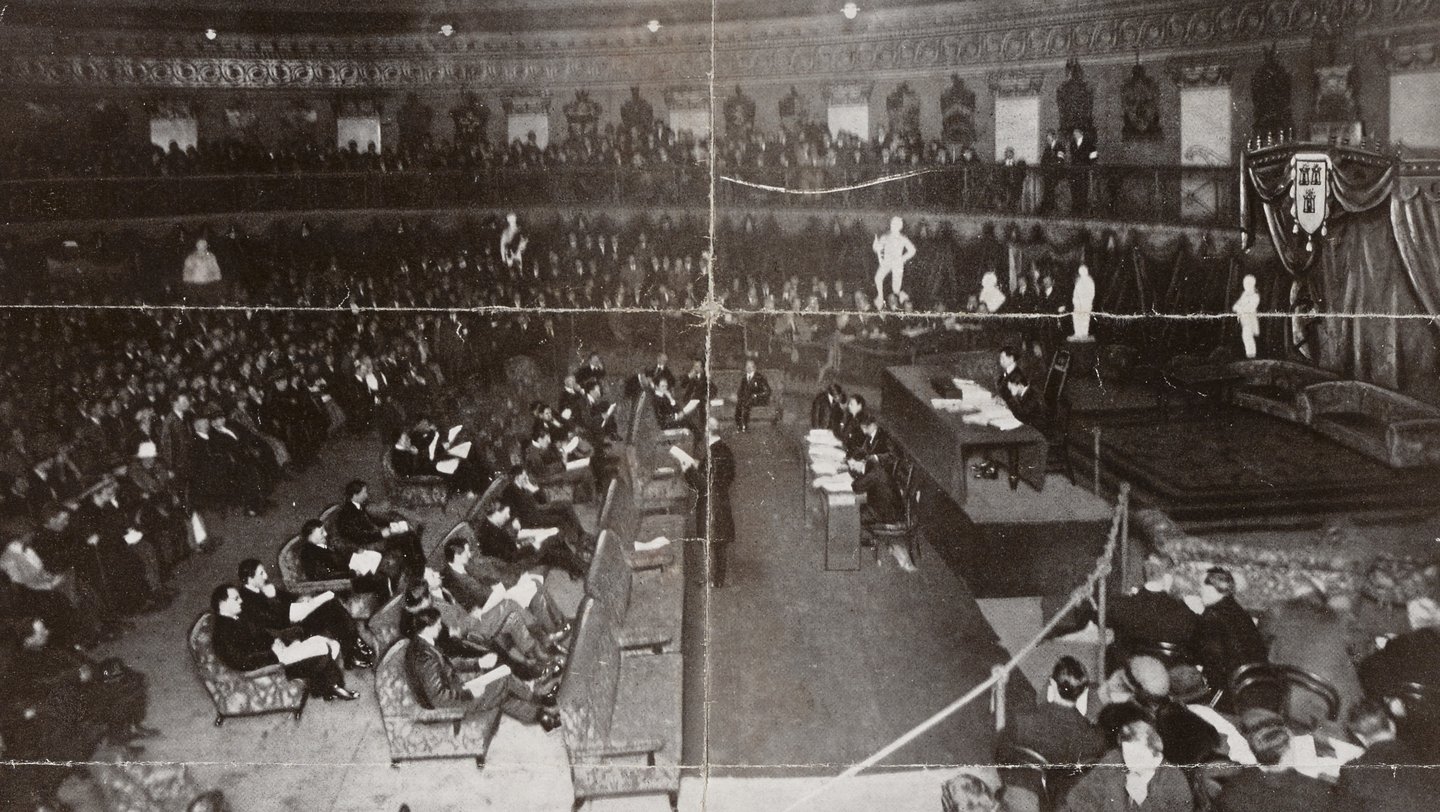
MacAlpine sees no hope for Irish demands at the Versailles Peace Conference. The day this was published, Sinn Fein won its historic victory in Ireland’s elections taking 73 of 105 Irish constituencies in the British parliament. Refusing their seats, they created Ireland’s revolutionary Dail Eireann on January 21, 1919 and the War of Independence would begin.
‘Ireland and the Peace Conference’ by Eadmonn MacAlpine from Revolutionary Age. Vol. 1 No. 8. December 14, 1918.
GREAT hopes that Ireland’s case will be satisfactorily settled at the Peace Conference, though the actions of President Wilson, are being manifested just now by that section of the Irish race in America who were ever loud in their advocacy of Ireland’s rights when those rights were in fashion, and when the way to political preferment lay through “love” for the Emerald Isle. “Prominent” Irish-Americans are now busily engaged in bringing “influence to bear” on Washington to the end that America shall champion Ireland at the Peace table.
The more “prominent” these men, the less definite they are in stating just what would be considered a settlement by the Irish people. The vague term “self-determination” is being bandied back and forth, as if it were in itself some abracadabra that would in some inexplicable manner open the way to Irish freedom. A short time ago these very men, who are now the adherents of self-determination, were in complete accord with the late John Redmond when he announced that Asquith’s Home Rule Bill, or as it was technically called the “Better Government of Ireland Bill,” would be accepted by the Irish people as “a full and complete settlement of the Irish question.” Since that time things have changed in Ireland. In Easter Week 1916, the little group of men, who for seven days raised the standard of revolt in the Irish capital, completely erased Home Rule from the Irish mind and in its place firmly established the idea of an Irish Republic.
It must therefore be taken for granted that a settlement of the Irish question means the establishment of a Republic acceptable to the Irish people and that this, and nothing less, is what these people expect to materialize for Ireland as a result of the Peace Conference, and is the end to which President Wilson would strive. But England insists that the question is purely one of local administration, the granting of local autonomy to an acknowledged portion of her empire. Lloyd-George, speaking for the British Government, has explicitly stated, within the past few days, that neither the Independence of Ireland nor the coercion of the north-east portion of Ulster into a Home Rule government would be for a moment considered by England. Nearly every minister of the British government has publicly stated that the question of Ireland is one affecting the purely internal affairs of the British Empire and can in no sense be considered as one of the problems arising out of the war.
A large section of the American press also embraces this view. The “Christian Science Monitor” on December 12, in a news article under the caption “Efforts Seen to Confuse Issues at Peace Table,” states that friends of the President are somewhat disturbed by certain events, one of which is “the effort to enmesh the President in the tangle of the Irish question…Their position is that the justice of the Irish cause…has nothing at all to do with the situation presented…
“The President has, on more than one occasion, refused to interfere in the Irish question. He is perfectly well aware that any effort on his part to interfere in a matter that is purely internal and the business alone of the United Kingdom, would be resented just as quickly in London, as would a British effort here to secure better prices for wheat for Swedish farmers in Minnesota.”

This is very plain speaking, and anyone who has taken the pains to study the present situation can readily see that it is fairly near the reality of the situation. The best that may be expected for Ireland as a result of “resolutions” is the setting up some form of Home Rule Government that will give the Irish people the fiction of freedom and deny them the reality.
It is very much open to question whether those now advocating Ireland’s rights from this side of the water would find themselves in agreement with what the Irish people have in mind when they speak of an Irish Republic. The proclamation of the Provisional Government of the Irish Republic states: “We declare the right of the people of Ireland to the ownership of Ireland. and to the unfettered control of Irish destinies, to be sovereign and indefeasible.” Taking into consideration the writings of James Connolly, one of the signatories to the proclamation; the fact that it was signed at Liberty Hall, the Headquarters of the Irish Transport and General Workers Union; the fact that the majority of the forces whose arms supported the proclamation were the men of the Citizen Army, the first class conscious army in the world; and the subsequent speeches of such men as William O’Brien, chairman of the Irish Trade Union Congress for 1918, it is not unreasonable to suppose that the “right of means something more then is usually meant by the people of Ireland to the ownership of Ireland” bourgeois proclamations using somewhat similar terms.
The Irish Trade Union Congress at its last session declared for the establishment of a Workers’ Republic, and it was by means of a general strike, demonstrating their economic power, that the Irish people resisted the imposition of conscription. The Irish working class twice in the past two years has demonstrated its power and indications, such as the reception accorded to Maxim Litvinoff, the ambassador to England of the Russian Soviet Republic, during his visit to Dublin, show that the general sweep of revolutionary ideas in Europe has not left Ireland unmoved. There is no doubt that Ireland has progressed beyond the stage where she is willing to shed the blood of her sons merely to exchange one form of tyranny for another, where she will send her sons to languish in English jails in order to change from the domination of the English government to the domination of the Martin Murphys, the Guinesses, the Barbours, the Harland and Wolfs, and the Burnses of Irish Capitalism.
For the past 50 years Ireland has dabbled in bourgeois politics, hopeful that she might relieve her misery by ousting the foreign domination of England, but within recent years the conviction has slowly but surely taken root in the minds of the Irish people that their miseries were not so much the result of domination by England as of the domination by the capitalist system, of which England is such an able exponent. The great Dublin strike of 1912-13, and the subsequent industrial unrest that grew out of that economic this conviction, and today the workers of Ireland battle, were merely the outward expression of are on the high road to a full understanding of the cause of their miseries.
Ireland’s entrance into the industrial struggle did much to bring her to a realization of the real facts in the case. She found that the evils that weighed heaviest upon her were not peculiar to her alone, but were equally shared by the workers of the world. She found that the workers of England, living under what is presumably their own government, suffered from these same evils, and she found that when she took the field against her economic masters her friends and enemies but by the lines of economic interest were not determined by territorial or racial lines
Any settlement that might come from the Peace Conference as at present constituted must merely mean an outward change in the form of government and not in the system at present oppressing the Irish working class, and even this change will only result from the action of the Irish people themselves. The British Trade Union Congress at its last session showed a deplorable lack of understanding of the Irish question, when it went on record as favoring Home Rule for Ireland, clearly proving that it lies with the Irish workers to effect their own salvation, and that little hope can be entertained from the present leadership of the British working class, either by the Irish or the British worker.
Irish freedom has long been a burning question, a question towards the settlement of which, some of the ablest and best of her sons have freely spent their energies and when necessary their lives. Long periods of sullen despair have resulted in glorious moments of action and hope, only to be again followed by the soul-sickening fruits of failure, but always the light of freedom flickered and always the call to the struggle was answered. Every flame of freedom, that from time to time has swept the world, lighted the fire in Ireland and the new ideal of freedom–the freedom of the proletariat, the rise of the world’s disinherited, is today spreading throughout the length and breadth of Ireland, uniting the workers of the North with their brethern of the South.
And it is freedom in the new sense that it is now the goal of the Irish working class; Ireland’s demand is not Irish freedom, but freedom, and no one can be a genuine friend of the Irish cause who is not the friend of freedom everywhere. Even in the days gone by, when the struggle for liberty meant liberty in the bourgeois sense, the men and women who fought and died for Irish liberty were the advocates of freedom wherever the fight was being waged. But the idea of freedom for the workers is no recent innovation in Ireland; when most of the world was still thinking of the propertied classes, when it spoke the advocates of liberty in Ireland saw beneath the surface, saw that Ireland meant the workers of Ireland and not a small and privileged class of the Irish people. The Fenian Brotherhood knew what they were striving for, and expressed themselves in the following definite language:
“To permit a small class, whether alien or native, to obtain a monopoly of the land is an intolerable injustice; its continued enforcement is neither more nor less than a robbery of the hard and laborious earnings of the poor.”
While John Mitchell showed that he was not apart from the ideas that were then pointing the world towards the true path to liberty when he said: “Dynasties and thrones are not half so important as workshops, farms and factories. Rather, we may say, that dynasties and thrones, and even provisional governments, are good for anything exactly in proportion as they secure fair play, justice and freedom to those who labor.”
Whatever be the result of the Peace Conference, whether, as it appears at the moment, Ireland will be entirely ignored or whether she is given a sop in the form of Home Rule, the real settlement of the question can only rest with the people themselves. Ireland will never have freedom until the English people are themselves emancipated, but it is not improbable that the movement for such freedom may emanate from Ireland.
The British Labor party is slowly awakening to the realities of its position, it is already a probability that the next parliament in England will be controlled by the workers and then the futility of such control will lead to an actual taking over of the country by the workers and the establishment of an industrial democracy; and with the coming of industrial democracy in England the Irish question will be settled.
In view of the part the Irish working class has already played in the few years it has been actually active on the industrial field, it is not extravagant to suggest the probability that the movement to secure economic freedom for the peoples of the British Empire will start in Ireland. Reports reaching here indicate that the Irish workers are in no mood to be trifled with, and it is certain that any concerted movement for economic and political independence arising in Ire land will not meet with the fate of Easter Week, 1916, but will have the hearty cooperation of a large, and an ever growing, section of the British working class, with the result that the Irish and British workers will walk side by side down freedom’s path.
The Revolutionary Age (not to be confused with the 1930s Lovestone group paper of the same name) was a weekly first for the Socialist Party’s Boston Local begun in November, 1918. Under the editorship of early US Communist Louis C. Fraina, and writers like Scott Nearing and John Reed, the paper became the national organ of the SP’s Left Wing Section, embracing the Bolshevik Revolution and a new International. In June 1919, the paper moved to New York City and became the most important publication of the developing communist movement. In August, 1919, it changed its name to ‘The Communist’ (one of a dozen or more so-named papers at the time) as a paper of the newly formed Communist Party of America and ran until 1921.
PDF of full issue: https://www.marxists.org/history/usa/pubs/revolutionaryage/v1n08-dec-14-1918.pdf
 Revolution's Newsstand