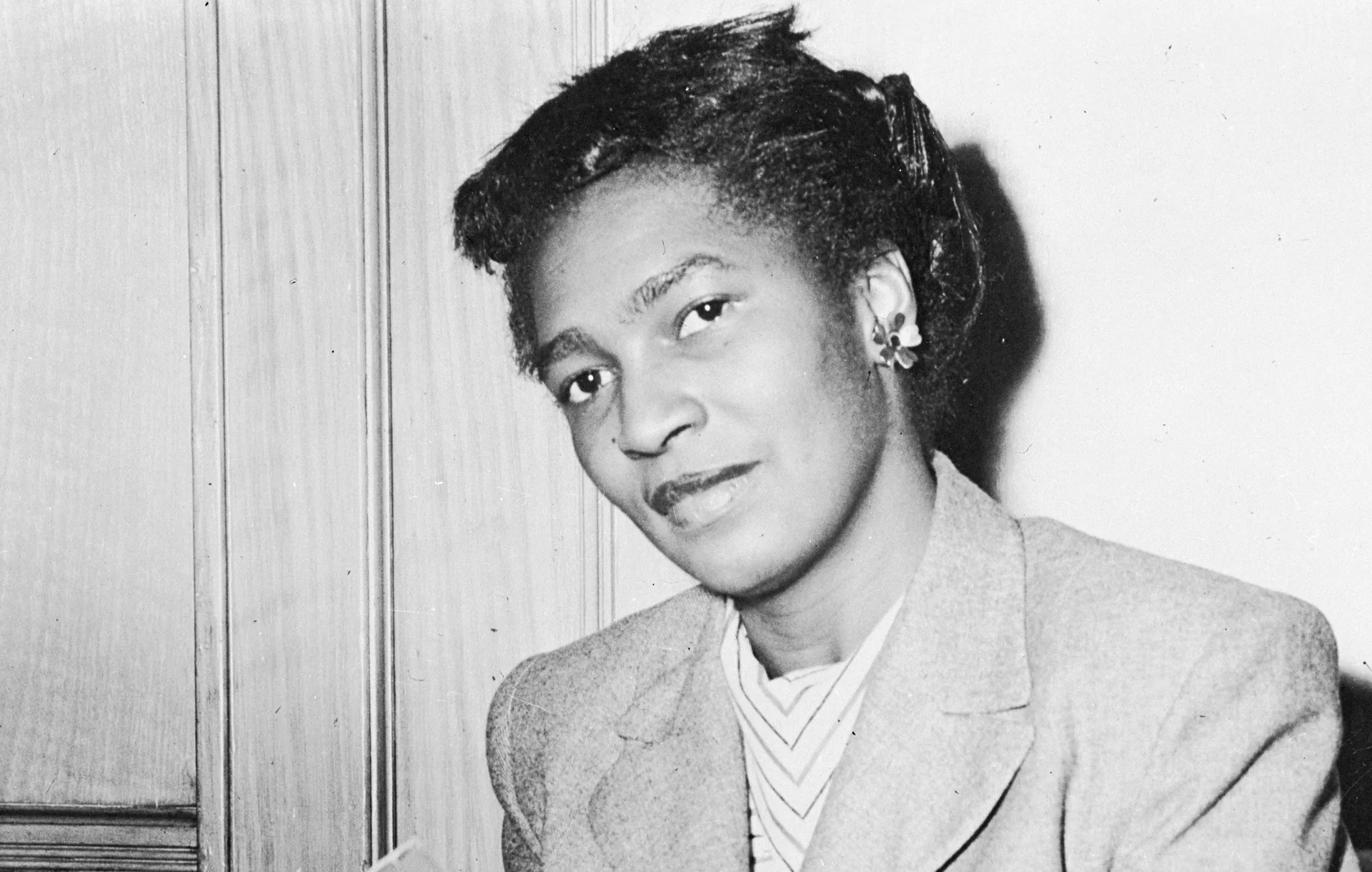
One of Claudia Jones’ earliest articles for the Daily Worker. She would go one to author many hundreds, including writing a daily column, Half of the World, for years.
‘Swell People–The Kind You Meet Any Day in Harlem’ by Claudia Jones from the Daily Worker. Vol. 15. No. 121. May 20, 1938.
Milton Herndon Branch of the Communist Party Discusses the Draft Constitution To Be Submitted at C.P. Convention
It was on Tuesday night, in the heart of the so-called “better section” of Harlem, that a Party unit met to discuss the draft Constitution of the Communist Party, proposed for adoption at its 10th Convention.
The people composing this unit are ordinary people-the kind that you can meet in Harlem any day in the week. People who are domestic workers, drill workers, truck drivers, carpenters, social workers, unemployed workers.
But up there on the hill, Sugar Hill, it is dubbed, at 701 St. Nicholas Ave., these people were discussing the vital questions of jobs, unemployment, relief, security and peace that face the Negro people.
The branch is composed of 100 members, 95 of whom are Negro. Named for Milton Herndon, who died in Spain fighting fascism, they are fast making their center place where people of the neighborhood visit. A number of the unemployed members of the branch are active in the Job Campaign now going on in Harlem.
At 9 o’clock promptly, with 30 people present, the meeting started with a singing of the “Internationale.” The chairman of the meeting, an unemployed Negro actor, called the meeting to order.
The routine business on the agenda, which included a march of time skit, Daily Worker sales, house committee reports, literature sales, was disposed of in 25 minutes. All were anxious to get started on the Draft Constitution discussion. By the time they had reached this point on the agenda, 20 more people had arrived.
A young, white woman comrade, with glasses and curly black hair, read the draft constitution, section by section.
DISCUSS CITIZENSHIP
Section I was read: “The name of the Party shall be the Communist Party of the U.S.” brought the remark from Alphonso Love, a militant A.F. of L. drill worker, “There’s none better.”
A West Indian-American worker asked the question whether anyone who hadn’t declared his intention to become a citizen yet, could still be considered a member of the Communist Party. He was thinking, he said, of some West Indian friends of his who were not yet citizens, but were about to become Communist Party members.
To this, the organizer replied, that certainly they should become citizens. Anyone, he said, who believes in the principles of the Communist Party, believed in fighting for democracy in America would certainly want to become a citizen.
The section dealing with the pledge of new members to the Communist Party was next read. The part of the pledge which called for “all Communists to give full support to all progressive movements” was discussed by a number of the branch members.
THE RECOVERY PROGRAM
“Take the President’s Job Recovery Program,” said a Negro woman domestic worker, “you know that the Communists support the President’s program, because even though it is limited, it provides three million jobs for the people who need it badly enough. The people know that the Communists are the best fighters for relief and jobs for the people, in spite of what the reactionaries say. This is what the pledge of the Communists to support progressive movements mean today.”
The financial director asked for a re-reading of the section on dues, concerning members in good standing.
“The Communist Party,” he said, “has no du Ponts, Morgans, to support the organization. We must impress our members with this fact. Many times our members, if they would know of this, would pay up. They like to be in good standing. It’s just like an insurance policy for us–when we find we are in arrears, we will pay up.”
Article 6 of the proposed Constitution was next. “The Communist Party of the U.S.A. upholds the democratic achievements of the American people.” Comrade Love, the Canizer of the Branch took the lead.
He spoke of the cry of American reaction who would dub the Communists as a “subversive organization.”
“What the reactionaries are really afraid of,” he said, “is that the Communists will se to it that the 13th, 14th and 15th Amendments to the Constitution are enforced. The danger they see of Communism is not that the Communists will destroy the Constitution, but that they will uphold it and enforce it.” The issues of Scottsboro and Herndon show that the Communists mean what they say. Applause rang in that Workers Center.
PREAMBLE PROPOSED
And so on, section by section, participation by the branch members who considered their discussion and suggestions to the proposed draft constitution the most important thing they could be doing that evening. The time alloted for discussion of that evening was now over. A proposal was made that a preamble for the Constitution, be added to the draft proposal. It was to be sent in to the Central Committee. All pledged to think over the discussion of the evening and bring in any proposals they might have to the next meeting.
NEW MEMBERS JOIN
The headquarters are simple and attractive. Three posters adorn their walls. A large picture of Milton Herndon, with an American flag draped over it, a poster of Abraham Lincoln, which says, “Give Aid to Spanish Democracy,” and a Daily Worker poster which reads: “It Gives Us a New Outlook.”
Literature sales go well in this branch. These workers are proud of their center, proud of their branch, proud of the Communist Party. Before the meeting closed, two new members of the branch joined the Communist Party. Tonight, as every Tuesday night, they left their meeting, with the determination to go out and recruit new hundreds of Negro workers to the Communist Party.
The Daily Worker began in 1924 and was published in New York City by the Communist Party US and its predecessor organizations. Among the most long-lasting and important left publications in US history, it had a circulation of 35,000 at its peak. The Daily Worker came from The Ohio Socialist, published by the Left Wing-dominated Socialist Party of Ohio in Cleveland from 1917 to November 1919, when it became became The Toiler, paper of the Communist Labor Party. In December 1921 the above-ground Workers Party of America merged the Toiler with the paper Workers Council to found The Worker, which became The Daily Worker beginning January 13, 1924.
PDF of full issue: https://archive.org/download/per_daily-worker_daily-worker_1938-05-20_15_121/per_daily-worker_daily-worker_1938-05-20_15_121.pdf
 Revolution's Newsstand