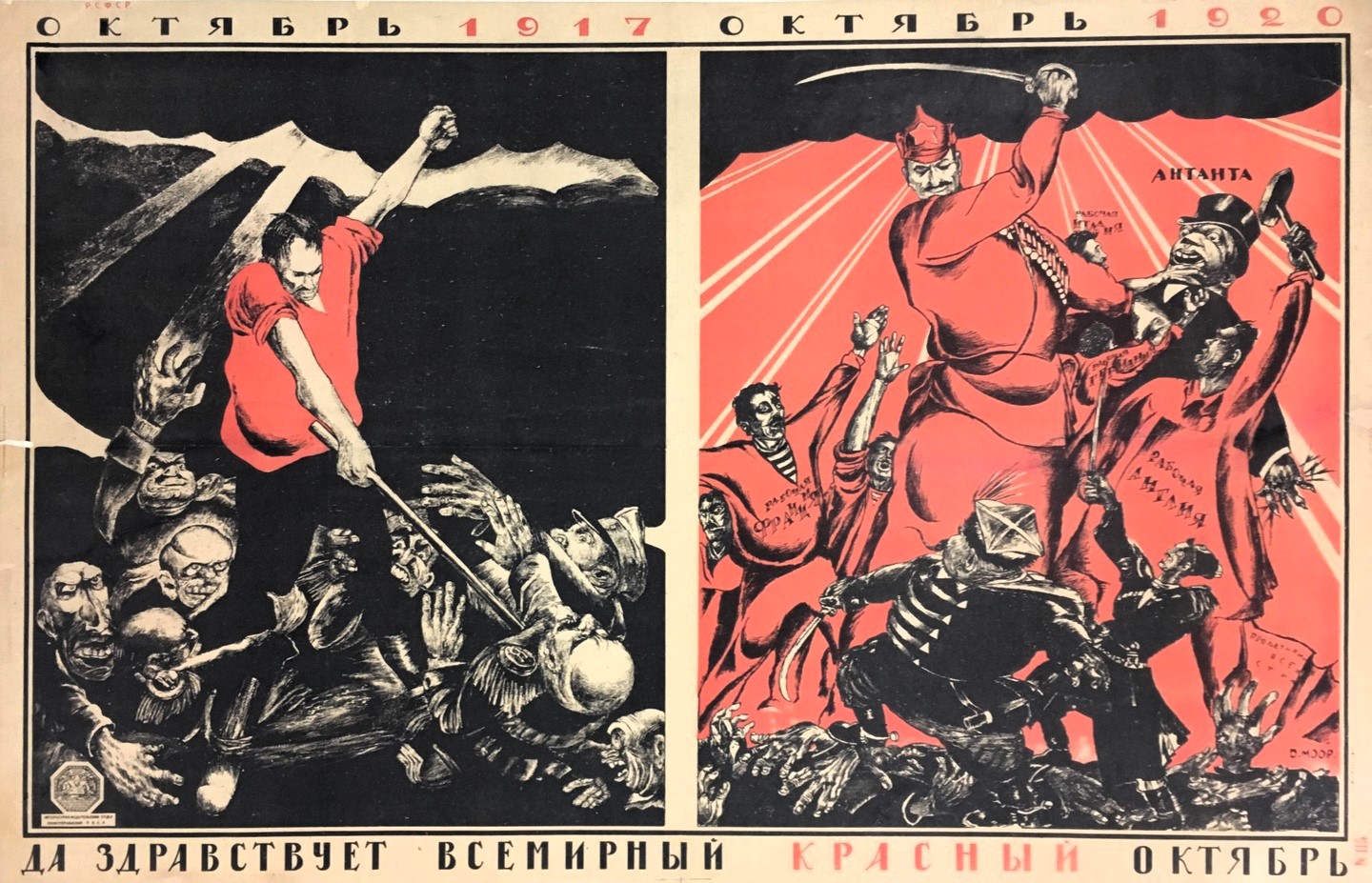
It can still be surprising to read how open the early Bolsheviks were about their situation. Here, Karl Radek takes stock on the Revolution’s fifth anniversary, a year into the New Economic Policy.
‘Lessons of Five Years’ by Karl Radek from Soviet Russia (New York). Vol. 7 No. 11. December, 1922.
The Social Results of Five Years of Soviet Russia’s Existence
DURING the first three years of the Soviet Republic the Russian proletariat, leaning upon the revolutionary parts of the peasantry, first of all destroyed to the last roots the entire political apparatus of Tsarism and of the bourgeoisie which had been left untouched by the March revolution. Later it destroyed the power of the landholders. It transferred the land to the peasants and wrung industry from the hands of the bourgeoisie. Through its policy of nationalization during the first three years of the existence of Soviet Russia, the proletariat created the necessary means for a victorious defense of the Soviet State and the social achievements of the revolution against the international counter-revolution which formed and supported the White Guards. The proletariat could attain this aim only on the condition that it should seize all the material means of the bourgeoisie, centralizing these means in the iron hands of the Soviet Government and securing the hinterland by a merciless application of terror.
After this period of the armed civil war had been concluded with the victory over Wrangel, the problem of economic reconstruction came to the fore. The attempt to remove the debris and the ashes of the civil war with the help of the labor army—that is, the living, unskilled force of the peasant masses—was not successful. This attempt was made not only in the interest of the working class, but also in the interest of the peasantry, which had suffered much because of bad transportation conditions and lack of fuel. It did not succeed because the need for defense against the Polish attack and against Wrangel forced the return of the labor armies to the front; and because the continuation of the civil war in 1920 further impaired the condition of agriculture. Before the cornerstone of industrial reconstruction could be laid it was necessary that agriculture, which had suffered severely during three years of world war and the three years of civil war, should recuperate.
In tackling the problem of economic reconstruction Soviet Russia had to return to the position of the November Revolution, whose limits under stress of the civil war it had very often transgressed. It had first of all to renounce the system of requisitions, which system did not leave anything to the peasantry above the minimum absolutely indispensable for its life. And during the time when the sons of the peasants under the leadership of the workers were defending their soil it was impossible to renounce the requisitions from their fathers; they were needed to feed the army and the industrial toilers engaged in war work, notwithstanding the fact that industry was unable to give to the peasants manufactured articles in exchange for bread. The policy of requisitions required the complete prohibition of all trade. But the fact that the peasant was deprived of the entire surplus of his work destroyed his impulse for production in excess of personal needs.
The substitution of a moderate tax in kind for the requisitions and the allowing of free trade with the remaining part of his produce was thus not only a concession to the dissatisfaction of the peasant masses (which expressed itself particularly in the winter and spring of 1921), it was also a means of strengthening the peasant agriculture as the first condition for economic revival.
But the allowing of private trading in the village meant its revival in the city as well. As the state industry after six years of war was not in a position to satisfy the needs of the peasantry, private industry and initiative had to be permitted in the city, too, in order to increase the amount of manufactured articles with which to get from the village the amount of bread which the city needed.
The lack of sufficient organizers, making it impossible to continue state management of small and many medium nationalized industries, also worked in the direction of concessions to private enterprise. The state was obliged to concentrate its forces upon the reconstruction of the main branches of key industries, the revival of which enables it to hold control of the entire economy of the country. Thus the new economic policy is not a temporary retreat before the necessities of the moment, but a proletarian policy which is conceivable only in a country in which the peasantry prevails, especially at a time of international isolation.
The Soviet government had to go still further in its retreat from the social policy of the first three years of its existence. Staggering under the weight of an enormous state debt inherited from Tsarism and from the bourgeoisie, which had been obliged to look for loans on the capitalist market for the acceleration of its economic development, the Soviet power was also constrained to make concessions to the moneyed bourgeoisie by yielding to it part of the already existing enterprises, as well as the exploitation of hitherto untouched natural riches of the country. Thus there arose on the economic field as a result of the five years! existence of Soviet Russia the necessity for the simultaneous existence of state management of the key industries, (the railroads, etc.), of petty private peasant economy, of private trading not only in the small handicrafts and in small industry, but also in those branches of big industry to which private economy is admitted in the form of lease contracts.
The concessions made to foreign capital are becoming the point of departure for the strengthening of the economic power of the proletarian state, under the assumption that these concessions will enable the Soviet Government to use part of the rent obtained from the foreign concessionaires for the increase of production in the big enterprises of the proletarian state. For this reason foreign capital attempts to convert these concessions of the Soviets into an indemnity for damages sustained by foreign capital through the Revolution, refusing at the same time to grant any credits; it desires in this way to force the Soviet Government to hand over the entire Russian industry, the railroads, and the national resources of Soviet Russia, over to foreign capital.
This effort to destroy the possibility of an economic victory by the Soviet power in its struggle against hostile economic forces which endeavor to control Russian economic life, was rejected by the Soviet Government at Genoa and at the Hague. It refused to assume material obligations without receiving the necessary means for strengthening the economic life of Soviet Russia. And it tries to break down the practical financial blockade of international capital by concluding separate agreements with single groups of capitalists and single states which most need relations with Soviet Russia. The success of this struggle depends upon the further development of the international situation, upon the next harvests and upon whether the economic organs of the Soviet Government will be able to compete with private capital upon the Russian market.
Political Results
The world bourgeoisie sees in the new economic policy the beginning of the complete capitulation of the Soviet Government, of the complete renouncement of socialist reconstruction by the Russian proletariat. The parties of the Russian petty bourgeoisie, which acted under the banner of socialism, the parties of the Mensheviks and the Social-Revolutionists, who in the course of the revolution were broken to pieces by the worker and peasant masses, these together with the international bourgeoisie, portray the new economic policy as the beginning of the end of Soviet Russia. They aim to attack the Workers’ Republic in the hope of bringing Russia back to the road of capitalist development, under the form of political bourgeois democracy. In reality they are enemies of socialist reconstruction, as they proved in the period of the March revolution; they are endeavoring to create conditions under which the bourgeoisie would triumph. They aim at the reintroduction of bourgeois democracy in the hope that under such a political system the peasantry which forms the majority of the Russian population would be unable to defend the nationalization of key industries and that as a class of small proprietors they would not make any sacrifices for the protection of the nationalized industries.
But as the parties of the Mensheviks and the Social-Revolutionists do not dare to come out openly with this program, they demand at present liberty for all socialist parties, among which they include themselves. Were they granted this freedom, they would become the organizing center for the rich peasants and for the petty bourgeoisie of the cities and in addition to that they would also become a legal organization center for the big bourgeoisie which has proved very often that it fully understands how to subordinate to its interests the organizations of the petty bourgeoisie. They would be unable—and they proved it during the war, during the March Revolution and the civil war—to offer resistance to the pressure of the foreign bourgeoisie; on the contrary they would serve the foreign bourgeoisie as a transmission apparatus for pressure upon Soviet Russia. Therefore, the party of the proletariat must defend its dictatorship against the demand of the petty bourgeois parties by all means, because any permission extended to the petty bourgeois forces to organize represents the greatest danger for the achievements of the November Revolution.
Precisely because the new economic policy means partly a revival of the bourgeois economic forces, all methods of the proletarian dictatorship must be employed to prevent these economic forces from being used as a means for the economic and political organizing of the bourgeoisie. The entire meaning of the policy of the big and petty bourgeoisie, of the Left Cadets, of the Social-Revolutionists and also the Mensheviks consists in the struggle for legality on the ground of the new economic policy, availing themselves of the Soviet constitution.
In using their slogan of “free Soviet elections” the Mensheviks and the Social-Revolutionists invoke the Soviet constitution. But the Russian proletariat and the Communist Party cannot permit the Soviet constitution to be used as a weapon for destroying the Soviet power and for substituting the dictatorship of the bourgeoisie for the dictatorship of the proletariat. Just as the Soviet constitution was born in the struggle against the bourgeoisie and against its petty bourgeois henchmen, the Social-Revolutionists and the Mensheviks —just so the continuance of the Soviets and the economic achievements of the November Revolution must be defended through the struggle against those parties which proclaim the necessity for availing themselves of the Soviet constitution in order to destroy it. This by no means signifies a diminution of the importance of the Soviets as is claimed by the Mensheviks and Social-Revolutionists. The workers’ and peasants’ Soviets were the weapon for the overthrow of the power of the bourgeoisie. In the period of the civil war this form of the proletarian dictatorship became the clenched iron fist of the proletariat which has in its hands the Red Army and the industry of the country. The center of life was transferred from the Soviets to the fronts of war and labor, to the revolutionary workers who directed the defense of the republic.
After the end of armed civil war, with the improvement of the economic existence of the working class and the peasantry, the dictatorship of the proletariat begins again to develop. The Soviets are being imbued with new life, they are seeking and finding new methods for the administration of the country. They will not lose by the absence of the representatives of the petty bourgeois parties; the stories of the Mensheviks and the Social-Revolutionists about the passing away of the Soviets through lack of free criticism are malicious inventions. In no other press in the world is there such an open, merciless criticism of the activity of the government as in the Soviet press, which is not afraid in the face of a world of enemies to discuss all the drawbacks, all the weak points of the Soviet regime.
The absence of the Mensheviks and the Social-Revolutionists from the Soviets does not mean an absence of criticism, but merely the absence of the counter-revolutionary disintegrating activity from the ranks of the workers’ and peasants’ democracy. The dictatorship of the proletariat, which is being exerted by the dictatorship of the Communist Party, can change its methods of action, it can pass from the form of terror, of the most acute civil war, to the forms of revolutionary legality, but it must remain the iron protective organ of the proletarian state, it must remain ready to return to the forms of terror if the bourgeoisie dares to undertake a new attack against the working class.
Prospects
In 1918 one could still fear that the conclusion of the war without an immediate victory of the world revolution would lead to the downfall of the Soviet power. But now, after five years, if can be asserted with conviction that it has sufficient strength to hold its own for a long period of time in spite of its isolation. The decline of the bourgeoisie, the disintegration of the White Guard forces, the discrediting of the petty bourgeois parties of the Mensheviks and the Social-Revolutionists as the allies of the Russian and international counter-revolution, the organization of a powerful Communist Party, the slow but gradual improvement of the Soviet apparatus and the Red Army—all this gives the Soviet power a big, political advantage over all its enemies.
The agricultural character of the country permits it slowly but securely to heal its wounds and to create the basis for an industrial revival. The deep contradictions in the camp of the world bourgeoisie, the sharpening of the social struggle in the capitalist countries, the crisis in the East, which is getting more acute every day—all this increases the international importance of Soviet Russia and opens prospects for commercial agreements with the capitalist West which will render possible the acceleration of its individual revival, the consolidation of the forces of the Russian proletariat, the improvement of the situation of the working class.
The new economic policy caused disappointment in many sections of the Western European proletariat, which itself is struggling against tremendous difficulties, and was drawing its hopes and forces from the conviction that Soviet Russia would finish capitalism at a single blow. But all the news about our strengthening, all the news about the improvement of Soviet Russia’s situation will be a new incentive to the growing forces of the international proletariat and thus a new factor for the strengthening of Soviet Russia.
Soviet Russia is compelled to defend the breach which it had made in the front of world capital much longer with its own forces than could be foreseen in 1917. This circumstance placed an enormous burden upon the shoulders of the Russian proletariat. But Soviet Russia has proved to be stronger than was hoped by Russia’s working class itself at the time when it conquered power. For five years Soviet Russia victoriously repulsed the attacks of the world bourgeoisie, and it is able not only to preserve its power up to the moment of emancipation of the proletariat in the industrial countries, but can effectively help it in its struggles.
Soviet Russia began in the summer of 1919, published by the Bureau of Information of Soviet Russia and replaced The Weekly Bulletin of the Bureau of Information of Soviet Russia. In lieu of an Embassy the Russian Soviet Government Bureau was the official voice of the Soviets in the US. Soviet Russia was published as the official organ of the RSGB until February 1922 when Soviet Russia became to the official organ of The Friends of Soviet Russia, becoming Soviet Russia Pictorial in 1923. There is no better US-published source for information on the Soviet state at this time, and includes official statements, articles by prominent Bolsheviks, data on the Soviet economy, weekly reports on the wars for survival the Soviets were engaged in, as well as efforts to in the US to lift the blockade and begin trade with the emerging Soviet Union.
PDF of full issue: https://www.marxists.org/history/usa/pubs/srp/v6-7-soviet-russia%20Jan-Dec%201922.pdf
 Revolution's Newsstand