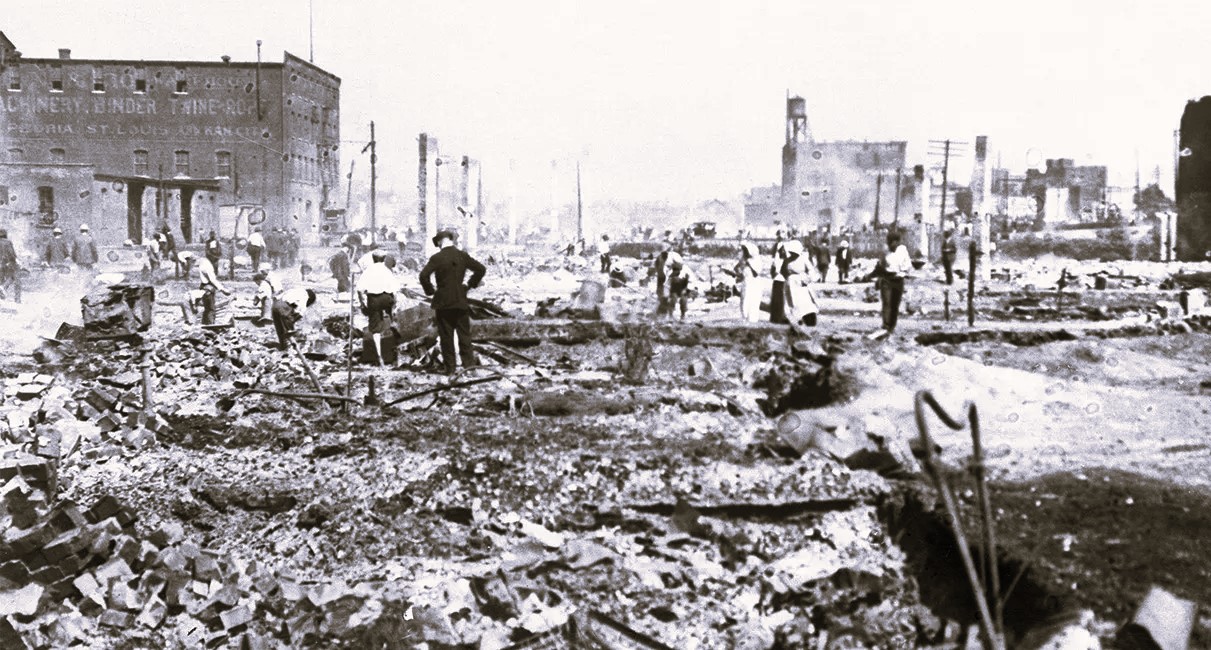
Louis C. Fraina’s interventions on U.S. racial politics show a far greater appreciation of its reality than most of his white counterparts in the Socialist movement. In this sharp editorial on 1917’s East St. Louis pogrom of over one hundred Black workers for the S.P.L.A.’s ‘New International’ he chastises his fellow Socialists for repeating the tired explanation of ‘economic causes’ and ‘competition for jobs’. The labor movement’s refusal to approach Black workers as Black workers in the name of ‘class first’, was, of course, a ‘race first’ policy in defense of the relative privilege of the white workers’ position. Instead, Fraina places responsibility squarely on the A.F.L.’s racist reinforcement of those ‘economic causes’ and a ‘competition for jobs’ in defense of white supremacy.
‘East St. Louis, The Negro, and Unionism’ by Louis C. Fraina from New International (S.P.L.A.). Vol. 1 No. 7. July 21, 1917.
THE East St. Louis outrage, in which scores of Negroes were brutally killed and their homes burned, is an incident that cannot be dismissed with the stereotyped phrases damning Capitalism for its iniquity.
The responsibility of Capitalism is plain, the economic factors obvious. But there is a responsibility of Organized Labor involved, a heavy responsibility that cannot be shirked.
The day after the outrage, the secretary of the local Federation of Labor issued a statement condoning the actions of the murderous mob. President Gompers has condoned the part played by Organized Labor in the outrage on the plea that the employers are responsible because they imported Negro labor from the south. In so many words, the justification is that the Negroes were taking the jobs of the whites, and accordingly deserved being killed. This is a dastardly plea.
White men who take the jobs of strikers are not massacred by the strikers. They may be intimidated, they may be assaulted, which under certain conditions may be justifiable action; but they are not massacred and their homes destroyed. The A.F. of L. cannot plead that the Negro is a scab, because the A.F. of L. refuses to organize the Negro. The trades unions are “job trusts” which through various methods exclude the bulk of the workers from membership. Their animating purpose is to provide the members with jobs. By excluding the mass of the workers, the unions of the A. F. of L. encourage scabbery.
Instead of organizing the Negro and jointly fighting the employers, the unionists of East St. Louis expressed a ferocious spirit of race hatred and thereby made proletarian solidarity a still more remote thing of the future.
No one denies the share of Organized Labor in the outrage–the friends of the A. F. of L. simply justify it in a variety of ways.
And worse of all, we find the Socialist Party, which should be the moral and intellectual advance guard of the Working Class, compromising on the issue, remaining silent, or extenuating the whole affair by a discussion of its “economic causes.”
At the recent City Convention of the Socialist Party of Greater New York, a resolution was introduced on the East St. Louis outrage that indicated the responsibility of Organized Labor. The resolution was rejected, and a compromise resolution adopted:
“We express our unutterable horror at the outrages committed upon the Negroes in East St. Louis on July 1 and 2, and we demand that the perpetrators of these fiendish deeds, as well as the local authorities who failed to give the Negroes sufficient protection, be prosecuted and punished.”
A characteristic declaration–sound and fury, signifying nothing!
The New York Call admits that the outrage is the consequence of “a fierce and intense fight for jobs,” its solution being “to remove the economic causes.” Must the Negro wait for the Cooperative Commonwealth before he can secure at least a measure of justice? It is a stupid and reactionary attitude. It plays right into the hands of Capitalism by dividing the working class along racial lines. Moreover, it is going to keep the Negro away from Socialism by making him strive to improve his conditions as a Negro, instead of as a worker.
The Negro constitutes a large proportion of the proletariat of America. The industrial transformation that is now convulsing this country is making the Negro migrate north and enter industrial pursuits in large contingents. These are facts that cannot be waved aside with dogmatic phrases. They must be faced and settled intelligently. Either the union movement organizes the Negro as a fellow-worker, or the capitalist is going to pit Negro against white to the destruction of both.
The unions must be free to all workers, they should seek to organize all the workers. The policy of the “job trust” inevitably produces disaster, particularly in the new era of Capitalism and its greater efficiency. And if the A. F. of L. refuses to organize the Negro, the unskilled and the unorganized generally, then it becomes a prime task of the Socialist Party–if it is Socialist and revolutionary–to drive the unions to action and use all its power to make good the deficiency of the A.F. of L.
New International was the paper of the Socialist Propaganda League of America begun in Boston as ‘The Internationalist’ at the start of January 1917 and first edited by John D. Williams. The SPLA was founded by Left Wing SPer C.W. Fitzgerald , who had contacted Lenin in the fall of 1915 over their shared opposition to the war and positions around the Zimmerwald Conference. Lenin and continued their correspondence. With publisher and editor John D Williams and Dutch revolutionary SJ Rutgers, Fitzgerald officially began the SPLA in November, 1916, the first po-Bolshevik organization in the US. In early 1917 Williams went to New York to tour for the SPLA. On January 16, 1917 a meeting in Brooklyn attended by Leon Trotsky, Nikolai Bukharin, Alexandra Kollontay, V. Volodarsky, and Grigory Chudnovsky representing the Russian revolutionary movement with Louis B. Boudin, Ludwig Lore, Louis Fraina, and John D Williams of the SPLA. Both the New International(ist) and Class Struggle journals were born at this meeting. In the spring of 1917 SPLA headquarters moved to New York where Louis Fraina took over as editor. The paper lasted only about a year before Fraina began publishing Revolutionary Age.
PDF of full issue: https://www.marxists.org/history/usa/pubs/new-international/v1n07-jul-21-1917-ni.pdf
 Revolution's Newsstand