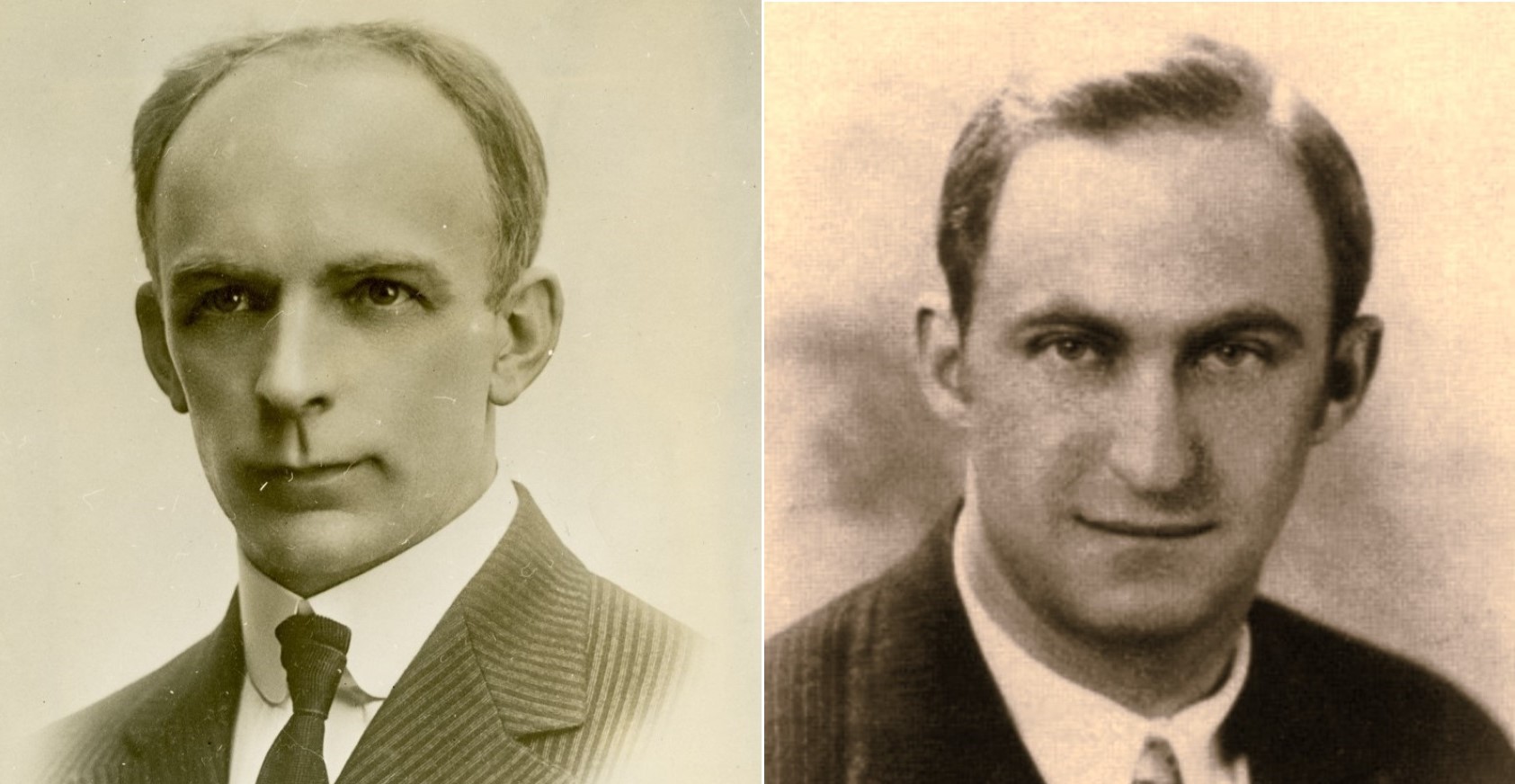
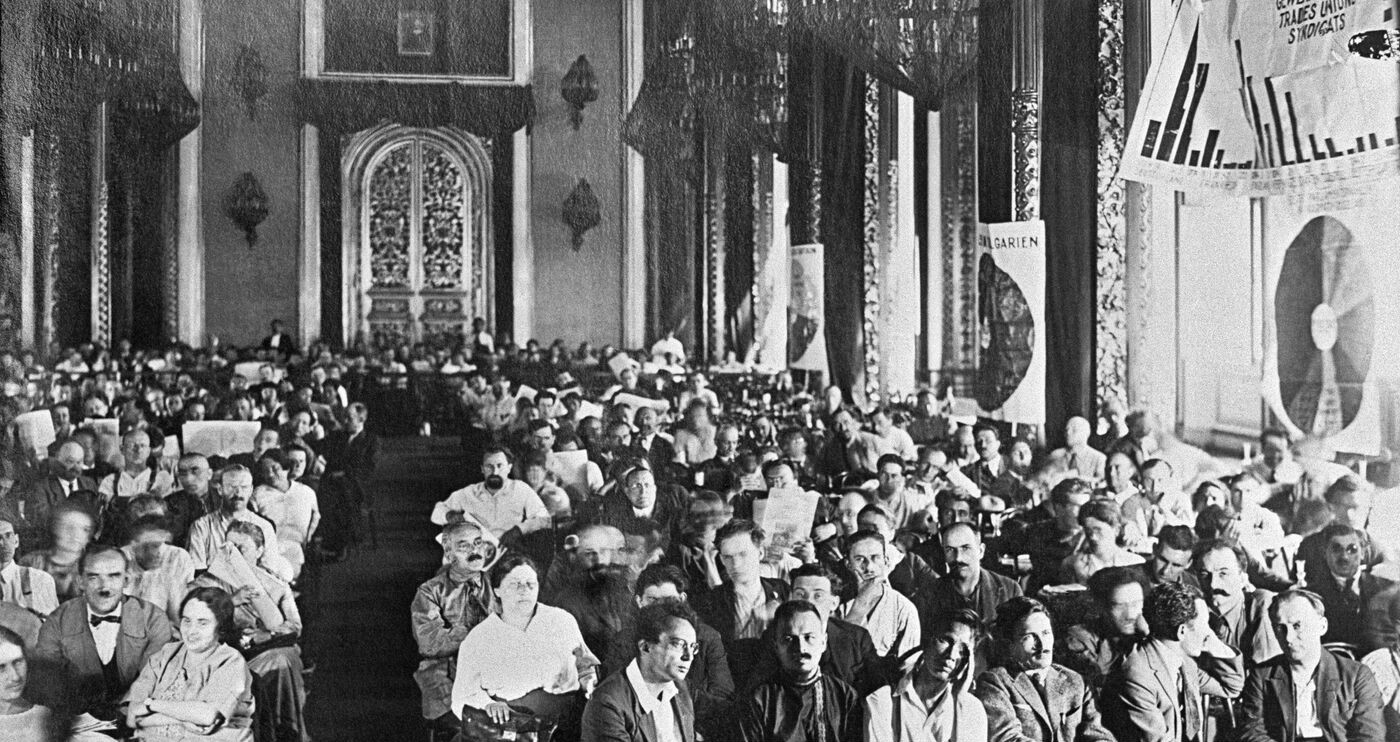
Continuing the look into the 1920s differences within the U.S. Communist Party. Heading to a split, representatives of U.S. Communist factions travel to Moscow to plead their case and ask for a determination from the E.C.C.I. at its 5th Enlarged Plenum in early 1925. Representing the then majority were William Z. Foster ‘Dorsey’, James P. Cannon, and John Williamson; for the minority Ruthenberg ‘Sanborn’, Jay Lovestone ‘Powers’, and John Pepper. An ‘American Commission’ headed by Otto Kuusinen was tasked with resolving the issues and presenting a binding resolution. Below are the report of Kuusinen’s commission, comments by Zinoviev, statements on the accord from unnamed factional representatives, and finally the full text of the (unanimously passed) resolution. Though the factional conflict would continue for years more.
Between international congresses, the highest authoritative body of the Communist International was the Enlarged Executive Committee meeting once or twice a year. After Lenin’s 1924 death came the Comintern’s ‘Bolshevization’, the attempt to create a uniform international movement, centralized and organizationally based on a certain model of Bolshevism. The role of the Comintern changed from political discussion, education and guidance, determination of common international policy and activity–to managing the internal organizational affairs and crafting the national positions of its sections. For worse and for better.
‘Report and Resolution of the American Commission’ by Otto Kuusinen and Grigori Zinoviev from International Press Correspondence. Vol. 5 No. 39. April 28, 1925.
Comrade Kuusinen gave a report on the work in the American Commission:
The American Commission, with the American comrades, unanimously decided today to recommend that the draft resolution which we are submitting here to be adopted. The question upon which the conflict arose in the American Party was whether the Party should fight in the immediate future for a Labour Party or not. As you know, the majority of the Central Committee of the American Party opposed it, and the minority supported it. In the opinion of the Commission, the majority based its policy in this respect too much on superficial temporary phenomena. The minority is absolutely right in its confidence in the vitality of the Labour Party movement.
But the question has also another side. In speaking of the labour party, it was evident that one side has an entirely different conception of the Labour Party from the other. One side fought of the coming Labour Party in a much narrower sense than it ought. A revolutionary, or af least semi-revolutionary Labour Party will probably always remain a pious wish. A revolutionary Labour Party is so long an impossibility, as long as the workers’ Party of America will become this Labour Party. But it is possible that a Labour Party will rise earlier than that. What purpose can a Labour Party serve for us? It will become a field of activity for our revolutionary work among the masses, in order to win them over gradually to the revolutionary standpoint. But it will also be a school for the working masses themselves, where they will get the experience of the necessity of class organisation, and one other very important experience the experience of the treacherous role of the reformists, who will in all probability take the lead in this movement. We have already had a clear symptom of this during the last few weeks. The Socialist Party under the leadership of the well-known Mr. Hillquitt, was compelled recently to oppose the LaFollette Party on the question of the Labour Party. The reformists could not formally abandon their leading role in the labour organisations. Otherwise they would be politically dead.
The Commission proposed that the former slogan “Farmer Labour Party” must be changed from now on to that of “The Labour Party” only. That must be done in conformity with the change in the objective situation in America. The agricultural crisis was temporarily overcome by capitalism in America, although it was accomplished by the expropriation of the property of a large mass of small farmers. At present there is no basis for a joint party of the workers and small farmers. That naturally does not mean that the Communists must not continue their work among the small farmers with the greatest energy.
The working class is approaching great mass struggles. On the whole, however, it must be said that at present the situation is not yet pregnant with revolution. American capitalism seems to be standing at the height of its power. At present it has overcome the situation created by the superfluity of capital by exporting capital to impoverished Europe. The Dawes affair seems a step toward world monopoly to American finance capital. This great power is, however, deceitful. When one is standing on top and can stay there, it is a very advantageous position. Bui when he comes to a slant and begins to slide, then the higher he stands, the worse it is for him. The great task of the American comrades is to help finance capital to slide down.
In the resolution the commission stated that both the leading groups have made mistakes in their platform; the Party is, however, well on the road to Bolshevisation, but it is still much too weak. The Party comrades of both groups must together do everything in their power to strengthen the Party.
One other important task: the Party has a Right Wing led by a comrade named Lore, who may not be altogether unknown to you, and of whom there can be no doubt that the is an opportunist. The Commission declares in its resolution that there is no room for such an opportunist as Lore in the Central Committee of the Party. The Commission did not express an opinion on what the right place is for him, that has been left to the Congress of the Workers’ Party to decide. We are convinced that all the comrades of the Central Committee of the Party, irrespective of the group to which they belong, will deal with this question without ambiguity at the Party Congress. (Applause).
Comrade Zinoviev:
Comrades, I should like to make the following statement on the American question:
In the course of the negotiations I myself moved that the composition of the future Central Committees of the American Party be already intimated here in Moscow. I pro- posed that the present majority retain a majority in the future Central Committee, but that the present minority be assured representation proportional to its strength, to wit, not under one-third.
During the negotiations I then withdrew my motion as inexpedient. We are of the opinion that after having formulated a unified political platform, we may leave it to the Party itself to elect its Central Committee at the next Party Convention as it sees fit. This is in no way intended to express a preference for one of the two wings of the Party. I must emphasise that the Foster Majority did not absolutely insist upon having the composition of the Central Committee fixed here. That means that my motion was made neither at the initiative of the Majority nor of the Minority, but on my own initiative.
You know, comrades, that the Commission has put only one condition, that the opposition, that is the social-democratic group headed by Lore, be not represented in the Central Committee.
We believe that both wings, Foster’s as well as Ruthenberg’s, by all means belong in the Central Committee. Of course it is not easy for both wings to obtain a majority. Nevertheless, each maintains that it will gain the majority. The future will show which of the two has deceived itself. We can only wish both wings the best of good luck. Let them try to win a victory on the basis of the platform of the Communist International, however, only on the basis of the platform here formulated.
The wish was also expressed that both tendencies unite in fighting the social democratic tendency of Lore. If one wing should endeavour to defeat the other through collaboration with Lore that would be disloyalty to the Communist International. After eliminating the social democratic opposition a free-for-all struggle is permissible, of course in a comradely form within the organisation and only up to the Party Convention. After the Convention peace and tranquility must prevail so that an American Question should not again require the attention of the Comintern for a long time to come.
A Representative of the American Majority:
On behalf of the majority, I would like to state that we fully accept the resolution of the American Commission. We believe it provides a solution of all the disputed points in relation to the Labour Party question which have divided the Party for the last two years and that it lays down the correct line for the future.
From the beginning of the controversy which first arose in 1923 over the question of the formation of the Federated Farmer-Labour Party, the present majority has contended that the Labour Party must be a mass organisation with a firm basis of trade union support, and should not be merely a combination of the Workers Party and its sympathising organisations, and fought the theory that the Communists should endeavour to split off a Left Wing from the Labour Party as soon as possible to transform this split-off section into a mass Communist Party. The resolution of the Commission has clearly upheld this point of view and has declared that we are right in emphasising it.
After the Presidential election, the majority of the C.E.C. in its determined opposition to further attempts to organise a fictitious labour Party which could not fulfill the role of a mass Labour Party in the United States, went to an extreme and rejected the agitation for the formation of a Labour Party in the present situation. This was a mistake which is acknowledged and which will be corrected in accordance with the resolution.
On the basis of this decision the majority will strive to unite our Party to end the factional strife that has weakened our Party and to eradicate energetically the Right deviations present in the Workers (Communist) Party.
A Representative of the American Minority:
The minority of the American Party appealed to the Communist International on the American question, because it considered that there was at stake an issue which involved the whole question of the future of the communist movement in the United States, the question of developing the class consciousness of the American working class.
We see that in recent years a new tendency had arisen which expressed itself in the movement for the Labour Party. We believed that it was necessary for our Party to take the forefront in this struggle and so to move the backward masses in America a step forward. We believe that to cut loose from this movement would be to take from our Party the best avenue of its future development.
In the decision that has been proposed here we have the Communist International’s approval of this fundamental new point that the Communist Party in America must remain at the head of and take the lead in developing this movement: and consequently we can give our full approval to the thesis.
In the inner Party question also we have a decision to which we can give our full approval. One of the big differences in our Party was the question of the struggle against the Social-Democratic Lore faction in our Party. We insisted upon an uncompromising struggle to eradicate this tendency and this has been approved in the thesis.
Thus in the inner Party situation we believe that the thesis follows the correct line for the future good of the Communist Party in the United States.
The draft resolution of the American Commission was unanimously adopted.
‘Resolution on the American Question’ from International Press Correspondence. Vol. 5 No. 47. June 4, 1925.
1. General Situation.
American capitalism has temporarily overcome its crisis. Masses of workers, who in the last few years took up the struggle against the arbitrary reduction of their standard of living have been defeated in tremendous labour struggles and have been subjected to the heaviest yoke. Masses of small farmers, who were in a state of ferment because of the agricultural crisis, have been expropriated. At last the wide open price “scissors” was able to be closed in conformity with all the laws of capital; only in so doing the scissors cut these farmers off from their property. The requirements for the expansion of industrial export could, it is true, not be complied with in an adequate degree, but instead of this, new paths for the export of capital to impoverished Europe were opened. American finance capital has thus not only rescued its profit and its power on the home markets, but has won the position of the biggest shareholder among the world capitalist powers. It is now more powerful than ever before.
These victories of American capitalism have not been won without paying a big price. Even the Dawes Plan, which from the standpoint of Wall Street, appears as a ladder to world monopoly, is likely to draw American capitalism into a policy in which it stands to lose much more than merely its interest in German gold marks. It will involve it more and more deeply in the contradictions and crises of European capitalism and also in the imperialist world arena in conflicts and struggles for markets, for interest, for oil, colonies and power.
Furthermore, class relations in America are developing in a direction menacing to capitalism. The increased pressure of exploitation has forced large masses of workers to the point where class-consciousness inevitably awakens even amongst the most politically backward wage slaves. The quality of exploitation which has been greatly extended, is changing more and more the former heterogeneity of the American working class. It is true that capitalism is still able to bribe millions of skilled American workers by positions of privilege, but the circle of this privileged class is growing smaller and smaller. Mass un- employment as a permanent social institution and the mass proletarianisation of the small farmers, form a fruitful ground for the revolutionising process germinating in the depths. On the whole the situation of the American working class is at present far from being pregnant with revolution; it is different however, from what it was ten years ago.
The strengthening of the centralised government power, which interferes in the most brutal fashion in the everyday struggles of the working class, is an important factor in the increasing acuteness of the class struggles and in the acceleration of the crystallisation of class-consciousness. The cessation of immigration from Europe, the influx of hundreds of thousands of ruined proletarianised farmers (farmers of American origin who speak English, possess political rights and who will offer an energetic resistance to the exploitation and oppression of the trusts) as unskilled, badly paid workers, into the large towns and industrial centres, represent an important change in the structure of the American proletariat.
It is true that the majority of the American workers do not yet feel any fundamental change in their position. But the developing trend of this position has undergone a fundamental change. This change is only very slowly and with difficulty being understood by the masses.
2. The process of the development of political independence of the American workers, which commenced after the imperialist war and has continued under varying forms from year to year, is the political expression of the changed tendency of development of the class situation of the working class. This process is, however, still moving forward slowly and hesitatingly. This may be explained by various specific American causes and also partly because the American workers have a privileged position in comparison with that of workers in other countries. In no other capitalist country have the workers to overcome such internal and ex- ternal obstacles in the beginning on their way to political in- dependence. It is true that the time is already past when the reactionary leadership of the A. F. of L. could sell the entire vote of the organised workers just as it pleased to the highest bidder of the two capitalist parties. The political position of leadership of the agents of capital at the head of the A. F. of L. is in part undermined; in part paralysed by the anti-capitalist sentiments of the masses, but it is far from being eliminated.
The opposition of masses of organised workers to the continuance of their political bondage to the capitalists originally became apparent in various indefinite forms (for instance, in a section of the organisations affiliated to the C.P.P.A. here and there in the labour unions, etc.). However, it was clearer and more definite in the Farmer-Labour movement, which led in 1923 to the foundation of Farmer-Labour Parties in many States, and rallies considerables masses around its standard. The Communist Workers Party played, as we know, an effective part in this movement, and for a certain period even set the pace in it.
Prior to the last presidential election, however, the petty-bourgeois liberal opposition movement led by La Follette came to the forefront and irresistibly captured the mass sentiment of the semi-conscious, anti-capitalistically inclined workers and farmers.
3. The LaFollette Movement as a genuine petty-bourgeois phenomenon was of a two-fold nature: on the one hand, it was an objective symptom of the disorganisation in the camp of the bourgeoisie. On the other hand, in the prevailing crisis of American capitalism its objective purpose was the support of capital; to divert as a political safety valve the awakening class-consciousness of the proletariat from the consolidation of its independent class movement. Gompers understood this and allied himself with LaFollette. The semi-conscious labouring masses, however, saw in LaFollette, a standard bearer against Big Business and followed him blindly, for the Farmer-Labour movement still lacked political independence in such a degree. The majority of the workers in this movement desired the formation of a Labour Party, but they did not yet demand an independent proletarian class policy, they preferred rather to accept the guardianship of an opposition party of the petty-bourgeoisie. The path of the proletariat can even lead through such false roads in its first steps towards its constitution as a class.
4. The Fight of the Workers Party against Lafollette for the Labour Party Movement.
As was to have been expected at the beginning, Lafollette determinedly rejected any community of interest with a Farmer- Labour Party to be organised with the collaboration of the Workers Party, and he succeeded in isolating the Communists from the masses in the election campaign. For its part, the Workers Party opposed La Follette just as unflinchingly even though without prospects of much success. It must be recognised that in the elections La Follette gained an important victory. That does not mean that the tactics of the Workers Party were not correct. They were correct; our Party only met with a defeat which was not to be avoided under the given circumstances.
After this defeat a certain confusion became apparent in the ranks of the Workers Party. It seemed to the majority of the CEC and many comrades that the La Follette movement had paralysed any mass movement for a Labour Party for a long time to come. For a time after the elections it really appeared that even the masses who had previously supported the formation of an independent national-Farmer-Labour Party, wanted no other Party besides that of La Folette. In this situation the majority of the C.E.C. of the Workers Party drew the conclusion that the former chief slogan of the Party “For the Formation of a Farmer-Labour Party” had to be abandoned as useless, and the Party for the time had to concentrate its attention firstly on the unity of the fight for immediate concrete demands and upon the immediate strengthening of its own ranks.
Important and very symptomatic phenomena in the La Follette movement have already proved that this conclusion was incorrect. At the first opportunity in which a decision upon the formation of a La Follette Party was to be arrived at, at the conference of the CPPA. (the most important organisation in this movement) the adherents of the new Party split on the question of the form of organisation. Whether the Party should be built up on individual membership as La Follette demanded–or on a basis of collective affiliation. La Follette feels a very comprehensive fear of the preponderance of powerful labour organisations in his Party, but these latter are not inclined to make a renunciation of their influence through the Bye Laws. This struggle as to the form of the organisation is of course an expression of the class differences and antagonisms in the La Follette movement. Immediately after this split of the Conference of the C.P.P.A., the Executive of the Socialist Party came out into the open with the slogan “for the formation of a Labour Party”, with collective affiliation. The Socialist Party was also up to now one of the pillars of the La Follette movement, and since it is now against the La Follette Party on this question, this is of much more significance than the former platonic play of the Socialist Party with the Labour Party slogan. Numerically this reformist Party is now very small, but it has considerable ideological influence amongst the trade union officials.
In view of these facts there can scarcely be any doubt that in the near future the problem of the Labour Party will even more than before be an actual, even the most important political question on the agenda of many trade unions and other labour organisations. The Minority of the Central Executive Committee of the Workers Party was right in having confidence in the vitality and future of the Labour Party movement. The Workers Party must now do its utmost to further this movement.
5. Tactics in the Fight for a Labour Party.
Not the rejection of a struggle for the Labour Party, but an adjustment and further development of our tactics in this struggle are called for, by the present situation in America. Our slogan itself should now be revised in so far that we no longer agitate for a “Farmer-Labour Party” but only for a “Labour Party”, since in the changed conditions the premises for the formation of a joint Party of workers and small farmers are lacking.
The Communists need not demand nor even expect that the Labour Party will immediately be a revolutionary, radical party of workers, in which the Communists will take the lead. In this respect the slogan has been put somewhat too narrowly by the Minority of the CEC. Communists should clearly realise that the formation of a Labour Party signifies for the affiliated workers only the beginning of their political emancipation and of the development of their class consciousness. It is very possible that in America, at first there will be for a time at the head of the Labour Party similar reformist labour traitors to those, in England, or even worse. Nevertheless, the formation of such a Party may for a time represent a definite step forward in the American labour movement, and the Communist Party is obliged to participate in this Party, if only the latter permit in a sufficient degree freedom of criticism and agitation on the part of the affiliated organisations.
Why must the Communists act thus?
Because it is their task to remain in closest contact with the masses in order to influence the latter continually in a revolutionary sense. However, mere agitation and propaganda, even the best, is not sufficient for the revolutionary influencing of the masses. For this purpose the masses require their own revolutionary experience. They can obtain essential elements of this experience in the Labour Party, even though the latter be directed by reformists. In that case the masses, after their disappointments will learn to know the reasonable role of the petty-bourgeois reformists, and that is very important. Furthermore, they will gain valuable experience in the independent political organisation of the working class.
The ideas of class and class consciousness should be inculcated as thoroughly as possible in the masses of the American working class by the preparatory campaign of the Communists for the formation of a Labour Party. This is not to be done abstractly, for it would have no success in this manner, but in immediate connection with the most urgent everyday demands of the workers. The Communists should induce the working masses to present these demands to the reformists and to the leaders of the La Follette organisations and to call upon them for joint action with the Workers Party. Should they accept or reject such proposals sooner or later the traitors will expose themselves. After every such instance, the masses of workers will, however, more and more clearly realise the necessity of an independent class Party of their own. And if they do not yet recognise the Communist Party as this class party they will still feel that the slogan of a Labour Party is the consequence of all their everyday demands, and thus this slogan gains vital mass power.
This fight will require persevering energy and much patience. It would be a mistake for us to begin too prematurely with the organisational measures for the formation of the Labour Party. This could only give the La Follette crowd a trump card in their fight against the Labour Party movement and aid them to reconsolidate their own ranks. We, however, should on the contrary drive an ever deeper wedge into the La Follette movement. Of course, the entire organised mass of workers will not join upon the formation of such a Labour Party, but at best only a section. But the conditions for the successful formation are not ripe as long as there is not a firm mass basis of trade union support. The majority of the Central Committee was quite right in emphasising this point. If the Workers Party were merely to be combined with the organisations sympathising with it, no Labour Party could be formed from this combination.
It may be that the mass support for the idea of the Labour Party will reveal itself so strongly in some cities and even in some states, that organisational measures can be taken without further hesitation. The formation of the National Labour Party should be advised against until at least 500.0000 organised workers are definitely won over to it.
After the formation of the Labour Party, what the Executive emphasised a year ago should he kept in mind, that it is not advisable to endeavour to split off a Left Wing from the Labour Party as soon as possible in order to transform this split off section into a mass Communist Party. We must rather endeavour to win increasing masses in the Labour Party for the revolutionary point of view and to let this left wing grow within the Labour Party and at the same time to take the most advanced and revolutionary elements into the Workers Party. This policy is to be observed both prior to the formation of the Labour Party and subsequently.
6. Strengthening and Consolidation of the Workers Party.
The fight for the formation of the Labour Party in no way excludes propaganda and recruiting activity for the winning and training of new members for the Workers Party. On the contrary, this work should be carried out simultaneously with the utmost intensity. The role of the Workers Party as the Communist Party of the country should neither be hidden nor diminished.
As the Workers Party is at present constituted, it is still altogether too weak to collaborate with sufficient effectiveness in the proletarian mass movement of this great country. This natural weakness was particularly evident in its election campaign. As long as the Workers Party does not at least double its membership (and especially increase manifold the number of its American members), it cannot be said that it fulfils the requirements of an American (legal) Communist Party. Under 110 circumstances should it underestimate in any way the importance of such “minor” tasks, as the circulation of the “Daily Worker” and the establishment of new organs, the development of the “Workers Monthly”, the publication and distribution of good propaganda literature, the organisation of Party schools, recruiting weeks, etc.
The organisational structure of the Party still lacks to a considerable extent the necessary cohesion. This is to be improved primarily by systematic, thorough concentration of the Party members of all the different nationalities in centralised organisations. The formation of international branches and factory nuclei is therefore on this account the most urgent organisational task of the Party.
7. Communist Trade Union Work.
In America the regular work of Party members in the trade unions must be considered now, as the fundamental work on which depends the success of the Party in most of the other fields, and especially the struggle for a Labour Party. There- fore, any tendency to neglect or minimise the importance of this work must be energetically combated. In every single trade union organisation Party members must be organised into a Communist Fraction and must act unitedly on every question. These fractions get their instructions from the Party and work under its control. Communist fractions must take an active and energetic part in all mass economic struggles.
The Party must give energetic support to the Trade Union Educational League and do its utmost to develop and extend it. Efforts must be made to convert the T.U.E.L. into a great opposition movement of the Left bloc. All attempts of the reactionary trade union bureaucracy to isolate the T.U.E.L., to undermine its influence in the trade unions and to limit the membership to Communists and their closest sympathisers must be energetically resisted.
8. Party Work on the Other Fields.
Although the Party is at this time not to propagate the formation of a common party for workers and farmers, it must not only work among the agricultural labourers, but must at the same time do its utmost to get into contact with and exercise control over the poorest tenant farmers and farmers who are in debt; for they are destined to play a very important role in the American revolution as future allies of the proletariat. Neither does this modification of the main political slogan of the Party mean that the Party is not to work in the already existing Farmer-Labour Parties. The task of the Communists in the existing Farmer-Labour Parties is as follows: they must organise the industrial elements as a special wing, which should be drawn at an opportune moment into a Labour Party and form a bloc with the organisations of the poor farmers.
The Party must pay more attention and give more support to the work of the Communist Youth. It is moreover of the utmost importance for the Party to make at last in good earnest a beginning with the work among the working women. The women members of the Party and non-Party working women are to be drawn into revolutionary work which the Party must organise. The existing non-Party proletarian women organisations are not to be done away with, but should be made use of for revolutionary work.
9. Struggle against Lore’s Opportunism.
Lore represents a non-Communist tendency in the Workers Party. Already the decision of the E.C.C.I. in May 1924, pointed out that Comrade Lore’s ideology was the ideology of the Two and a Half International. Lore supported Levi against the C.I. He misinterpreted the policy of the C.I. almost on every question. He declared that the main task of the Communist Party of Ger- many in the revolutionary situation of 1923 should have been to prevent the revolution by every possible means. Lore spread the most ridiculous illusions concerning the “mission to establish world peace” of Ramsay MacDonald. He warned the French Communists against the overthrow of Herriot. He fought against the necessary centralism of the Party in the name of the autonomy of the German Federation. The ideological struggle against Comrade Lore’s tendency is essential for the Party.
The Executive proposes to the Workers Party to come to a definite decision on the Lore question at its next congress. In any case the Executive is of the opinion that the Central Committee of the Party is not the place for such an opportunist as Lore.
10. The firm Consolidation of Communist Forces.
The above platform, adopted by the Enlarged Executive Committee of the Communist International, has also been approved by the representatives of both groups in the Workers Party. The Executive Committee of the C.I. discovered errors in the attitudes of both groups which must be rectified.
The Executive Committee is of the definite opinion that fractional conflicts between the two groups must now absolutely cease. Although it is true that this fractional conflict arose out of real differences, it has, nevertheless, been of too acute a character on both sides and at times assumed impermissible forms. The Executive Committee does not object to a concrete and calm discussion being caried on until the Party Congress, but, in the interest of Party unity it demands the unconditional cessation of Party war fare.
In particular, the Executive Committee must point out that it regards a campaign conducted against Comrade Pepper as absolutely uncalled for, all the more since, firstly, comrade Pepper himself has no intention of returning to work in the Workers Party, and secondly the Executive Committee desires to use his energies for other important tasks. The Executive Committee knows that Comrade Pepper during his brief stay in America performed services for the Workers Party for which he deserves praise. The Executive Committee demands that ail personal polemics on both sides should cease.
The Executive Committee regards it as absolutely essential that the representatives of the Party majority and minority should henceforward conclude a fraternal peace and work in communist cooperation. The leading comrades are primarily responsible for setting a good example to the other Party members in this respect.
The Party Congress will be held at an early date. All disputed questions which may arise between the two groups in the Party Central Committee in the interval, and which cannot be agreed upon, are to be settled in a parity commission under the chairmanship of a neutral comrade. This commission shall also control the actual conduct of the Party discussion.
The Executive Committee is of the opinion that the Party Congress, in a calm atmosphere, free from all fractional passions, should elect the Party Central Committee from among the comrades of both groups. The group which will be in the minority at the Party Congress must in any case be assured a large representation in the Central Committee.
Naturally, both the groups, having adopted this platform, must at the Party Congress actively oppose any of the followers of Lore being elected to the Central Committee.
International Press Correspondence, widely known as”Inprecorr” was published by the Executive Committee of the Communist International (ECCI) regularly in German and English, occasionally in many other languages, beginning in 1921 and lasting in English until 1938. Inprecorr’s role was to supply translated articles to the English-speaking press of the International from the Comintern’s different sections, as well as news and statements from the ECCI. Many ‘Daily Worker’ and ‘Communist’ articles originated in Inprecorr, and it also published articles by American comrades for use in other countries. It was published at least weekly, and often thrice weekly. The ECCI also published the magazine ‘Communist International’ edited by Zinoviev and Karl Radek from 1919 until 1926 monthly in German, French, Russian, and English. Unlike, Inprecorr, CI contained long-form articles by the leading figures of the International as well as proceedings, statements, and notices of the Comintern. No complete run of Communist International is available in English. Both were largely published outside of Soviet territory, with Communist International printed in London, to facilitate distribution and both were major contributors to the Communist press in the U.S. Communist International and Inprecorr are an invaluable English-language source on the history of the Communist International and its sections.
PDF of full issue: https://www.marxists.org/history/international/comintern/inprecor/1925/v05n39-apr-28-1925-inprecor.pdf
PDF of issue 2: https://www.marxists.org/history/international/comintern/inprecor/1925/v05n47-jun-04-1925-inprecor.pdf
 Revolution's Newsstand