
A rare, early translated article from Julian Marchlewski. A central figure in the Polish and German workers’ movement for decades, Marchlewski (Karski), formed a partnership, one of our movement’s great political collaborations, with Rosa Luxemburg and Leo Jogiches during their 1892 exile in Zurich, where together they founded the Social Democratic Party of the Kingdom of Poland. Exiled from Czarist Poland for his revolutionary activity to Germany, when this was written Karski was editor of Leipziger Volkszeitung. He soon resigned in protest after the Party leadership refused an article by Luxemburg. Withdrawing from Party leadership, in December 1913 he began Sozialdemokratische Korrespondenz with Luxemburg and Franz Mehring as regular contributors. In this article Karski gives a social and political history of Prussian oppression of Poles.
‘Persecution of the Poles In Prussia’ by J. Karski (Julian Marchlewski) from New Review. Vol. 1 No. 19. August, 1913.
A recent debate in the German Reichstag reminded the world anew of the tragedy of the Polish people; the subject of the debate was the infamous policy pursued by the Prussian government in regard to the Poles.
In order that the matter may be understood, the history of the disruption of the Polish nation must be briefly recalled.
In the middle of the seventeenth century Poland was, next to Russia, the greatest state in Europe. As in the other countries of the continent, the nobility of Poland had seized the control of the country, and the peasantry was reduced to absolute servitude. But Poland was bounded on the East by extended territories the population of which was on a lower plane of civilization, and it was an easy matter for the Polish nobility to subject and to tyrannize over these regions–Lithuania, White Russia, Podolia, the Ukraine. The nobility “colonized” these lands by reducing the native population to serfdom and at the same time introducing Polish peasants and forcing them to statute labor. The virgin lands of the steppes bore rich fruit, and Poland became the “granary of Europe,” exporting immense quantities of grain, cattle, wood and wool. The wealth of some of the noble families became colossal. These families then seized the political power also and established an oligarchy. The state took on the strange form of a republic with a king at its head. elected for life. The legislation was placed by law in the hands of the nobility as a whole, which met regularly to transact the business of the state; but in fact a small number of magnates ruled, because the great mass of the smaller nobility was eco- nomically dependent upon them. However, it was to the interest of these magnates that the power of the state should not be augmented, and they particularly opposed the establishment of a standing army, because with its support the king would have become the actual ruler. If danger threatened, from Russia or Turkey for instance, the mounted troops of the nobility took the field, but there was no standing army. Thus in 1663, when the Turks besieged Vienna, King Jan Sobieski led 40,000 cavalry to the aid of the Austrian emperor and defeated the Turks. This aristocratic republic could maintain itself in this manner as long as its neighbors were weak. But when in the eighteenth century Austria and Prussia became powerful military states, and when Russia also, under the rule of Peter the Great, rapidly became a despotically governed military state, Poland found herself an almost defenceless state between neighbors of superior strength. Then the squadrons of the levies of the nobility counted for little against modern armies of perfectly trained troops. These three neighbors now pressed upon Poland from every side. The only means of salvation would have been to call the Polish people to the defense of the realm. But that the nobility would not permit. They feared that the peasants’ weapons would be turned against themselves and that the king, supported by the armed peasantry, would put an end to the arbitrary rule of the nobility. In order to maintain their absolute rule over the peasants, the nobility exposed the country to the danger of losing its independence.
Therefore the inevitable happened. Fredrick II, King of Prussia, who had long waged war with Russia and Austria, concluded peace with those states and joined with them in a predatory raid upon Poland. Thus in 1772 took place the first partition of Poland; the three governments annexed the provinces of Poland which were adjacent to themselves, and the Polish state was greatly diminished. In vain a small contingent of patriotic Poles sought to save at least what remained of the fatherland by means of reforms that would enable it to put up an effective defense and prevent further spoliation. The reforms were frustrated by the governments of the robber states, and this was done all the more easily since the magnates betrayed their country and shamelessly sold themselves to the enemy.
After Austria and Prussia had been defeated by the revolutionary armies of France, they concluded to indemnify themselves at Poland’s expense, came to an understanding with Russia to this end, and in 1793 effected the new spoliation, the second partition of Poland. The Poles rushed to arms. Thaddeus Kosciusko, who had learned the art of war in the American Revolution, was given the supreme command. But the nobility even then refused to avail itself of the only possible means of saving the fatherland, namely, calling the whole population to arms. Only if the war had been conducted with revolutionary means, only if serfdom had been abolished and the peasants freed, could the Polish people have prevented the second partition of their country. But the nobility would not consent, and Poland fell, a victim of the class interests of the nobility. Kosciusko’s army was defeated. In 1795 the three powers undertook the third partition of Poland. Then came the Napoleonic wars and with them the possibility of the restoration of Poland. But when Napoleon was overthrown, Europe was divided anew, and at the Congress of Vienna in 1815 the robbery committed upon Poland was finally confirmed. Since then the Polish people has been divided into three parts–one under Russian, another under Austrian, and the third under Prussian rule.
We shall deal here with this last portion and with the national persecutions by the Prussian government to which the Poles have been subjected.
During the first few decades of its rule the Prussian government sought to win over the Polish nobility. It permitted a limited autonomy to exist in the Polish provinces and the Polish nobles were eligible to government offices and military appointments. When the emancipation of the serfs throughout Prussia took place, the nobility in these provinces were treated with special tenderness. The peasants received only a small portion of the land and were under obligation to pay enormous sums to the landlords. To this must be added the fact that economically these landlords were in a very advantageous position, because in the first half of the nineteenth century there were exported from these Polish provinces, as in general from the eastern portion of the Prussian monarchy, high-priced agricultural products, which went to the western portion and even abroad, especially to England, Holland and Belgium. Under these circumstances the Polish nobility under Prussian rule abandoned all plans for national independence. In Russian Poland the nobility in 1830 and 1863 organized armed uprisings in their struggle against alien rule, but in Prussian Poland calm prevailed.
The bourgeoisie was the more easily reconciled with Prussian rule since nationally it was greatly mixed. Even before the fall of the Polish state there were many Germans in the cities of these provinces. The explanation is very simple: since the peasants lived in servitude, were absolutely subject to the landed nobility and were chained fast to the soil, there was no movement of population from the country to the cities. On the other hand, swarms of artisans and merchants were constantly arriving from Germany and settling in the Polish cities. This immigration was especially strong during the Thirty-Years’ War, when the German cities suffered greatly. It was naturally the western cities, those close to Germany, that received the majority of these immigrants. We might name Posen, Gnesen (Danzig), Bromberg and Thorn. When these cities came under Prussian rule the German portion of the bourgeoisie was naturally treated with especial favor and soon it appeared as if these cities were completely German.
Hence the Prussian government had an easy task as far as the upper classes were concerned: nobility and bourgeoisie underwent a rapid Germanization and made no resistance to the new rule. On the contrary, the peasantry and agricultural laborers remained Polish. But these masses lived on in stupid indifference and took no interest in public life. The peasant and the agricultural laborer were Poles without knowing it, so to speak. They spoke Polish because that was the tongue of their fathers, they preserved Polish customs because they knew no others.
But then in the seventies of the last century something occurred which brought these Polish masses into conscious antagonism to the Prussian government. After the establishment of the German Empire there broke out a conflict between the government and the Catholic church, the so-called “Kulturkampf”; the Catholic clergy were subjected to persecution and chicanery. Since the Poles are Catholic, and since in the minds of the people Polish and Catholic, German and Protestant are synonymous, the persecution of the Catholic church soon assumed in the eyes of the popular masses of Poland the character of a national persecution. The clergy were naturally sly enough to support these ideas and they gained fanatical adherents thereby. This outburst of a Polish-Catholic movement aroused the wrath of the Chancellor. Bismarck, and then began a policy of furious national persecution. The Polish language was no longer permitted to be used anywhere. The authorities and the courts were not allowed to use the national language in dealing with the Polish population, the names of Polish localities were changed. One of the most barbarous acts was the sudden expulsion from Prussia of those Poles who were not Prussian subjects. In the border provinces lived many thousands of Poles who were Austrian and Russian subjects. In 1885 they suddenly received an order to leave Prussian territory within twenty-four hours, and those who did not go voluntarily were taken by force to the frontier. It meant material ruin for many thousands of families.
But the most shameful blot upon this policy of oppression is the persecution of the school children. Since 1887 the Polish language has not been allowed in the schools and whoever is bold enough to instruct children other than his own in the reading and writing of Polish runs the risk of being thrown into prison. An exception was made of religious education, which is given in Polish, although in the last few years the government has sought to introduce the German tongue there also. The children, who regarded that as an attack upon religion, refused to say their prayers in German and were cruelly punished by their teachers. In some localities this was even the occasion of bloody conflicts: the fathers and mothers of the punished children protested publicly against the teachers, the protestants were attacked by the police, blood flowed, many were imprisoned, and cruel punishments were imposed. Thus the Prussian government itself is making the Polish school children martyrs of the national cause.
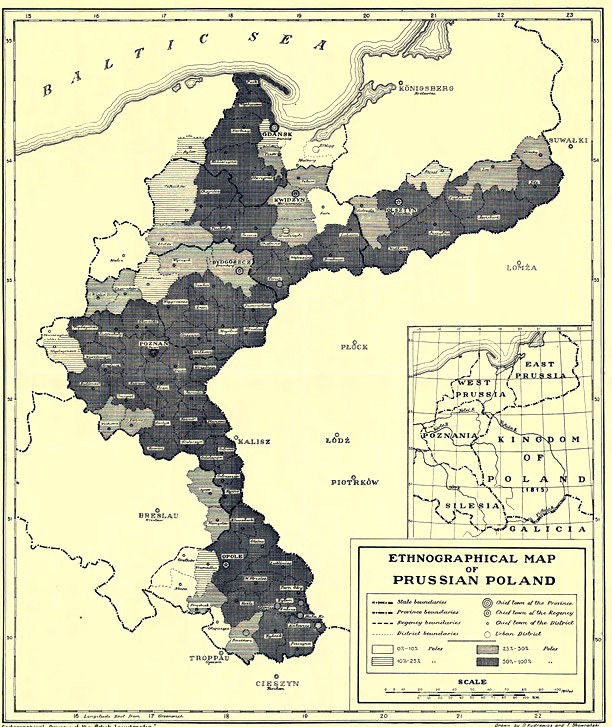
Finally the Prussian government transferred to the economic field its attack upon the political nationality. At the prompting of the Prussian Junkers (country squires) located in the Polish provinces, Bismarck formed the plan of buying the land from the Poles and settling German farmers upon this land. In 1886 the “Ansiedlungskommission” (Settlement Commission) was created for this purpose. One hundred million marks of national funds were placed at its disposal for the purchase of the lands of Polish owners. The matter was thought to be very simple, those formulating the plan counting upon selling the purchased land to German farmers and again buying Polish properties with the money thus obtained. But the event proved otherwise. The German farmers, who emigrated from the provinces, could not adapt themselves to the agricultural methods and did not prosper. The government was obliged to help them. They then received the land under special conditions: they were only required to make small payments and to pay a low annual rental, they were assisted in every possible way by the state, houses were built for them at low prices, and cattle and agricultural implements were furnished them. In this way the one hundred million marks were soon expended and additional sums were appropriated. Up to the present around seven hundred and forty million marks have been expended in this way. With this money 395,000 hectares (1 hectare equals 2.47 acres) of land have been bought, which amounts to about 7.2 per cent of the area of the two Polish provinces of Posen and West Prussia. An undivided portion of this land is still in the possession of the government, upon another portion 19,570 German farmers have settled up to this time. If five persons are counted to each family, the number of persons would be 97,850. Since the population of the two provinces numbers about two million, it is obvious that the purpose of augmenting the German element has not been accomplished. Nor did the “buying off” of the Poles amount to anything. Only a small portion of the land was bought from Poles, nearly 72 per cent. of the area was purchased from German owners. This came about as follows: The government was obliged to pay very high prices for the land, and so the German Junkers saw that it was “good business” and were willing to be bought out. The government was agreeable and for years it has been buying from Germans.1
But these purchases of land by the government have had very grave social and economic consequences. First of all the price of land has been forced to a very high level–in 1886 the government paid 586 marks a hectare for the land, in 1911 it paid 1,354 marks. But the prices throughout the entire country were artificially raised thereby, and it is to be feared that this must in the future lead to a serious crisis.
But this policy reached the height of infamy in the persecution of the Polish peasants. The latter bought land from the great land-owners out of their own resources by forming cooperative associations. But the government tricked them in unheard of fashion. They were forbidden to build houses on the lands purchased. Even if a Polish peasant wishes to build a stable to live in, he is punished. A famous case is that of the peasant, Drzymala by name, who, when he was forbidden to build a house on his land, bought a cart, such as is used by traveling comedians, and lived in it. The government desired to drive him out, and the result was protracted litigation through all the courts.
The last act in this policy of persecution was the passing of a new law according to which Polish peasants can be forced to sell their lands to the “settlement commission.” Thus the property right of the Poles is abolished so that their land may be wrested from them. This is a violation of the constitution, an act of sheer violence.
But this insane policy of persecution has not resulted in the weakening, but in the strengthening of the Polish nationality. According to the law that pressure creates counter-pressure, all the persecutions have only brought it about that the masses of the Polish people have become filled with fierce hatred for the Prussian government and are holding all the more stubbornly to their nationality.
It is also of special interest to note a tendency of the Polish element to press into the cities. This is very easily explained: the cities grow, as everywhere, at the expense of the country districts and new masses are constantly pressing into the city from the country. Formerly, as stated above, the cities in Poland had many German inhabitants, but in the last few decades the incoming stream is Polish, because the villages which furnish the men are Polish. While in the villages these men were politically indifferent, in the city they read newspapers, join the unions, take part in public life and become for the first time really conscious of their nationality. That is a social process which proceeds irresistibly. Hence matters are shaping themselves in this way: the Prussian government wishes a forcible “Germanization” by artificial means, but social evolution is quite naturally effecting a “Polonization.” Hence we can be sure that the Prussian government will never accomplish its purpose, will never succeed in depriving of their nationality the Poles, who look back upon a thousand years of culture.

However, there can be no doubt that this struggle over nationality is very harmful to the Poles, and to the Germans as well. The German and the Polish bourgeoisie are trying to persuade the masses of workers that all social antagonisms must be put aside in view of the struggle for “national interests.” And, in fact, they have temporarily succeeded in checking the progress of Socialism in these provinces, inflaming the Polish and the German workers against each other, and retaining them in the camp of the bourgeoisie. Directly also the working class is being injured in its fight for better living conditions. Since the acquisition of land is made difficult for the Polish agricultural laborers, the process of proletarization is accelerated. Hence the emigration of the Polish peasant population increases, for the men must seek bread by going into the factories and mines. Then we also see hundreds of thousands of Polish workers settling in the German provinces, especially in the industrial Rhenish and Westphalian districts, that is, in purely German regions. The driving of the Poles from the land increases greatly the industrial reserve army and thereby makes the wage struggle more difficult. Therefore the Social-Democracy of Germany is combatting this policy of persecution, not only for reasons of justice and fairness, but also because of the plain class interests of the workers. But the Polish workers are coming to recognize more and more the selfish policy of the Polish bourgeoisie. Slowly but surely the idea is making headway that the struggle for Socialism is at the same time the sole means to prevent national oppression and persecution.
1. It is interesting to learn how these German Junkers came into the Polish provinces. When the rape committed upon Poland had been completed, the numerous estates which were in the possession of the Polish State and of the Church were presented to favorites and mistresses of the Prussian king, or else were sold for a song. In addition, a portion of the Polish nobility had been ruined by the war and their estates were bought up by all sorts of questionable speculators using all kinds of trickery. Hence, a hundred years ago the Polish land was bestowed lavishly upon a mob of courtiers and to-day the government is paying the descendants of that rabble high prices for the land. And this is called “national policy.”
The New Review: A Critical Survey of International Socialism was a New York-based, explicitly Marxist, sometimes weekly/sometimes monthly theoretical journal begun in 1913 and was an important vehicle for left discussion in the period before World War One. Bases in New York it declared in its aim the first issue: “The intellectual achievements of Marx and his successors have become the guiding star of the awakened, self-conscious proletariat on the toilsome road that leads to its emancipation. And it will be one of the principal tasks of The NEW REVIEW to make known these achievements,to the Socialists of America, so that we may attain to that fundamental unity of thought without which unity of action is impossible.” In the world of the East Coast Socialist Party, it included Max Eastman, Floyd Dell, Herman Simpson, Louis Boudin, William English Walling, Moses Oppenheimer, Robert Rives La Monte, Walter Lippmann, William Bohn, Frank Bohn, John Spargo, Austin Lewis, WEB DuBois, Arturo Giovannitti, Harry W. Laidler, Austin Lewis, and Isaac Hourwich as editors. Louis Fraina played an increasing role from 1914 and lead the journal in a leftward direction as New Review addressed many of the leading international questions facing Marxists. International writers in New Review included Rosa Luxemburg, James Connolly, Karl Kautsky, Anton Pannekoek, Lajpat Rai, Alexandra Kollontai, Tom Quelch, S.J. Rutgers, Edward Bernstein, and H.M. Hyndman, The journal folded in June, 1916 for financial reasons. Its issues are a formidable and invaluable archive of Marxist and Socialist discussion of the time.
PDF of full issue: https://www.marxists.org/history/usa/pubs/newreview/1913/v1n19-aug-1913.pdf
 Revolution's Newsstand