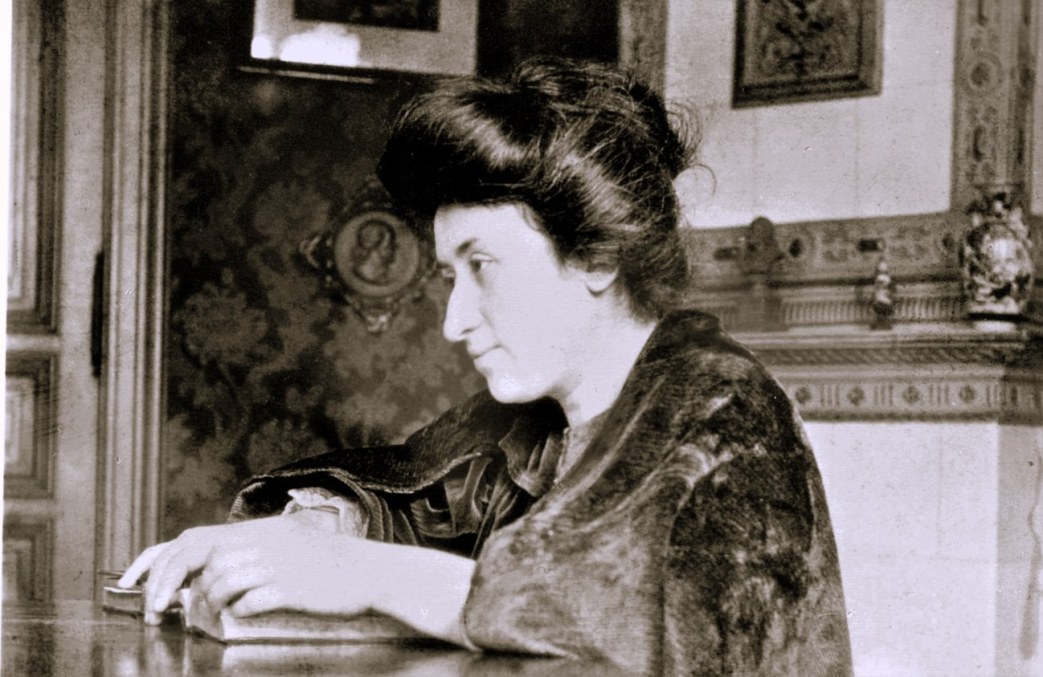
In August, 1904 Rosa Luxemburg began serving her first time in jail, Zwickau Prison, sentenced to two months for ‘offending the sovereign.’ A crime for which she felt no guilt. Here she writes to Luise Kautsky.
‘To Luise, From Zwickau Prison’ (1904) by Rosa Luxemburg from Letters to Karl and Luise Kautsky, 1896 to 1918. Edited by Luise Kautsy, Translated by Louis Lochner. Robert M. McBride and Company, New York. 1925.
Undated. Zwickau 04.
Dearest:1 Many thanks for Carl’s photo with the delightful dedication! The picture is excellent, the first really good portrait of him that I have seen. The eyes, the expression in the face — everything splendid. (Only the necktie, the necktie swarming with white beans, which fairly fascinate the eye! — a tie like that is reason for a divorce. Yes, yes, the women — even in the case of the most exalted spirit they notice the tie before everything else…) The picture gives me great pleasure. Yesterday the letter from grandmother arrived. She writes a dear message in order to cheer me up, but succeeds poorly in hiding her own depression. Give her my heartiest greetings; I hope she is in good spirits again; here at least there is the loveliest weather. It seems, however, that as soon as I am away, the whole world is at sixes and sevens. Is it true what I have read in the Tageblatt — has Franciscus resigned?!2 But that would be a debacle a triumph for the entire Fifth Estate. Was it not possible, to keep him from taking this step? The whole affair really upset me and depressed me. And you don’t even write me details about it, you terrible thing!
It is evening now, and a soft breeze is blowing into the cell from above through my dormer window. It touches my green lamp-shade lightly and softly turns the pages of my volume of Schiller, which lies opened before me. Beyond the prison a horse is being led home slowly, and its hoofs strike the pavement quietly and rhythmically in the stillness of the night. From afar, hardly audible, I hear the capricious notes of a mouth organ on which some cobbler’s apprentice, ambling by, is blowing a waltz. A line comes to my mind that I read somewhere recently: “Imbedded amid the treetops — lies your quiet little garden, — where the roses and carnations long have waited for your love — imbedded amid treetops — lies your little garden”…I don’t catch the meaning of these words; in fact, I don’t know whether they have any meaning, but, together with the breeze, which fondly strokes my hair, they rock me, as it were, and awaken queer feelings in me. This gentle breeze — this treacherous little thing — it beckons me to go far, far away, I don’t know myself where. Life is playing an everlasting game of hide-and-seek with me. I always have the feeling that life is not within me, not wherever I happen to be, but somewhere else, far away. Back at home, in my childhood, I used to sneak to the window in the earliest hours of the morning — it was strictly forbidden to arise before father — open it wide and peep out into the courtyard. To be sure, there was not much to be seen there. Everybody was still asleep, a cat walked gently on soft soles across the court, a couple of sparrows quarreled with each other, twittering insolently, and Long Antoni, clad in his short sheep-fur, which he wore summer and winter, stood at the pump, resting both his hands and his chin on the broomstick, deep reflection being writ upon his sleepy, unwashed face. This Antoni, you see, was a man of higher instincts. Every evening after the gate had been locked he sat in the hall-way on the bench that constituted his sleeping accommodations, and in the twilight of the lantern spelled out the official “Police News,” aloud, so that it sounded throughout the house like a subdued litany. He was guided by nothing save a pure interest in literature, for he did not understand a word and merely loved the letters for their own sake. Nevertheless it was not easy to satisfy him. When on one occasion, in response to his request for something to read, I gave him Lubbock’s “Beginnings of Civilization,” which I had just finished with a great effort as my first “serious” book, he returned it to me after two days, declaring that it was “no good.” For my part, it took me several years before I realized how right Antoni was. — Well then, Antoni used always to stand there for some time deeply lost in thought, after which, without any previous warning, he burst out into a quaking, crackling, far-resounding yawn, and this liberating yawn always meant: now the work begins. I can still hear the drawling, clacking tone emitted by the wet, crooked broom as Antoni drew it over the cobble stones and aesthetically and carefully drew delicate, even circles that looked like the fringe of Brussels lace along the border. His sweeping of the court was nothing short of a poem. And that was the nicest moment, too, before the empty, noisy, hammering life of the tenement house began. A consecrated stillness of the morning hour hovered over the triviality of the pavement, above in the window panes there glittered the early gold of the young sun, and high above there floated rosy-cheeked, dainty clouds before they disappeared in the grey heaven of the metropolis. At that time I had the firm conviction that “life,” “real” life was somewhere far away, beyond the roofs. Since then I have been traveling to find it. But it always hides behind some roof or other. Was it, after all, nothing but a hallucination, and has real life remained right there in the court, where we read the “Beginnings of Civilization” for the first time with Antoni?
I embrace you affectionately,
Rosetta.
The Basle “comedy” brought me real pleasure.3 Wullschlaeger,4 who receives the blessing from Rome, and beside him son excellence Millerand,5 who sings hymns of praise to Berlin!…What are those words of the old convent hymn: Et pro rege et pro papa bibunt vinum sine aqua. Cheerio! The world is getting more beautiful all the time!
NOTES
1. Up to now Rosa Luxemburg has used the more formal second person plural “Sie” when addressing the Kautskys. From now on she uses the familiar second person singular “Du.” Transl.
2. Franz Mehring, who in consequence of a quarrel had resigned the editorship of the “Leipziger Volkszeitung.” Trans.
3. Evidently refers to the fact that the International Association for Labor Legislation met in Basle (in 1904) and that at the end the Italian delegate, Soderini of Rome, thanked the Basle Government for the reception. L.K.
4. Wullschlaeger, a Swiss socialist and governmental counsellor in Berne. L.K.
5. Millerand had evidently—I have not been able to find this out exactly—said something complimentary to the German social policy. L.K.
Letters to Karl and Luise Kautsky from 1896 to 1918 by Rosa Luxemburg. Edited by Luise Kautsky, Translated by Louis Lochner. Robert M. McBride and Company, New York. 1925.
Contents: Introduction by Luise Kautsky, Beginnings, 1896-1899, Incipient Friendship1900-1904, From the Imprisonment at Zwickau to the First Russian Revolution, The First Russian Revolution 1905-06, Up to the World War 1907-1914, Letters from Prison During the War 1915-1918, Postscript by Luise Kautsky, Appendix: Biography of Karl Kautsky. 238 pages.
PDF of book: https://www.marxists.org/archive/luxemburg/posthumous/lettersofrosaluxemburg-1922.pdf
 Revolution's Newsstand