
This is, by far, the most substantial article I have come across in the time-frame of this project on the ecological crisis caused by capitalism and the deleterious effects of that degradation on workers, farmers, and the environment that sustains them. A comprehensive look at the human-caused reasons for modern flooding, its disastrous results, proposed capitalist solutions (always short-term, dependent on investment returns, and graft), and what a long-term solution based on conservation of natural resources and rational, holistic planning might entail. An important article that deserves a place in the canon of Communists considering ecology .
‘Flood Control’ by James Harmon from The Communist. Vol. 16 No. 6. June, 1937.
DEATH, destruction, chaos and despair have again ridden the flood waters of the Ohio River and its tributaries, a tragic prophecy of what may happen again next year. Floods are nothing new in the United States. DeSoto saw them when he discovered the Mississippi. And each generation since has seen them. Only in those historic times there were no lowland farms, towns, cities and centers of population and industry.
The floods of our generation challenge those of all history. The reason for floods are many, but they are not hard to find if we examine the historic development of westward expansion, and the plunder of the natural resources of the country by the ruling class and the total lack of any sort of plan regarding land utilization. The climax of this disregard of land planning has brought distress to millions. of croppers and tenant farmers.
As the flood waters recede, pious editorials and sensational headlines also recede and disappear. The work of flood prevention and control remains to be done just as in the previous years. The capitalist papers have taught that floods are a natural calamity, an act of God, like volcanic eruptions uncontrollable and beyond the power of man. However, there is nothing to support them in the works of competent technologists and scientists on the subject. Of course there is one exception, some of the editorials in the Engineering News Record, that technical organ of the bankers and industrialists. Sometimes the editorials disagree with the technical material that discusses methods of flood prevention and control.
The technical facts show that not only can floods be controlled, but there is a large measure of prevention within the power of man. It means the reclamation of natural resources, the stewardship of the social capital of America for the producers, the workers and small farmers only if they begin to speak and recognize their own class interests in the problem of conservation. The task of making effective a program of conservation is the task of the workers and farmers. It means solving the problems of the sharecropper tenant farmer, dust bowl farmer, of floods, of power utilization, and to this end all efforts should be united to make effective immediately the six-billion-dollar program of the Roosevelt administration.
The most usual floods, those of the past months and of Spring, 1936, are clearly caused by an overtaxing of the natural water courses. Thereafter, such floods are rated as floods either by reference to maximum gauge heights or to corresponding maximum rates of flow through the given channel. Our discussion is concerned with the type of flood defined above, those which ordinarily result from excessive rain or melting snow and ice or some combination of these circumstances.
FLOOD PREVENTION AND CONTROL
This problem is not one of engineering alone. In its broadest sense a scientist would consider it one of social relations, the relation of man to his habitat. If the scientist were a Marxist he would consider it one step higher, as a complicated problem in political economy and social planning of the highest order.
Morris L. Cooke, former Administrator of Rural Electrification Administration, has summarized the problem of conservation as:
“…maximum present and future benefit from the use of natural resources; maintenance of renewable resources at a level commensurate with the needs of society; prompt adjustments to the advance in technology; balancing of natural against human resources; harmonizing the objectives of conservation with conditions of the present and future economic order.”
The problem of flood control and prevention is a problem of conservation of the human and natural resources of our country.
Engineers not because of their choosing have not been concerned with a genuine integrated program that would offer a material solution to so pressing a problem as floods. There is, however, a splendid body of technical material that has accumulated through the work of the various agencies of the federal government in this field.
is necessary to have powerful progressive legislative blocs or a Farmer-Labor Party that would enact the necessary legislation and safeguards which would enable the toilers and the technicians to carry to fruition their programs against the wishes of the all-powerful industrial masters of the great utilities and mass production industry trusts.
An integrated program of flood control and prevention would include the control of soil erosion, prevention of sedimentation of reservoirs, providing water for domestic and industrial purposes and farm irrigation, especially in time of drought, reforestation, storage reservoirs, dikes, and cheap hydroelectric power. To the latter point the utility owners are devoting their chief barrage of injunctions and propaganda against government ownership and operation.
The approach to the technology of flood control and prevention can best be divided into two sections; first, upstream engineering, which would comprise all those methods of land treatment and soil conservation that would increase or restore the capacity of soils to absorb and infiltrate waters, and the retardation control of surface flowage of unabsorbed waters; the second part, downstream engineering, which is concerned with the control of powerful forces exerted by water; it includes great reservoirs and storage basins, spillways, dikes, and hydroelectric developments that should be the regular concomitant of this harnessed force.
The practice of the Army Engineering Corps, which does go per cent of the flood-control work, has been primarily a piecemeal job of downstream engineering without the necessary reforestation and soil-conservation program that must go to make a program complete and effective.
Urgency of upstream engineering flood prevention, with its central theme of erosion control, is more important than the problem of flood control and its engineering edifices which are rendered practically useless without it. The annual losses by soil erosion are far greater than of floods, $400,000,000 per year. The problem is less localized, the threatened result is the destruction of the most valuable farm lands and with it the whole complicated industrial economy that capitalism has built. Level lands, cultivated or uncultivated, have a minimum hazard in loss of top soil (of which there is generally only six to eight inches to produce crops) by the run-off and wash-off action of water. But, only 75,000,000 out of the necessary 350,000,000 acres of crop land of the United States fall within the classification of level lands. The nation is then dependent essentially upon sloping lands for cultivation, which must be protected.
At present, an area of about 100,000,000 acres of once fertile farm land has been ruined. This area is equal in size to Illinois, Ohio, Maryland and North Carolina combined. The prospect is that 100,000,000 acres still largely in cultivation are now gradually losing their top soil, and that another 100,000,000 acres of good land are now threatened. It will not stop unless the government stops shifting the burden to the individual farmer, because adequate treatment is beyond his economic ability and is not limited by farm, county or state boundaries. It is a national problem and cries for treatment as such.
The farmer in many cases has been pictured by the capitalist press as an ignoramus who does not understand his own technical problems. Farmers know what must be done to solve the erosion problem which they did not cause. The blame can be laid at the doorstep of the extreme greed of manufacturers anxious for markets and cheap raw materials, as well as the railroads and land speculators who helped promote the expansion west- ward. In this westward trek, forests were cut down and land unfit for crops was stripped of its grass cover. Lumber companies, mines, and railroads took part in the destruction. Rugged individualism ruled; social planning was unthinkable.

In April, 1936, Facts for Farmers said,
“Can the farmers afford the cost of erosion control? On the ten demonstration projects soon to be completed the average cost per acre came to $6.67; in Duck Creek, Texas, it amounted to $11.18 per acre. These figures understate the cost. They give an average cost per acre for the whole area covered and not just the eroded portion within the total area; they do not include maintenance costs or losses to the farmer of taking land out of production; and they do not include the cost of supplies, equipment and labor furnished by the C.C.C.
“…With small farmers fighting to ward off foreclosures they cannot afford to pay the cost of terracing, of building check dams, or of shifting from commercial crops to grass. Even the cost of strip cropping or contour furrowing is proportionately higher for smaller farmers who lack equipment necessary for economical operation.”
If erosion is allowed to go unheeded and unchecked, it will drive the farmers off the land and raise the price of food for the city workers and endanger the food supply of the nation.
The farmer in many cases has been degradation of the social capital of America goes forward at an increasing pace. The cumulative loss estimated by soil erosion specialists since 1900 is $10,000,000,000, enough to pay for three flood control and prevention programs on a full complete national scale. This sum does not include the annual damage resulting directly from floods.
Besides the direct threats of soil erosion to the economic life of the farmer, the food supply and the rendering inadequate of the downstream flood control engineering works, there is still another; it menaces the water supply storages of great industrial centers. The great cities of America are forced to go further and further away in order that a regular supply of water for domestic and manufacturing purposes may be had. Boston had to go sixty-two miles away to tap a stream. New York now brings part of its sup- ply over ninety-two miles away and plans now to go over 290 miles down to the Delaware Water Gap at an estimated cost of $392,000,000. The Hetchy-Hetchy Reservoir, built at a cost of $125,000,000, supplies part of San Francisco water from a distance of 200 miles.
To protect these very important and expensive reservoirs, large tracts of land must be protected in the various watersheds and basins. The protection means the proper vegetation and forests to bind the soil and provide the necessary return of organic compounds that make them more absorbent. The life of the reservoir, and in turn the material prosperity and existence of the population, are dependent on effective soil management and land utilization.
Water uncontrolled in its erosive action takes up the soil in fine particles called silt. Many of the storage reservoirs of the Southern Piedmont have been filled by silt to the top of the dam within less than thirty years. One major reservoir on the Colorado River in Texas was filled in the course of five years. The Elephant Butte Reservoir in New Mexico, estimated to have a life of 220 years at the present rate of silting, will be useless in times of protracted drought at the end of sixty years. And in Western Illinois and Iowa, railroads have had to raise tracks and bridges in accord with progressive building up of stream channels and valleys with erosive debris. This catalogue of destruction could go on to show hundreds of other examples of how the water supplies and the lands of our country are being squandered at a rate so startling that it surpasses any historic period, civilized or barbaric, and at a cost that is incredible by any system of accounting. The price of protection and conservation is only a very small fraction of the accelerated cost that the people must bear for the rapidly depreciating social capital, our lands and waters.
The great drought in the so-called “dust bowl” area has created an unenviable record in the annals of American agriculture. This drought has lasted for almost three years and reduced three-quarters of the farming population to a relief status. The dust storms that ravage the “dust bowl” and accompanied the drought have the closest relationship to the problem of water conservation in all its phases and to soil erosion. Because with the drought came that other dreaded enemy of the soil of the great grain and cereal plains; the wind.
Government reports showed that on May 11, 1934, the farmers of these areas watched wind whirl aloft to the sky “over 300,000,000 tons of the fertile topsoil”. The estimated annual loss is 3,000,000,000 tons of soil ravaged by wind and water. Consider then the position of the farmer whose sole capital in the land for productive purposes is the six to eight inches of top soil that swirl in the air, cutting off sunlight to a somber grayness, giving him dust pneumonia and asthma, and reducing him and his family to the status of serfs on relief.
The control and prevention of dust storms must take place within the realm of soil treatment itself. H.H. Bennett summed up the causes thusly:
“The enormous dust storms of the last two years were the result of an accumulation of circumstances, climaxed by several years of intense drought. Overgrazing, followed by mechanized cultivation of grain and the consequent destruction of natural sod cover, had bared the soil of the high plains. Then came the drought.”
Crop failure for several years bared the land completely of cover and a soil baked dry and powdered blew easily before ready winds.
In the limitless reservoir of the soil, in its ability to retain moisture, and by careful crop management, dust storms can be controlled. Expedient measures such as listing and clodding fallow fields are not lasting measures. A permanent solution of the dust storm problems calls for the conservation of moisture by soil and engineering structures so that it may be utilized in times of protracted drought. Such a plan calls for financial assistance by the government so that the farmer can take some of his land away from his income paying production and assign it to a cropping system that will keep vegetative cover almost continuously on the land. These provisions carried out at Dalhart, in the Texas Panhandle, by the Soil Conservation Service over an area of 20,000 acres produced complete control of wind erosion of the soil.
OBSTACLES IN THE WAY OF A COMPLETE FLOOD CONTROL AND PREVENTION PROGRAM
Ample evidence has been shown of the urgency and absolute necessity for entering into a long-term national pro- gram that will conserve our land and water resources. There has been much money spent on flood control, something like the sum of $1,500,000,000 in the last ten years. But in spite of vast expenditures these works have been of little avail to the waters that must flow steadily toward the sea; ask the farmers in the Ohio Valley and the workers in Louisville.
‘The Roosevelt administration at- tempted schemes to tinker with these fundamental problems of national re- sources, but with practically little or no success. The rulers of our country find themselves in a desperate position. If they don’t do something, it means that their own properties and holdings are endangered from year to year. Of course, they usually pass on the increased costs to the lowly consumer and worker; the small farmer and worker suffer most in these disasters.
All work that has been done to date, and that includes T.V.A., has been this careful crazy quilt patching so that the worker and farmer will bear the cost, while the banker’s interest, the industrialists’ and grain speculators’ prices, and the utility magnates’ rate structure will remain undisturbed. This is the nucleus of capitalist “planning”, conservation of the small group of exploiters at the expense and misery of the millions of workers and small farmers.
The Soil Conservation Service has determined the physical facts but cannot make them effective to protect the land. When the Supreme Court rejected the A.A.A., the Act was expanded to provide soil conservation if the farmer reduced his cash crop acreage. Such a set-up proved conclusively that it couldn’t fight soil erosion, be- cause its primary objective was to get around the Supreme Court decision. In practice, the county committees which administered the act were con- trolled by the large farmers and absentee corporation owners, who had now a better means than the old A.A.A. to drive the smaller farmer off the land.
The new “ever normal granary plan” offered by Secretary Wallace on February 8, 1937, before a group of national farm leaders is nothing more than a revival of the old A.A.A., plus the inadequate soil conservation benefits, plus a crop insurance plan which would go to the large landowners again the way the old A.A.A. curtailment benefits did.
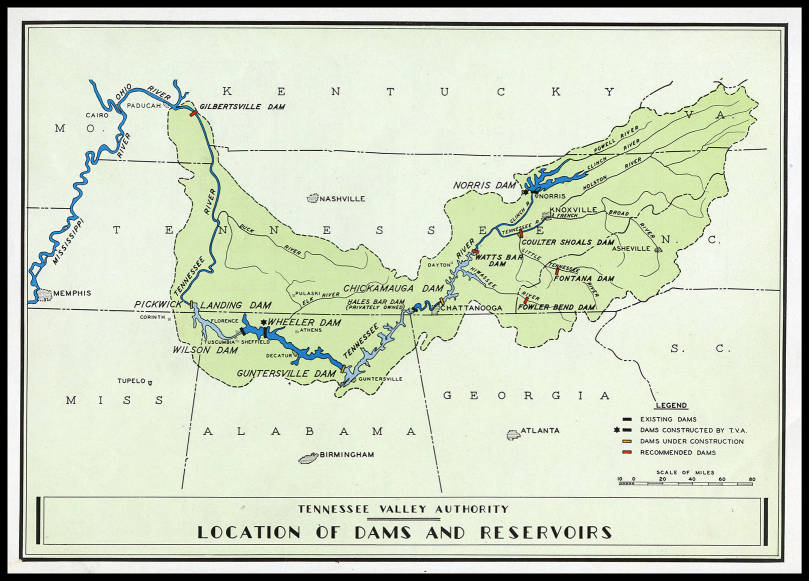
Many earnest and sincere people have pointed to the accomplishment of the Tennessee Valley Authority as a step toward “socialism”, a genuine at- tempt at social planning. It is true that T.V.A. represents an excellent indication of the great possibilities that the technical talent of America can achieve, but it certainly is not all that would-be “social planners” have boasted of. This project was initiated primarily for war purposes, the production of nitrates, but was extended later to include development of the entire watershed with hydroelectric power and its general conservation of water and land resources features. The Supreme Court decision upheld the T.V.A., not in any direction of conservation, but as a war baby.
The work of engineers in and around T.V.A. represented the best in scientific land utilization. To protect the watershed of the Norris Lake and Dam, T.V.A. acquired 100,000 acres of land and there carried out the whole range of scientific management of forestry, soil mechanics, and mining. Another aspect of T.V.A.’s rounded hydrologic program was the development of electricity by hydroelectric means. T.V.A. was going to challenge the utility magnates of the U.S.
When the eighty square miles of storage space for water of Norris Lake were cleared, T.V.A. created a new type of rural refugee. Every tree under the waterline was felled, bridges, churches, houses, schools and even graves were removed. And 4,000 families, about 20,000 people, were made to leave before the rising waters of the reservoir. The families that suffered most from this man-made flood were the tenants and the sharecroppers. Neither T.V.A. nor any other government agency made any substantial pro- vision for them. These people only lost the bare homes they had by the condemnation proceedings, they got no money. Consequently, they did not have the money to move far, and they have not the money to buy land. In any event, there is only submarginal land available around the dam. These tenant families must either squat on the very worst land which, incidentally, T.V.A. planned to retire from cultivation, or wander along like nomads.
What was the position of other workers, the forestry workers who were to maintain the watershed and raise the annual deficiency of timber above normal requirements? They were given houses and twenty-five acres of land at a modest rental and about 100 days of work in the forest at $2.50 to $3.50 per day. Their farming practices will be models for poor farmers. They are taught fireside industries to trade with each other or with the “outside” for cash. Gardens will yield 80 per cent of their food.
So, with this type of “planning”, we have a return to a colonial economy with wages at about $250 per year, less rental of house and land, less food not raised on the land, less farm and household appliances and medical expenses.
What about the ambitious power program? At present, the Commonwealth & Southern Power has obtained an injunction from Judge Gore at Nashville, Tenn., so sweeping that it prevents the extension of T.V.A. power lines to areas not even served by the utilities. And, meanwhile, the Authority itself is divided over just what policy to pursue. Doctor A. E. Morgan is pleading for friendly co-operation with the utilities and Mr. Lillienthal is practically ready to throw down the gauntlet and fight for cheap power for everyone in the territory administered by the Authority. There are other members of the committee with differences of opinion but these two represent the most important poles on which the policy must eventually see- saw, depending on who can exert the most pressure politically, the workers and farmers or the utilities.
While the small farmers and other members of the rural community are girding for the fight for cheap light and power, John C. Parker, Vice-President of the Consolidated Edison Company, told the winter session of the Convention of the American Institute of Electrical Engineers of his opposition to President Roosevelt’s electrification proposals. Mr. Parker was also critical of what he termed, “the current abnormal interest in power problems”. The power industry, he asserted, is being injured by “widespread and exaggerated enthusiasm” of those who are constantly urging the development and extension of electric power.
Yes, by their own admission, the power bosses are afraid of this great interest of the workers and farmers in the amount of money that they must pay tribute each month. Everybody hates a utility. The question of control of power will be a political fight in this country of the most stirring kind. There must be a showdown soon because of the development of other drainage basins such as Boulder Dam, Bonneville and Grand Coulee, all federal power projects.
SUMMARY OF FLOOD CONTROL AGENCIES
Of course, this problem has been recognized by past administrations at one time or another. A report last year by the Federation of Architects, Engineers, Chemists, and Technicians showed that there are at least eleven federal agencies that deal with some aspect of flood control. The most important of these, the one which spends the most money, is the Corps of Engineers, U.S. Army (civilian function). Each of them has done some work, and has made some contribution to the problem.
But it now remains to consolidate their function under one special agency that will be empowered to plan and carry out its work by the proper appropriations from Congress.
Appropriations are important; money goes a long way to make a pro- gram possible. Last year when the floods came there was (as there is this year) a flood of bills to remedy the whole situation. Famous last year was the billion-dollar omnibus flood control bill, which Congress abandoned at the request of the President for another bill calling for only $300,000,000 that would take care of immediate needs. This they passed but never appropriated the money. That is how the flood situation was remedied last year. What will the answer be this year?
This year the President has just sent the program of the National Resources Board to Congress. This program calls for an expenditure of $6,000,000,000 over a period of six years, with a lump sum annual appropriation under regular budget procedure for expenditures on approved projects. These projects, though, are to be timed for the time when the Board in control thinks that the “economic pump” needs to be primed. In the words of President Roosevelt, this is a long-range plan to provide the best use of our resources and to prepare in advance against any other emergency”. If such plan were to be courageously carried out, it would be necessary to appropriate $6,000,000,000 yearly over the whole six-year period.
The lack of scientific management of the natural resources of America must stand for all time as one of the greatest indictments of capitalism as a system of political economy. From a country wonderfully endowed with the richest of natural wealth, we are now facing a country that is being stripped bare, with floods mounting in intensity each year, and a farming class that is being reduced to serfdom. America, as no other country in the world today, represents a travesty of civilization; the most advanced capitalist technology with the wild flood waters putting out the fires in its great steel centers and the skyscrapers of its crowded cities standing cold, idle, deserted. These are the monuments to capitalist greed that is ravaging a country and its people.
We Communists have said many times how we love America for the beauty of its land and the strength and revolutionary tradition of its people. Then, we must take this responsibility and show the people how to fight for the preservation of America for themselves and their children. We can show what the planned greed of capitalism has wrought of America, the farmers’ and workers’ poverty, floods, dust storms, a denuded, cheerless countryside. The time is short. Competent technologists believe that we have less than twenty years to complete the task of conservation. Now is the time to begin to save America for the workers and farmers, for progress, plenty and peace.
There are a number of journals with this name in the history of the movement. This ‘Communist’ was the main theoretical journal of the Communist Party from 1927 until 1944. Its origins lie with the folding of The Liberator, Soviet Russia Pictorial, and Labor Herald together into Workers Monthly as the new unified Communist Party’s official cultural and discussion magazine in November, 1924. Workers Monthly became The Communist in March, 1927 and was also published monthly. The Communist contains the most thorough archive of the Communist Party’s positions and thinking during its run. The New Masses became the main cultural vehicle for the CP and the Communist, though it began with with more vibrancy and discussion, became increasingly an organ of Comintern and CP program. Over its run the tagline went from “A Theoretical Magazine for the Discussion of Revolutionary Problems” to “A Magazine of the Theory and Practice of Marxism-Leninism” to “A Marxist Magazine Devoted to Advancement of Democratic Thought and Action.” The aesthetic of the journal also changed dramatically over its years. Editors included Earl Browder, Alex Bittelman, Max Bedacht, and Bertram D. Wolfe.
PDF of full issue: https://www.marxists.org/history/usa/pubs/communist/v16n06-jun-1937-The-Communist.pdf
 Revolution's Newsstand