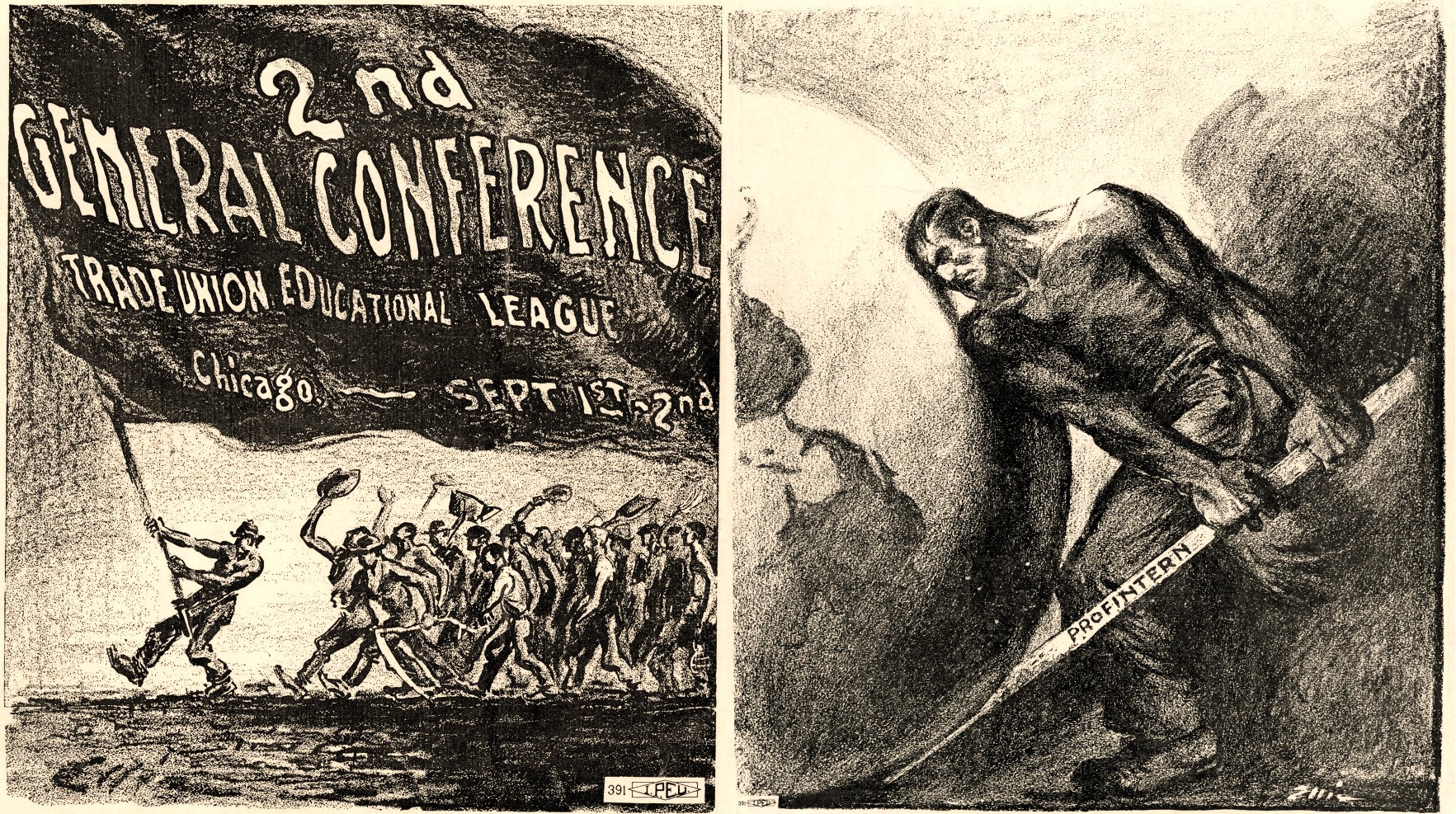
A valuable report on the first year of work to the Second General Conference of the Trade Union Educational League held in September, 1923 from its National Committee. The report covers the general situation, the amalgamation movements, the Farmer-Labor Party, district organizing, industrial committees, publications, the R.I.L.U., union militant conferences, solidarity and defense work, finances, and local constituent groups.
‘Report of the T.U.E.L. National Committee’ from Labor Herald. Vol. 2 No. 8. October, 1923.
THE past year has produced many proofs, positive and negative, that the Trade Union Educational League is a vitally necessary and highly effective movement. The negative proofs come from the bankrupt state of the trade union bureaucracy, which it totally unable to meet the present critical situation of the labor movement; while the positive proofs are furnished by the very successful work of the League.
In the report of the League’s National Secretary-Treasurer to the Second Congress of the R.I.L.U., it was pointed out that despite the return of industrial prosperity the badly-shattered labor movement could not regain the lost ground without far-reaching changes in tactics, structure, outlook, and leadership. The reasons urged being that the capitalists have so enormously strengthened their organization and taken on such a high degree of militancy in their “open shop” drive that the old-time methods of craft unionism are almost entirely useless. The experience of the past year has entirely borne out this forecast. Those who expected the trade unions to grow and become vigorous again with the return of good times, as has always been the case after previous periods of industrial depression, have been entirely disappointed. The whole movement is stagnant and paralysed. Save among a few skilled trades, it is not recovering appreciably. In fact, as a whole, it is probably going backward numerically, notwithstanding the “good times.” The masses are disillusioned with the old slogans and practices and will have none of them. The victorious employers reign supreme. With another industrial breakdown impending, the weakened, demoralized trade union movement faces the greatest crisis in its career.
In this desperately critical state of affairs, the old trade union leadership is totally bankrupt. It can neither think nor act in terms of the present situation. Amazed and demoralized, it sees the movement torn to pieces and knows not what to do to stop it. The one group in the labor movement that has anything constructive to offer is the body of left-wing militants organized in the Trade Union Educational League. The League’s program of amalgamation, labor party, a great organizing campaign, affiliation with the R.I.L.U., etc., alone furnishes the key to the situation. Its application is the one way through which the labor movement can rehabilitate itself and march forward to power and success.
The Amalgamation Movement
In carrying on its fight for progress, the League has been very active. Success has attended its efforts in almost every case. The launching and furtherance of the amalgamation movement is doubtless the greatest achievement. All the world, now knows of the 14 State Federations, 8 International Unions, and countless city central and local unions that have been won for the cause. The latest accomplishment was when the Lithographers’ International Union, a highly skilled craft union, endorsed amalgamation almost unanimously, basing its demand for one union in the printing trades upon the plan issued by the Amalgamation Committee of the Printing Trades. At least 2,000,000 trade unionists have declared for amalgamation since the League’s campaign began. It is the greatest industrial union drive in the history of the American labor movement. Amalgamation sentiment is everywhere. Beyond a doubt if a general referendum could be had on the subject, which the reactionaries will be careful to prevent, the organized workers would declare by an overwhelming majority for combining the craft unions into industrial organizations.
The rank and file of American Organized Labor has been won to the broad concept of industrial unionism. Now comes the harder task of giving organizational expression to this widespread demand for amalgamation. In this phase, we have to confront the most desperate resistance of the reactionary officialdom. They will leave absolutely no stone unturned to prevent the consolidation of the unions. This means that we must re- double our efforts. We must carry the fight to all the conventions of the international unions, and so shape our demands that the organizations are actually brought to consolidate. This latter phase of actually amalgamating the unions is much more difficult than the winning over of the rank and file to the principle of industrial unionism. We must devote the utmost energy to its accomplishment. The real effect of our work will be measured by the results we get on this score.
The Labor Party
The League has also achieved remarkable success in carrying on the campaign for a labor party, as promulgated by the First Conference of the T.U.E.L. We have raised this issue in unions all over the country. Great masses of the workers have been won over to a realization of the indispensability of political action. Happily, objective conditions in the political situation have rendered the workers especially receptive of the League’s program for a labor party. The greatest single effort the League made in this movement was to send out a referendum, together with an extended trade union statement of the need for a labor party, to 35,000 local unions of the broad trade union movement. This brought a tremendous response and was one of the principal factors in the organization of the July 3-4-5 Convention of the Farmer-Labor Party, which resulted in the foundation of the Federated Farmer-Labor Party. Since the latter’s formation, the League has given it whole-hearted support, and we urge that this be continued and intensified. The fate of all our industrial work depends upon the intelligence and vigor with which the campaign for a labor party is prosecuted.
Other Campaigns
Since the conference of the Eastern District, T.U.E.L., where the issue was raised, the League has been carrying on a militant movement to have the unions, local, state, and national, to start big organization campaigns to enroll the masses of unorganized. We are warning Organized Labor of the fatal mistake it will make if it allows the present favorable industrial situation to pass by without strengthening its ranks for the bitter “open shop” battle that will inevitably develop as soon as industry begins to slacken up again. This is one of the most vital features of our work and it must be carried on with the utmost diligence. The heart of our industrial program is represented by the slogan, Amalgamation and a Great Organizing Campaign.
In the movement to win the trade unions in favor of the United States Government recognizing Russia, the League has taken an active part. In every convention, its militants will be found working for this measure. Labor unions too numerous to mention have been won over. This movement is most promising and will in all likelihood be adopted by Organized Labor in spite of Gompers’ opposition. We must lend it every support. Its victory will deal a crushing blow to the old trade union bureaucracy.
Although the League has kept a steady pounding along that line, its campaign in favor of affiliation to the R.I.L.U. has been only moderately successful. This is largely because of the general isolation of the country as a whole and the labor movement in particular from European affairs. The best that could be done was to acquaint large numbers of workers with the broad principles of the R.I.L.U. But an exception must be made in the case of Canada; there the question of affiliation to the R.I.L.U. has been developed into an issue of first magnitude in the labor movement. Of this fact, the action of the Nova Scotia miners in voting to affiliate directly to the R.I.L.U., is but one proof of many that might be cited.
Organization of Districts
Following out the instructions of the First General Conference of the League, the National Committee has organized the four districts authorized: viz., Eastern, Central, Western, and Canadian. Unfortunately, however, because of lack of finances, the National Office has not been able to give the Districts the proper assistance. The Western District has been left entirely upon its own resources. Only moderate help has been given the others. Notwithstanding this, substantial achievements have been made, particularly in the Eastern and Canadian Districts. All things considered, the latter is the banner District. It is a real power in the Canadian labor movement. A prime aim of the League must be to maintain at least one paid organizer in each District. This is absolutely essential to the proper organization of our movement.
National Industrial Committees
Important progress has also been made in the organization of left-block committees in the basic industries. At present such committees exist in the following industries: railroad, coal mining, metal, building, food, printing, marine transport, tobacco, clothing, leather, and textile. All of them have printed programs and all are carrying on a systematic educational activity as best they can with their limited resources. They are the backbone of our movement and must be strengthened by every means possible. To this end, the National Committee makes the following recommendations, to be considered and acted upon by the Conferences of the various National Industrial Committees during the Second General Conference of the League:
1. Paid Secretaries: In order for the National Industrial Committees to be properly effective, their secretaries should be able to devote their full time to the work. This means they must be paid salaries, which can only be done by the militants in their respective industries. This matter should be given earnest attention.
2. Craft Sub-committees: In each important international union, there should be set up, as soon as practicable, a sub-committee. These craft sub-committees should work under the control and direction of the secretaries of the National Committees in their respective industries.
3. Local Industrial Groups: It is important that every National Industrial Committee have connections in all centers. Every stage of the League should see to it that the necessary local industrial groups are formed.
4. Programs and Bulletins: Every National Industrial Committee should have a printed program, not only relating to amalgamation, but to the whole pro- gram of the R.I.L.U. Each National Industrial Committee should also issue a bulletin regularly, no matter how small or modest this may be.
5. Finance: In order to get the necessary funds, the National Industrial Committees should push the sale of the Sustaining Fund Certificates. Under no circumstances should they collect any dues, per capita, or anything resembling the same.
Local General Groups
In many important industrial centers there are as yet no real functioning local general groups of the League, despite the fact that there are many revolutionaries in these centers. This is a deplorable and disgraceful state of affairs. It must be ended at once. Self styled militants must be gotten to function actively in the League or given to understand that they are non-militants. We have a great task of education and rejuvenation before us. This will require the closest co-operation of all progressive elements. To unify our forces so that we can exert the maximum influence on the labor movement is one of the very greatest problems confronting us. As one step towards solving it, we must have a living, functioning T.U.E.L. group in every industrial center.
Publications
The success of our efforts depends very largely upon the amount of printed matter that we are able to place in the hands of the workers. We must concentrate our efforts upon extending the circulation of THE LABOR HERALD. As yet, it is badly neglected and poorly organized in many centers. This should be attended to at once and the distribution of THE LABOR HERALD established upon an organized basis. Every local general group should take a large bundle monthly, which should be apportioned out to the various local industrial groups. All friendly unions should become individual subscribers. All accessible trade unions should be covered monthly by the local literature agent to secure subscriptions and individual sales. We must build up THE LABOR HERALD.
A particularly dynamic part of our literature system is the industrial programs. Dealing specifically with amalgamation and other burning issues, they are especially effective and no pains should be spared to give them the widest possible circulation. The same is true of the bulletins in the respective industries. They are the one effective means we have of acquainting the workers with the solution of their real problems.
During the past year, the League has published the following pamphlets: “Amalgamation,” by Jay Fox; “The Bankruptcy of the American Labor Movement,” by Wm. Z. Foster; “The Resolutions and Decisions of the Second World Congress of the R.I.L.U.”; and “The Russian Trade Unions in 1923,” by A. Tomsky. Wide circulation should be given these, as well as the other pamphlets of the League. We should aim at having at least one good pamphlet for each industry dealing with the problems of that industry, and also a pamphlet on each of the broad issues confronting Labor. A most important event for us is the launching of a daily paper by the Workers’ Party. This paper will actively support all the work of the League for amalgamation, labor party, recognition of Russia, revolutionary education, etc. Therefore, we must give it our heartiest co-operation. The League should make it a special order of business everywhere to see to it that the proposed revolutionary workers daily is a success.
Conferences of Militants
Since the First General Conference, many important conferences of militants have taken place. The most significant of these was that of the railroad workers in Chicago in December, 1922. Over 425 delegates, from all over the country, were in attendance. This definitely placed the amalgamation movement on foot in the railroad industry. Another vital conference was that of the Progressive Miners’ International Committee in Pittsburgh, June 2-3. Delegates, numbering 200, came from a dozen districts of the U.M.W.A., and launched the great left-wing movement now developing among the miners. Still another very important national industrial conference was that of the Needle Trades Section of the T.U.E.L. in New York, May 5-6, where these militants mapped out a whole revolutionary program for their industry. At the same time and place, conferences were also held of the textile workers and the Eastern District of the T.U.E.L. On May 13th, a week later, the shoe and leather workers had a very successful national industrial conference, drawing up plans of amalgamation and a general program of activity for the militants in that industry. On Aug. 4-5, the Eastern Section of the Canadian District held a conference. Some 40 delegates, from as many different centers, were present. In September, the Western Section of the Canadian District will hold its conference. Such conferences of industrial sections and districts are very valuable and should be held whenever circumstances permit.
Red International Committee
In order that full co-operation may be established among the revolutionary elements wherever they may find themselves, in independent unions or A.F. of L. organizations, the Red International Committee has been organized. This has been formed in harmony with the decisions of the Second Congress of the R.I.L.U. A full statement of the Principles and Rules of the R.I.C. will be found in the August, 1923 number of THE LABOR HERALD, and is appended herewith. This should be considered by the Conference. We recommend the adoption of the Rules and accompanying statements.
The question of the relationship to the independent unions is one of prime importance to the League. It is absolutely necessary that the militants within the in- dependent organizations work in full harmony with those inside the A.F. of L., so that all groups may co-operate together towards the creation of a real united front of Labor. Many people seem to have the notion that the League waves aside as superfluous the various independent unions. This is altogether erroneous. The League supports genuine mass organization wherever it finds it, always seeking to combine by amalgamation the various labor fragments in a given industry. In the April, 1923, number of THE LABOR HERALD there is contained a statement of the National Committee on this general subject. It is attached hereto. This also should be considered by the Conference and either approved, rejected, or modified. We recommend its adoption.
Defense Work
In the past year the League has done its fair share of defending class-war prisoners, particularly those arrested in Michigan. Much still remains to be done, however. Mooney and Billings, innocent victims of a dastardly frame-up, are wasting their lives in California jails; Sacco and Vanzetti are still imprisoned in Massachusetts and Jacob Dolla in Pennsylvania; J.B. McNamara and Matt Schmidt are still in San Quentin, jailed for their activities in the historic struggle of the Structural Iron Workers; while hundreds of I.W.W.’s, too numerous to mention by name, are jailed all over the country. In the battle to free these militants, the League must take an ever-more active part. We must allow no partisan or factional considerations to stand in our way. Wherever a militant is arrested for class activities, we must give him, regardless of his ideas or affiliations, our heartiest assistance. Any policy less broad than this would be a discredit to our organization and a betrayal of Labor’s cause.
Finance
As usual with revolutionary organizations, one of the supreme problems of the League is to finance its activities adequately. As yet, our income is altogether insufficient to meet the demands being made upon us. The national and local Leagues must give this fact their earnest consideration. One means recommended to relieve this urgency is to give a widespread sale to the Sustaining Fund Certificates. Every participant and sympathizer of the League should be secured as a contributor to this very necessary Fund. Another helpful financial measure will be for each local general group to hold at least one picnic in the summer and one entertainment or dance in the winter on behalf of the National League. If these two plans are carried out vigorously, the League will have sufficient funds to prosecute its task in the manner necessary if we are to accomplish our real mission. Below is the financial statement for the year:
In conclusion, we bid the militants to go with good heart and determination to the coming year’s work. Although the situation may seem dark and gloomy, with our whole trade union leadership in a state of bankruptcy and the working masses totally demoralized, still gleams of light may be discovered streaming through the overhanging pall of gloom. These hopeful signs are the movements now being pushed by the Trade Union Educational League; the drives for amalgamation, a labor party, recognition of Soviet Russia, and the rest. Let us, therefore, plunge into the work ahead of us with renewed enthusiasm, confident in our ability as militants and with undying faith in the power of the working class finally to free itself from the myriad chains now holding it in slavery,
Fraternally submitted,
National Committee.
The Labor Herald was the monthly publication of the Trade Union Educational League (TUEL), in immensely important link between the IWW of the 1910s and the CIO of the 1930s. It was begun by veteran labor organizer and Communist leader William Z. Foster in 1920 as an attempt to unite militants within various unions while continuing the industrial unionism tradition of the IWW, though it was opposed to “dual unionism” and favored the formation of a Labor Party. Although it would become financially supported by the Communist International and Communist Party of America, it remained autonomous, was a network and not a membership organization, and included many radicals outside the Communist Party. In 1924 Labor Herald was folded into Workers Monthly, an explicitly Party organ and in 1927 ‘Labor Unity’ became the organ of a now CP dominated TUEL. In 1929 and the turn towards Red Unions in the Third Period, TUEL was wound up and replaced by the Trade Union Unity League, a section of the Red International of Labor Unions (Profitern) and continued to publish Labor Unity until 1935. Labor Herald remains an important labor-orientated journal by revolutionaries in US left history and would be referenced by activists, along with TUEL, along after it’s heyday.
Link to PDF of full issue: https://www.marxists.org/history/usa/pubs/laborherald/v2n08-oct-1923.pdf
 Revolution's Newsstand