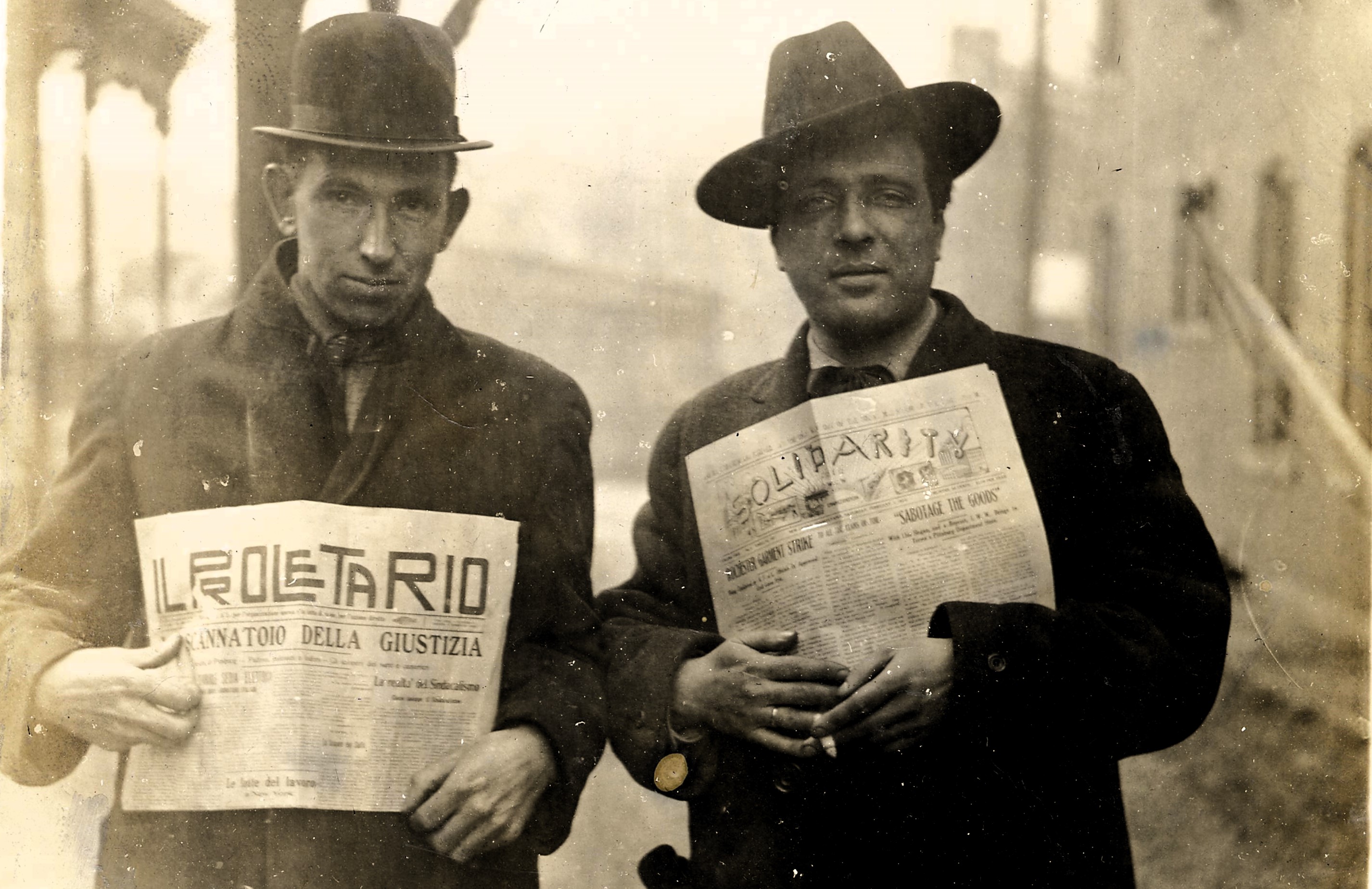
That Ireland’s 1916 Rising against British rule occurred during the first World War as millions marched to their deaths in the name of a murderous nationalism, caused many on the U.S. left at first to doubt its progressive, its revolutionary, nature. Not so Arturo Giovannitti. Perhaps drawing on Italy’s past radical national movement, perhaps because of his own experience as a political prisoner facing the death penalty, the revolutionary poet and labor activist immediately found himself understanding and in sympathy.
‘Ireland and the Social Revolution’ by Arturo Giovannitti from The Masses. Vol. 8 No. 10. August, 1916.
THE Irish revolution, which has just come to a tragic end, or perhaps has just begun, has been denounced from many quarters and many viewpoints, both in print and by word of mouth, even by men and women who in time of peace abroad and tranquility at home love to style themselves as social revolutionists.
It is to the latter, more than to the acknowledged and avowed conservatives that I wish to present the case of the Irish Rebellion of last month and discuss briefly the theoretical effects of national revolutions upon the class struggle of the proletariat. Many of my Socialist friends have seen fit to remind me that the only revolution worth while is the one which aims at the expropriation of the capitalist class, and that all other uprisings are futile and childish, whenever they are not altogether reactionary; thereby smilingly inferring that my Irish sympathies were out of tune with my ideas of internationalism.
Now, I am not one of those who have a purely emotional and sentimental interest in revolutions, nor do I sympathize with all sorts of insurrections solely because they imply discontent and revolt against an oppressive government (not even reactionaries rise violently against anything that is not oppressive or contrary to their interests); but I do firmly believe that any direct effort of a people to overthrow an objectionable state of affairs, whether of a political or an economic order, is another step towards the ultimate establishment of a real human society through the dictatorship of the proletariat.
In this respect it seems to me that these friends of mine who refuse to interpret the Irish Rebellion as the initial step of the Irish proletariat towards their economic emancipation, make the same mistake Marx and Bakunine made when they frowned upon the activities of Mazzini and Blanqui, the two arch-conspirators of all times, solely because their social ideas were strongly seasoned with nationalistic passion. My ultra radical friends seem to forget that the very conception of the social revolution developed out of national aspirations and inspirations, and that the International itself was the spurious child of another European conflagration, in just as crucial a turning point in history as the present one.
It is, indeed, quite easy to find out that, whereas the labor movement, as a definite organized effort of the workers to improve their conditions, rose autogeneticaly out of situations and circumstances of a purely economic nature, as a part of the struggle for existence transported from the biological to the social field; the concept of the revolution as a conscious spiritual aspiration towards an ultimate state of society, was engendered by a series of popular upheavals against foreign oppressors before it became an organized move against the internal ones. After all democracy in its origin was nothing but a reverberation within of a struggle that moved outwardly, in the sense that in the great majority of cases the struggle against the tyrant originated as the struggle against the intruder and the stranger. In no instance, moreover, was internal political freedom obtained, unless national autonomy and self-government had first been established. The idea of a free commonwealth is not compatible with that of submission to foreign rule or even foreign paternalism, there being a contradiction in terms between democracy and acquiescence to outside influences, even though those influences might be apparently working for the common good. Whenever the nation does not yet exist, the appearance of the idea of nationality implies a greater social consciousness, a larger spirit of solidarity and an aspiration towards a superior form of justice.
It is, then, quite safe to assume in this respect that the war of the classes cannot take a direct form of overt combat for the supremacy of a given economic category within a certain nation, unless that nation has first become an established unit.
The classes exist only in potential when a life-and-death struggle for national recognition goes on–in order to be well delineated they presuppose national unity and the elimination of all problems that, whether real or fictitious, are the equal concern of all social and economic aggregates. There is no class war in times of great national distress, such as famines, earthquakes, plagues and even wars, nor can a violent struggle of the proletariat against the ruling classes be expected when that national distress takes the form of universal resentment against over- bearing outsiders. If there is a class war, then the ruling classes are attacked only in so far as they represent foreign domination or to the extent they have sought its protection and recognized it, that is, whenever they are suspected of being unpatriotic. I know of no instance in which the wealthy classes of a subjugated nation were set upon by the proletariat when they stood out for the national ideal, even though their exploitation of labor was not lesser than that of other capitalists in free autonomous countries.
In plainer words, the classes do not become distinct from each other and respectively counteractive in their separate economic fields, unless they have first become completely dissociated from each other, a thing they cannot do when they are bound by a common ideal that is realizable only by their mutual co-operation. The truth of this assertion is to be found in the fact that whereas the interests of employers and employees are divergent and opposite the world over, only in nations where national homogeneity and political unity have been effected, a class-conscious revolutionary movement of the workers takes place.
The International, which properly originated in France and Germany–two countries which had enjoyed national independence for centuries–could not gain any foothold in Italy until that country had become unified and the political dream had been realized and tested; nor could the trade union movement become a factor in the civic life of America, until the union of the States had again been reestablished.
On the other hand, when the national feeling overbrims the national boundaries and becomes aggressive and actuated by a spirit of conquest, as is practically the case with England (a world-empire), and ideologically with Germany, the revolutionary incentive as a force of internal transformation, is considerably attenuated, if not altogether nullified. Further still, all nations that never resented foreign invasion and dominion are entirely devoid of any revolutionary feelings. (Canada, Lapland, Lithuania, Ukrainia, and, to a greater extent that it is commonly believed, Australia.)
If this contention is true, as I believe, it follows that discarding all wars of aggression and expansion as another and perhaps a greater deterrent of the revolutionary spirit, revolutions are the outgrowth of a surpassed national strife for autonomy, and that whenever that strife takes place, it is followed by a more or less radical reconstruction towards a larger form of democracy. Moreover, whenever a nation frees itself from foreign rule by a direct struggle of its people, that nation instinctively and fatally assumes that form of government which is most consistent with the spirit of its times, there being a strong current of sympathy between established democracies and any and all forms of revolution. The expulsion of the Manchu from China foreboded unmistakably a Chinese republic, rather than an empire. The same was the case with Portugal. An Irish monarchy is inconceivable, as inconceivable as an American empire. If we had an Italian monarchy it was due to the fact that Italy was finally unified by a king-made war, while the people’s movement there was strongly republican. Likewise the Norwegian monarchy rose out of secession permitted and even encouraged by the ruling house of Sweden, without a shot being fired. The single exception was of Turkey is such only apparently, for in that case the revolution was partizan in character, rather than national.
This notion, which apparently controverts the Marxian theory that the movement of the workers issues from their economic conditions and the desire to control them, rather than out of pure spiritual leanings and aspirations, proves that no revolutions surge up automatically, but that they are rather colligated to each other by a sort of lineal genealogy, to the extent that where there have been no previous successful revolutions it is extremely hard to transplant the notion of the proletarian one. This explains the lack of a true and proper socialist movement in Ireland, as well as Canada and other places which the reader will discover by surveying mentally the map of the world.
There is, for instance, no reason why the agricultural workers of Minnesota should be less class conscious than those of North Italy, nor is there a reason why the railway men of America shouldn’t come up to the militancy of their French fellow workers, from the viewpoint of pure economic conditions. But the reason becomes apparent at once if we consider that while the former are still grappling with the problem of national homogeneity aggravated by the influx of foreign labor (even immigrants are to a certain extent considered as invaders), the latter have definitely settled that problem, or at least they had settled it before the present war injected new national issues.
At the same time, so far as nationalism holds out any hope, however delusive it may be and finally prove, of social, political and economic betterment, the working people, following the course of least effort, will instinctively associate themselves with the larger numbers, that is with their fellow citizens, rather than with their fellow workers. The national idea is an experience which every people must go through before they realize its futility. The experience of other nations will not act as a caution or deterrent.
It is, therefore, from the strict viewpoint of the revolution of the workers, that Socialists, Anarchists, Syndicalists and radicals must look with sympathy on and encourage and even aid the present uprising of the Irish people, keeping well in mind that whatever revolution takes place in the world today, and whatever its aims, it cannot fail to embody to a greater or larger measure a part of the economic program of the workers’ movement. All popular uprisings, as we have stated before, are fatally bound to come up to the most advanced social and economic notions of the times, no matter what their original motives may be. There are, indeed, no reactionary revolutions and no unjust ones. The battering down of any old system implies the establishment of the most modern one. Those who don’t believe it had better read the Irish proclamation of Independence, and they will find that the signers of it have proclaimed at least one ultra-modern measure–equal suffrage–which has not yet been established in any of the democratic and semi-socialist nations of the world. It is equally presumable that the Irish Republic would not have an upper house of Congress, as there are no Irish Lords in the English sense of the word, the big landowners of Ireland being considered as “foreigners,” and therefore enemies to be counted out.
Like Mexico, Ireland would have to face the agrarian problem as the most important phase of its national construction, and it is logical to foresee that it would deal with it in a revolutionary manner. Further still, being more or less bound to recognize and take into account all elements which would fight the revolution, it could not very well ignore in its constitution the labor element which, such being the millennium traditions of the proletariat. will have been the most important factor in it.
The struggle of the classes in Ireland cannot be brought to the surface in any other way. The enemies at home cannot be discovered while everybody is focusing his attention and training his gun on the enemy abroad. What is true of France and other European countries in this time of war, is equally true of Ireland in this time of national crisis. There cannot be any Socialism in France while the Germans are there, nor can there be a revolutionary movement in Ireland till the English rule has been destroyed. The Irish Republic must be.
The Masses was among the most important, and best, radical journals of 20th century America. It was started in 1911 as an illustrated socialist monthly by Dutch immigrant Piet Vlag, who shortly left the magazine. It was then edited by Max Eastman who wrote in his first editorial: “A Free Magazine — This magazine is owned and published cooperatively by its editors. It has no dividends to pay, and nobody is trying to make money out of it. A revolutionary and not a reform magazine; a magazine with a sense of humour and no respect for the respectable; frank; arrogant; impertinent; searching for true causes; a magazine directed against rigidity and dogma wherever it is found; printing what is too naked or true for a money-making press; a magazine whose final policy is to do as it pleases and conciliate nobody, not even its readers — There is a field for this publication in America. Help us to find it.” The Masses successfully combined arts and politics and was the voice of urban, cosmopolitan, liberatory socialism. It became the leading anti-war voice in the run-up to World War One and helped to popularize industrial unions and support of workers strikes. It was sexually and culturally emancipatory, which placed it both politically and socially and odds the leadership of the Socialist Party, which also found support in its pages. The art, art criticism, and literature it featured was all imbued with its, increasing, radicalism. Floyd Dell was it literature editor and saw to the publication of important works and writers. Its radicalism and anti-war stance brought Federal charges against its editors for attempting to disrupt conscription during World War One which closed the paper in 1917. The editors returned in early 1918 with the adopted the name of William Lloyd Garrison’s The Liberator, which continued the interest in culture and the arts as well as the aesthetic of The Masses/ Contributors to this essential publication of the US left included: Sherwood Anderson, Cornelia Barns, George Bellows, Louise Bryant, Arthur B. Davies, Dorothy Day, Floyd Dell, Max Eastman, Wanda Gag, Jack London, Amy Lowell, Mabel Dodge Luhan, Inez Milholland, Robert Minor, John Reed, Boardman Robinson, Carl Sandburg, John French Sloan, Upton Sinclair, Louis Untermeyer, Mary Heaton Vorse, and Art Young.
PDF of full issue: https://www.marxists.org/history/usa/pubs/masses/issues/tamiment/t64-v08n10-m62-aug-1916.pdf
 Revolution's Newsstand