
One year after the Revolution, and the understanding that October was both a part of, and dependent on, the international revolution was paramount in the thinking of the Bolsheviks. For the Soviets to survive, the imperialists must not only face the determined bayonets of the Red Army, but their own insurgent working class. In this address delivered before the All-Russian Soviet Executive Committee of October 22, 1918–just days before the German revolution exploded–Lenin survey’s Europe emerging revolutionary foment as the cataclysmic World War comes to an end.
‘The International Revolution’ by N. Lenin The Proletarian Revolution in Russia by N. Lenin and Leon Trotzky with Louis C. Fraina. Communist Press Publishers, New York City. October, 1918.
I believe our present situation, despite ail the contradictions it contains, can be characterized by two theses: First, that we never before stood so near to the international proletarian revolution as at present; second, that we on the other hand never found ourselves in a more dangerous position than now.
And the most serious part of our situation consists in the fact that the broad masses of the people are hardly aware of the danger that menaces us. Therefore, it must be one of the principal tasks of the Soviet representatives to make the present situation entirely clear to the broad masses— no matter how difficult this task may sometimes be. The weightiest objection that was raised against the Soviet Government, not only by the bourgeoisie but also from the ranks of the lower middle class that had lost faith in Socialism, was that we allegedly had begun the Socialist revolution in Russia in reckless manner, as the revolution in Western Europe was not yet due.
Comrades, now in the fifth year of the world war the general collapse of Imperialism is an evident fact; now it is clear that the revolution in all the belligerent countries is unavoidable. We, however, whose existence at the beginning was counted by days or weeks, at the most, have done more in this year of the revolution than ever has been done by any other proletarian party in the world. The bourgeoisie no longer denies that Bolshevism is now an international phenomenon. Of course, you know that the revolution has broken out in Bulgaria and that the Bulgarian soldiers are organising councils, or Soviets, after the Russian model. Now comes the news that similar Soviets are in the process of being organized also in Serbia. The national bourgeoisie of the various small States of Austria will not be able to hold out. In Austria, too the revolution of the workers and peasants is knocking at the door everywhere.
In Germany the press already talks openly of the abdication of the Kaiser and the Independent Social Democratic Party now dares to speak of the German republic. This certainly means something! The German revolution is already a fact. The military party talks about it openly. In East Prussia revolutionary committees have been formed; revolutionary slogans are being uttered. The Scheidemann gang will not remain at the helm very long; It does not represent the broad masses of the people.
So far as Italy is concerned, the revolutionary sentiment of the proletariat of that country is evident to us. When Gompers, the social patriot who has turned himself over to the bourgeoisie, visited the cities of Italy and preached patriotism to the workers, he was hissed out everywhere. During the war the Italian Socialist Party has taken a big step toward the Left. In France at the beginning of the war the number of patriots among the workers was only too great, for it was declared that the soil of France and Paris was menaced. But there, too, the attitude of the proletariat is changing. When a letter was read to the last convention telling what mischief the Entente was up to in Russia there were shouts of “Long live the Russian Socialist Republic” and “Long live the Soviets!” Yesterday we got word that at a meeting held in Paris 3,000 metal workers greeted the Soviet Republic.
And in England it is true that the so-called Independent Labor Party has not openly entered into an alliance with the Bolsheviki, but its sympathies for us are constantly on the increase. The Socialist Labor Parties of Scotland have even come out openly for the Bolsheviki.
This fact looms up before us entirely on its own initiative: Bolshevism has become a world theory and the tactics of the international proletariat. And the workingmen of all countries who formerly read only the lying and calumnious articles and news reports of the bourgeois press, are now beginning to take stock of what is happening in Russia. And when last Wednesday a demonstration took place in Berlin, and the workers—in order to show their ill-will toward the Kaiser—wanted to march in front of his palace, they then went to the Russian Embassy in order thus to announce their solidarity with the facts of the Russian Proletarian Government.
So, Europe has got this far in the fifth year of the war. Therefore, we also declare that we were never so near to the world-wide revolution as we are today. Our allies are millions and millions of proletarians in all the countries of the world. But for all that, I repeat that our situation never before was so precarious as it is at present, because in Europe, as well as in America, Bolshevism is being reckoned with as a world power and a world danger.
Immediately following the conclusion of the peace of violence (Brest-Litovsk) we began the positive work of building up the Socialist republic. As soon as we gave an opportunity to the peasants actually to get along without the land owners, and a chance to the industrial workers to arrange their own life without the capitalists, as soon as the people understood that it could manage the State itself, without slavery and exploitation, then it became clear to everyone, and also manifested itself in practice, that no power and no counter-revolution in the world would be able to overthrow the Soviet power, i.e., the government of the workers and peasants. It required many months for us to come to this conviction in Russia.
In the cities the revolution began to consolidate itself already in November, 1917, but in the country it did not do so until the Summer of 1918. In the Ukraine, on the Don, and in various other places, the peasants have had occasion to feel the power of the Constituents and the Csecho-Slovaks in their own affairs. This required many, many months, but our agricultural population comes out of the struggle hardened. The peasants finally became aware of the danger menacing them from the side of the capitalists and the land owners, but were not frightened, and merely said to themselves: “We have learned much in a single year, but we shall learn still more.”
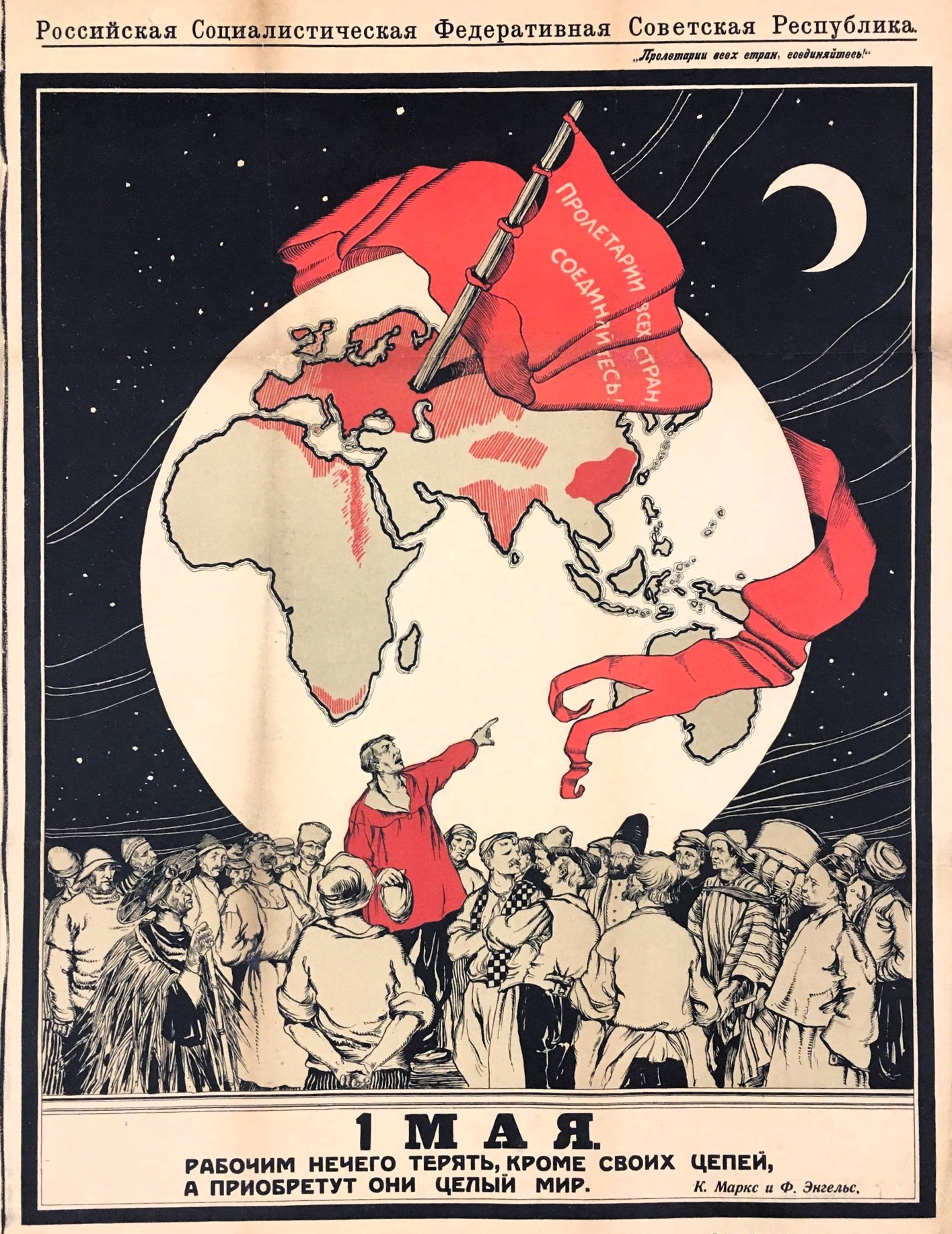
The West European bourgeoisie, that up to now has not taken the Bolsheviki seriously, is now becoming aware that in Russia a power has arisen and stands there alone which is able to arouse true heroism and a genuine spirit of self-sacrifice in the masses. When this proletarian power began to infect Europe the bourgeoisie of the world noted that it, too, must reckon with this enemy. And so the bourgeoisie began to unite more closely in proportion as we drew nearer to the proletarian world revolution which flared up, now here, now there.
Now the situation for us, for the Russia of the Soviets, has changed and events are following their course at a quickened pace. Before, we had to deal with two groups of imperialistic robber States, that were striving to destroy each other. But now they have noticed, especially by the example of German Imperialism, that their principal enemy is the revolutionary proletariat. By reason of this fact a new danger for us has now arisen, a danger that as yet has not quite unfolded itself, and is not yet fully visible, the danger that the Anglo-French Imperialists are quietly preparing for us. We must keep this danger clearly before our eyes so that we, with the aid of the leaders of the masses, with the help of the representatives of the workers and peasants, may make the broad masses of the people aware of this danger.
In German Government circles we may now observe two lines of thought, two plans for salvation, as it were, if there can be any talk at all of salvation. One group says: “We want to gain time and hold out until Spring; perhaps we may succeed in winning by arms!” The other says that it is of the greatest importance to arrive at an agreement with England and France at the expense of the Bolsheviki. In this connection one might believe that between the English and French on the one side, and Germany on the other a tacit agreement something like this exists: ”Don’t you Germans leave the Ukraine so long as we have not arrived there. See to it that the Bolsheviki don’t get in, then everything else will be adjusted.” And the Germans take great care to do so, for they know that for proved service they, too, will get some of the loot.
That is the judgement of the Anglo-French imperialists, for they very well understand that the bourgeoisie of the occupied districts—Finland, the Ukraine, or Poland—will not be able to hold its ground a single day after the withdrawal of the German garrisons. And the bourgeoisie of these countries who only yesterday sold their territory to the Germans, are today offering their fatherland to the English and the French. This conspiracy of the bourgeoisie of all countries against the revolutionary workers and the Bolsheviki is constantly becoming more clearly outlined and becomes cynically apparent. So it is our direct duty to point out this danger to the workers and peasants of all the belligerent countries.
But for us, comrades, the German revolution is favorable. Considering the power and the degree of organisation of the German proletariat we may believe that the German revolution will develop such power and will be so well organized that it will solve a hundred international problems. Only we must know how to march in line with the German revolution, not to run ahead of it and injure it, but to help it. And our comrades, the communists of the Ukraine, must bear this in mind. Our principal work must be carrying on propaganda, but a daring, persistent propaganda.
We must not forget that Germany forms the most important link in the revolutionary chain. The success of the world revolution depends to the greatest degree upon Germany. We must not fail to consider the changes and excrescences accompanying every revolution. To every country the revolution follows its particular ways and these ways are so different and tortuous that in many countries the revolution can be delayed one or two years. Every country must pass through definite political stages in order to arrive at the very same point—the inevitable proletarian revolution. And although the international proletariat is now awakening and making important progress, we must confess that our position is particularly difficult because our enemies direct their attacks against us as their principal enemy. Now they are preparing to fight, not against the hostile armies, but against international Bolshevism.
We must direct our entire attention at present to our southern front, where the fate, not only of Russia, but also of the international revolution, is to be decided. We have many prospects of victory. But what favors most of all is the fact that a change has taken place in the popular feeling. The people have grasped the fact that in defending Soviet Russia it is not defending the interests of the capitalists, but its own interests, its own country and desires, its factories and shops, its life and liberty. The discipline of the Red Army is gaining, but it is not a discipline of the club, but the discipline of Socialism, the discipline of a society of equals.
The army is turning out thousands of officers who have gone through the course of study in the new proletarian military schools, and other thousands who have only gone through the hard school of war itself. Our southern front is the front against the whole Anglo-French Imperialism, against the most important opponent we have in the world. But we do not fear this opponent, for we know that it will soon face the struggle with its “internal enemy.” Three months ago it was said that only the half-crazy Bolsheviki could believe in the German revolution; but today we see how in the course of a few months Germany has changed from a mighty empire to a rotten tree trunk. The force that has overthrown Germany is also working in England. It is only weak today, but with every step that the English and French advance in Russia this force will steadily rise to power and will even become more terrible than the Spanish influenza.
The seriousness of the situation must be apparent to every worker who knows what he is aiming at and he must make the masses see it, too. The mass of workers and peasants is mature enough to be allowed to know the whole truth. The danger is great, but we must, and shall overcome it. and for this purpose we must develop and solidify the Red Army without halting. We must make it ten times as strong and large as it is. Our forces must grow with every day, and this constant growth will give us the guarantee, as before, that international Socialism will be the victor.
[Lenin’s speech was greeted with tremendous enthusiasm, and a resolution was passed embodying his recommendations.]
The Proletarian Revolution in Russia by N. Lenin and Leon Trotzky with Louis C Fraina. Communist Press Publishers, New York City. October, 1918.
For a PDF of the book: https://archive.org/download/in.ernet.dli.2015.158284/2015.158284.The-Proletarian-Revolution-In-Russia_text.pdf
 Revolution's Newsstand