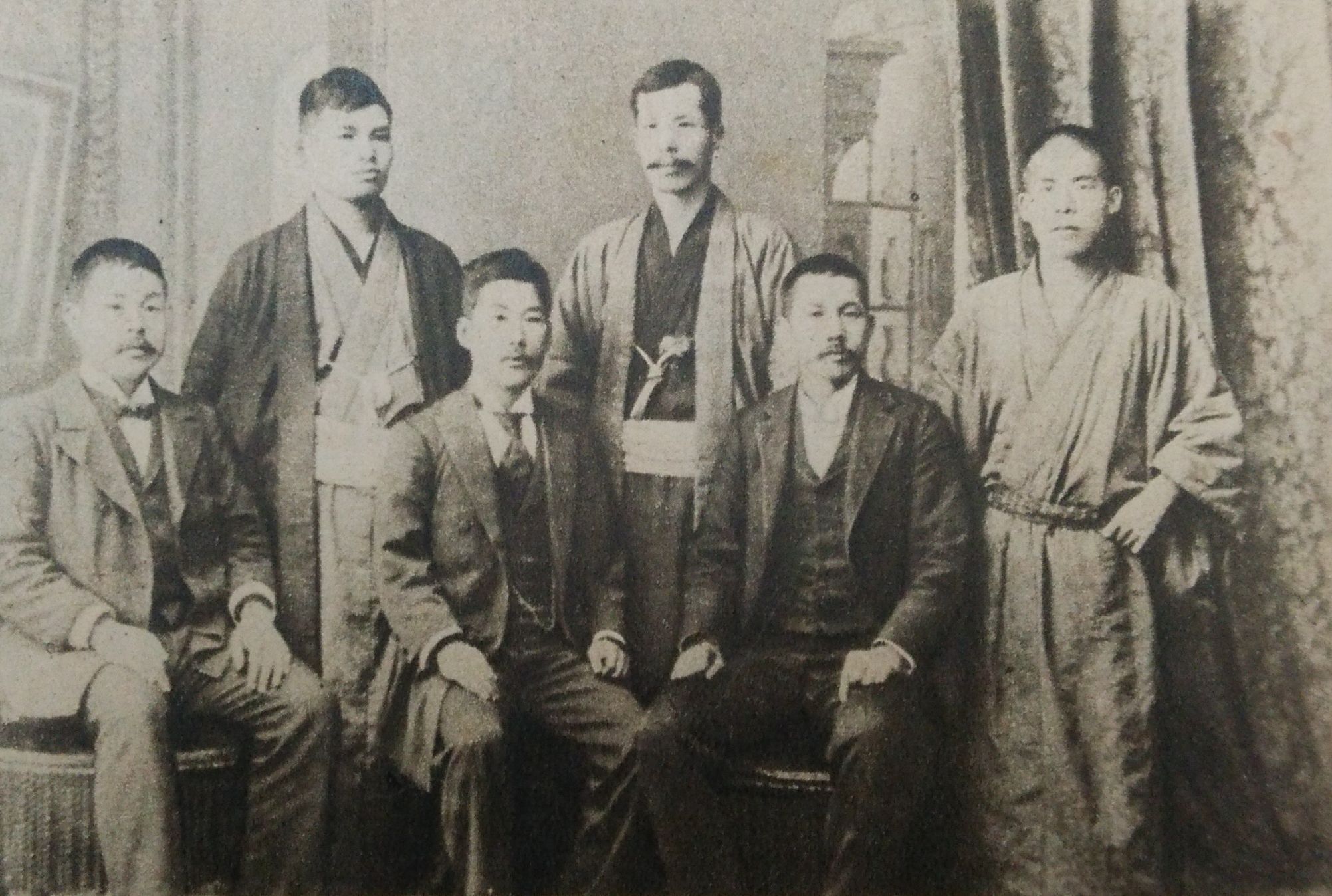
Katayama reports on the consequences of the Japanese invasion of Siberia and the beginnings of the Communist movement.
‘Japan in Relation to the World Revolution’ by Sen Katayama from The Communist. Vol. 2 No. 16. January 5, 1921.
Japan and America are the only countries where the Communist movements are illegal and driven underground. Both countries are equally reactionary and under the dictatorship of the capitalist class; with this difference however: In Japan the capitalists are weaker than the militarists while in America it is just the reverse. It is not necessary to carry the comparison further. After all, both are in the firm grasp of capitalism.
Present-day Japan has been undergoing changes both because of internal and external pressure. The changes are very remarkable because lately Japan has become notorious as the Prussia of the Far East. But it is not the pre-war sort of Prussianism. It is rather of the decadent type, in the last stages, and is fast crumbling to pieces. As is well-known Japan’s intervention in Siberia failed utterly, costing over three-quarters of a billion yen, killing and wounding something over ten thousand Japanese soldiers and besides gained for herself an unenviable reputation and hatred among the Russians and non-Russian-speaking populations, Japan’s intervention in Siberia, fortunately, gave the Chinese and Koreans a supreme opportunity to assert themselves and to seek the friendship of their real friend and neighbor–Soviet Russia.
For the first time in its history the army discipline and morale broke down in the Japanese army, even among the higher officers. For instance, General Oi, the commander-in-chief in Siberia, was reported in the press to have flatly refused to withdraw the army from Siberia. A Japanese lieutenant at Harbin committed suicide in the barracks with a “tea-house” girl in his arms. For a lieutenant to live with a prostitute in the barracks reveals the utter lack of discipline in the Japanese army. We know of only one similar instance that of the French General Macmahon during the war in 1870, who is reported to have kept a woman in his headquarters.
Japan however, was compelled to withdraw its Siberian expeditionary troops, General Oi was compelled to do so by the Minister of the Treasury who informed General Oi that more money was forthcoming for the Siberian expedition.
The most discouraging to the army authorities, but equally encouraging to the people of Japan, lies in the fact that a disproportionately large number of officers were killed in Siberia. This news has just been revealed. This means either, that the officers were unsuccessful in making the soldiers their bodyguard or that they were actually murdered by soldiers. The latter assumption is very likely. Petty mutinies have been reported from time to time against the officers. Details however are lacking. But the army authorities very carelessly have made public the true report of the actual casualties among officers which shows something was radically wrong in the relations between officers and soldiers. Many Japanese soldiers tame under the influence of the Bolsheviki, Bolshevik propaganda and literature have been discovered time and again right in the army barracks through out Japan. Incidents such as these reveal the true condition of Japanese militarism.
Moreover there is one important factor that has been exerting pressure upon Japan from the outside–the awakening of the Chinese. The Chinese have been undergoing development much more rapidly than the Japanese of fifty years ago. Since the Japan-Chinese War of 1894-1895 the Chinese have made a marked advance and they have overthrown the Imperial Government in Pekin in 1910, and deposed the Emperor establishing the Chinese Republic in its place. At present China is in a very settled condition for she has had a second and a third revolution. The latter is still in process of struggle between the North and South of China; although the Powers support the Pekin Government, China of the North, yet the Pekin Government cannot as yet unify the country. The division of China into North and South is purely political and no new divisions are taking place; the division is between capitalism and Socialism: the former is supported by the allied Powers politically by giving her a seat in the Council in the League of Nations and financially by the formation of the Chinese Consortium; the latter is primarily supported by the Moscow Government.
The unification of Siberia under the rule of the Far Eastern Republic was complete with the fall of Chita and the defeat of the last reactionary Russian General Semenoff in the latter part of Oktober. The manifesto of the New Far Eastern Republic was sent to the Vladivostok Government in the early part of November und the ministry was formed, as quoted in the Vladivostok dispatch to “Osaka daimich” on November 23rd, 1920, Krasnoschokov is the minister of foreign affairs. This man is the leader of the newly-formed government. Out of thirteen ministers of the Government seven are Communists; one is Menshevik, one from the peasant group, one representative from the workers and three non-partisans. This government so constituted really means a Communist government. It is not yet a Bolshevik government although the majority of the ministers are Bolshevik and the present government is necessarily dominated by Communist principles, We must not forget however, the fact that this government was created by the express wishes of the Russian Soviet Government as a “neutral” state. This situation compelled the Japanese army to withdraw in utter disgrace and failure, and has left a very deep impression on the Japanese people. The Japanese are losing their faith in militarism not much because the army failed in Siberia but because the army undertook such a dishonorable expedition.
There is another fact that will soon make itself felt on the military classes of Japan, namely, the activities of the Siberian Revolutionary Committee. The chairman of the committee is Mr. Smirnoff; among the others on the committee are, Cadorowitch, Showan, Sokoroff. Yourin, Irnikayatsky, Kosareff, etc. Their resolution, published under the above signature in the Moscow “Izvestia” on September 19th, 1920 consists of nine articles. It reads as follows: 1) This committee is the highest organ that represents the central government in Siberia, 2) It governs over the peoples of the different races residing in Siberia and controls the administrative, economic and all other governmental business, 4) It is responsible for the execution of all decrees issued by the All Russian Central Committee National Defense and Workers’ Committee and each department of the central government, 5) It is the duty of this committee to report to the central government on its rules and resolutions, while all the officials of Siberia are under the obligation to submit to the rules and regulation of this committee.
The above resolution shows that the neutral zone government in Siberia is controlled by the Revolutionary Committee which is responsible to the Russian Soviets at Moscow.
Another important factor is the Russo-Chinese negotiations for peace. In September of this year a military and diplomatic committee headed by a Chinese General arrived in Moscow to negotiate for peace On September 27th foreign Minister Chicherin of the Soviet Government delivered a memorandum to the Chinese Committee to be transmitted to the foreign minister of the Pekin Government the contents of which are already known to the world. While the Chinese General and the committee were in Moscow negotiating for a democratic peace between China and Soviet Russia, Mr. Yourin, one of the members of the Siberian Revolutionary Committee was negotiating for a commercial treaty at Pekin with the head of the Chinese minister of foreign affairs. The progress of these negotiations was hampered by the Ameri can Ambassador, Mr. Crane. The matter seemed to be at an end in Pekin However, we read Shangai despatch dated November 8th, under the title “Great Bolshevik Propaganda Begun to Make Entire China Red”, which reveals that the mission of Mr. Yourin was not purely commercial negotiations representing the Far Eastern Republic, but also for Bolshevik propaganda, It seems that a conference took place in Pekin at which was discussed the question of how to make China a Bolshevik country. Mr. Yourin was of course, the central figure in the conference which lasted ten days. Further, the despatch says that Mr. Yourin would supervise and coordinate all the propaganda committees scattered all over China; hitherto these committees were not properly organized. Though they will conduct a systematic and effective propaganda in the future. At the conference were present five Bolsheviks from Shanghai, who have since returned and begun a campaign of intensive propaganda. They now publish three magazines “Light”, “Sun” and ‘Labor’. All three are issued in Chinese and Korean languages. They preach Communism. The editors are Sun Yet Sen, Sun Koi and Co Hai-Hu. Mr. Bopof is now in Shangai as the director of the movement. Magaryof is also there helping to conduct the propaganda; the latter is the same one who conducted Bolshevik propaganda at Yokohama last year and was ordered, to leave the city within five days.
Another despatch given out by the Japanese Government gives some further details as to Bolshevik propaganda in China. This despatch claims that sometime in October Moscow sent out the Eighth Propaganda Train with 250 Bolshevik propagandists to the Far East, Among this party art two prominent members of the Soviet Government. The centre of this propaganda is aimed at Shanghai. Propaganda will also be sent in Japan through underground channels, utilizing three Bolshevik visited at Holland for Japanese propagandists.
There are two secret organizations in Shanghai; one consists of peasants and workers while the other is made up of those returned from Europe and America. Both of these organizations are under the influence of the Bolsheviki through the able leadership of Mr. Ching. The despatch also claims that several Koreans are in this movement who are staunch Communists. This despatch states also that of the four hundred thousand workers in Shanghai about 80 percent are already members of the two forementioned parties. It reports that in one province where a Mohammedan General is leading the Bolsheviki, the Constitution of Soviet Russia has been translated into Chinese and widely distributed,
These despatches and news items are printed In the Japanese daily papers and are having a tremendous effect on the masses, while it seems to the throwing the authorities into panic and consternation.
Of course the foremost class to come under the influence of Bolshevik propaganda is the working class. Until very recently the Japanese workers were unorganized and no attempt had been made to organize them. The Japanese workers had very little experience in the labor movement since 1901 because of the exception laws. Even strikes were seldom undertaken by the workers. But our Japanese workers have been rapidly awakening in the last few years. In the great rice riots of 1918 the Japanese masses began to feel their own power. Since then labor strikes have been increased in number and more and more workers are being involved in the strike movements. A number of cases of sabotage have developed also with invariable success. These are general phenomena of the Japanese labor world to-day. At present we have many labor unions most of them organized within the past year or two. These are estimated to comprise over one hundred thousand members The labor unions are at present organized into two separate federations, one with its headquarters at Tokio and the other at Osaka; but it is expected that very soon all then labor strikes have increased in number one national federation. This convention will be held at Tokio next January. Already committees to take up the question have been appointed by the principal unions of Tokio and vicinity. As to the dominating spirit of these labor unions we cannot draw any positive conclusions at present. We can however, give some hints to show the spirit and tendencies. We will take one example, the Yu-Ai-Kai is the largest union in Japan. It has the largest membership with forty branches. This union held its annual conference a few months ago at which many progressive measures were voted upon and passed. One that was not passed but had a strong minority vote was to do away with parliamentarism and to adopt direct and mass action instead. This step was advocated by the Tokio groups which are supposed to be very radical. Two or more directors of the Yu-Ai-Kai are thorough going Bolsheviki in ideas and unofficially are advocating Bolshevism as the ultimate solution of the labor problem.
Here is another instance that will go to show the spirit of the Japanese worker. On July 17th, 1920, the Western workers (including Osaka and the territory west of Nagoya and the entire western part of Japan) held a special meeting at which the problems of the unemployed were discussed. The meeting was called by the Osaka Federated Unions. There were about 1,600 present. A manifesto and resolution was passed unanimously at this meeting from which the following extract is taken and speaks for itself:
“Look at the unemployed workers standing on the street as cheerless as a dog in the house of death. Civilization and modern machinery cannot rescue them. Has Capital and the State no power? Why must tens of millions of unemployed hunger in vain on the streets? Because of the crisis and bankruptcy brought about by the capitalist class innocent workers are doomed to a violent death! When they strike the power and might of the Government arrests them. There is no protective legislation for them. Even the right to organize is denied them. They all weep and suffer like prisoners in jail.
“The unemployed curse as they lie down on the streets: “Unless we destroy capitalism we cannot conquer the anarchistic condition of the industrial world. We are hungry for bread, rescue us! Give us the right to organize!
“NO! We will rise up and demand it, nay, take it ourselves. Then we shall find a way to save ourselves from our present misfortunes. We must emancipate ourselves from the trap of capitalism! We know a way ourselves. Therefore, we the producers, are aiming at the destruction of capitalism, the root cause of unemployment and the crisis which results from surplus production. We shall make a real society. We await eagerly the dawn of the Labor Movement of the World!”
Such bold utterances would never be tolerated by the rigid police rule of the authorities were the authorities not aware that they were unable to restrain the audience from mobbing them if they dared censor the meeting. The authorities even feared to suppress the publication of the manifesto printed in the Nippon Kodo Shimbun, a radical labor paper edited by Comrade Srahatta.
It was planned to organize a Socialist Party and the wellknown comrades of Tokio and Osaka held public meetings to discuss the matter openly. This was done to see what the attitude of the authorities was as well to discover the sentiment of the public. As soon as it was announced in the press many applied for membership in the new party; the applications came from all over the country and the majority of them from the working class. The printed prospectus signed by some fifty prominent comrades was suppressed. Therefore it had to be distributed secretly; but the work of preliminary organization went on unabated and the membership applications numbered nearly three thousand and the organization meetings were well attended. The Chairman of the Koba meeting wrote me as follows: “Since I denounced the authorities at the Kobe meeting I am no longer safe. Meetings were great success. At Osaka about 4000 tickets were sold; at Toklo about 1500 and Kobe 2000. At Kobe I presided. A Y.M.C.A Hall was too small for the meeting. About 1000 who could not gain admission surrounded the building all night and dispersed only after the whole police force was mobilized. One thing especially impressed me was when the police tried forcibly to disperse the meeting one of us yelled out “Shakal-shugi Banzai!” (Long Live Socialism). Then the whole audience joined the cry spontaneously in one voice, throwing hands and hats into the air. The noise was tremendous and the police stood aghast for a time not knowing what to do, declaring “Banzai” within the crowd outside joined in it and the noisy demonstration lasted fully an hour. It was Indeed a victorious moment and I felt that my time to come out into the open bad come!”
On the tenth of December 1920 they met to celebrate the founding of the party. The meeting was suppressed which seems to have driven the movement underground. Of course the work will be slow but the members will come in in spite of all. Thus the illegal party will grow steadily as the oppression becomes severer and stricter than ever. It is already reported that the Tokio Government has creased the city police force from 7600 to 9370. Besides the gendarmes are enormously increased in number so that they can co-operate with the police beyond their regular duty of policing soldiers and ferreting out suspicious civilians. But our comrades are not idle. They have been organizing secretly. As they are not accustomed to underground work it seems that could not entirely conceal the traces of their meetings and meeting-places. The first meeting was held at a swell club in Tokio and the third meeting at the university graduates society where only graduates or friends of graduates are permitted to enter. Evidently many university graduates are participants of the secret meetings. This shows that our comrades now are developing many sides to the movement. It is reported that among those who met at the above-named society there were seventeen Japanese comrades, four Koreans, three Chinese and one from Formosa, altogether eleven foreigners. Most of the Koreans are extremists. The police have given out a rumor that the fourth meeting will be held at an unknown place and that among those to be present will be Indians as well. One of the plans, as announced by the police, is the formation of an Asiatic Socialist Federation with headquarters either in China or Siberia, where freedom of speech and assembly are tolerated. We cannot mention names in order not to endanger the work of world-wide propaganda. But there are many comrades entirely unsuspected who are carrying on the work of organizing the Japanese proletariat and the Communist Party.
An editor of the Oriental Economist wrote me from Kamakura, near Tokio, on November 16th, on present-day conditions in Japan:
“The world situation is such that there must come a fundamental reconstruction. It is the only way to make the world worthwhile to work and live in. Japan too is at an impasse on all sides, political, economic, social and religious, etc. A feeling of intense anxiety for the future is evident in all circles high and low in every sphere of society. Only the lack of power prevents the new ideas from cutting through this impasse. But this is only temporary. The world-wide revolutionary waves dashed and are dashing upon Japan. There is a popular suffrage movement but the popular sentiment of the masses goes beyond that movement and is beginning to demand a more radical solution than universal suffrage. If the ruling classes should realize the gravity of the situation and grant universal suffrage the present unsatisfactory condition may be prolonged for a little time: but judging from the reactionary policies of the Japanese Government we think that the future of Japan will never be peaceful again.”
The above is a private communication but it was written in a country where sealed letters and communication between individuals are subject to the prying eyes of the authorities. We can read between the lines and understand that Japan of the present is ripe for the social revolution.
Emulating the Bolsheviks who changed the name of their party in 1918 to the Communist Party, there were up to a dozen papers in the US named ‘The Communist’ in the splintered landscape of the US Left as it responded to World War One and the Russian Revolution. This ‘The Communist’ began in September 1919 combining Louis Fraina’s New York-based ‘Revolutionary Age’ with the Detroit-Chicago based ‘The Communist’ edited by future Proletarian Party leader Dennis Batt. The new ‘The Communist’ became the official organ of the first Communist Party of America with Louis Fraina placed as editor. The publication was forced underground in the post-War reaction and its editorial offices moved from Chicago to New York City. In May, 1920 CE Ruthenberg became editor before splitting briefly to edit his own ‘The Communist’. This ‘The Communist’ ended in the spring of 1921 at the time of the formation of a new unified CPA and a new ‘The Communist’, again with Ruthenberg as editor.
PDF of full issue: https://www.marxists.org/history/usa/pubs/thecommunist/thecommunist3/v2n16-jan-05-1921.pdf
 Revolution's Newsstand