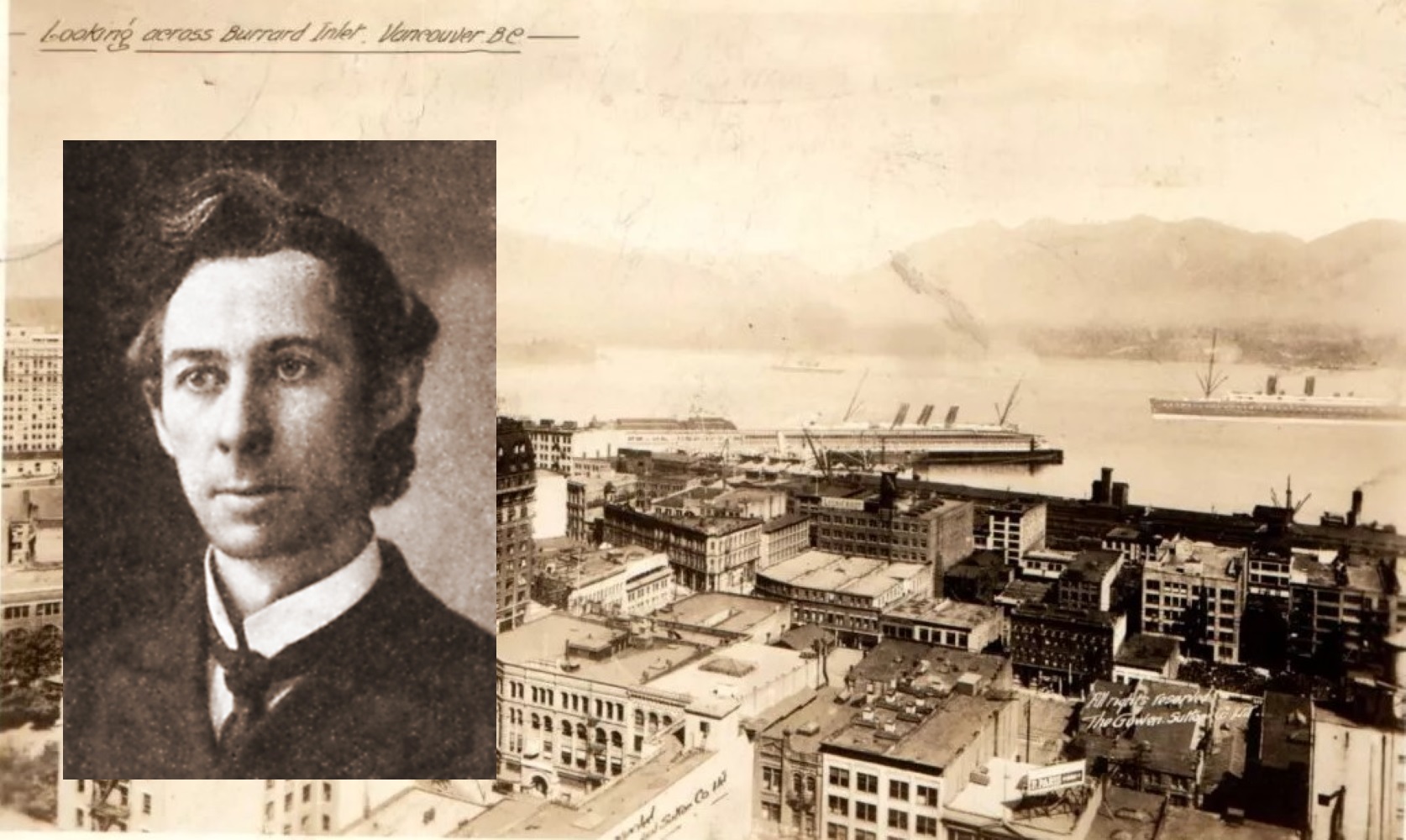
Jay Fox recounts his December, 1912 lecture trip to Vancouver, a city with a relatively strong syndicalist tradition.
‘Syndicalism in Vancouver’ by Jay Fox from The Syndicalist. Vol. 3 No. 2. January 15, 1913.
My first public talk on the subject of “Syndicalism” was delivered in the Labor Temple, Vancouver, B.C., December 22. I visited Vancouver on invitation of the Syndicalists of that city, who arranged for the meeting. The trip was entirely by water and involved three changes of boat. But the trip is a luxurious one, especially from Seattle, on the finely fitted Canadian Pacific steamer. The journey gives one a lasting impression of the natural beauty of Puget Sound. The only stop was at Victoria, on Vancouver Island, once a trading post of the Hudson Bay Company, now the capital of the province, and, until quite recently, the most important Canadian city west of Toronto. After an hour and a half stay at Victoria we steamed out to Vancouver. We arrived at 7 p.m. I was met by Comrades Porter and Gilbert, who took me to the I.W.W. hall, where I had the pleasure of meeting Fellow-Workers Trainor, Horne, Mohring, Foxcroft and others.
On Sunday I attended a meeting of the Trade Union League, the Syndicalist organization. This league has only been a short time in existence, but already its influence is being felt in the Vancouver labor movement.
The political Socialists practically control things around the Labor Temple, and the league is bracing itself to offset the baleful influence of politics by the propaganda of direct-action methods in dealing with economic problems. Nothing is more harmful to the labor movement than the propaganda that the union is insufficient as a weapon of offense and defense. Nothing strengthens a worker’s hopes like the knowledge that in his union he has an instrument through which he can not only improve his lot temporarily, but ultimately emancipate himself. I was very deeply impressed by the pronounced and vigorous stand the league is taking on this question of politics.
These men are not theorists; they do not reflect the attic philosophy of some old thinker. They are everyday workers whose ideas are the result of practical experience; they are taking up the Syndicalist propaganda because Syndicalism fills the void which they have instinctively felt in their union movement.
The public meeting was well attended. It was one of those meetings I always like to be at. It was not a rip-roaring meeting, full of sound and fury. It was calm and thoughtful, and the questions showed that it grasped the idea and was anxious to carry away the right impression of Syndicalism.
I never was so profoundly impressed with the need of any propaganda as I am of Syndicalism after this visit to Vancouver. If I had any doubts or fears, they have all been swept away. If I had a suspicion that Syndicalism is too far in advance of the toilers in this country, that while it may be all right in Europe, where economic thought is far in advance of us, these thoughts were quickly dissipated by the matter-of-fact way the movement is developing, without any pressure of oratory or strong personalities to boost it on. There is no forced draft in this movement, no loud noise, no beating of drums–just natural growth.
There is one thing the men complained of. They want a paper, and when I assured them that THE SYNDICALIST would soon be in their hands and would be out regularly hereafter, they were extremely pleased and promised it their unanimous support.
In order to dispel any suspicion that it might be a dual organization in disguise, the league has made it a rule to accept no member unless he carries a card in the union of his trade or calling, and continued membership depends on that card being kept paid up.
On Monday morning, when I was about to take the steamer for home, we got a telegram from Fellow-Worker Elliott of Nelson, B.C., urging me to go there, where they wanted three or four lectures. But I did not have time to go, owing to the status of my case in Tacoma. I hope to visit League No. 1, though, before I go to Chicago.
The Syndicalist began as The Agitator by Earl Ford, JW Johnstone, and William Z Foster in 1911. Inspired by the revolutionary syndicalism of the French CGT, they felt they were political competitors to the IWW and in early 1912, Foster and others created the Syndicalist Militant Minority Leagues in Chicago with chapters soon forming in Kansas City, Omaha, Minneapolis, St. Louis, Denver, Seattle, Tacoma, Vancouver, San Francisco, and Los Angeles. They renamed The Agitator The Syndicalist as the paper of the Syndicalist League of North America with Jay Fox as editor. The group then focused on the AFL. The Syndicalist ceased publication in September 1913 with some going on to form the International Trade Union Educational League in January 1915. While only briefly an organization, the SLNA had a host of future important leaders of the Communist movement. Like Foster, Tom Mooney and Earl Browder who were also members.
PDF of full issue: https://www.marxists.org/history/usa/pubs/agitator/v3n02-w50-jan-15-1913-syndicalist.pdf
 Revolution's Newsstand