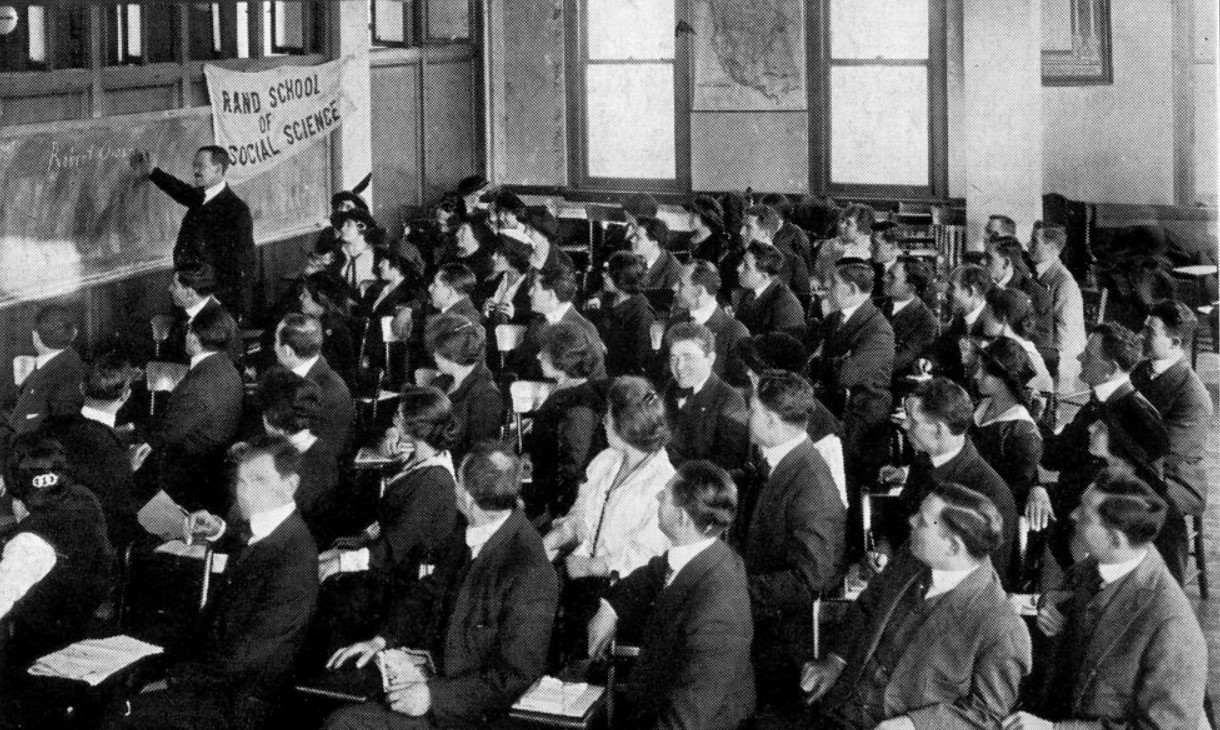
How the Rand School was founded. This historically important institution of the Socialist movement in the U.S. began with an endowment from Elizabeth Rand, comrade and wife of George D. Herron, a leading figure and publisher in the Socialist Party. A workers’ education school, in addition a publishing house, research institute, as well as camps and retreats were developed. The school came under the Social Democratic Federation after the split in the Socialist Party in 1936 and changed its name to the “Tamiment Institute and Library” with Its collection forming the basis the Tamiment Library and Robert F. Wagner Archives at New York University today.
‘The Rand School of Social Science’ from The Chicago Daily Socialist. Vol. 1 No. 269. September 6, 1907.
What the First School of Its Character in the United States Is Doing; Progress Marked
One of the educational institutions that is attracting wide attention in the educational world is the Rand School of Social Science New York., 112 East Nineteenth street. Just entering on its second year, it is the first of the kind in this country. At the outset it is well to quote from the neat prospectus that has been issued by the school:
“The Rand School is an institution founded upon an endowment made at the suggestion of Prof. George D. Herron, by the late Mrs. Carrie A. Rand. with a contributory fund added by her daughter, Mrs. Herron. Its purpose is to teach political and social science from the standpoint of Socialism.
HOW FOUNDED.
“In view of the oft-repeated questions as to the origin of the Rand School of Social Science, and the connection of Prof. and Mrs. George D. Herron with the establishment and work of the school, the American Socialist Society hereby makes the following statement in order to preserve an authentic record on the subject:
“The Idea of establishing a school for the teaching of social science from a radical and advanced point of view was seriously occupying the mind of Mrs. Carrie A. Rand during the later years of her life. Originally she had under consideration the establishment of such a school in connection with the town College. The controversies between that college and Prof. Herron, culminating in the enforced resignation of the latter, demonstrated to Mrs. Rand the futility of expecting that institution to become a vehicle for the dissemination of free and progressive thought. In the absence of any existing institution which could be entirely entrusted with the task of establishing and maintaining such a school, Mrs. Rand made provisions in her will for the creation of a trust fund to be expended by two trustees appointed by her, for general educational purposes on Socialistic lines, without specifying the details of the proposed organization and work.
A SCHOOL IN NEW YORK.
About two years before the death of Mrs. Rand, Prof. Herron, who then resided in New York City, conceived the idea of establishing a permanent school in the city of New York for the purpose of affording Socialists and others a full opportunity to study the philosophy of Socialism and allied sciences, substantially on the lines subsequently adopted by the Rand School of Social Science. Prof. Herron laid his ideas before Mrs. Rand, who gave them her hearty and enthusiastic approval. In fact, Mrs. Rand was seriously considering the establishment during her lifetime of such a school, but her untimely and unexpected death prevented the realization of her hopes.
When the terms of Mrs. Rand’s will were made known, it appeared that the manner of the disposition of her estate was by no means free from legal and technical objections. A contest seemed imminent. and threatened to tie up the trust fund for a number of years, if not to destroy it altogether. That the contest was prevented, and the establishment of the school made possible is due entirely to the generosity and devotion of Mrs. Herron, one of the chief beneficiaries under the will, and trustee of the school fund established by its terms. Rather than countenance the possibility of having the cherished ideal of her mother frustrated in the courts of law. Mrs. Herron settled with the contestants on their own terms, making personal financial sacrifices–sacrifices so large that they almost equaled in amount the endowment fund itself.
THE WILL’S PROVISIONS.
“Just previous to her death, Mrs. Rand had signified her earnest wish that Mr. Morris Hillquit should be made co-trustee with her daughter, and this appointment was made shortly afterward. When the difficulties attending the dispute over the will were settled. Prof. and Mrs. Herron proceeded to lay the foundation for the immediate establishment of the school. Ill health, however, forced Prof. Herron, who had expected to give his entire time to the enterprise as teacher and organizer, to leave the country for some time, but his absence has in no way diminished his interest in the school. Both Prof. and Mrs. Herron have at all times remained in close touch with the work and progress of the enterprise, and have given very valuable advice and assistance on several important matters connected with it.
The resources of the school are made up from the following income of the endowment bequeathed. by Mrs. Rand: From tuitions, from the sale of books and pamphlets, from dues and contributions of the Rand School Society, and from other voluntary contributions.
The American Socialist Society is an incorporated body title to the property of the Rand School and administers its affairs.
The officers of the school are:

Mrs. Charlotte Perkins Gilman, President F.E. Brelthut, Vice-President. and W.J. Ghent, Secretary-Treasurer. The school has recently, taken over the work of the Intercollegiate Socialist Society, an organization formed two years ago for the purpose of promoting the study of Socialism in the colleges. The officers of this school are: J.G. Phelps Stokes, President; Upton Sinclair First Vice-President: Harry W. Laidler. Second Vice-President: W.J. Ghent, Secretary, and Paul Kennaday. Treasurer.
COLLECTION OF BOOKS.
The Rand School has a collection of the best books and pamphlets on social and political science. It has also files of the leading Socialist and radical periodicals. VISITORS ARE CORDIALLY INVITED TO MAKE USE OF THIS COLLECTION. An archive of rare and valuable books, pamphlets and manuscripts is in process of formation, to which contributions, by loan, or gift are solicited.
The Rand School offers, upon nominal terms, a series of lecture and study courses in social and political science. These courses are divided into two groups. First are SYSTEMATIC COURSES with personal assistance of instructors, required-use text-books, examinations and other elementary methods. Next are LECTURE-CONFERENCE COURSES, with opportunity for questioning the instructors. The first year of the Rand School was notably successful. An average of ten classes a week was given for the greater part of the school year. In addition, a course of free Sunday lectures was given from January 13 to April 28. The attendance in the regular classes ranged from 2 to 125, and at the Sunday lectures from 25 to 340. There were 566 single paid admissions to lectures in the regular courses. The number of students who attended one or more courses (exclusive of the Sunday lectures) was 221, and the total of attendances (including the Sunday lectures) was 6,819. Of the 221 enrolled students 128 were men and 93 were women. Of the men, 74 were members of the Socialist Party, 4 of the Socialist Labor Party ad 50 were non-members. Of the women, 32 were members, or the wives or daughters of members, of the Socialist Party, and 61 were non-members.
The Chicago Socialist, sometimes daily sometimes weekly, was published from 1902 until 1912 as the paper of the Chicago Socialist Party. The roots of the paper lie with Workers Call, published from 1899 as a Socialist Labor Party publication, becoming a voice of the Springfield Social Democratic Party after splitting with De Leon in July, 1901. It became the Chicago Socialist Party paper with the SDP’s adherence and changed its name to the Chicago Socialist in March, 1902. In 1906 it became a daily and published until 1912 by Local Cook County of the Socialist Party and was edited by A.M. Simons if the International Socialist Review. A cornucopia of historical information on the Chicago workers movements lies within its pages.
PDF of full issue: https://www.marxists.org/history/usa/pubs/chicago-daily-socialist/1907/070906-chicagodailysocialist-v01n269-simonsonstuttgart.pdf
 Revolution's Newsstand