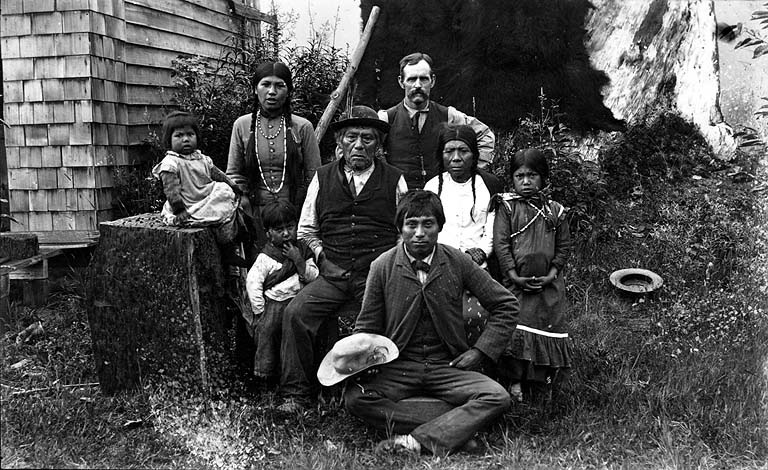
Washington State’s indigenous Nooksack people join in the Hunger March movement during the deprivations of the Great Depression.
‘Farmers’ Action Gets Washington Indians Relief’ by Frank Ecklor from Producers News (Plentywood). Vol. 15 No. 45. February 3, 1933.
INDIAN SPOKESMAN GIVEN GREAT OVATION AT OLYMPIA, WASH. HUNGER MARCH
Nooksack Valley, Washington, like the rest of the United States is in a critical condition in spite of the fact that this is one of the most productive valleys in the country.
GIVE CAST OFF CLOTHES
We find workers and small farmers in a destitute condition, and to carry out Hoover’s promise that no one would be hungry or cold this winter a so-called relief station was established at Everson to furnish clothing to the needy. The plan was to redistribute the cast-off clothing of the middle class and what old shoes and clothing could be begged from the workers and farmers.
The Red Cross sent in some government cloth and other clothing in order to keep the farmers and workers from struggling for real “cash relief” at. the expense of the state and the employers. Red Cross flour was also distributed at the same place.
To obtain any of these things one has to be investigated by a widow who receives her instructions from the county charity officers. An applicant has to give his life history to get a few rags. Old shoes were mended by the local shoemaker once a week (after being investigated) who was paid $2 a day for labor, rent, use of equipment, light and water. This work was undertaken by the local Lions club and has completely broken down.
MANY INDIANS DESTITUTE
A large percentage of those who are in this destitute condition belong to the Nooksack Indian tribe. These Indians do not live on a reservation but, are government wards and receive no relief except local charity. The relief. agents discriminate against the Indians and don’t even let them go to the relief station the same day the white farmers go. They go on Wednesday and Saturday is the day for others. Many Indians receive nothing.
Sunday, Jan. 15 some of the local farmers attended the Indian Mission church services after which a meeting was held to explain the necessity for the Indians to organize with the whites.
SEND FIVE TO OLYMPIA
They agreed that this was the only thing to do and thereupon they elected five delegates to participate in the state hunger march which was to start from there the following morning at five o’clock. Three of these delegates were men and two were women. A resolution was drawn up demanding the treaty rights as granted by Governor Stevens. This demand was adopted by the Indian delegates from other sections.
When the Indian spokesman took the floor at, the convention at Olympia he received the greatest applause of any delegate present. The Indians pledged themselves to unite with the white workers and farmers and not to relax until every one had won every demand.
At the meeting held at the church the Indians told how many of them were unable to get even the barest necessities at the local charities. The white farmers told them that if they would come to the station Saturday (white day only) they would support them in their demands for relief.
INVESTIGATED AGAIN
Saturday many appeared but were told by the charity heads that nothing would be done until they were investigated again. A white worker then stepped forward and asked if they would get relief after that. He was told, “They will if they need it.”
“Just as if they would ask for your junk if they didn’t need it,” he replied.
The white worker then went with a couple of the Indians to the home of the investigator and brought her down to the relief agency where all had to go thru the rigamarole of “investigation” once again. They then received some relief.
The Indians openly stated after that that the only thing that was getting them any relief was the fact that they were organized with the white workers and farmers.
Producer’s News was a radical rural voice that became a Communist publication in the late 1920s. First published in Plentywood, Montana in Sheridan County, one of the few places to elect Communists in the 1920s. as the organ of the Montana Non-Partisan League beginning in 1918, took a left turn and passed into the hands of Communist editor Charley Taylor and then the Montana Farmer-Labor Party in 1924. In the late 1920s the paper became the voice of the United Farmers League before becoming the organ of the Communist-dominated Farm Holiday Association in 1935, ending its nearly twenty year run in 1937.
PDF of original issue: https://chroniclingamerica.loc.gov/lccn/sn85053305/1933-02-03/ed-1/seq-1/
 Revolution's Newsstand