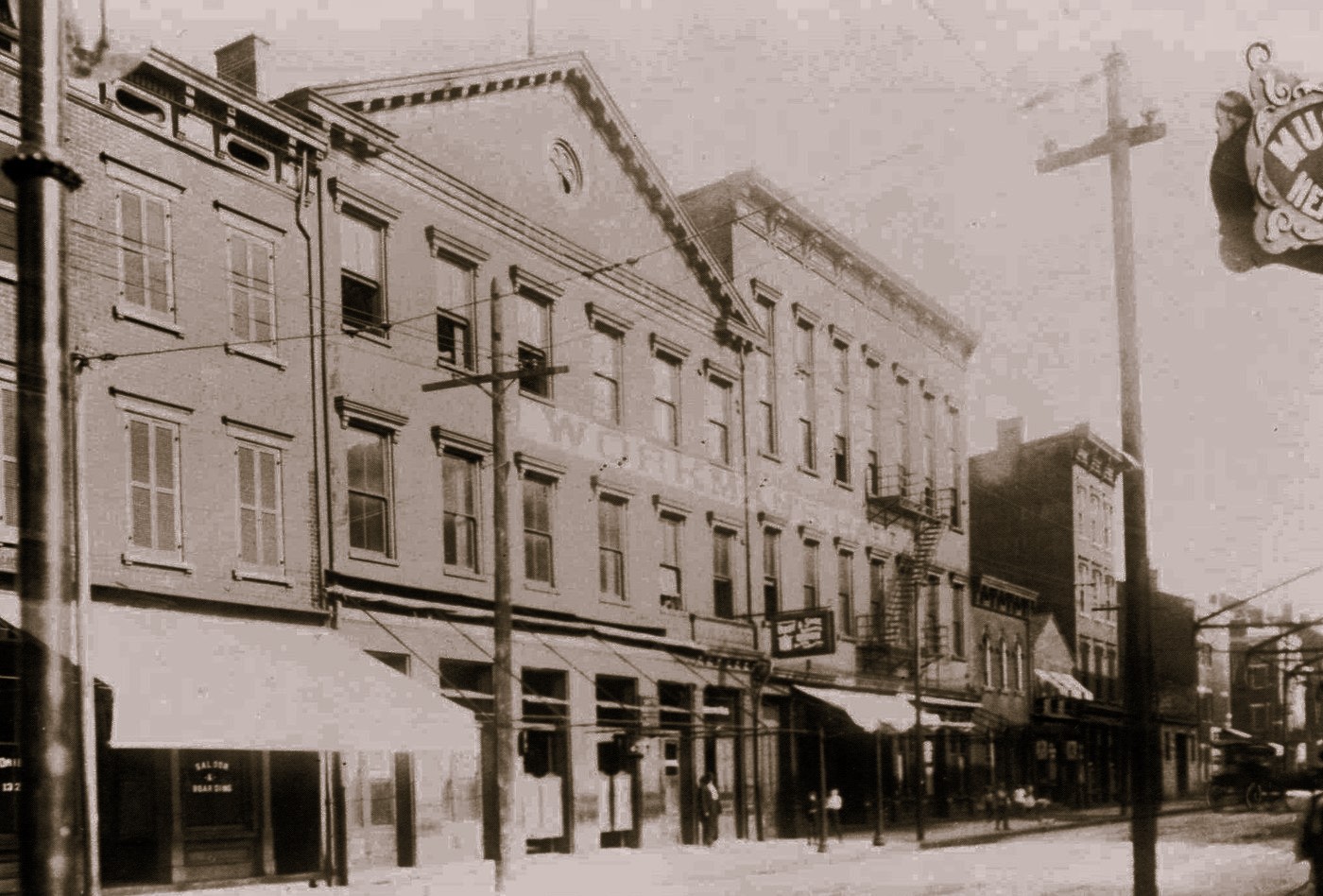
A 19-year-old Elizabeth Gurley Flynn brings the Good News to Cincinnati, speaking at a hall built in 1859 by August Willich’s Der Socialer Arbeiter-Verein.
‘Miss E.G. Flynn Deeply Impresses Cincinnati Working Class’ by K.E. from The Weekly People. Vol. 17 No. 29. October 12, 1907.
Excellent Address Delivered at Workman’s Hall–Large Attendance Convinced of Futility of Gompers Unionism–Capitalist Press Surprised Into Being Truthfully Complimentary.
Cincinnati, O., Sept. 30. Miss Elizabeth Flynn of New York, the talented young Socialist, delivered an excellent address at Workmen’s Hall here, last night. She made a forcible impression upon her large audience, and a few curious who drifted in to scoff went away to wonder.
The capitalist press was surprised into giving Miss Flynn some excellent notice. The Post, for instance, said this morning:
“That mere slip of a girl on the platform, with her childish face, and her simple skirt barely reaching to her ankles–is she going to give a school recitation? The question is a natural one, for at first glance at Elizabeth G. Flynn it seems incredible to believe that this 19-year-old orator is going to wrestle with the gigantic economic problems of the day.
“Simplicity is the keynote of this girl. Her mass of dark, wavy hair is plainly parted and fastened low at the back of her head. She is inconspicuously garbed in a plain white shirt waist and a black skirt. The hat which she removed–before speaking is an untrimmed gray fedora–altogether neither stylish nor dowdy, but severely simple.
“And her oratory matches her democracy of manner. There are no flowery flights of rhetoric, no elocutionary climaxes, only simple, straightforward language, without word ‘trickery or declamation. Leaning lightly against a table, she speaks in ordinary conversational tones, using both hands in constant explanatory gestures, more like a teacher than an orator. She makes no natural pauses for applause, and appears to be somewhat annoyed by interruptions of approval.
“Underneath this modesty and simplicity, however, is the intellect of giant: This was shown at Workmen’s Hall Sunday night, where she spoke in behalf of the Industrial Workers of the World. Not only did she present her subject clearly and forcibly, but afterward answered intelligently all the questions fired at her by argumentative auditors.
“In her talk Miss Flynn took occasion to flay Samuel Gompers and the American Federation of Labor. That organization, she declared, was really detrimental to the workingmen because it tied them into little bundles and set. them to fighting one another. At present, she said, it was nothing but organized scabbery.
“Gompers was criticised as a traitor to the cause because he said that the interests of labor and capital were identical.
“They are not and never can be identical, Miss Flynn declared, and Gompers utters such an absurdity only because it is profitable for him to do so.
“Labor, she urged, should be organized not according to crafts, but ac- cording to the several industries and all the men who assist in producing the same commodity should belong to the same organization,
“The futility of the present labor union system is shown, she said, by the telegraphers’ strike, in which those with satisfactory contracts remain at work and thus help the scabs break their brother unionists’ strike.” K. E.
New York Labor News Publishing belonged to the Socialist Labor Party and produced books, pamphlets and The People. The People was the official paper of the Socialist Labor Party of America (SLP), established in New York City in 1891 as a weekly. The New York SLP, and The People, were dominated Daniel DeLeon and his supporters, the dominant ideological leader of the SLP from the 1890s until the time of his death. The People became a daily in 1900. It’s first editor was the French socialist Lucien Sanial who was quickly replaced by DeLeon who held the position until his death in 1914. After De Leon’s death the editor of The People became Edmund Seidel, who favored unity with the Socialist Party. He was replaced in 1918 by Olive M. Johnson, who held the post until 1938.
PDF of full issue: https://www.marxists.org/history/usa/pubs/the-people-slp/071012-weeklypeople-v17n29.pdf
 Revolution's Newsstand