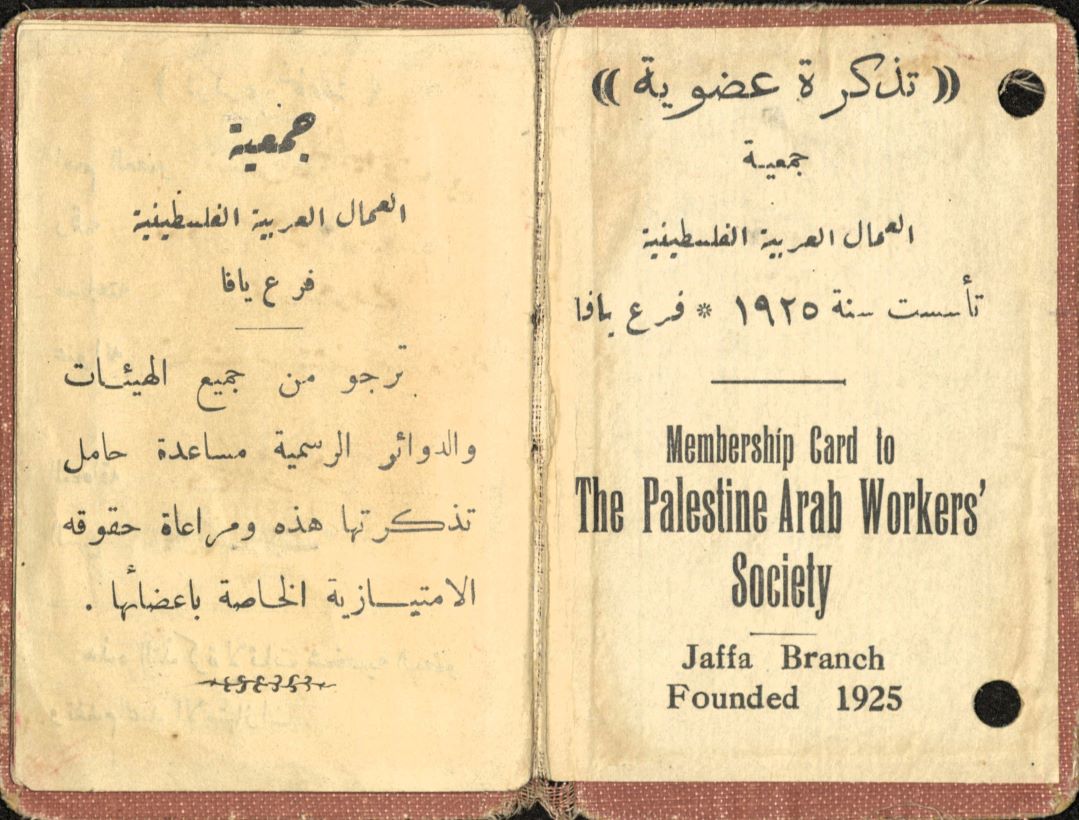
A report on the historic 1930 congress of the Palestine Arab Workers Society.
‘The Rise of the Arab Working Class’ by Mustapha Sadi from International Press Correspondence. Vol. 10 No. 5. January 30, 1930.
In Haifa (Palestine) there has taken place a historical event which has great importance for the further development of the Labour movement in the Arabian countries.
The Arab worker is waking up; he is beginning to realise under what hard conditions he has to live and is seeking after means in order radically to improve them. After a long tentative quest he has now succeeded in finding the means. It is the same means which the workers of other countries have tried with so much success. i.e. the creation of proletarian organisations, of mass trade unions.
This was the aim and purpose of the first Congress of the Arab Workers of Palestine which took place in Haifa. In all there were present 60 delegates, representing several thousand Arab workers in Palestine and the neighbouring countries.
Everywhere the workers awaited this first congress with tense eagerness. In Haifa itself the congress premises were constantly besieged by workers who followed the proceedings with the keenest interest. On the opening of the Congress the delegates paid homage to the Arab workers who have fallen in the fight against British imperialism. There followed the reading of telegrams of greeting which had arrived from various European as well as Arabian countries. Particularly great enthusiasm was aroused by the message of greeting from the Arab Secretariat of the League Against Imperialism calling upon the workers to be the advance-guard of the anti-imperialist fight.
The speeches of the various delegates constituted a series of descriptions of the sufferings of the Arab workers; his oppression, his exploitation, his starvation wages, his 12 to 14 hour working day. the lack of any laws for the protection of labour, the appalling hygienic conditions under which the Arab workers live etc.
But the Congress was not entirely free from various influences which wished to work upon it from the outside. The Arab bourgeoisie, who played such a treacherous role in the recent revolt, is now endeavouring, under the pretense of “general national” interests, to penetrate the various Congresses which are being held as a result of the revolutionary mood of the population.
Thus one or two representatives of this class appeared on the platform in order to speak of the general “common” national interests. They encountered, however, the resistance of the class-conscious elements. Amidst the applause of the whole Congress the class-conscious delegates answered these representatives of bourgeois ideology, “no, there can be no understanding between the workers and the bourgeoisie. The nation is divided into two classes: capitalist and worker, oppressors and oppressed, and between them a fierce fight must be fought to the end.”
But the agents of the nationalists were not abashed: they endeavoured to intimidate the Congress delegates, to threaten them with government repression and to allure them with hypocritical words. As a matter of fact certain results of national-reformist influence are to be seen in some decisions of the Congress; but as the following enumeration shows, the class-conscious elements captured the most important positions.
The most important demands and decisions of the Congress are: Eight-hour working day; improvement of wage conditions; founding of trade unions in Palestine and in the Arabian countries; law for the protection of labour; work for the unemployed: proclamation of strikes as often as necessary; founding of a trade union newspaper, to be called “Workers of Arabia”; protest against the government-levies on the Arab villages; protest against the new laws; complete independence for Palestine: special treatment for political prisoners; solidarity telegram to the Indian workers; protest against the concession of the Dead Sea; protest against the Jewish emigration; employment of Arab workers on government work according to the percentage of the Arab population etc.
After the adoption of the decisions a new Central Committee was elected which includes several class-conscious workers. The Congress concluded with three cheers for the Arab workers’ Congress and a solemn pledge to defend the cause of the working class.
The Congress marked the hour of birth of the Arab proletariat as a distinct class the foundation of the first proletarian mass organisation.
International Press Correspondence, widely known as”Inprecorr” was published by the Executive Committee of the Communist International (ECCI) regularly in German and English, occasionally in many other languages, beginning in 1921 and lasting in English until 1938. Inprecorr’s role was to supply translated articles to the English-speaking press of the International from the Comintern’s different sections, as well as news and statements from the ECCI. Many ‘Daily Worker’ and ‘Communist’ articles originated in Inprecorr, and it also published articles by American comrades for use in other countries. It was published at least weekly, and often thrice weekly.
PDF of full issue: https://www.marxists.org/history/international/comintern/inprecor/1930/v10n05-jan-30-1930-Inprecor.pdf
 Revolution's Newsstand