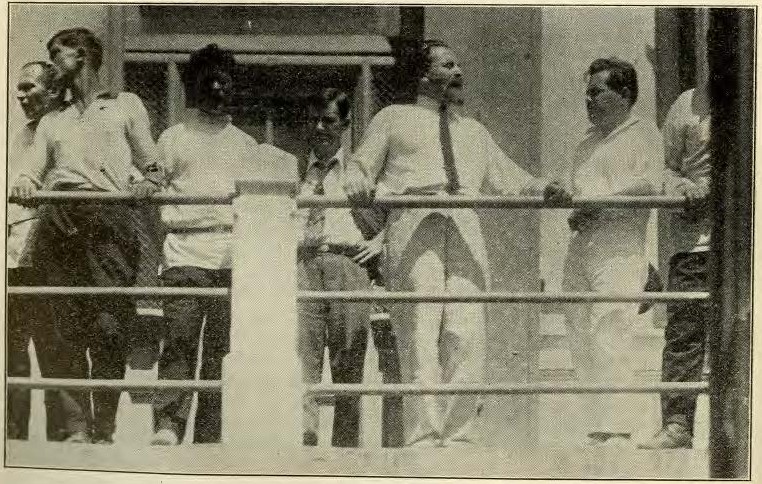
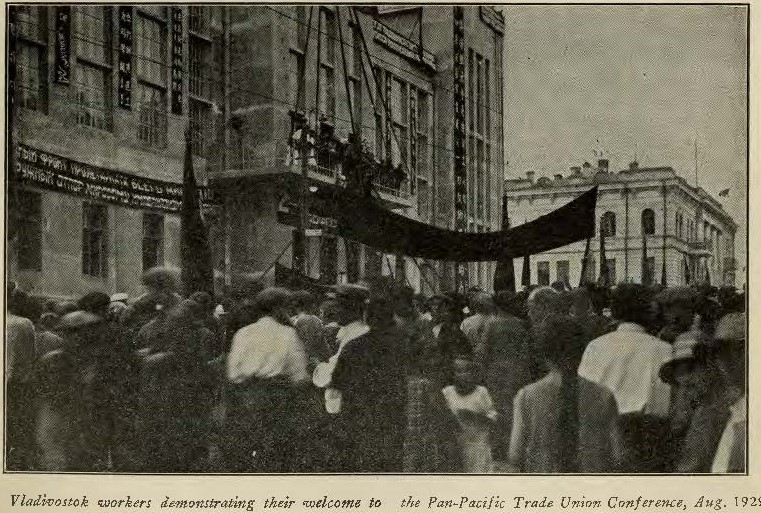
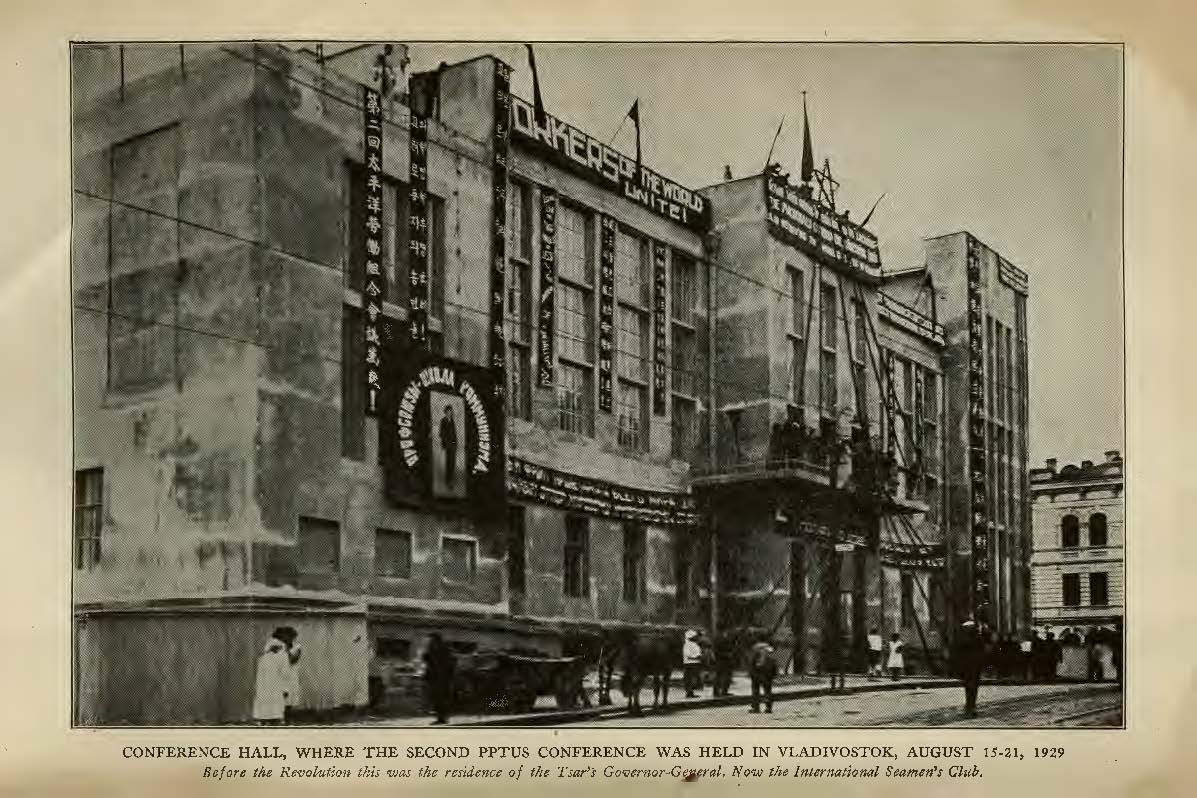
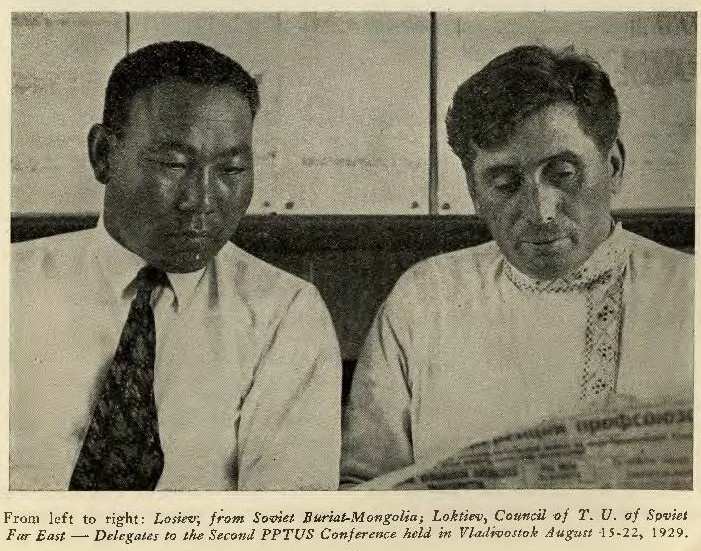
Resolution from the second congress of the Pan-Pacific Trade Union Secretariat (PPTUS), a subdivision of the Red International of Labor Unions, held in Vladivostok during August, 1929.
‘The Tasks of the Trade Unions in the Pacific Countries in the Struggle against War and Imperialism’ from Pan-Pacific Monthly. No. 32. November, 1929.
Resolutions and Decisions of the Second PPTUS Conference
1. The struggle for domination in the Pacific and for the exploitation of the colonial and semi-colonial peoples in the countries bordering the Pacific becomes keener and keener from day to day, in connection with the increased productive capacity of the capitalist countries on the one hand and the shrinking of the markets on the other. It is in the Pacific that the interests of the USA, Japan, Great Britain and France clash more strongly, for it is in this area that we find the largest and most important colonial and semi-colonial countries, whose exploitation is the fundamental pre-requisite for the very existence of the imperialist powers.
2. The fierce struggle for domination in the Pacific is due to the fact that the colonial and semi-colonial countries in the Pacific possess huge sources of raw materials and cheap labor, and in the case of war these countries can furnish large colored armies. Such countries as China, India, Indonesia, the Philippines, Indochina, etc., constitute huge human reservoirs and possess inexhaustible resources; it is this that makes them the object of the fiercest competition and rivalry. The struggle for domination in the Pacific is a struggle for monopolistic and exclusive influence in these countries, aimed at the elimination of all competitors and the subjugation of hundreds of millions of people in the interests of the ruling classes of the strongest capitalist country.
3. The central object of this intense competitive struggle among the imperialist powers, particularly among the USA, Japan and Great Britain, is China with its hundreds of millions of population, with its rich natural resources, with its diligent population and enormous market for foreign goods.
In China there is a continuous and feverish struggle among these imperialist powers for domination. Everyone of these imperialist powers supports its own particular militarist clique and its group of followers among the bourgeoisie; each one of them has its own spheres of influence, its ports, concessions and territories. The struggle between the various militarist cliques reflects the struggle between the various imperialist powers for the division of China, among themselves. Having come later than the others into China, the U.S.A. parades under the flag of liberalism; it declared itself for the open door policy solely for the purpose of winning over to its side the bourgeoisie and feudal lords of China and in order to squeeze the Japanese and British competitors out of the Chinese market. There is a vicious circle of insoluble contradictions around China.
The imperialist powers are at present involved in the most terrific struggle for the capture of the Chinese market.
4. Out of this arises the unceasing armament race, the construction of military and naval bases, the fortification of the coasts and islands lying in the Pacific. All this is done under the smoke screen of pacifist phrases about overcoming the crying contra dictions, about disarmament, etc. But under the mask of naval and military conferences on the question of disarmament, the mad race in the construction of dreadnaughts, cruisers, submarines, hydro-aeroplanes and other instruments of war still goes
The increase of production and the simultaneous contraction of the markets forces the ruling class to prepare for the use of force, in order to seize from the hands of the competitors and rivals, by military force, the most advantageous positions in the colonial and semi-colonial countries.
5. The sharpening struggle for domination in the Pacific reflects the regrouping of forces in world politics and world economics, for in this fierce struggle, the USA appears as the main challenger against Great Britain for world domination, and against Japan for domination in the Pacific. The new constellation of forces after the war, when the USA forces Great Britain ever further into second place, domination in the Pacific means domination of the world. That is why the struggle for hegemony in the Pacific is so bound up with the struggle for the “freedom of the seas,” which in fact means freedom for one country and closed doors for all the others. Until quite recently it was Great Britain who was mistress of the seas. Now the United States is after the mastery of the seas. And while she is fighting for the “freedom of the seas” the USA is feverishly creating that force, which will guarantee her this “freedom” against all her rivals and competitors.
With the post-war crisis having become chronic, with the economic power of England dwindling, with the growing industrial and imperialist activity of Germany, with the growing contradictions between England and France, the intensification of the struggle of the colonial peoples against imperialism, with the growth of the revolutionary struggle of the working class in all capitalist countries and the mad struggle for markets, and the venomous hatred of the whole capitalist world against the USSR, which is growing economically and politically–war becomes the only solution for the imperialist powers. The characteristic feature of this situation is the circumstance that no matter where the new war may start, whether in Europe or America, in the Atlantic or on the Pacific, the new war will become a world war, for the question of the re-division of the world will arise again.
7. On the other hand, there can be no doubt that the imperialist powers, while preparing for war against one another, are also preparing for war against the USSR, for the peaceful construction of socialism in the USSR disturbs the equilibrium of the whole capitalist system, weakening the position of the ruling classes, for it serves as a constant living example for the workers of the whole world, illustrating the possibility of doing away with the exploitation of man by man and the re-organization of society on socialist foundations. This preparation for war against the Soviet Union is carried on systematically and with the greatest determination, irrespective of which party is in power in the USA, England, Germany or France. The conservatives, liberals and reformists all equally hate the victorious proletarian revolution, and are all ready to prevent the development and the construction of Soviet Russia on a socialist basis.
8. The provocative action of the Chinese militarists on the Chinese Eastern Railway which was prepared by the imperialists proves on the one side that they are ready to use all measures in order to deal a crushing blow to the Soviet Union, and on the other hand that they are ready to start a war in any part of the world to directly or indirectly participate in the war in order to capture by force new territories and new spheres of influence. The plan of the United States to internationalize the Chinese Eastern Railway by giving over the control of the railway to an international trust is an attempt to strengthen its hold upon Manchuria, to clear the ground for its imperialist aims with the aid of the Chinese militarists. Similar provocations may take place at any moment and thus the toiling masses of the world will be faced with the war danger.
9. The pressure of the imperialist powers on the colonial and semi-colonial peoples, the preparation of war against the Soviet Union, the increasing exploitation, the stifling of the emancipation movement in all countries, the direct help extended by the imperialists to the reactionary military and feudal cliques in China, India, etc., the mass arrests and killings of workers in colonial. and semi-colonial countries–all these taken together puts before the trade union organizations bordering the Pacific Ocean very serious problems. These problems are largely those of methods of struggle against imperialism, of struggle against the war danger, and of methods and tactics of fighting the feudal and national bourgeoisie.
10. One of the first conditions of a successful fight against imperialism and against the war danger is the necessity of transforming the existing trade unions into mass organizations and the irreconcilable fight of all these organizations against imperialism, against all the elements who are ready to collaborate with the imperialists and all those who propagate class collaboration. The struggle against war and imperialism is possible only when it is based on a merciless class fight, only when the workers and peasant organizations will be able to connect their fight against war and imperialism with their immediate interests, only if they connect their fight against imperialism with the fight against the feudal landlords, with their fight for the land, with the fight for the seven hour day, for real social legislation, for the overthrow of the feudal bourgeois reactionaries and for the establishment of a workers and peasants government.
11. Experience has shown that a successful fight against war can be carried on only when we conduct daily propaganda in educating the masses of workers in the spirit of the class struggle, explaining to them the part played by the imperialist and national bourgeoisie in the preparation of war, and we carry on steady propaganda among the soldiers and sailors, when we establish the united front between the colored and white soldiers, and between the soldiers and workers and peasants. Only by carrying on our daily and tireless work for the political unification of the working masses and for the establishment of permanent connections with the soldiers and sailors, can we succeed to accomplish fruitful results, in our fight against war and imperialism.
12. The fight against war and imperialism in the countries bordering the Pacific must be carried on under the slogan of “Down with all racial barriers”, because maintaining of racial barriers is the best means in the hands of the bourgeoisie for the incitement of the colored workers against the whites and vice versa. And also of different colored races against each other. Not a racial war but a class war, not a war of nations, but a war of the exploited against the exploiters, not a war against the Soviet Union but a war against those who organize an attack against the Soviet Republic–this is what we stand for. Only under this slogan can we successfully carry on our work and prepare the masses for decisive action against their bourgeoisie and against the imperialists when war will be declared.
13. Of especial importance in the work of preparing the proletariat for the fight against war and imperialism is the task of uniting (organizing) the most exploited sections of the working class in the colonies and semi-colonies, the working women and young workers. In connection with this it is necessary to fight against bourgeois pacifism, which gained a certain influence among women and young workers by means of establishing various sport organizations, beneficial and educational societies. These organizations are being rapidly spread by the imperialists and their agents in the colonies and semi-colonies. The task of the organizations affiliated to the PPTUS is to draw the women and young workers into the anti-imperialist movement and do all in their power to attract them in the fight of the working class against the danger of new imperialist wars and imperialism.
14. In order to carry on a successful fight against war and imperialism it is also necessary to carry on a merciless fight, not only against the open imperialists, not only against the bourgeois and feudal lackeys, in the colonial countries, but also against the reformists who have taken upon themselves the task of corrupting the labor movement in the colonies and to subject it to imperialism. Reformism of the imperialist countries under the mask of pacifism is the direct agency of the bourgeoisie. This is illustrated by the whole activities of the General Council of the British trade unions, as for instance by its recent action against the textile strikers in Bombay and by the whole activities of Redo Sodomei of Japan, the A.F. of L. in USA, the CGTU in France. The reformists in the colonial countries (for instance in Inda, Indonesia and so on) are the paid agents of the imperialists and of their respective national bourgeoisie. Against all reformists we must carry on a merciless fight since they are attempting to carry out the imperialist and bourgeois reformist policy within the working masses of the Pacific countries. Every worker in the Pacific must understand that the active penetration of the reformists of the imperialist countries into the countries bordering on the Pacific, pursues the aim to perpetuate imperialist oppression and exploitation at the same time the block of reformist of imperialist countries with those of the colonial countries which is being formed by the agents of international capitalism. Mr. Albert Thomas, directly endangers the struggle for independence of the colonial and semi-colonial peoples, because the main task of the native reformists is to lead the movement of the masses into the channels of class-collaboration and conciliation with imperialism.
15. War is inseparable from imperialism. Imperialism will never give up voluntarily the privileges and territories which is force- fully acquired in the colonial and semi-colonial countries. This is why the independence of the colonial and semi-colonial peoples cannot be won unless imperialism is crushed. Therefore the agitation and propaganda and the whole work of the trade unions in the countries bordering the Pacific must be carried on under the slogans: “Drive out the Japanese imperialists from Korea, China and Formosa”, “Drive out British imperialists from India, China and Singapore”, “Drive out the American Imperialists from China, the Philippines and Hawaiian Islands,” “Drive out the French imperialists from Indo-China”, “Drive out the Dutch imperialists from Indonesia”! etc. In China, where the struggle among the imperialist powers is reflected in the wars between the militarist cliques, it is necessary to issue the slogan “Down with war between the various militarist cliques!” War by the workers and peasants of all China against the militarist cliques and their imperialist bosses!”
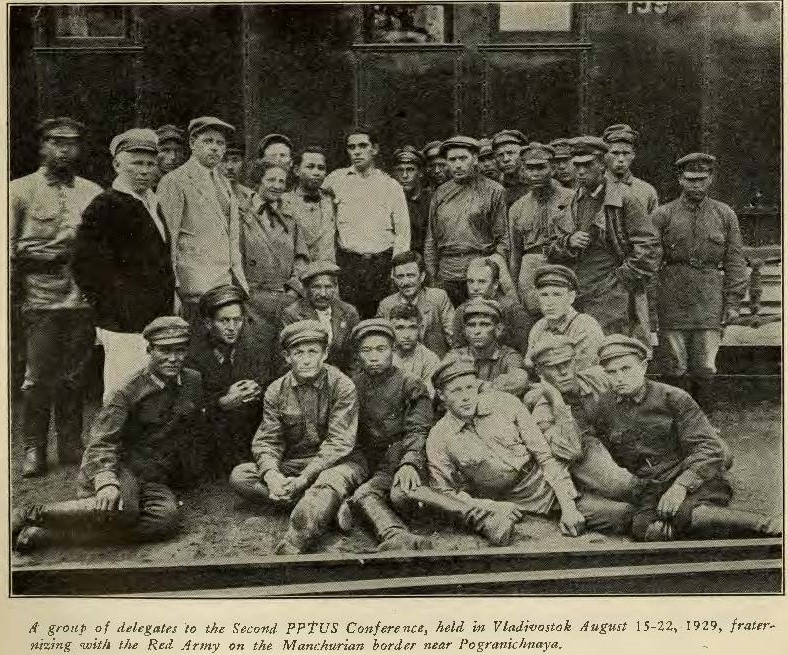
16. The more the struggle against war and imperialism will be carried on an international scale the greater will be its success. This means that it is necessary to draw into the struggle white and colored workers to carry on agitation in the armies in the imperialist countries as well as among the occupational troops in the colonies. At the same time it is necessary to carry on anti-imperialist work among colored troops and to draw into active work the workers, women workers, and the youth of all colors and races. Those sections of the working class of all countries which had great experience in this work must render all possible help to their class brothers in order to extend and consolidate the front of the workers of the Pacific countries in the fight against war and imperialism.
17. The ousting of the imperialists from the colonial and semi-colonial countries is a It is for this reason question of power. that the main task of the trade unions in the countries bordering the Pacific is to penetrate the factories and shops, to organize the workers and peasant masses and to establish a real force for the impending fight. Without this there cannot be any real fight against and imperialism. entrenching ourselves deeply into the masses, without the development of the work of our illegal and legal trade unions, without the daily participation of the trade unions in the economic fight of the working class, no real fight against war and imperialism is possible. This is why all the work of sections affiliated to the trade union secretariat must be directed towards the drawing in of the masses of the trade unions, the fight for the open existence of the trade unions and for the organization of the masses in order to crush capitalism and to establish the power of labor. This is the only road leading to the ending of war and imperialism.
The Pan-Pacific Monthly was the official organ of the Pan-Pacific Trade Union Secretariat (PPTUS), a subdivision of the Red International of Labor Unions, or Profitern. Established first in Ha in May 1927, the PPTUS had to move its offices, and the production of the Monthly to San Francisco after the fall of the Shanghai Commune in 1927. Earl Browder was an early Secretary of tge PPTUS, having been in China during its establishment. Harrison George was the editor of the Monthly. Constituents of the PPTUC included the Australian Council of Trade Unions, the All-China Federation of Trade Unions, the Indonesian Labor Federation, the Japanese Trade Union Council, the National Minority Movement (UK Colonies), the Confédération Générale du Travail Unitaire (French Colonies), the Korean Workers and Peasants Federation, the Philippine Labor Congress, the National Confederation of Farm Laborers and Tenants of the Philippines, the All-Union Central Council of Trade Unions of the Soviet Union, and the Trade Union Educational League of the U.S. With only two international conferences, the second in 1929, the PPTUS never took off as a force capable of coordinating trade union activity in the Pacific Basis, as was its charge. However, despite its short run, the Monthly is an invaluable English-language resource on a crucial period in the Communist movement in the Pacific, the beginnings of the ‘Third Period.’
PDF of full issue: http://fau.digital.flvc.org/islandora/object/fau%3A32144/datastream/OBJ/download/The_Pan-Pacific_Monthly_No__32.pdf
 Revolution's Newsstand