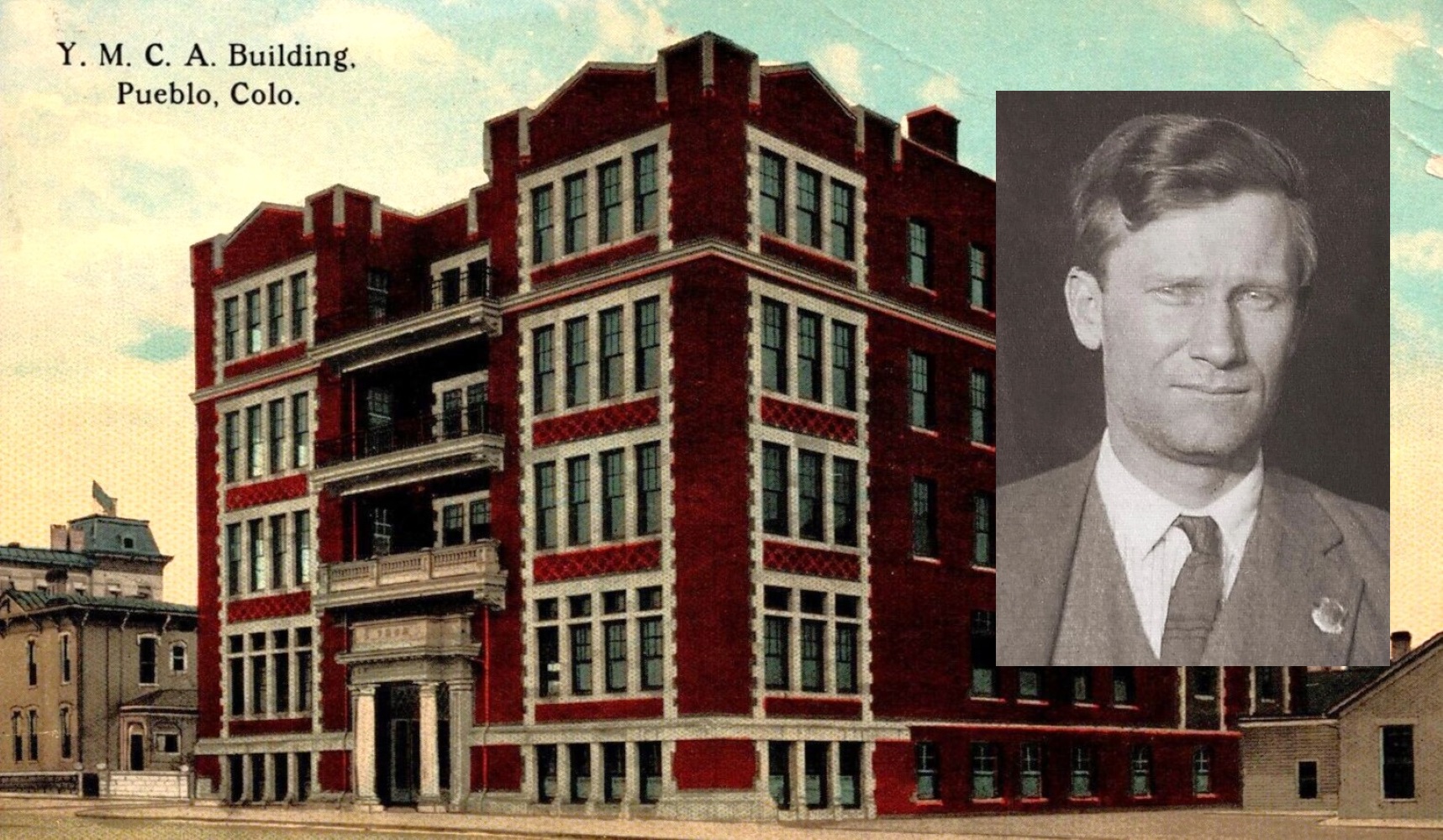
Acting as head of the International Labor Defense, Cannon visits, and describes, the town of Pueblo, Colorado during the bitter 1927-8 strike against the Rockefeller’s Colorado Fuel and Iron Co., which ran the state.
‘Colorado, Realm of the Rockefellers’ by James P. Cannon from the Daily Worker. Vol. 5 No. 72. March 26, 1928.
PUEBLO is the hub of the southern coal fields in Colorado. Its single industry is the huge steel mill of the Colorado Fuel and Iron Company, the same Rockefeller concern that dominates the coal industry here. It claims 60,000 inhabitants and is listed in the atlas as an independent municipality, but I did not encounter a single person among the many to whom I spoke during my visit there who showed this illusion. “The C.F. and I” is omnipresent and, in popular opinion, omnipotent in Pueblo. It is the largest steel plant west of Chicago and employs about 6000 men. It squats over the town like an ugly and menacing monster, watching, ruling and regulating everything. No feudal lord ever exercised more arbitrary power over human lives than does this awesome company of the Rockefellers which everybody calls by its initials, “The C.F.I.” Thousands grow up, work out their lives and die without ever being free from the fear and terror of its vindictive power.
A PUBLIC meeting of such an organization as the International Labor Defense is a big event in Pueblo, for the little band of courageous comrades who organize it as well as for the company. The C.F. & I. never sleeps and never gets careless regarding the possible outcome of radical speeches. A large part of my audience consisted of company gunmen, spies and officials who came to watch and to intimidate, to impress the workers with their determined opposition to such meetings and to take down the names of those daring to attend.
THE rule of the C.F. & I. is not confined to its 6000 employes during working hours. It pervades the whole life of the community, utilizing various methods and institutions. It has its officials directly elected to the School Board and puts “Company men” in other public office without much camouflage. There is a big company store, a company church, a company Y.M.C.A., and a company hospital. All have plenty of customers. There is even a special Christian Endeavor lay-out conducted in Spanish to serve the spiritual needs of the Mexican workers along company lines.
THE company hospital is an imposing edifice and is an object of company pride. The hospital, I was told, has 85 nurses and 27 doctors and a number of other things which I have forgotten. The Pueblo plant is called the “Minnequa” Steel Works, and the company hospital bears the same euphonious Indian name. I asked the man who was showing me around to tell me the meaning of this Indian word “Minnequa.” “It means,” he said, “man, be quiet!”
“THE Steel Works ‘Y’ keeps ’em young and spry!” is the snappy slogan on a poster advertising the efficacy of the gymnasium as a means of keeping the joints from getting rusty during slack time and lay-offs. It is reported or rumored that the Rockefellers have endowed many “Ys” and other institutions of Christian Endeavor and Exercise, but they made the workers in the Minnequa plant pay for their own. Every man in the plant had to donate a day’s wages to the building of the company Y.M.C.A. If they don’t go and get their money’s worth of exercise, it’s their own fault.
IN this Realm of the Rockefellers a group of comrades carry on their work with fortitude and perseverance that is a real inspiration to see. The head and front of the group is a woman, the wife of a steel worker, whose name I will not mention. Nothing daunts her. Through poverty, terrorism, the menace of the blacklist, threats of violence and prosecution, she goes on with her work, with demeanor unruffled and faith undimmed. Company spies and thugs quail before her. We rode around town with her in an automobile belonging to her family to see this and that comrade whom she had on her list for visitation and prodding up. She was unable to drive, although the car had been in the family a long time, and Comrade Showan took the wheel. I asked her why she didn’t learn to drive and she answered with a trace of confusion, “I guess I am afraid.”
As a contribution to the campaign of the party to get the members to vote and take part in the elections I offer the story told me by a Pueblo Comrade, who said he has been voting since he was 16 years old. “I had come from the old country and I was working in the coal mines of Colorado,” he said, “when the Superintendent told us to lay off next day and vote for McKinley or we wouldn’t have any jobs next day. “I told him I was only 16 years old, but he said that didn’t make no difference, no vote, no job, so I voted. “The next year in Montana it was the same thing on election day, only this time we were told to vote for the Democrat or there would be no job.
“That night I ran into a socialist meeting and heard Debs speak. I liked what he said and the next day I voted for him and kept on voting for the socialist party every time till 1924 when then I voted for Foster. “Who is going to be the party candidate this year?”
The Daily Worker began in 1924 and was published in New York City by the Communist Party US and its predecessor organizations. Among the most long-lasting and important left publications in US history, it had a circulation of 35,000 at its peak. The Daily Worker came from The Ohio Socialist, published by the Left Wing-dominated Socialist Party of Ohio in Cleveland from 1917 to November 1919, when it became became The Toiler, paper of the Communist Labor Party. In December 1921 the above-ground Workers Party of America merged the Toiler with the paper Workers Council to found The Worker, which became The Daily Worker beginning January 13, 1924.
PDF of full issue: https://www.marxists.org/history/usa/pubs/dailyworker/1928/1928-ny/v05-n072-NY-mar-26-1928-DW-LOC.pdf
 Revolution's Newsstand