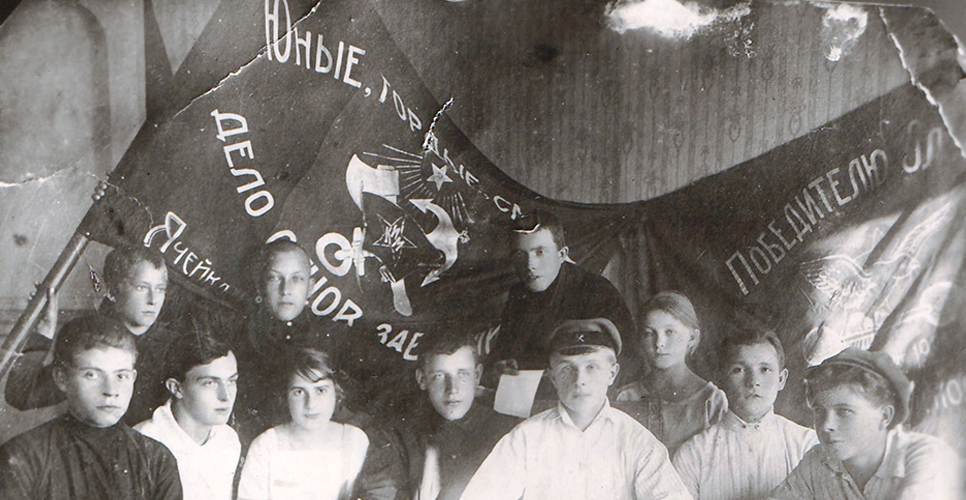
A valuable short history of youth organizations in the Revolution and the formation of what would become the Young Communist League.
‘The Young People’s Movement in Russia’ from Soviet Russia (New York). Vol. 2 No. 8. February 21, 1920.
Before the February Revolution of the year 1917 there was in Russia no movement of the young people of the working class, as far as the existence of special young people’s organizations was concerned. e youth of the working class was represented in the illegal, underground, general socialistic circles and organizations and comprised in them the most advanced element. The young people’s circles existing here and there were very slight, as a result of their working conditions, and consisted in the majority of cases of intellectuals and students attending the gymnasia or engaged in graduate or private study. Only among the Polish and Jewish youth were there germs of young people’s organizations.
The bourgeois young people’s movement also appeared very weak. Even the bourgeois youth and that of the petty-bourgeois intelligentsia was not organized, to say nothing of the youth of the working class, who remained away from the liberal and Christian young people’s societies. The organizations of the youth of the schools, labor units for the cultivation of the land belonging to men at the front, the organizations for aid to wounded soldiers, etc., were very small in number, and collapsed at the first breath of the Revolution before they had had a chance to develop. The February Revolution gave the working and peasant youth of Russia a chance to proceed to the building up of their own organizations. Throughout Russia great activity began in this direction.
The first to be established was the Petrograd organization. Immediately after the outbreak of the February Revolution organized groups were formed in the large works and factories of Petrograd among the working youth. The latter were particularly numerous in the three great factory districts of the city, in the Narva, Peterhof, Viborg, and Neva quarters. After the organizing, at first on the basis of city districts, these groups later formed a general city organization, named “Labor and Light.” The fact that bourgeois-liberal elements had sneaked into the organization accounted for the absence of any political platform; the organization pursued solely cultural and educational aims, and its program of work continued a good deal of chauvinistic appendages. It may be well understood that such an organization could not long satisfy the radical element. And so it happened that in June, 1917, an independent group was formed for the purpose of founding a new “Socialist Federation of Working Youth.” Several city district organizations that had seceded from the “Labor and Light” at once joined the new organization. On August 18, 1917, the first general city conference of the working youth of Petrograd took place. It did away completely with the “Labor and Light” society and sanctioned the “Socialist Federation of the Working Youth of Petrograd” as the sole unified organization of the young workers. At the same time the Conference joined the Young People’s International. Although the political platform of the new organization was of a general socialistic nature, its activity from the first stood under the sign of Bolshevism. Only isolated intellectuals stuck to the Right or Centrist Socialist groups. But this was true of very few of the young people of the working class and very rare in the case of juvenile workers.
The sphere of work of the Socialist Federation of Working Youth included activity in political, cultural, and educational fields, then the protection of the economic interests of the young people. Training conscious fighters for Socialism, raising of the general level of development of the young people, the six-hour day for juveniles below 18 years of age, the abolition of night work, and other measures for the protection of young workers—these were the essential points of the working program of the Socialist Federation of Working Youth. The organization was divided according to city districts. The membership was not particularly large, at one time attaining the number of 16,000. The society worked in close connection with the Petrograd Bolsheviki, but at the same time was regarded as an independent organization. The Petrograd society published the magazine called The Young Proletarian, the first number of which appeared on November 15, 1917. The society defended the Revolution with arms. Thus in February, 1918, at the time of the advance of the Germans the society went to the front nearly en masse and there organized fighting divisions of the young people’s federation. Petrograd remained without active members and the organization approached dissolution. Only after the conclusion of the Brest peace it was reorganized, and it has continued its activity to this day. All through, many members of the organization have been active in the Red Army, Communist, Soviet, and other workers’ organizations of adults.
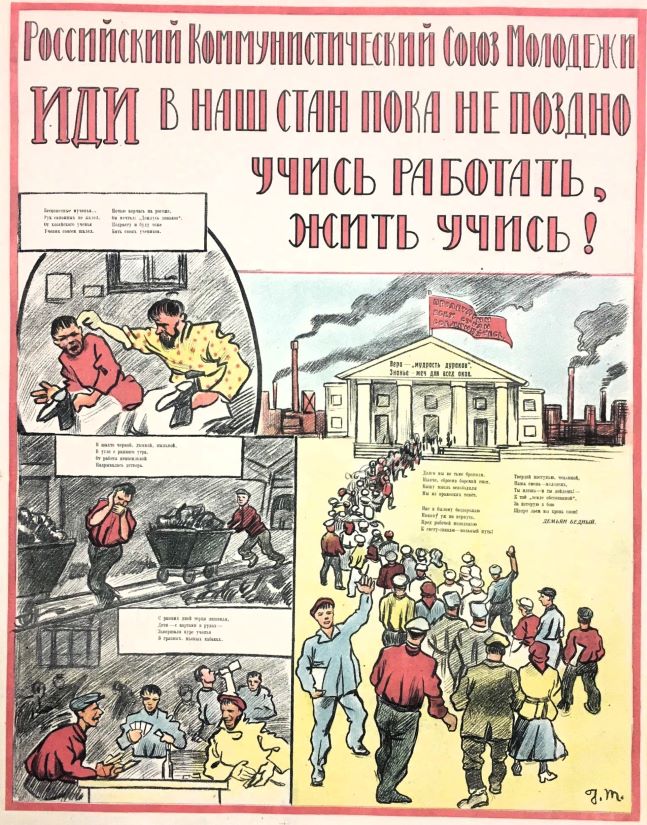
In June, 1917, there was founded in Moscow the organization known as the Society of Young People with the Moscow Committee of the former Russian Social-Democratic Labor Party, or Bolsheviki. The great majority of the members were young workers. Only expressed Bolsheviki were accepted for membership, although without compulsion of party membership. The purpose of the society was to deepen the Marxist view of life among its members, to spread Bolshevist ideas among the working youth, to protect the economic interests of juveniles, to further general intellectual development, and not least to work for active membership in the party. There were 200 members. The activities of the society were in close conjunction with those of the party. It was formally a subordinate division of the party.
The sixth party conference of the Bolsheviki, held July-August, 1917, adopted a resolution regarding the organizing of the young people which says that the young people’s societies must be spiritually bound up with the party but must at the same time retain their independence. In view of this resolution, and as a result of the necessity of carrying the work out into the widest masses of the young people, the society was reorganized. In the program of the new organization, “The Federation of the Working Class Youth of the Third International,” it was announced that the organization would fight on the one hand against the Social-traitors, and on the other against the Anarchists as a petty-bourgeois movement. Meanwhile the society united great masses of non-partisan, politically uncertain working class youths. The number of members vacillated between 2,500 and 4,500. The mass of the young people soon came under the influence of a central division of young Bolsheviki and were soon convinced of the correctness of Bolshevik ideas. The society did political propaganda work and cultural work, at the same time developing great activity in the field of labor protection for juveniles by advancing among other things the demand of the six-hour working day for young workers up to the age of eighteen, supported the party in its daily running work and provided the party from its own ranks with new fighters for Socialism.
In the days of the October Revolution, during the fight with the counter-revolutionaries in Ural region, on the Don with the Czecho-Slovaks, at the time of the advance of German imperialism against Soviet Russia and at the present moment when the republic of the proletariat is fighting numerous enemies, the Moscow branch of the Federation of the Working Class Youth of the Third International, as well as the branches of the other cities, sent out many fighters for Communism who, first in the ranks of the Red Guard and now of the Red Army, have proved objectively that the proletarian is able to give his life when it is a matter of liberating himself.
We spent more time describing the Petrograd and Moscow organizations because they are regarded as the models upon which the organizations of the working class youth of the country at large have been built up, and while the latter bore different names, they did essentially the same work.
Very shortly after the February Revolution young people’s organizations were formed, not only in the capital cities and in larger towns in the country at large, but even in smaller towns and factory settlements, and even out in the country. While in the cities and in the individual factory plants the societies of the young people were pure class organizations in their make-up and in their purpose, the newly formed organizations of the peasant youth in the country were to serve in most cases purely cultural and entertainment purposes. More rare was the formation of societies of a socialistic character in regard to their purpose. Such organizations were grouped mainly about factory towns, the working youth of which performed organizing work among the peasants in the surrounding villages. However, the greatest part of the peasants’ organizations were far removed from politics. They adopted the most sentimental names, such as “Awakening,” “Dawn,” and the like.
The October Revolution gave the young people’s movement the next impetus and advanced the spontaneous arising of organizations and furthered their activity. Immediately after the October Revolution there arose in Petrograd and Moscow the idea of calling an All-Russian Congress, and in that connection came up the necessity of an All-Russian young people’s organization. But there were many hindrances in the way of the convening of such a Congress, thus first of all the grave political events, the difficult situation of Russia and other factors. Nevertheless, in October, 1918, it was found possible to call the Congress. It was opened on October 29 and remained in session until November 14, The Congress was attended by 178 delegates representing 20,000 members. The results of the Congress were the organization of the work on an All-Russian basis, the setting up of a general program, and the working out of a uniform constitution, then the formation of the All-Russian Communist Young People’s League, and the election of the Central Executive.

At the present time the League has a membership of 70 to 80 thousand juvenile workers and peasants, united in 600 to 700 organizations. To the All-Russian Young People’s League belong the young people’s societies of the Ukraine, Lithuania, and White Russia, forming two organizations, the Communist Society of Working Class Youth of the Ukraine and the Communist Young People’s Society of Lithuania and White Russia. Thus both form a part of the All-Russian Communist Young People’s League. The first-named has 10,000 members and has branches, particularly in the cities. The first Congress took place in Kiev July 25, 1919. The other, as a result of the occupation of Lithuania and a considerable part of White Russia by White Guards was at the time paralyzed. The individual societies in Russia are divided according to provincial and district areas; often sectional congresses and conferences are called.
The main body of the League are working and peasant youths and only a small part belongs to the Communist intelligentsia. The young workers and peasants are accepted freely as members, while an intellectual must first have recommendations and a test period. The League has several printed organs. In all there are at present 15 magazines and 2 dailies. The central organ of the League, The Young Proletarian, appears in Moscow. The strongest organization is in Petrograd and has over 6,000 members, distributed over 14 district organizations. Each of the latter has its own club and in the various factories and shops party groups. From the members of the League was formed a division of 1,000 troops, a part of which is now serving on the Petrograd front, while the rest are protecting the interior of the city. Recently the League had a mobilization which called several thousand of the members to arms. Many active workers are thereby called away, and this hampers the work. In some villages societies’ activities were suspended because of the absence of the best workers. Meanwhile the activity of the League has not been completely stopped, and it is being strengthened and extended visibly by the addition of new unused forces from among the working youth.
For the 5th of October the Central Executive has called the second All-Russian Congress of Young People’s Societies, which will without a doubt strengthen the young people’s movement in Russia and advance its development to a high degree.
Moscow, July 25, 1919.
Soviet Russia began in the summer of 1919, published by the Bureau of Information of Soviet Russia and replaced The Weekly Bulletin of the Bureau of Information of Soviet Russia. In lieu of an Embassy the Russian Soviet Government Bureau was the official voice of the Soviets in the US. Soviet Russia was published as the official organ of the RSGB until February 1922 when Soviet Russia became to the official organ of The Friends of Soviet Russia, becoming Soviet Russia Pictorial in 1923. There is no better US-published source for information on the Soviet state at this time, and includes official statements, articles by prominent Bolsheviks, data on the Soviet economy, weekly reports on the wars for survival the Soviets were engaged in, as well as efforts to in the US to lift the blockade and begin trade with the emerging Soviet Union.
PDF of full issue: https://www.marxists.org/history/usa/pubs/srp/v1v2-soviet-russia-Jan-June-1920.pdf
 Revolution's Newsstand