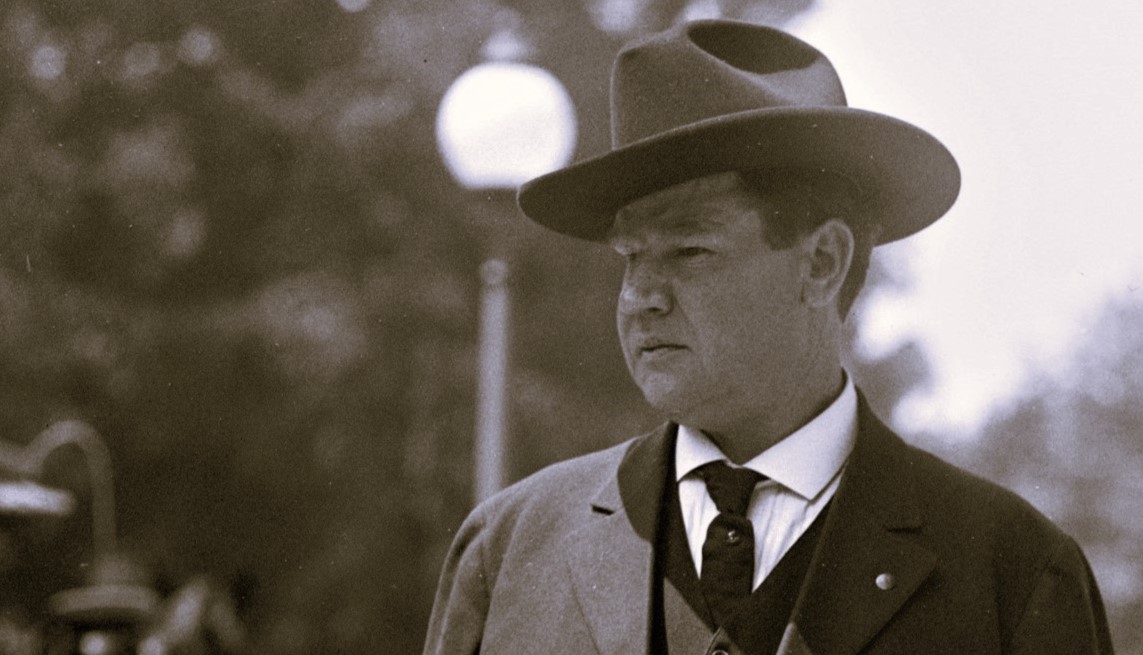
A delightful account of Bill Haywood’s impact as he tours California to build the left wing in the Socialist Party and campaigns for a seat on the national leadership, which he would win the next year.
‘Haywood in California’ by J. Edward Morgan from The International Socialist Review. Vol. 12 No. 3. September, 1911.
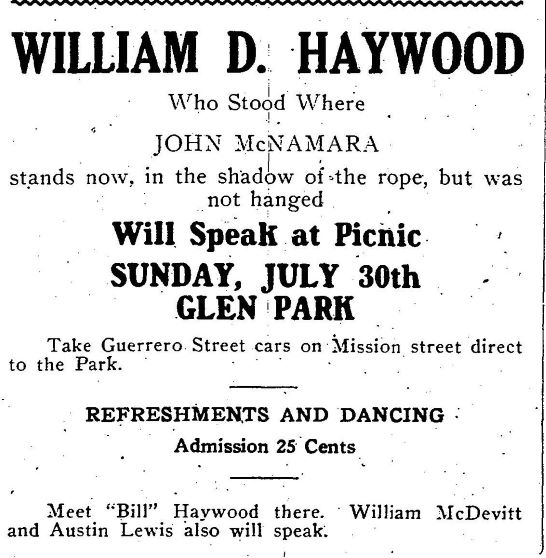
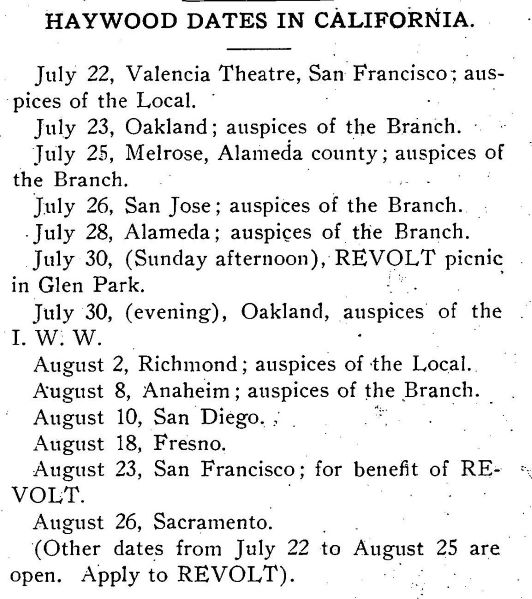
PACKED halls; aroused audiences; warm greetings, clamorings for more dates; long and enthusiastic after discussions among near, far and clear Socialists, craft unionists and industrialists, onlookers and sympathizers; a painstaking, apathetic labor press and a scrupulously silent capitalist press; all rebels alert and alive, smiling, watching, daring and doing; honest minded craft, unionists sharply listening and going home asking themselves questions—straws these that point the meaning of Haywood’s meetings in California.
Haywood comes with no message of divine deliverance kept sacred through centuries of slavery by the sleeping gods. No new, god-inspired interpretation of “Natural Rights,” “Mosaic Leadership,” “Cosmic Oneness,” or “Messianic Consciousness.” Slighted by the gods and abandoned by the saints, with the keen grasp of the class conflict glinting in his eye, the heat of class loyalty quickening his pulse and the clarion call of battle on his tongue, he came, he said: “To pull the mask from society, strip it stark naked, and make its brutal hideousness so plain that even a preacher might understand the class struggle.”
And this he did. As Mark Antony lifted Caesar’s bloody robe and pointed dead Caesar’s wound, unmasked the conspirators, so Haywood lifted prostrate labor’s bloody pall, pointed the cankering wounds, the centuries of added insults, wound on wound, blow on blow, then tore the mask from King Capital’s snarling jowl and cried: “He did it. Labor’s friend. Your brother. Here is the Class Struggle. The battle of the brothers!”
Through England, through France, through Spain, Russia, Germany, Japan; China; through Canada and Mexico, back to the U. S. by way of Los Angeles and the lair of “The Old Gray Wolf.” We followed appalled, aghast at what we saw and heard. Everywhere the same prostrate, mangled form of labor; everywhere the same gloating, blood-spattered monster of the Iron Heel, crushing, despoiling, enslaving.
During that two hours we journeyed on that hell-bent pilgrimage with Haywood all illusions vanished. Not a prayer was said, not a psalm was sung; not a resolution written or a vote cast. Some inaudible sermons were preached by awakening conservatists by way of self expression, with a “by damn it,” and Johansen French phrases for benediction. I believe the preachers and moralists present got a sniff of the class struggle, choked and floundered and bedizzened by the grit and grind, the gouge and grapple, the blood and hell of the class war through which Haywood dragged them. Race consciousness got an awful jar, with a class conscious rebel of bull-pen psychology ripping the cloak of hypocrisy from society to the holy horror of its defenders.
The lawyers got a soulful gaze at the niche they fill in society; and the detectives had the exquisite pleasure of watching Haywood vainly striving to drop a plummet to the bottom of their depravity.
The working men and women saw amazed and maddened the hideous picture of the class war. Found themselves born into this slavery and about to die enslaved in mind and body. They craned their mental necks in agony for a way out. Haywood, unlike Gompers, pointed the way out. Everyone looked and saw a clear path the way Haywood pointed. From the clouds their gaze was turned earthward and inward. Moses and the leadership of modern saints was forgotten. All seemed to marvel at working class stupidity. Craft unionism got a terrible jolt when the big audience saw labor on its knees giving up a half million dollars to kidnappers to ransom one of their fellow slaves held captive for his loyalty to his class, when to simply remove the arm of labor from the wheels of industry would bring the kidnappers to meek and mild submission.
It was rough usage—too rough for sensitive souls—when Haywood said: “In a pinch we might get along without the preacher.” Were I a preacher I would doubtless resent the sting and preach him to hell and back again and chase him through all hell’s dominions. He would have to acknowledge me a part of the divine plan for the salvation of his impudent soul.
Think of getting along without Billy Sunday! With twenty-five thousand souls saved a year at only two dollars a head! (Or should I say two dollars a spook? Do souls have heads?) Think of the Socialist craft afloat, adrift, hellbent, with not a heavenly pilot aboard to steer it into the ethereal waters of “Messianic Consciousness.” The rough-neck may build the craft, load the freight and hoist sail; his cleverness of brawn and brain take this coarse and peculiar turn. Hide, muscle and bone, with a steering brain—the material man for this unimportant, vulgar, material work. But such tugged hands and jagged souls, daring wind and tide to do their worst, lured by the savage call of the wild, will steer for the open seas. Vain of their pent-up power, mad at the call of. Freedom, they will throw old charts and Mosaic codes to the winds, ignore the heavenly pilot, and giving saintly leaders and push out into the black unknown; shoo the surry-fum and cherry-bum. from paradise, chase the bogy man through hellgate and capsize the craft in the devil’s private fishing pond and the New Jerusalem go up in smoke.
Strong muscles and brave hands to build the craft, but more delicate hands and finer souls to steer it through troubled waters! “Those soft, sensitive, pudgy hands can’t man the wheels,” says Haywood. “Take yours away for a week and let them try it. When they get over trying, McNamara will go free.” So Haywood believes that soft, spongy, race-conscious souls, halting and timorous, cannot be trusted to guide the Socialist craft through the stormy waters of class-conflict.
Haywood’s coming to California is opportune. The Socialist Party here seems to be afraid of its shadow; of its very name; of its own voice—that is, afraid of itself. Trying to make itself pleasing to itself, for the sake of pleasing its enemies, it has bit off its own head. its tail, coughed up its entrails, sun-dried and sugar-coated them, then swallowed them with the oldest and shrewdest political adventures in California officiating at the delectable ceremony.
The clear voice of the man on the revolutionist’s job sounding the slogan of class battle will help the shame-faced Socialist to stand once more on his own legs and listen to his own voice without heart failure.
Here’s hoping Haywood will stay on the job until the workers get the goods and THE Review outgrows every capitalist sheet in the land.
The International Socialist Review (ISR) was published monthly in Chicago from 1900 until 1918 by Charles H. Kerr and critically loyal to the Socialist Party of America. It is one of the essential publications in U.S. left history. During the editorship of A.M. Simons it was largely theoretical and moderate. In 1908, Charles H. Kerr took over as editor with strong influence from Mary E Marcy. The magazine became the foremost proponent of the SP’s left wing growing to tens of thousands of subscribers. It remained revolutionary in outlook and anti-militarist during World War One. It liberally used photographs and images, with news, theory, arts and organizing in its pages. It articles, reports and essays are an invaluable record of the U.S. class struggle and the development of Marxism in the decades before the Soviet experience. It was closed down in government repression in 1918.
PDF of full issue: https://www.marxists.org/history/usa/pubs/isr/v12n03-sep-1911-ISR-gog-Corn.pdf
 Revolution's Newsstand