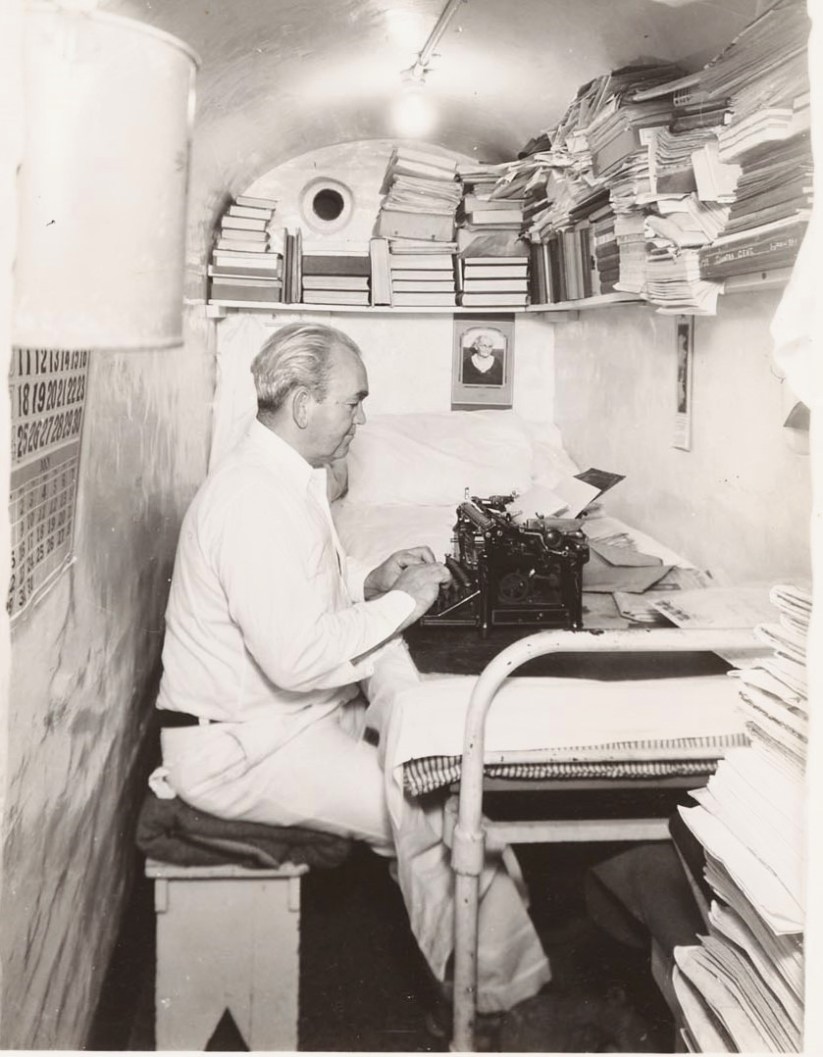
Prison is hell for all who must endure it, but political prisoners have it especially rough. Not just ‘special’ treatment while inside, but separation from the movement they’ve dedicated their lives to on the outside. Vern Smith writes on the inauguration the I.L.D.’s Committee for Books for Political Prisoners to address what the prisoners themselves say is a central need.
“Send Me Books to This Prison Cell” by Vern Smith from The Daily Worker. Vol. 9 No. 313. December 31, 1932.
Some Personal Experiences; Vivid Letters from Class War Prisoners
SUPPOSE you go to jail. We have to carry on the fight, and some losses are certain. The casualties are replaced many times over, the fight goes on–but suppose you just happen to be one of the casualties?
You know you have some duties. You have to make your case useful to the workers. You have to plan your defense, do what will make the right sort of agitational publicity. You have to send out and sometimes smuggle out statements and exposures. You have to conduct yourself in court with judgement, and a certain audacity, turning everything to your use and the use of your fellow workers. You have to take the offensive. You do what you can to win the case, but most of all, you make the case show up the capitalist system, and lead other workers to struggle.
If you are convicted, the chance to do propaganda is not ended, but it is much harder. There are more vexations, interferences; more subtlety and ingenuity is required of the prisoner.
And if, as sometimes happens, they watch you so closely, you can do little but endure, that, too, is useful, and has to be carried on with staunchness and courage, and a constant alertness for the chance to change from a passive to an active role.
Well, while you are doing all this, either in jail or “the pen” you’re locked up, your movements considerably circumscribed, your food is bad, your news of the struggle outside cut down, and there is some danger. You may be third-degreed, lynched or framed. If you are caught in the monotonous machinery of the “Big House” you still have some risks of abuse, etc. Time wears on you. You are under a nervous strain.
CONFINEMENT MAKES YOU JUMPY
Just at the time you need your greatest keenness and best judgement, conditions make it hardest to exercise good sense. Confinement, either isolation or enforced companionship and overcrowding with other prisoners, makes you jumpy. Some brood and grow morose. Some get into a quarrelsome mood, leading to disgraceful “jail rows” in which even comrades fight each other over little things that outside would cause only a passing frown. Some feel that they are cut off from activity, forgotten. Usually there is an aggravating sense of time being wasted. However, you reason against it, everybody suffers more or less, in a way that impairs efficiency just when it is most needed. Now the best way to keep up morale in jail is to be sure that your time is not being wasted, that you are not cut off, that you are preparing yourself for better activity once you get out. The warden or jailor treats you better if he sees that a lot of people outside are interested enough in you to send you papers and books. The best way to avoid the irritations of prison life is to be educating yourself and educating other prisoners. Or, even light reading “passes the time” and releases the tension, varies the monotony and in that elevates morale.
Until this year there was no central committee looking after just this part of the prisoners’ needs, in a systematic manner. Recently, however, there was founded the Committee for Books for Political Prisoners, a sub-committee of the National Committee for Defense of Political Prisoners and the Prisoners Relief Fund. It gets books anyway it can. Any donation, sent to the Committee, Room 337, 80 East 11th Street, New York, would be welcome. Usually in county and city jails second-hand books are allowed in; usually in prisons they must be sent new through the publisher. Books or money, therefore, would both be useful.
Some idea of the practical value of this committee’s work can be gained from the letters it has received.
SCOTTSBORO BOY WRITES
Haywood Paterson, one of the Scottsboro boys, framed and facing electrocution, writes from his death cell in Kilby Prison:
“I am proud of our friends and I wish that they knew that I really do appreciate all that they are doing for us…I just feel good tonight and feel like writing. Again I want to let you know that we received some books a few days ago, which you were so kind as to send us and they have been accepted and appreciated with the warmest gratitude. Our dictionaries are just wonderful…” Teddy Jackowski writes from the jail at London, Ohio: “Just I am not reply you immediately to your letter because I couldn’t write any time when I want, only when I get permission to write. And I was very glad to get them books. So I like to read them books. So I am very much appreciate for that books. I would like to get more if you could send me. Please forgive me of I the accurately do not write letter because I am foreign born.”
Irving Keith, from Deer Island penitentiary, Massachusetts (now released), wrote: “I would like to get whatever works on Marxist theory that you can get for me and also novels and other works by revolutionary writers. I most certainly appreciate anything at all to read. I prefer the above types, because my time would thus be spent in valuable reading and study for the revolutionary movement…Good books make good companions, especially in jail, and makes the time easier to serve.”
Jim Nine, one of the jailed tobacco workers, writes from Tampa County jail: “I recently received three books, entitled “Living Philosophies,” “Out of the Beaten Track” and “Grand Mothers.” Those books have been read not only by myself but by some of my comrades of struggle also, which are imprisoned with me in this county jail. We have established here in our cell block a lecture group and as the majority of the prisoners are nothing else but working class elements, it will be much better if you kindly could send instead of the kind you sent, books relative to the class struggle. We will appreciate especially if in the next bundle you send us books written by Karl Marx and Engels…Please see what you can do to send us the “Daily Worker” every day, and the Labor Defender magazine. We appreciate in all its value this help…”
Mike Burich, in the Allegheny County Jail, Pittsburgh, writes: “I enjoyed these books and I sincerely hope that you continue to send me other books. I am a member of the working class and I prefer history and facts about my class. History of strikes. In your book of “Living Philosophies,” I liked Theodore Dreiser best. Please send me books by such writers as Dreiser, Scott Nearing, Lenin and Marx.”
Mike Michlan from the county jail in Bellefonte, Pa., says: “Those books that the commit- tee has sent me were very interesting. I would rather have some fiction story books, because they are interesting in a place like this.”
WANTS MARXIAN CLASSICS
Oscar Ericson, Imperial Valley prisoners in San Quentin, (now freed) wanted books on the class struggle from the Marxian standpoint, and adds, “Including also books which give authentic information on the different phases of the social, economic and political struggles of the workers… and on the U.S.S.R. Then there are novels and stories written in the same spirit.” He mentions the censorship, and that books barred by the warden are usually sent back to the sender.
John Lamb, one of the Centralia boys sentenced to 40 years back in 1919, asks for Sinclair’s novels, and says: “I think that establishing your committee is a wonderful idea.”
Jim McNamara, sentenced to life on a frame-up by William J. Burns and the Los Angeles open-shoppers, thinks that such a committee must be composed of freaks, or else, why should they, in a Christian community want to do anything for workers in jail? Are not the capitalists Christians? But he says: “Inform our good friends that if we should ever get out and they should get in, we would do the same for them.”
Edith Berkman, while confined in a hospital in Massachusetts, facing deportation for leading textile strikes in Lawrence, wrote: “The Writers Report on Kentucky,” and “The Labor Fact Book,” and especially requests the committee to send some to Keith in Deer Island. She says: “I think that your organization is very much needed.” Warren K. Billings, sentenced to life after the Preparedness Day frame-up in San Francisco, wants a German grammar and some kind of German “first reader.” He is learning the language while in jail. You see, they want, and they need, all kinds of literature. And, in jail, they make the best possible use of it.
The Daily Worker began in 1924 and was published in New York City by the Communist Party US and its predecessor organizations. Among the most long-lasting and important left publications in US history, it had a circulation of 35,000 at its peak. The Daily Worker came from The Ohio Socialist, published by the Left Wing-dominated Socialist Party of Ohio in Cleveland from 1917 to November 1919, when it became became The Toiler, paper of the Communist Labor Party. In December 1921 the above-ground Workers Party of America merged the Toiler with the paper Workers Council to found The Worker, which became The Daily Worker beginning January 13, 1924.
PDF of full issue: https://www.marxists.org/history/usa/pubs/dailyworker/1932/v09-n313-NY-dec-31-1932-DW-LOC.pdf
 Revolution's Newsstand