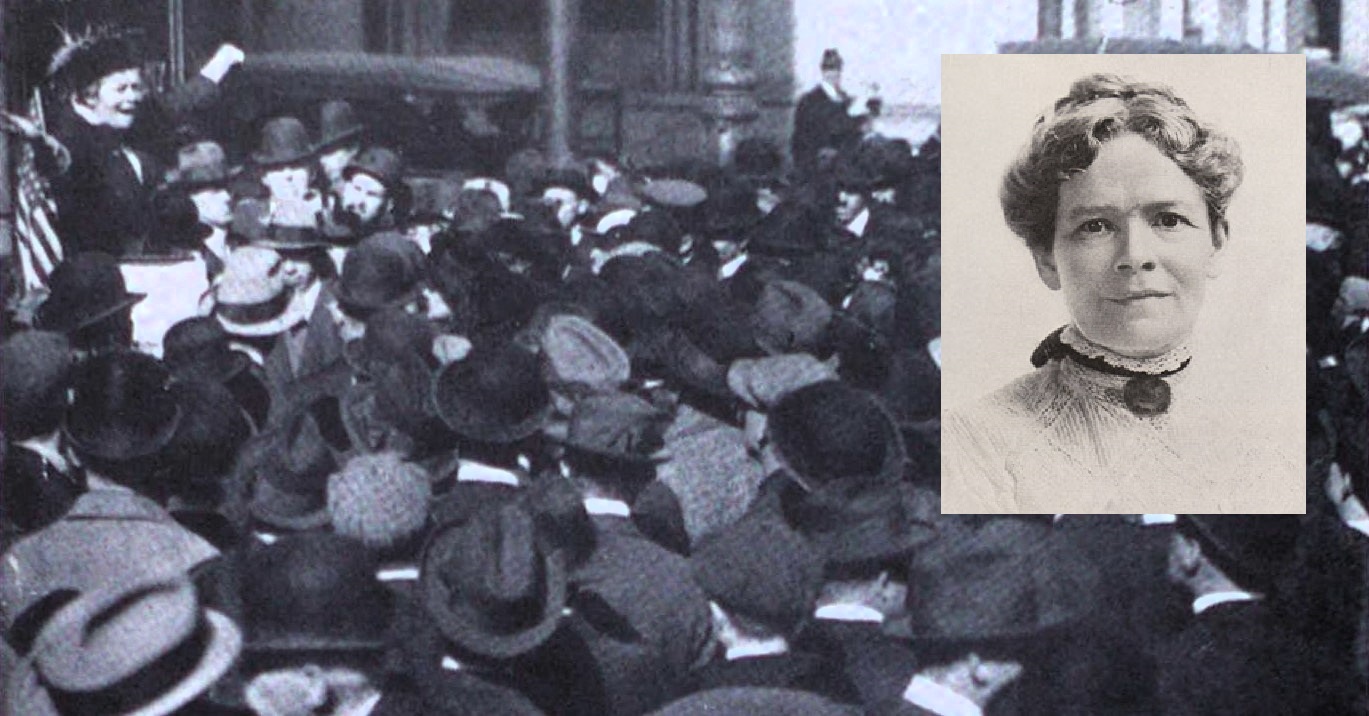
Born during the Civil War, Ella Reeve, later known as Mother Bloor (she had nine children, a number of whom became leading Communists), was a fixture on the left of the Socialist movement since 1897 when she first joined Debs’ S.D.P. to her death in 1951 in the Communist Party. In 1898, she moved to the S.L.P. for which she wrote this article on the strike led by the Socialist and Trade Union Alliance in Slatersville, Rhode Island.
‘Slatersville: A Great Historic Event’ by Ella Reeve Cohen from The People. Vol. 9 No. 12. June 18, 1899.
Facts Brought Out by the Strike Now Going On.
Slatersville, beautifully situated as it is, in the very heart of the high hills of Rhode Island has been suffering from the iron power of capitalism, even more than the average mill-town of the country. The mill owned by a corporation composed of the Slater family has been left in the hands of a Superintendent, while the family lived in Europe; one member only visiting Slatersville occasionally to put the screws on a little tighter.
One of our good comrades there told me that many times during the winter he had but $4.00 in his pay-envelope on Saturday night to take home to his wife, and three children. As he was one of the most skillful weavers of the suitings manufactured by this mill the conditions can better be imagined than described.
The pressure of such degradation has driven the weavers to desperation. There has been an exodus from the village of all who could obtain money enough to go away, or any hope of getting work in other towns. Those who remain are determined to win in the battle now on between the Alliance and the Superintendent of the mill.
During my visit to Slatersville I realized as never before the educational force of the Alliance, its power as a maker of Socialists. Providence comrades had helped them in their selection of literature and here they had a veritable University of Socialism at their headquarters. Not a home in the village, perhaps, contained more than one or two books, and here they could read undisturbed, here they held many discussions. One after another, the young men gave me such testimony as this: “I have been made a Socialist by the Alliance”: “the Alliance has convinced me that the Socialist Labor Party is the only party for the workingman”; and so on.
This reading and thinking has developed a body of men and women, holding firmly together, determined to “fight it out” along Socialist lines even in the very face of starvation. As I talked with the women in their homes, I found that they were upholding their husbands and fathers; that they, too, realized the importance of this STRIKE FOR PRINCIPLES.
At the open air meeting in the evening there was an attendance of nearly four hundred people. Men and women stood for two hours listening eagerly to the Gospel of Socialism, and words of encouragement from comrades of Providence, Woonsocket and New York.
The political effect of this economic struggle is already in evidence. The voters of the town of North Smithfield, which includes Slatersville, held their annual town meeting for the election of officers at a hall in Slatersville the Monday following the open air meeting of the strikers at which I was present. The Socialist Labor Party had candidates for Town Assessor and Town Sergeant. William F. Taylor, candidate for Assessor, was the Slatersville comrade who was discharged by Supt. Holt as “working against the interests of the corporation,” meaning his work in the previous strike, his article to THE PEOPLE explaining conditions in Slatersville, and his determined stand for the increase of pay and recognition of the Socialist Trade & Labor Alliance. Immediately after his discharge, after a meeting of the Alliance, the one hundred and thirty men and women, who are now striking, left the mill in a body.
He received 50 votes; the Republican 139, and the Democrat 104. This shows an increase of the vote in this district.
Timothy Manning, the S.L.P. candidate for Sergeant, received 60 votes. The Socialists also exerted a moral influence on the election. The papers from Woonsocket say that the Socialists were responsible for the politicians of the old parties “putting out their tickets in a more reserved manner.” One paper says: “During the day there were a great many clashes between the leaders of the old parties and the Socialists. The latter were determined to stop any attempt which might be made to purchase votes, but in spite of the vigilance it is said that there were a number who cashed their checks as soon as the result was announced.”
We have in this strike at Slatersville a union of French, English, Irish. Scotch and American workingmen and women demanding better economic conditions with a recognized political force backing them in their struggle. Is it not imperative that the Socialists in every corner of our land should see to it that they have the financial support necessary to complete the victory? It is a matter of vital importance, the money must reach them at once. Mill workers are watching their struggle in every town and village in Rhode Island and many are contributing from their own meagre wages, notably the workers of one large rubber trust factory, themselves suffering under bad conditions, contributed in one afternoon the sum of twenty dollars. If we win, as we expect, it will be a victory not alone for Slatersville, but a triumph for the whole working class organized as a political body against the capitalists.
New York Labor News Publishing belonged to the Socialist Labor Party and produced books, pamphlets and The People. The People was the official paper of the Socialist Labor Party of America (SLP), established in New York City in 1891 as a weekly. The New York SLP, and The People, were dominated Daniel DeLeon and his supporters, the dominant ideological leader of the SLP from the 1890s until the time of his death. The People became a daily in 1900. It’s first editor was the French socialist Lucien Sanial who was quickly replaced by DeLeon who held the position until his death in 1914. After De Leon’s death the editor of The People became Edmund Seidel, who favored unity with the Socialist Party. He was replaced in 1918 by Olive M. Johnson, who held the post until 1938.
PDF of full issue: https://www.marxists.org/history/usa/pubs/the-people-slp/990618-thepeople-v09n12.pdf
 Revolution's Newsstand