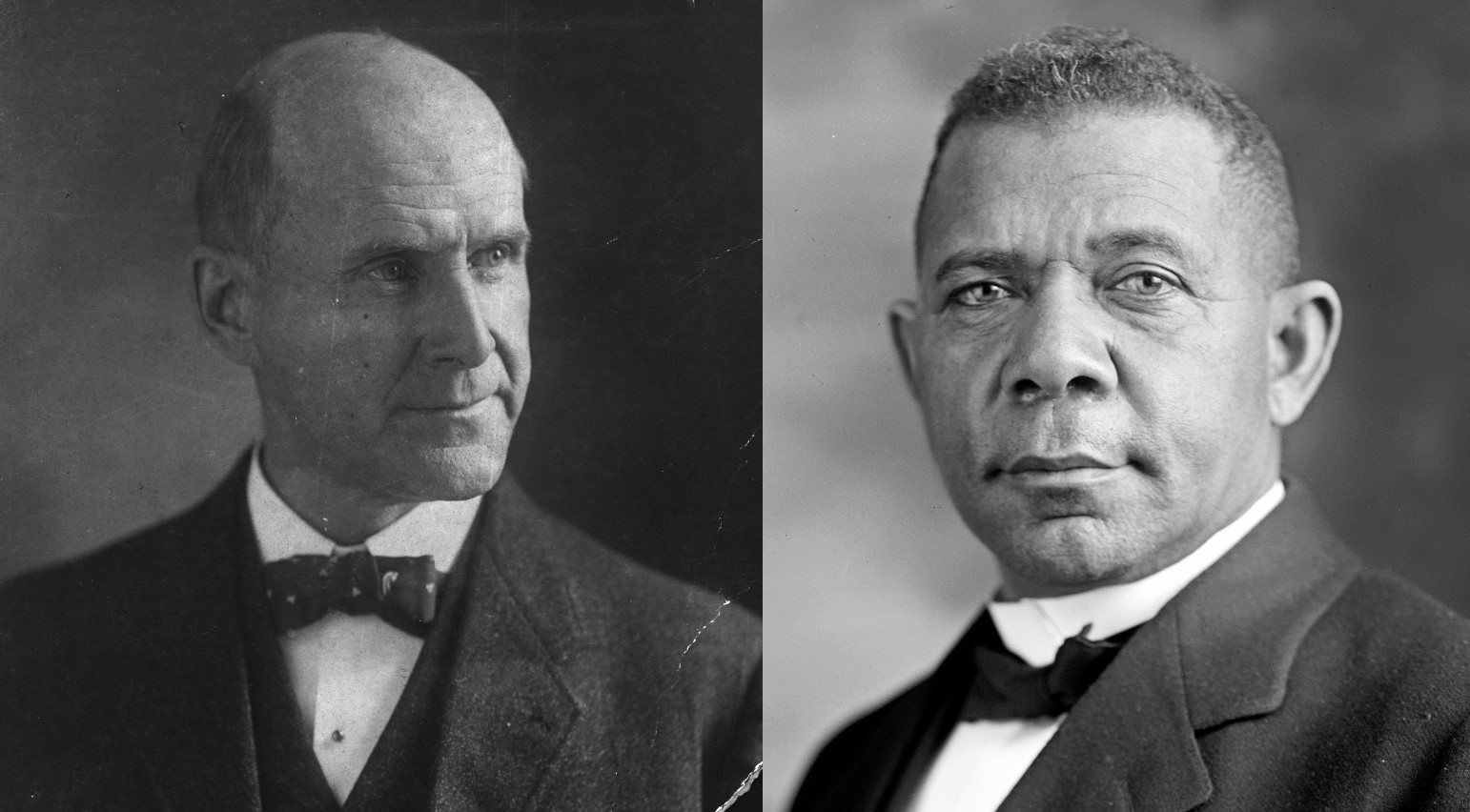
An important document for assessing Debs’ and the larger Socialists movement’s orientation at the time to Black liberation, in a country whose politics are defined by race. While Debs would certainly develop his views over the decades, becoming ever more conscious of Black demands, he never denied that winning Black workers and the struggle against racism were central to the U.S. class struggle. In this 1903 letter to the Indianapolis World, a Black newspaper from Debs’ home state, he answers a question put to him: “Booker T. Washington advocates industrial education for the Negro. Is the attitude of labor unions toward black labor compatible with the teachings of Washington? The World is a colored newspaper and would like to publish your views.” They also asked the President of the National Association of Manufacturers and attached his reply. Debs answers them both.
‘Debs on the Race Question’ from The Worker (New York). Vol. 13 No. 13. June 28, 1903.
Able Reply to Manufacturer Parry.
White and Black Workers Must Recognize the Identity of Their Interests–Criticizes Booker Washington’s Counsels of Servility–Race Division Fatal to the Cause of Freedom.
The following letter, under date of May 23, 1903, has been received from. Mr. Gurley Brewer, Editor of the Indianapolis “World,”:
“The ‘World’ is investigating Industrial conditions among colored people. Booker T. Washington advocates industrial education for the Negro. Is the attitude of labor unions toward black labor compatible with the teachings of Washington? The World is a colored newspaper and would like to publish your views.”
To this letter there was attached a clipping from the “World” containing an article from Mr. D.M. Parry, President of the National Association of Manufacturers, in answer to the same question, the burden of which was that organized labor is a trust and that a majority of its members are opposed to the colored workingman, especially in reference to the teachings of Mr. Washington. His arraignment of organized labor closed with the following remarkable paragraphs: “Mr. Washington is doing more than merely teaching his fellow Negroes; he is emancipating them from artificial conditions that act as a bar to their progressive development as a race” “Driven from the opportunity of learning to be artisans in the shops, their only hope is the technical schools such as Washington conducts….The chief hope of the younger generation of whites is also the technical school.” First, let me say that all my life I have opposed discrimination, political, economic, or social, against any human being, on account of color or sex, regarding all such as relies of the ignorant, cruel and barbarous past.
Capitalists Foster Race Hatred.
Next, there was a time when organized labor in the main was hostile to the Negro, and it must be admitted in all candor that certain unions, such as the railroad brotherhoods, still ignorantly guard the trades they represent, as well as their unions, against invasion by the colored man, and in this they have always had the active support of the corporations whose interest It is to have workingmen at each others’ throats, that they may keep them all, black and white, in subjection.
Indeed, it is a fact, that wherever labor unions, now or in the past, opposed the Negro, such opposition was inspired, or at least encouraged by the employing class represented by Mr. Parry, who now seeks so assiduously to place the responsibility on the poor ignorant dupes of his capitalistic master.
At Montgomery, Ala., some years ago, a riot was almost precipitated at the Instigation of the “upper class,” because the labor union under whose auspices I spoke, proposed the admission of Negroes to the opera house, on the floors reserved for white people, and the proprietor of the house declared that the house should be burned to the ground before any “damned n***r” should have access to it.
The ignorant members of labor unions, and there are many such, thanks to the system of wage-slavery Mr. Parry so ably defends, who still oppose the Negro, unconsciously echo the interests of their industrial masters, while those who know better and fight the black man are spies and traitors in the service of the same masters.
The convention of the American Railway Union which resulted in the great railroad strike of 1894, after a fierce and protracted debate, turned down the Negro and this was one of the factors in our defeat. The members of the opposition, as I remember them, proved subsequently to have been traitors to the union, sent to the convention, doubtless, at the instigation of the corporations to defeat the unity of the working class.
Does not the logic of common sense and business sagacity which Mr. Parry as a successful manufacturer possesses in such an eminent degree, confirm this view of the case?
Workers Rapidly Learning.
But in spite of all such influence, the labor movement in general, in America and throughout the world, stands. unequivocally committed to receive and treat the Negro upon terms of absolute equality with his white brother, and where this is not the case the genius of unionism is violated and investigation will disclose the fact that corporate power and its henchmen are at the back of it.
The Socialist Party, the political wing of the labor movement, is absolutely free from color prejudice, and the labor union, its economic wing, is rapidly becoming so, and in the next few years not a trace of it will remain even in the so-called black belt of the Southern States.
The workers of the world, mainly through organized effort, are becoming conscious of their interests as a class utterly regardless of color, creed or sex, and in time they will unite and act together upon a common basis of equality in spite of “the world, the flesh, and the devil,” and the Manufacturers’ Association.
A Hypocritical Plea.
The hypocritical plea of the industrial master for “the education of the poor Negro” while he is living out of his labor, deceives no one except the ignorant and servile victims of the wage system.
The first requisite, Mr. Parry, in elevating the Negro, is to get off his back. From the tone of Mr. Parry’s letter, I assume that he is a great friend to the Negro. Now there are any number of them capable of operating his factory and “bossing” it. How many does he employ, especially in the latter positions? To what extent does he make his professions good by associating with his black brethren and explaining to them, as Christ did, what they must do to be saved? Will Mr. Parry and his class pretend that their practice accords with their preaching? If they actually believe that the Negro is entitled to equal consideration with the white man why do they not set the example by meeting and treating him as their brother?
That is my conviction as a “union” man, and I have the consistency and courage to practice it. Until Mr. Parry and his class do the same, no intelligent Negro will be deceived by their professions of friendship.
Now as to Mr. Booker T. Washington and the attitude of organized labor toward his scheme of industrial education.
Your question implies that you look upon Mr. Washington as the Moses of the black race and his educational scheme as the sure means of their emancipation.
To answer your question candidly, I feel gratified to be able to say that Mr. Washington’s scheme is not at all compatible with organized labor.
Mr. Washington is backed by the plutocrats of the country clear up or down, to Grover Cleveland. They furnish the means that support his Institute, and if it were conducted with a view to opening the Negro’s eyes and emancipating him from the system of wage-slavery which robs and debases him while it fattens his master, not another dollar would be subscribed for the Negro’s “industrial education.” A few questions may be pertinent in this connection:
Why is it that the plutocrats, the trust magnates of the country are solidly in favor of Mr. Washington and his scheme?
What fraction of one thousandth of one per cent. of the eleven million Negroes in the United States are to get the benefit of his industrial education? What are they to do with it when they get it?
If the answer is that they will compete with their white brethren, then is it not, obvious that it means less wages and still lower depths of degradation for all?
Meekness and Humility.
Does not Mr. Washington advocate the meekness and humility of the Negro race and their respectful obedience to their exploiting masters? Would Wendell Phillips tolerate this scheme of saving the Negro through the charity of his master?
On what occasion did Mr. Washington ever utter one sentiment, one word in favor of emancipation?
When did he ever advise his race to stand erect, to get together as one, to assert their united power, to hold up their hands like self-reliant, self-respecting men and hew out their way from the swamps of slavery to the highlands of freedom?
What has he ever done to show the Negro that in the present industrial system he is simply the slave of the capitalist and the prey of the politician?
Why does he not tell the Negro that dependence upon charity is degrading that robust self-reliance is a thousand times better, that he has three million votes to enforce his demand and that he will be a slave as long as he listens to the siren song of his master and votes for capitalist parties that support wage-slavery?
Mr. Parry likes Mr. Washington and Mr. Washington likes Mr. Parry better far than Mr. Parry likes labor unions. As between the two Mr. Parry is the lesser enemy of the Negro. Washington lulls him to sleep with charity soothing-syrup while Parry stings him to action by attacking his unions.
I have much respect for Mr. Parry. He is a consistent capitalist and as such is far preferable to Mr. Hanna who flatters labor unions for the votes of their members.
I have also great consideration for Mr. Washington, especially as he was born a slave. His motive is doubtless pure, but unfortunately for himself and race, his blood is still tainted with reverence for and obeisance to the master, and he does not seem to realize that the auction-block and slave-pen differ in degree only, from the “labor-market.”
What the Negro wants is not charity but industrial freedom and then he will attend to his own education. There is no “Negro problem” apart from the general labor problem. The Negro is not one whit worse off than thousands of white slaves who throng the same labor market to sell their labor power to the same Industrial masters.
The workers, white and black, want land and mines and factories and machinery, and they are organizing to put themselves in possession of these, means of production and then they will be their own employers, they will get all they produce and the problem will be solved.
The difference between their trust and Mr. Parry’s present-day trust, will be that it will embrace the whole population, and in the meantime Mr. Parry deserves our thanks for calling attention to it.
The Worker, and its predecessor The People, emerged from the 1899 split in the Socialist Labor Party of America led by Henry Slobodin and Morris Hillquit, who published their own edition of the SLP’s paper in Springfield, Massachusetts. Their ‘The People’ had the same banner, format, and numbering as their rival De Leon’s. The new group emerged as the Social Democratic Party and with a Chicago group of the same name these two Social Democratic Parties would become the Socialist Party of America at a 1901 conference. That same year the paper’s name was changed from The People to The Worker with publishing moved to New York City. The Worker continued as a weekly until December 1908 when it was folded into the socialist daily, The New York Call.
PDF of full issue: https://www.marxists.org/history/usa/pubs/the-people-the-worker/030628-worker-v13n13.pdf
 Revolution's Newsstand