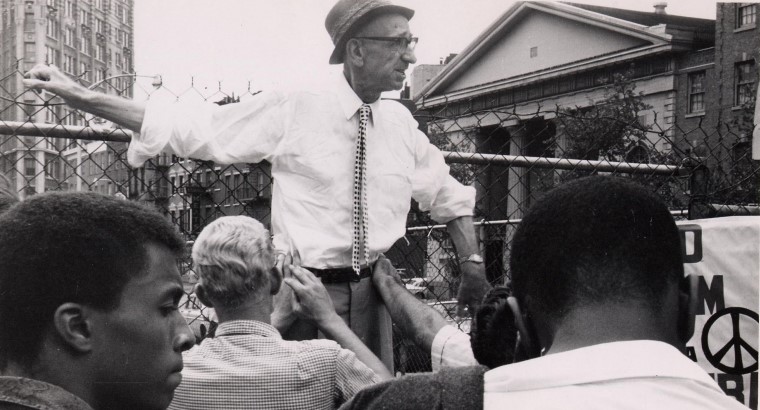
‘Working-Class Ethics’ by A.J. Muste from Labor Age. Vol. 21 No. 11. November, 1932.
IT is with some hesitation that I enter upon a brief discussion of this subject, having just been engaged in reading a very interesting, and I think penetrating, book written by Leon Samson entitled “The American Mind,” which along with a good many other sharp sayings, makes a remark to the effect that ethics is a field. in which any moron is at home. Perhaps that is all the more reason why occasionally wise and intelligent people should venture into it.
Until comparatively recently practically all people thought that the rules of ethics, or morals, were somehow handed down out of the sky, or that they existed in the nature of things. They were sacred, they were immutable, they were eternal. There are still a great many people who think that this is the case. It followed, of course, that any normal human being would understand what was right, just exactly as he would understand that two times two is four, when you explained it to him, and that he would undoubtedly and quite justly be sent to hell if he did not act according to the conception of right that was placed before him.
There is one consideration among a great many others which seems to invalidate that notion of the sacred and unchanging character of our codes of morality, the fact, namely, that there are a great many variations in these codes. In some places it has been a great virtue to be able to steal, for example, although it was regarded as a crime to be caught. In some communities and periods the possession of a number of wives has been regarded as a highly moral thing, a duty that I was owed to the community. In other communities and periods the height of virtue has been in not having a wife at all.
Stanley Hall, the great psychologist of Clark University, said that the best way to understand what ethics is, or morals, is to substitute for morals the word “morale.” That that is correct is suggested by the very derivation of the terms. Ethics comes from a Greek word, which means custom, folk-way. Morals comes from a Latin word which means the same thing. What is “right,” in other words, is the thing that is done, what is wrong is the “thing that is not done in polite society,” which is not accepted as honorable in the circle to which you belong.
There is the story about the boy who asked his father what was meant by ethics and when a thing was ethical and so the father explained: Suppose there are two men who are running a tailor shop two partners and one of the partners is in the shop and a man comes in to get a suit on which some repairs have been made. The customer hands the partner a $10 bill and he gives him back the change for $5.00 instead of for $10.00. Now the ethical question would be, the father explained to the boy, whether the partner would be right in withholding the facts from his partner! To use another instance, to scab may be the height of goodness or of badness depending on your code.
Morals Is Morale
If morals is morale, it means that the rules we observe, the standards of right and wrong that we have, are the means by which the group to which we belong hangs together. And that is exactly what morality in practice has always been, regardless of what it may have been in theory.
That does not mean that human beings started out with standards of morality ready made. They didn’t first get ideas and then act; they first acted and then got ideas as a result. People were made by the group to stick together; therefore, they became cooperative people. They were made to stand up in the face of the enemy; therefore, they became courageous people. other words, every human act has its effect both outwardly and inwardly. You hate an enemy and that has an effect upon him. It also does some- thing to you. You run away and that has a physical effect, it puts you at a certain distance from somebody else, but something has also happened inside you when you have run away.
It has always been found, furthermore, that bringing outward sanctions to bear upon people in order to get them to play the game, to carry on as the group required, was not enough. A man might be very courageous in the face of the enemy when his fellows were there to watch him and would know if he ran away, but when he thought he was alone he would not be so “courageous.” He might ordinarily be very careful not to touch his neighbor’s wife, according to the rules of the group, but he would not be so careful when he thought nobody was seeing him. So all groups added to the outward sanctions other influential, so-called religious sanctions, and said, “You have got to be good; you have got to observe the rules of the gang; you have got to run with the gang, even when you are all alone. And you had better, because God or the gods see you. You will be punished anyway whether other members of the gang happen to see you or not.”
Thus conscience develops, and because it develops in just this way, conscience is both the worst guide we have in the world and in a certain sense the best guide we have in the world. We sometimes say: “Do what your conscience tells you.” But people have murdered, have stolen, been intolerant, committed all the crimes under the calendar in the name of conscience, because doing a particular thing was in accord with the particular standard of morality upon which they had been brought up. On the other hand, human beings have survived precisely because they learned to act together, because they learned to play the game. It was possible to establish societies, tribes, nations, because morale was developed, that is to say, because people by and large were willing to act with the gang, to live as social beings, not merely because of outward compulsion, but because they had become social inside, because they had become capable of cooperation. We speak of the “survival of the fittest.” It would not be very far from wrong to speak of the “survival of the conscientious.” Those groups in which the spirit of cooperation, in which morale was developed at its highest, were the groups that survived.
This also suggests how we come to more advanced standards of action from time to time. To be moral, in the primitive sense that we have described, means to have a standard and a standard that you stick to even when you are not sure that you are going to suffer physical punishment if you do not. But that means that you are a person who has standards, and you then become able to apply standards in criticism of your own group, and so to advance to a higher standard still.
We may make certain other observations based upon this analysis of morale and its place in the function of the group. One of them is that groups are built up in conflict with other groups and so morale, while it is a thing that holds your group together, is also the thing that makes it possible for your group effectively to contest with an- other group.
Class Basis of Morals
In the second place, what we have said means that all morality so far, all morals, have been class morals, because the morality of any given human group will be the standard laid down, the standard required by the dominant economic element in that group. This element will impose certain rules upon others which they do not necessarily observe themselves. For example, you must be sober, you must be honest, you must be industrious, you must not gamble, you must be strictly moral, according to the prevailing code, in your relations with the other sex. These are the requirements that a selfish class morality makes of the workers; they are all rules that are often broken by the master class.
It is also an interesting thing to observe on the other hand, that the teachers of mankind have always talked about a universal morality rather than a class morality, have always talked about a human order in which everybody would belong to one group and all would play the game together in- stead of being in conflicting groups. That idea arises from the very nature of morality. Because if you say that human beings must have morale, that is to say, they must respect the other members of the group, where are you going to draw the line? As long as you are dealing with individual human beings, if you require that your personality be respected, what human personality have you got a right to despise or disrespect or treat in a way that you do not wish to be treated? And that creates a dilemma in this field of morals, because if you are going to be moral, you have got to be moral in connection with all with whom you come in contact, and in the nature of the case we deal in the actual world. in which we live today, with conflicting fighting groups, and morale is essential in the first instance precisely because it builds up your own group, holds it together in order that it may fight more effectively against the other group or class.
One of the phenomena that we always get therefore when conflict arises between groups, whether in the form of actual physical warfare or not, is divided souls among the combatants. When you have a divided soul you will try all the harder to rationalize, put a noble front on your action. In war people do exactly the opposite of the things they have been told to do: they are unfair, they murder, they lie. When people go to war, therefore, they always try terrifically hard to persuade themselves that it is at the command of God or that it is for some great cause which wipes out, atones for, all the crimes that they may commit.
If what we have been saying is true, then it follows that we can never truly realize the implications of morality, that we can never have morale in the complete universal sense of the term, until we get a classless society. Between the slave and the master there cannot be morals, there cannot be morale, save in a very limited sense, because the relation itself is such that the master does not respect, and constantly violates, the personality of the slave.
Need of Morale in the Labor Movement
It follows also that when we serve the revolutionary labor movement, strive to overthrow the class system, seek to build in its place the rule of the workers in which there shall no longer be subjects and slaves, we are doing the only effective thing we can do in our generation for building a world of justice and brotherhood.
All this implies that we are also confronted constantly with a serious dilemma in our work in the labor movement itself because the labor movement is itself divided. We must seek the triumph of the labor movement in order that classes may be wiped out. So long, however, as we live in the kind of world we do, we have not only a battle to carry on against capitalists and capitalism, we are likely to have battles and conflicts among ourselves.
If we say that in the conflict with capitalism anything goes, that there are no rules, there is no morale, because it is war, will that have an effect also upon our relations with our fellow-workers and upon the relations between us, our groups, and other groups in the labor movement? We cannot evade the consequences of the methods we use. Anybody who thinks that he can play with fire and not get burned, anybody who thinks that he can lie and not to that extent become a liar, anybody who thinks that he can vilify and not to that extent become foul-mouthed, is just ignoring one of the very simplest truths of psychology. Sometimes radicals have neglected that truth and we suffer unnecessarily from conflict, or from certain types of conflict in the labor movement because they have not taken account of that fact.
To give one illustration: A very curious thing happened in the development of gangsterism in the garment trades in New York City as I get the picture. You begin by having the employers using gangsters in strikes in order to break up the picket lines of the workers. Then the workers say: “It is war and we can use any method in order to meet the enemy, so we will employ gangsters in order to protect our picket lines.” That is the first step. The second step is, if you use gangsters in one strike then you have to use gangsters in the next strike. That means that presently the use of gangsters in strikes becomes a regular part of union equipment, union methods. The next thing is that the machine in the union which began by employing gangsters in fighting the employer on the picket line says: “If we can use gangsters to win a strike, why can’t we use them to win an election in the union?” and gangsters, who by that time have become a permanent part of the union machinery, are so used. The next step, of course, is for the gang fighting on the picket line and if we were to say, “If we have to do the have to win the elections, then we might just as well be the machine,” and that is exactly what in a good many places has happened. In the meantime the employer does not cease using gangsters. Gangsters are not particularly keen under ordinary circumstances about shooting each other, so they arrive at some sort of understanding. The two groups of gangsters then also arrive at an understanding with the police, so that from the stand- point of the workers absolutely nothing has been gained in the situation. Everything has been lost, rather, because in the meantime the rank and file of the workers have gotten out of the habit of doing their own fighting on the picket line.
I am presenting this problem not for the purpose of solving it in this article, but for the purpose of pointing out that if we grant that the use of any methods in order to gain our ends is justifiable, that does not mean that we can escape from having to reckon with the consequences that flow from the methods we use. The same thing happens in internal conflicts within the labor movement itself. If in our internal conflicts we proceed on the assumption that “anything goes,” if having gone on that principle in dealing with the boss we say next, and there is a very real danger that we will say it, “This element in the labor movement is no better, is perhaps even more dangerous than the boss, therefore also any methods are justified in dealing with this element in the labor movement,” then what happens?
What has taken place in the labor movement in this country and in certain other situations, what is likely to happen is that the psychology developed, the method used in one situation is inevitably transferred to every other situation with which you deal. You deal in a certain way with the boss, then you use the same methods in dealing, let us say, with reactionary elements in the union. Even within the more radical elements in the labor movement exactly the same thing happens; fighting occurs, with exactly the same methods, on the same basis, so there is a further division. Then within each new division exactly the same thing happens; fighting occurs on precisely the same basis and with the same methods, until you get endless divisions and a definite awakening of the movement as a whole.
I do not believe that any movement can survive on that basis. Certainly no organization, no institution can survive unless there is a measure of morale, a certain willingness to play the game, a certain willingness to give the other fellow a chance and to remain within certain limits of decency in dealing with him. If there is not morale then it follows that there is a state of war, and when there is war we have got to remember there are no rules any more. It means announcing that you are willing to stab in the back. If then the other fellow proceeds to stab you in the back, you may be sorry, but you haven’t any basis for being resentful. It means that you will use any method in order to overcome him. If eventually he uses any method, however dirty and low, in order to overcome you, you may be sorry because you are licked but you haven’t any basis left for resentment. You can’t have it both ways.
It seems to me that all this does present to us a serious problem, because to my mind it is highly doubtful whether we can achieve the victory of labor in this country, whether we can avoid having Fascism established here, unless we can manage to have a united labor movement. In the face of American capitalism, its power, its organization, its wealth; in the face, on the other hand, of the weakness, the backwardness of the American labor movement, as it stands today, the job is going to be difficult enough under the best circumstances. It seems to me we may make it impossible unless somehow or other we can develop a tolerably united labor movement. Lenin has shown us that the dogma of the inevitability of Socialism, that it is just going to come as a result of “natural processes,” regardless of what we do, is a deceitful and dangerous dogma for the working class. Something depends upon us, upon whether we develop an effective revolutionary movement. To develop an effective revolutionary movement in this country seems to me to require a united labor movement,
That does not mean, as I understand it, a movement that is free from all controversy. The only place where there is no controversy is the grave. Nor does it mean a plea for softness, a suggestion that people ought to be “nice” to each other and that if we could only be “nice” to each other, then we would have a grand labor movement, and maybe even the capitalists would love us. The two things the workers need fundamentally are intelligence and power, and everything else is secondary compared to those two things. But if we are to have morale in the labor movement, if we are to achieve victory at all in this country, we must have a degree of unity, and if we are to have that, it follows, for one thing, that we cannot spend all our time in controversy and in fighting each other—maybe 99 per cent of the time, but not quite 100 per cent. It follows that there has got to be some restraint in the methods we use, some element of decency beyond which within the labor movement and when dealing’ with workers, we do not go. And it seems to me to follow that if we cannot work in full harmony together, at least we can each of us concentrate our energies upon attacking the common enemy rather than upon attacking each other.
Labor Age was a left-labor monthly magazine with origins in Socialist Review, journal of the Intercollegiate Socialist Society. Published by the Labor Publication Society from 1921-1933 aligned with the League for Industrial Democracy of left-wing trade unionists across industries. During 1929-33 the magazine was affiliated with the Conference for Progressive Labor Action (CPLA) led by A. J. Muste. James Maurer, Harry W. Laidler, and Louis Budenz were also writers. The orientation of the magazine was industrial unionism, planning, nationalization, and was illustrated with photos and cartoons. With its stress on worker education, social unionism and rank and file activism, it is one of the essential journals of the radical US labor socialist movement of its time.
PDF of full issue: https://www.marxists.org/history/usa/pubs/laborage/v21n11-nov-1932-labor-age.pdf
 Revolution's Newsstand