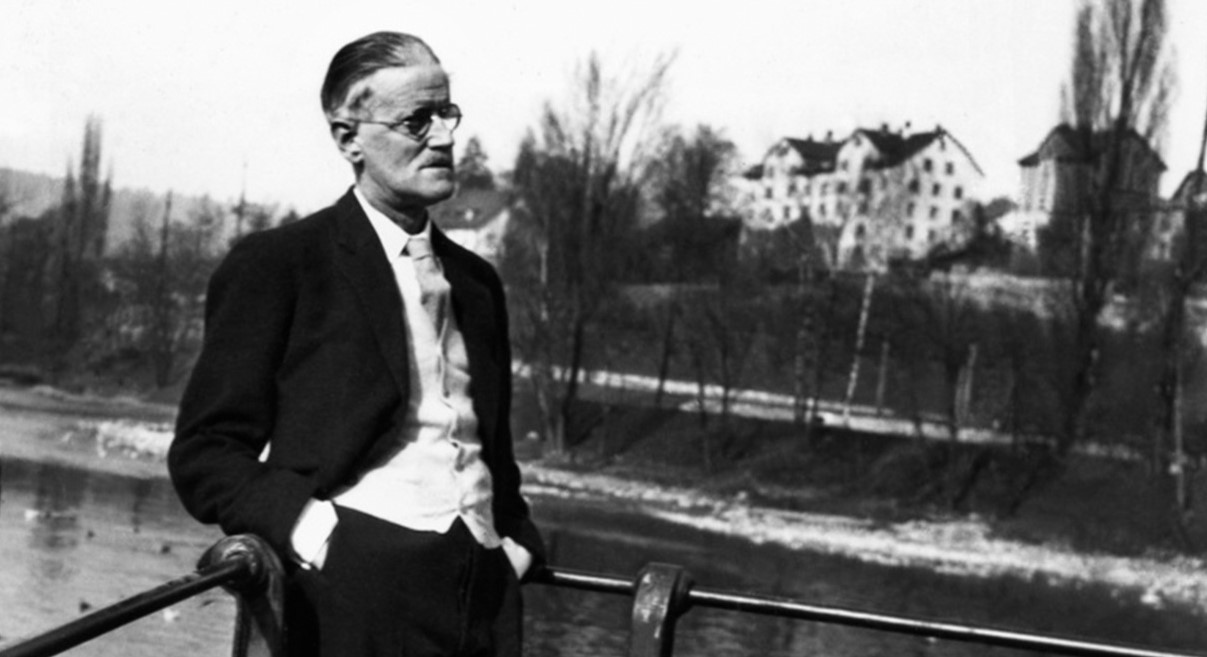
Marxist literary critic and New Masses editor Samuel Sillen with a look at the legacy of James Joyce on his death in 1941.
‘James Joyce: Death of a Nihilist’ by Samuel Sillen from New Masses. Vol. 38 No. 7. February 4, 1941.
In his nihilism, the Irish novelist summed up the failure of a society which frustrated his own talents. A note on his contribution and limitation as an artist.
ACCORDING to James Joyce’s biographer, Herbert Gorman, the author of Ulysses and Finnegans Wake never read anything by Karl Marx except the first sentence of Das Kapital, “and he found it so absurd that he immediately returned the book to the lender.” Whatever the accuracy of this report, it is at least characteristic. It illustrates, for one thing, Joyce’s arrogance, that intemperate and almost theatrical assertion of superiority which was reflected in his remark to Yeats, on their first meeting: “We have met too late; you are too old to be influenced by me.” It illustrates too that self-conscious disdain for politics, growing out of his early disillusionment with Irish Nationalism and Roman Catholicism, which led McCann, in the Portrait of the Artist as a Young Man, to tell Stephen Dedalus (i.e., Joyce): “Dedalus, you’re an anti-social being, wrapped up in yourself.” But most important of all, it indicates the ironic contradiction in which Joyce was caught and which goes so far toward explaining his complex career as an artist: the contradiction, namely, between his persistent desire to write a comprehensive epic of the modern world and his persistent failure to grow beyond the philosophical systems of Aristotle, Aquinas, and Vico.
THE “MODERN”
Reviewing the life and work of James Joyce, one comes suddenly upon an unexpected and overwhelming doubt. How singularly lacking in modernity is this most celebrated of Moderns! The narrow Jesuits at Clongowes Wood College, the shabby genteel bourgeoisie of Dublin, the Victorian prudes of London, and the stylized rebels of the Parisian left bank–did they not triumph, in a sense, despite their pedantry, philistinism, complacency, and pseudo-emancipation, all of which, in turn, Joyce abominated? At the end of the autobiographical Portrait, Stephen Dedalus renounces the smugness, hypocrisy, and treachery which he had found in Dublin: “I will not serve that in which I no longer believe, whether it call itself my home, my fatherland or my church: and I will try to express myself in some mode of life or art as freely as I can and as wholly as I can, using for my defense the only arms I allow myself to use, silence, exile and cunning.” He re- solves “to forge in the smithy of my soul the uncreated conscience of my race.” But in Ulysses, the insurgent soul wanders restless, guilt-laden, a contemporary Telemachus in search of his spiritual father, who turns out to be–Leopold Bloom, archetype of bourgeois philistinism, decaying driftwood of a culture in shipwreck. And the dream-protagonist of Finnegans Wake, H.C. Earwicker (Here Comes Everybody Haveth Childers Everywhere) does not create the conscience of his race but chronicles its abysmal decline. There is no thrust into the creative future, the thrust which, truly feared by Jesuits and philistines alike, provides the essential impulse of the genuine epic of modern life. There is of the genuine epic of modern life. There is only the bleak and banal vision—the infinitely elaborated last-second revelation of the drowning man whose world has been one vast regret, without order, without mission, without hope.
Does not the nihilism of James Joyce, does not his patiently orchestrated bitterness and frustration, express the mood and values of a society which, on one level, he could hate with the fierce vigor of a Swift or Juvenal, but which at the same time corrupted his own understanding? From Giambattista Vico’s philosophy of history, as embodied in the Scienza Nuova, Joyce borrowed a theory that societies rotate in fixed and similar cycles culminating in the interdestruction of nations and a mystical resurrection from the ashes. Refusing to read beyond the first sentence of Marx’s scientific analysis of history and modern society, Joyce could find solace in the symbols of scholasticism and in poetically inspired Renaissance myth-makers. Joyce worked feverishly to create a work of art which would give a wholeness to the shattered fragments of existence; but not even his extraordinary creative talents could build an indestructible unity out of the esthetics of Aquinas, the psychology of Freud, the history of Vico, and the stubborn realities of twentieth century life. He did succeed, brilliantly, in epitomizing at the point of disintegration the vast failure of a civilization whose vanished splendors afforded a grim contrast to its present catastrophe. Ulysses is the anti-Odyssey. In Joyce, as in T.S. Eliot, Ezra Pound, and William Butler Yeats, one feels a pathetic and impotent nostalgia. With furious loathing for the encircling world, the creative spirit has turned upon itself with almost masochistic fury. Freshness, freedom, optimism have become mocking illusions. The literary creator has become hopelessly separated from his fellow creators, the masses of producers, plain people. An impasse has been reached. The tension has become unbearable, and only a truly creative society will release the truly creative genius. One cannot help realizing all this, if one reads sensitively Joyce’s epics of negation. There is no better assurance that something has gone wrong, deeply and terribly wrong with the world.
During the early twenties, many earnest and gifted writers looked to Joyce as a liberator of modern literature. In Paris, following the first World War, he came to symbolize the revolt against Victorianism, Puritanism, Sentimentalism. What these writers failed to realize was that Joyce more truly represented the culmination of a European literary tradition than the beginning of a new one. For if they had remembered the work of the Symbolists in France, the defeatism of the Formalists in Russia, if they had been acquainted with the novels of Huysmans or Proust, or if they had understood the significance of Dostoievski, they must surely have recognized that Joyce’s negation, his aloofness from the masses, his self-annihilating subjectivism brought to a focus the tendencies of an epoch, the epoch of the “superfluous man,’ of the poet against society, of the “revolutionist of the word.” To the unfinished sentence at the end of Finnegans Wake one could add: “Beyond this no further.” It is in this sense that I would hesitate to describe Joyce as a Modern. With him the old Europe has come to an end; for the generation emerging from this war it is already a historic Europe.
CONTRIBUTION
Nevertheless, there are, in Joyce’s masterpieces of finality, resources which may well refresh the work of a new generation of writers. He led the attack against frozen artifices of language, and as a result of his work every writer in English may utilize a freer and more flexible vocabulary. The victory of Ulysses in the courts earned for other authors the right to treat the human body with the greater frankness which it deserves. Joyce’s wit, his unfailing ear for the music and associations of language, his merciless satire of sham-literary styles, and his interesting experiments in the treatment of interior monologue have surely added to the techniques of modern fiction.
It can hardly be denied, however, that Joyce himself carried his technical dexterity to the point where it served to block rather than to heighten communication with the reader. The best passages of Ulysses are the least obscure; there are huge chunks of material upon which the reader is stranded. Finnegans Wake is incomprehensible, short of years of linguistic training, encyclopedic references to the point of pedantry, and a detailed knowledge of the author’s private associations. A glossary of Finnegans Wake would be infinitely more difficult, I daresay, than a glossary of the whole body of Shakespeare’s plays. In both Ulysses and Finnegans Wake, there is a multiple system of symbols and allegories which too often reduce the composition to an elaborate underground network with several layers of trains running in different directions, jumping tracks, connecting with one another sometimes with miraculous ease and more often with tremendous and bewildering crashes. The destination of the trains is by no means always certain. Instead of being liberated, the language has become fettered with a thousand and one many-meaning associations of the subconscious.
Joyce lived in poverty and exile, unable for years to get his work published, and then only by small private printers at some sacrifice. In his own life, he illustrated the alienation of the artist from bourgeois society, which was one of the central themes of his work. He died in Zurich on January 13. He would have been 59 years, old on February 2. His passing from the literary scene suggests the passing of a whole epoch of literature, the most gifted creators of which will be of interest long after the society which twisted their talents has disappeared. The genius of James Joyce summed up bourgeois literature of the period of imperialism; it was a mirror, however fragmentary, of that period; and it was a brilliant witness of the incompatibility between a society organized on the profit principle and the freely functioning creative talent.
The New Masses was the continuation of Workers Monthly which began publishing in 1924 as a merger of the ‘Liberator’, the Trade Union Educational League magazine ‘Labor Herald’, and Friends of Soviet Russia’s monthly ‘Soviet Russia Pictorial’ as an explicitly Communist Party publication, but drawing in a wide range of contributors and sympathizers. In 1927 Workers Monthly ceased and The New Masses began. A major left cultural magazine of the late 1920s and early 1940s, the early editors of The New Masses included Hugo Gellert, John F. Sloan, Max Eastman, Mike Gold, and Joseph Freeman. Writers included William Carlos Williams, Theodore Dreiser, John Dos Passos, Upton Sinclair, Richard Wright, Ralph Ellison, Dorothy Parker, Dorothy Day, John Breecher, Langston Hughes, Eugene O’Neill, Rex Stout and Ernest Hemingway. Artists included Hugo Gellert, Stuart Davis, Boardman Robinson, Wanda Gag, William Gropper and Otto Soglow. Over time, the New Masses became narrower politically and the articles more commentary than comment. However, particularly in it first years, New Masses was the epitome of the era’s finest revolutionary cultural and artistic traditions.
For PDF of full issue: https://www.marxists.org/history/usa/pubs/new-masses/1941/v38n07-feb-04-1941-NM.pdf
 Revolution's Newsstand