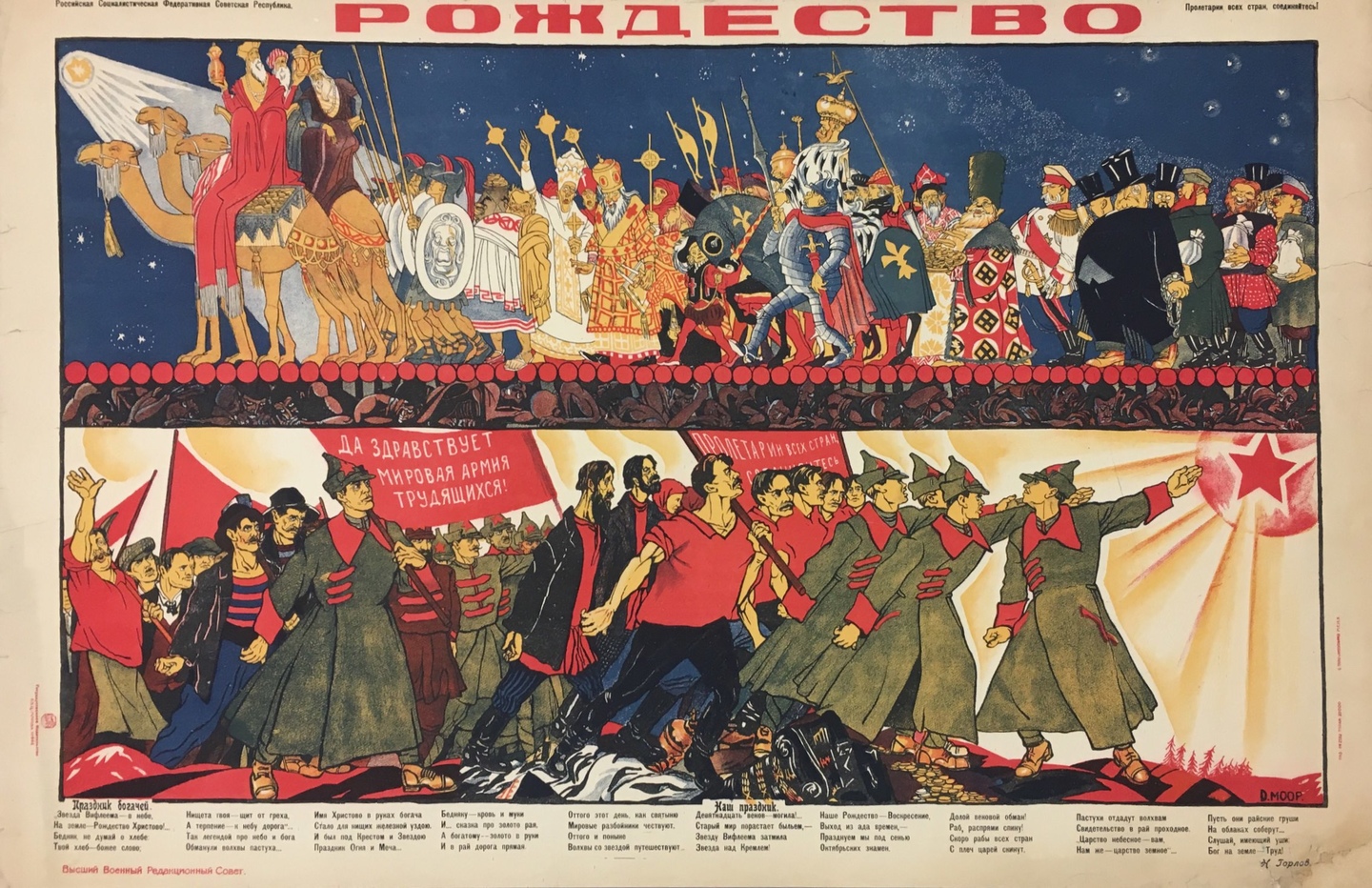
A look at the early attitudes and practices in the Revolution towards religion from the Liberator’s Soviet correspondent ‘X’. If any comrade can identify the writer, it would be greatly appreciated.
‘Religion Under the Bolsheviks’ by X from The Liberator. Vol. 2 No. 7. July, 1919.
IT all depends on what you choose to call “Religion.” If you identify Religion with the Official State Church of the Czar, then the Soviet Government may perhaps be said to have buried it, but scarcely to have killed it–for it perished with the old regime in the first flames of the March Revolution. It was a part of the Czar’s imperial governmental machine. It was charged with the duty–for which it was richly paid–of upholding the Czar. Its highest institution, the Holy Synod, was composed of archbishops appointed and dismissed by the Czar, under the permanent control of a civil official, the Ober Procurator–the “Eye of the Czar.” The Czar was the head of a Church-State, to be obeyed, as Article 1 of the “basic laws of the Russian empire” stated, “not only through fear, but in reverential piety, as is commanded by God Himself.” The archbishops were thus not only thus not only church, but also state officials, whose duty was to keep the populace in submission to their master. The lesser clergy had the same duty, including the humble but necessary function of acting as police spies. By imperial ukase they were ordered to report to the government anything detrimental to the government which might be revealed to them during confession. In general, the whole machine labored to create a popular psychology of obedience to the existing authorities. For their loyalty the Czar rewarded his churchly servants with golden and diamond crosses, orders, and other insignia of excellence, as also with more material benefactions in the form of land and money; and the Church itself was of course handsomely supported by the government. This State Church, as a part of the Imperial Church-State of Czardom, fell into irretrievable ruin with its master. The Holy Synod is doubtless still incredulous of this fact, but it need not detain us here. We merely mention in passing that it is dead, and that the Bolsheviks cannot even claim, the credit of its happy demise.
As for Religion in the sense of the Greek Catholic faith, that has simply been put on an equality with all other faiths. Anyone is free in Russia to worship as he pleases, or not at all. Formerly, the Greek church had a monopoly on the right to worship-a monopoly enforced by law. With the exception of a few racial faiths, such as the Jewish and Mohammedan, which were “tolerated” but heavily penalized, it was a crime in Russia to believe in any but the Greek faith. Membership in these “heretical” sects was generally held in secret, for the heretic was likely to be exiled for life to Siberia. The clergy of other faiths were forbidden to preach their faith to Greek Catholics, and “the seduction of orthodox adherents into an unorthodox religion” was a crime. Even when such a convert had changed his faith without “seduction,” the unorthodox church was forbidden to receive him into its fold, and the criminal who had thus changed his faith was directed to be “turned over to the persuasive powers of the clerical authorities,” which might result in life-long imprisonment in a monastery prison. Marriages of dissenters were not recognized as legal. These conditions were partly ameliorated by the legislation which followed the revolution of 1905; a few forms of dissent were now, recognized, and change of faith be- came permissible, though the law against “seduction from orthodoxy” remained in force. As a result of this permission, the Greek church in the year 1905 alone lost to Roman Catholicism more than 170,000 persons, to Mohammedanism 36,000 and to Lutheranism 11,000.
The legislation of 1905, passed as a result of the revolutionary uprising of that year, cut down the in- come of the Greek church so much that it found an incentive even more powerful than loyalty to the Czar to make it active in oppression of the people. From that time on, finding its very existence as a privileged institution threatened by revolutionary agitation, it became a definite and conscious counter-revolutionary force. As such a force, it fought the revolutions of March and October, 1917–particularly the latter. Its officials, and almost its entire personnel, were not only utterly untouched by the new spirit which had come into the Russian people, but they were bitterly reactionary. Yet after the March revolution, with preposterous naivete, they proposed that the new revolutionary government should continue to support them. And, perhaps realizing that the church could be taught to perform the same functions for a capitalistic democracy that it had performed for the imperial autocracy, certain bourgeois “reformers” actually proposed that the separation of the Church and State should not interfere with the financial support of the former by the latter! This question was still unsettled at the time of the Bolshevik revolution, and the matter was very swiftly decided at that time by actual and thorough disestablishment. The church as a counter-revolutionary force has thereby been so completely unhorsed that its influence is negligible.

The church as a property-owning institution and this is doubtless the crux of the slanders against the Soviet State with regard to its treatment of “religion”–has been treated like any other large property-owner. Its property has been taken away by the State, and restored to the people. And oh, what a fall was there, my countrymen! You need not be afflicted with statistics to realize that the Greek Church was gorged with wealth; nor need you be asked to believe that every monk was a Rasputin, in order to conceive that the life of the princes and dukes of the church was sufficiently luxurious to be a national scandal. And you can readily understand that such personages, forced to depend upon what voluntary support might be forthcoming from the people of Russia, would cry aloud to the world that the crime of the ages had been inflicted on Christ’s representatives here on earth! As a matter of fact, strictly religious edifices are open as always to priests to conduct services in and people to worship in. Devout atheists, no doubt, will read with disapproval the thirteenth article of the Church decree, which declares that “Buildings and objects specially intended for religious purposes are turned over to the religious organizations for their free use.” What! a Socialist State letting religious organizations use its property to preach “superstition” in? Brethren, it is so. And they don’t even charge them any rent. The Church has, in fact, been merely relieved of its economic functions, and left to fulfil its spiritual mission, if it can find a genuine one to fulfill.
But finding a genuine spiritual mission is going to be a hard task for the Greek Catholic church of Russia. Its spiritual mission in the past was simply to preach submission to the tyranny of the Czar. In lieu of that, it shows a tendency to undertake the spiritual leadership of the cause of counter-revolution. But here it finds that the wicked Bolsheviks have anticipated its purposes. Article 5 of the Church decree declares that “The free performance of religious cults is protected only in so far as they do not interfere with social order and are not accompanied with an attempt upon the rights of citizens and of the Soviet Republic. The local authorities are authorized to use all the necessary means for the maintenance of public order and safety for that purpose.” That is to say, if a Russian priest urges, from his pulpit, the assassination of Lenin, he is treated somewhat as an American enthusiast would be who on religious grounds urged the assassination of an American public official. He would get short shrift. Yes, it is quite as unsafe to advocate the forcible overthrow of the existing government from a Russian pulpit, as it would be from an American one. And that is what all the accusations of Bolshevik tyranny against the Russian priesthood amount to. They have as many rights as any other citizens and no more. They are distinctly not encouraged to take up counter-revolution as a spiritual vocation.
And this leaves them in desperate straits. For the Greek Catholic faith-maugre the novels of Dostoevsky!–consists, so far as the people are concerned, in spiritual submission, and in the observance of fasts. With the spiritual submission gone, the fasts do not continue to have their old fascination. There is an interesting article in the anti-Bolshevik newspaper, “Ponedelnik Vlasti Naroda,” which recounts the last chapter of the history of Greek Catholicism—the last, unless it really does discover a new mission of a genuine sort. The article deals with the attitude of the peasants toward God. The peasants are of course the historically religious class in Russia–the city toilers. are proverbially unbelievers. It seems that the peasants have a new attitude toward God, which the writer of the article illustrates with a homely story. There used to be, in the district of which he writes, a very pious peasant named Ivan. He kept all the fasts (for bear in mind that this was what being pious meant, aside from the duty of submission to the Czar!)—he kept all the fasts, and in the Greek Catholic faith there are a lot of them to keep, about one every other day; and he gave the butter and the other delicacies which his piety kept him from consuming, to the village priest. So it was until the revolutionary year of 1905–when to the amazement of everybody this very pious man was observed to be keeping his butter and spreading it on his own bread and eating it on fast days! His neighbors questioned him about his fall from grace, and he replied something like this: “Well, I have been thinking. I have been thinking that there are so many fast days altogether that if we keep them all it means that we fast about two days in every three. We do this, the priest tells us, because God wishes it. But it has occurred to me that it may be because the priest wants the things himself which he forbids us to eat. For why should God ask us to starve ourselves? We are the children of God, and God is very rich. If we should go into the home of a rich man, and he should ask us to sit down at the table, if we did not eat he would be hurt. How much more then should God be hurt at the behavior of us his children, when we do not enjoy the many good things that he gives us! We have been behaving as if we were the slaves of God, instead of his children. I do not believe we are the slaves of God, I believe we are God’s children, and I am going to behave like a child of God from now on.”
Well–the writer goes on to say–Ivan is dead, but the peasants in his district are now beginning to remember him and quote what he said. “It seems,” they say, “that we are the children and not the slaves of God, after all. Ivan was right.” And they don’t give their best to the priest, but keep it themselves. They live on the finest of everything, fast days have become feast days, and the art of cookery is taking on a metropolitan magnificence!
Perhaps this is sheer materialism–and perhaps it isn’t. Perhaps the Russian peasant has discovered a spiritual meaning in Christianity which his priests have not been able to discover for him. It’s not a bad conception of Christianity, at that-Children of God! If Greek Catholicism can rise to the height of that conception, it may still continue to mean something to the Russian people. But if it is too thoroughly identified with the old order, its end has come-for the Russian people are no longer the Slaves of God.
But, just as there is freedom of belief, so also is there freedom of non-belief. In this respect Russia is freer than America, which still in various of its state constitutions restricts the holding of certain offices to believers. In Russia, of course, non-belief labors under no such disability. But a more striking difference is one which is not to be sought for in the laws of the two countries, but rather in their public opinion. In the United States it is necessary for governors and presidents to render lip-homage to conventional Christian beliefs, as for instance in the proclamations by which we are urged on set occasions to give thanks to the Christian Deity for benefactions that are sometimes not very obvious. It is difficult to imagine an American president, even if he were at heart an agnostic, failing to meet such an occasion with at least due hypocricy–impossible to imagine one who would venture to state candidly the role which Christianity and its Deity have played in the class-struggle. If, however, we turn to Russia, we find Bukharin, member of the supreme economic council of the Soviet State, and delegate to the International Communist Conference writing, in an article on “Church and School in the Soviet Republic”: “One of the instruments for the obscuring of the consciousness of the people is the belief in God and the devil, in good and evil spirits, saints, etc., in short–religion. The masses of the people have become accustomed to believe in these things, and yet, if we approach these beliefs sensibly, and come to understand where religion comes from, and why it receives such warm sup- port from the bourgeoisie, we shall clearly understand that the function of religion at present is to act as a poison with which the minds of the people have been and continue to be corrupted.”
Of course, if you asked an American president, or any devout Quaker, or H.G. Wells, or even one or two metropolitan clergymen, they might tell you that they also are opposed to religion in so far as that is what it is used for. But Bukharin, as an economist, finds the economic aspect of religion the only one of any significance at present; and as a high official in the Soviet State, he can outline, as he proceeds to do in his article, the plans of his government for “the spiritual liberation,” as well as the economic liberation, of the toiling masses. toiling masses. He might have been more reassuring to some people in the Socialist movement in other countries if he had made a distinction between religion. as a means to the spiritual enslavement of the people, and religion as the embodiment of a popular aspiration toward spiritual fulfillment. If he had done so, it would probably have been somewhat in this form: “Yes, comrades, I am aware that the people’s desire for liberty has often, in Russia as elsewhere, taken the form of a popular religious reform movement; and this, among other reasons, accounts for the severity with which religious heresies were punished under the old regime. But when the working class becomes conscious of its interests as a class, it ceases to pour its revolutionary emotions into a religious mold. That is what has happened today. The twentieth-century form of the people’s revolt is direct political and economic communism. The working class has better weapons than religion. We do not care to attempt to convert the bourgeoisie to a Tolstoyan equalitarian Christianity. We are only concerned to liberate the masses from Czarist Christianity.”
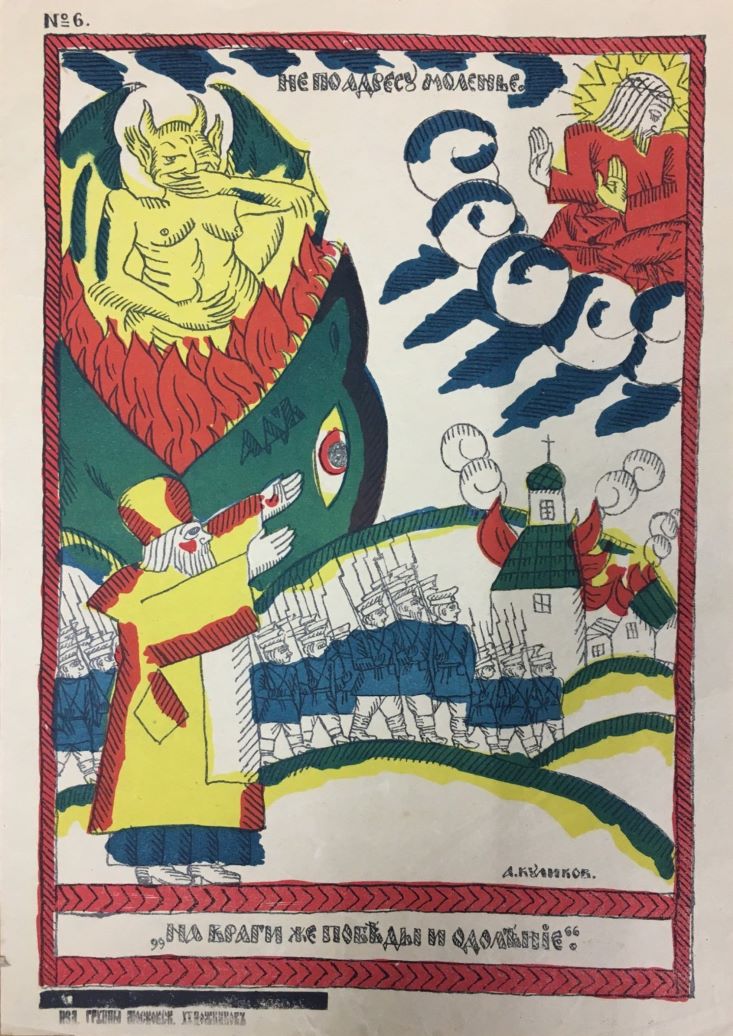
So he would perhaps explain himself; but he is not talking to tender-minded Socialists on this side of the globe, but to people who understand quite well the economic function of the Russian church; and so what he does say, quite forcibly, is this: “We must fight the Church, not with force, but with conviction. The This Church must be separated from the State. means, the priests may continue to exist–but let them be supported by those who wish to purchase their poison, or who have some other interest in their continued existence. Another poison of this type is opium. Those who have smoked it behold all sorts of lovely visions, are at once transported to Paradise. But the use of opium later results in a complete undermining of the health, and the user gradually becomes insane. It is similar with religion. There are persons who like to smoke opium. But it would be criminal for the state, at its own expense, i.e., at the expense of the entire population, to maintain dens for the smoking of opium and to hire special persons to minister to the needs of the frequenters of these places. We must therefore proceed with the Church as follows (in fact, we have already done it) we must deprive the priests, hierarchs, metropolitans, abbots, and all the rest of the crowd of all support from the government; let the true believers if they like, feed them on sturgeon and salmon, of which the holy fathers are such devoted devourers.
“On the other hand, we must guarantee freedom of belief. There necessarily follows the rule: Religion is a private affair. This does not in any sense mean that we must cease our struggle against the Church by opposing its convictions with ours. It simply. means that the State must not support any Church organization.
“The priests must be kicked out of all the schools; if they like, let them ply their task of misguiding the young in some other place: they shall not do so in the government schools; the schools shall be worldly, of the world, not of the priests.”
And this recalls another definition of religion–the cultivation of other-worldliness. Men like Bukharin are not only, as Socialists, opposed to other-worldliness because it is taught to the workers in order to make them more easily amenable to oppression; they are also, as scientists, opposed to other-worldliness in itself. For they believe that the world can never be beautiful and happy and efficient until mankind centers its attention realistically upon actual life. To do this, we must needs overcome more than the class- debasing tendencies of religion–we must overcome the human tendency to self-abasement before the Unknown which is so near the root of the religious attitude. When we can do this, when we can face the universe with realistic and not superstitious confidence, when all mankind can share in the spiritual freedom that has been in every generation the privilege of a select few, a new era in human history will begin. In that day “the being that is yet within the loins of Man shall stand erect upon the earth and stretch out his hands among the stars.” Such is the belief of men like Bukharin.
And the Russian Soviet State is the first government in the world in which men in such a position as his are free to speak and to work in behalf of such a belief–free to put forward a new idea of human perfection based on positive science in place of the old ideals of revealed religion. Both those who believe in the religion of God and those who believe in religion of man, if there is strength and courage in their belief, will be glad to welcome an era in which no special interest of an economic kind will come to the support of any religion, and the ways in which men choose to relate themselves to the mystery of being will rest upon their own free and pure choice.
The Liberator was published monthly from 1918, first established by Max Eastman and his sister Crystal Eastman continuing The Masses which was shut down by the US Government during World War One. Like The Masses, The Liberator contained some of the best radical journalism of its, or any, day. It combined political coverage with the arts, culture, and a commitment to revolutionary politics ay a pivotal time in Left history. The writings by John Reed from and about the Russian Revolution were hugely influential in popularizing and explaining that events to U.S. workers and activists. Increasingly, The Liberator oriented to the Communist movement and by late 1922 was a de facto publication of the Party and was sold to the Party by Eastman. In 1924, The Liberator merged with Labor Herald and Soviet Russia Pictorial into Workers Monthly. The Liberator is an essential magazine of the US left.
PDF of full issue: https://www.marxists.org/history/usa/culture/pubs/liberator/1919/07/v2n07-w17-jul-1919-liberator.pdf
 Revolution's Newsstand