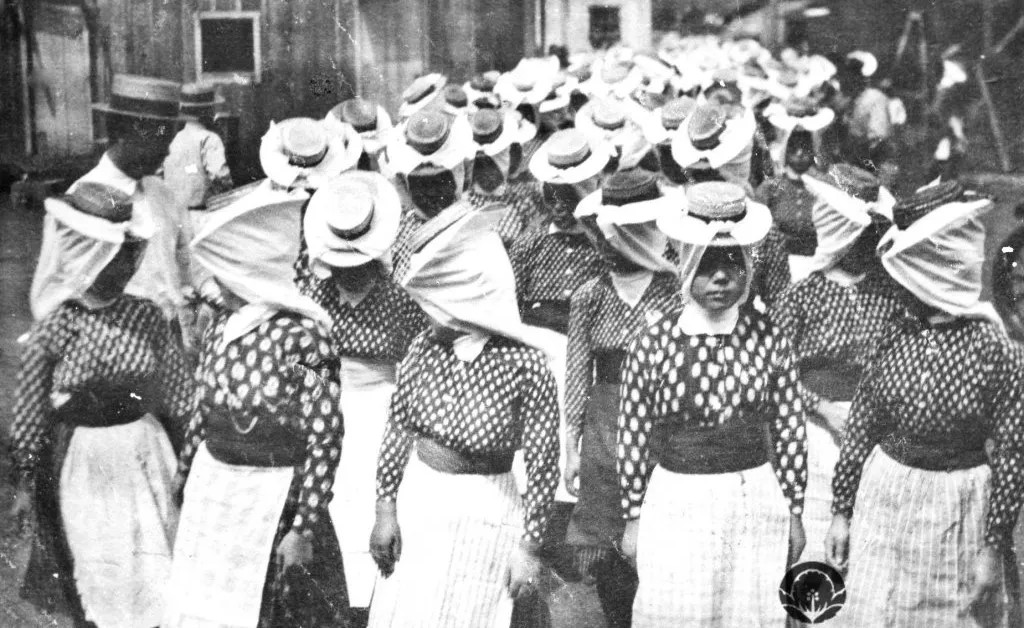
Resolution on women workers of the larger Pacific Rim from the second congress of the Pan-Pacific Trade Union Secretariat (PPTUS), a subdivision of the Red International of Labor Unions, held in Vladivostok during August, 1929.
‘Resolution of the Pan-Pacific Trade Union Conference on the Question of Women’s Labor’ from Pan-Pacific Monthly. No. 32. November, 1929.
WOMEN’S labor is being widely employed by imperialist and national capital in industry and in big agricultural enterprises in the countries of the Pacific. As the cheapest labor power thrown on the market by the peasantry in the Pacific countries, which is being proletarianized, woman’s labor as the cheapest labor power is subjected to the most terrible exploitation.
The carrying out of capitalist rationalization and the preparation of the capitalists of all countries for new wars leads to an increase in employment of unskilled women and to an intensification of exploitation of the working class as a whole, and women in particular, worsening the general conditions of labor and increasing the already great reserves of unemployed. Capitalist exploitation of women in the Pacific countries, as well in the East as a whole, where remnants of feudal customs still prevail is worsened by the complete lack of any rights for women in the political field and in home life. In connection with this, it must be stated that the revolutionary trade unions in the Pacific countries have not carried on sufficient work among the women workers. The revolutionary unions underestimate the importance of women workers in industry and the need of organizing the broad masses of women workers and of drawing them into the general class struggle of the working class for the immediate economic demands of the working women. This struggle must be connected with the general political tasks, with the fight against imperialism and new imperialist wars. All this, considering the present day international situation, is of great importance.
The percentage of women workers employed in industry and in capitalist plantations in the Pacific countries reached in recent years from 40 to 50 percent of, and in some industries (textile, silk, and on plantations)–up to from 70 to 80 percent.
In the colonial and semi-colonial countries, the most ruthless exploitation of women workers is taking place, and the practise of signing contracts, which bind women workers to the place of employment for certain terms and for a miserly wage, leads to conditions bordering on slavery. On the other hand, wages of women in the colonies are only a small fraction of the wages received by men and women workers in the capitalist countries. The long working hours, reaching from 14 to 15 hours a day, along with the complete lack of any protection of the labor of women and protection of maternity and the unsanitary conditions of work, lead to a high percentage in the number of sicknesses and deaths among women workers.
The carrying out of capitalist rationalization at the present time leads to still greater exploitation, to a decrease in wages, to worsening of the general labor conditions, to an increase in the already high percentage of deaths among women workers.
The spontaneous participation of great masses of women workers in the strike struggles of recent years is steadily growing. In Japan, we have the strike of textile workers in the years 1923, 1925, 1927: the active participation of women in a number of strikes in Tokyo (1925-1927), which were carried out and led by women workers.
In spite of the growing participation of women in the strike movement, women workers in Japan are very weakly organized in the trade unions (12,000 women are members in the trade unions; the total number of women in industry is 308,900); the majority of them are textile workers, organized in the reformist unions. Still greater in extent, activity and heroism was the participation of women workers in the revolutionary struggles of recent years in China; in the economic and national- emancipation movements. Thousands of women workers participated in the movement, particularly in Shanghai, Canton, Tientsin, etc. Their historical role can be judged by the uprisings in Shanghai and Canton in 1927, and by their great heroism shown in the revolutionary struggle against imperialism, the traitorous Chinese bourgeoisie and the Kuomintang. This led to the great number of victims among women workers when white terror began to reign. During the revolutionary upheaval in China, the number of organized women workers had greatly increased. In 1927 in the four most important provinces there were 325,000 organized women workers.
In British India recently we also notice the growth in the participation of women workers in the strike movement. In the strike of the textile workers (1928-1929) thousands of women alongside the men, participating in strike committees and in picketing. Nevertheless, great numbers of women workers in India are not organized and the greatest part of women workers (including the most exploited, employed in plantations), are not drawn into the class struggle.
In the uprisings of 1926 in Indonesia, in the labor movement of Korea, and in the strikes in the Philippines, there has been witnessed the spontaneous participation of broad masses of women workers unorganized in most cases.
While the organizational and ideological influence of revolutionary class organizations upon the industrial female workers and working masses in general is as yet quite insufficient, the imperialist and national bourgeoisie strives for influence on the most backward masses of working women by means of reformist and centrist trade unions, different women’s leagues and various other organizations. In order to cope with these efforts of the reformists who organize the working women into special women’s leagues and societies which isolate them from the general class proletarian movement, we should carry on systematic and efficient work among the broad unorganized masses of the working women.
4. To secure the basis for their agitation and propaganda work for the drawing of the broad masses of working women into the trade unions, the revolutionary organizations have to work out in detail and make popular a special programme of demands concerning the essential social, economic and general working conditions of the working women. In view of the difference in the living and working conditions in different countries these demands have to be worked out correspondingly and put forth in the time of economic struggles of the working class. The following are the most important and basic demands:
Programme of demands: Economic:
1. Equal wages for equal work irrespective of sex and nationality.
2. The 7-hour working day in industry, and 8-hour day in rural economy, a weekly day of rest and a yearly leave of absence with regular payment.
3. Abolition of corporal punishment for the working women.
4. Complete abolition of night work for women. An active enforcement of such abolition.
5. Prohibition of employment of women in harmful enterprises, underground and by dangerous machinery.
6. Inspection of sanitary conditions in factories, workshops and factory hostels.
7. Motherhood protection. Eight weeks’ paid leave before and eight weeks after confinement and free medical assistance at the expense of the enterprise.
8. The establishing of nurseries for the children of the working women in enterprises at the expense of employers.
9. Abolition of labor contracts for women.
10. Political and legal equality for woman workers.
11. Abolition of different religious and revolutionary trade unions must pay special daily-life restrictions for women.
Besides that, it is necessary to work out a series of special demands with regard to the needs of women workers employed in industry in different countries, for instance, against prison regime of factory hostels in Japan, against cruel treatment, etc. The immediate and fundamental tasks of the Pacific trade unions amongst the women. workers for the time to come is the organizing of women into revolutionary trade unions.
The trade unions should carry on:
a) Organization of broad masses of industrial and rural women workers on the basis of unified general class trade unions. The present isolation of women proletariat in the East must be brought to an end.
b) The drawing in of the women workers should be effected in the very enterprise, through special work by a comrade, preferably by a woman, from the rank of the revolutionary shop nucleus or shop committee.
c) In order to more successfully draw women workers into the unions, it is necessary to put out demands of especial interest to the women workers in general, and to the given enterprises in particular.
d) Women workers should be elected to all leading trade union organs from top to bottom on an equal footing with men.
c) The organization of trade union work among women workers can be successful only when we recognize the great importance of this work and create a special cadre of militants, able to carry on this work.
f) Propaganda for the admission of women into trade unions should be carried on at factory meetings. During big economic conflicts it is necessary also to call special meetings of women workers. It is very useful to call from time to time special conferences of women workers, organized as well as unorganized.
g) Taking into consideration the low level of cultural and political development of the broad masses of women workers in the countries of the Pacific the great percentage of illiterates and semi-literates, the attention to work out special forms of propaganda methods of agitation, and cultural work among women workers. Educational work must become one of the most important methods of drawing women workers into the trade unions.
The organization of workers’ clubs, wherever possible, is one of the best methods of drawing in women workers. In these clubs it is necessary to organize special lectures, courses and schools for women workers, corners and rooms; it is not advisable to organize special and separate women’s clubs.
The most active women should be drawn into the work of the clubs, and into the workers’ correspondence movement. The trade union press should devote special articles to the question of women’s labor and to the demands of women workers.
h) The active drawing of the masses of women workers into the strike struggle requires various forms, but the most important form is the participation of women workers in all committees, preparing and leading the strike struggle, in strike committees, in picket committees, etc.
The trade unions should counteract every attempt aimed at considering a strike for women’s demands as a pure women’s strike. Every strike in an enterprise is a strike of all workers of the given enterprise whatever the demands may be.
The trade unions should struggle against all attempts of a capitalist making use of old survivals in the matter of interrelations be- tween man and man in the oriental countries to crush the united front of proletariat, which survivals lessen the activity of women in the cause of a general class struggle.
The trade unions should carry on the struggle against strike breaking on the part of women in the time of strikes which frustrates the class struggle of the proletariat.
The trade unions should pay attention to drawing the women into the struggle against unemployment, on equal footing with men.
For the purposes of organizational guidance among the women in revolutionary trade unions it is necessary:
a) For every shop committee or revolutionary trade union nucleus or for every group of enterprises to appoint a special comrade, if possible a woman, for conducting the work among women workers.
b) The industrial trade unions also appoint a special comrade heading a commission.
c) The same commissions are to be organized at the industrial confederations of trade unions.
d) Ideological guidance is to be placed into the hands or revolutionary executives of trade unions before whom the above-named committees are responsible.
e) The committees should form bodies of active representatives of most important branches of industry and biggest enterprises; the body of active workers is to participate in the activity of commission and performs some specific tasks.
f) The scope of the activity of such commissions should include: actual working out of programmes of demands for women workers, participation in strike leadership, in conducting educational activity among women workers, active participation in cultural, economic and organizational activity of trade unions, in convoking and working out agenda for women workers conference in collecting materials and data on working and living conditions of working women, on their needs and demands, their feelings etc., selecting the most revolutionary elements from rank and file woman workers, publishing, distributing and popularization of leaflets, pamphlets, newspapers, etc., among women workers. The commission works under the control of executive committees of the trade unions and is responsible to them.
The work in reformist unions.
The adherents of revolutionary minority of reformist unions should conduct a systematic activity among the woman workers, members of unions; in order to win them for their own camp. Here it is especially necessary to begin from the very bottom of an enterprise. Where the reformist unions have women’s sections and commissions we should work in those organizations, keeping a proper political line and disclosing at every opportunity the reformist actions of the leaders. It is of great importance, too, to take part in conferences of woman workers, convened by reformist unions in order to struggle for all conciliatory attempts, for a correct political line. work among the woman workers of those unions is very complicated and requires working out a special plan of action, taking into consideration the surroundings, yet it is the more necessary as in many unions (Japan) the number of woman workers organized into the reformist unions is far greater than that of the members of revolutionary unions.
The work in women’s leagues and societies.
The work among the woman workers of certain branches of industry, who were drawn into, strictly speaking petty-bourgeois women’s and feminist leagues (Japan, India), special women’s societies of mutual help (such as waitress’ union, union of petty clerks of Japan, etc.) and into every other women’s supposed-to-be-“non-party” societies, pursuing the ends of narrow feminist pacifist, chauvinist nationalistic or religious character (Y.M.C.A.) in China, Federation of Buddhists in Japan, numbering more than a million of women members, women section of national party “Sarekat Islam” in Indonesia, etc.
These organizations should be fought with all energy, it is necessary to struggle against the influence of their ideology on the masses of women workers, to disclose the cases of their conciliatory politics, pseudo-pacifism, and, in many cases utter reactionary nature of those societies pointing out to the women workers that the only way of getting political and civil rights lies in the participation in the revolutionary struggle of their class.
The Pan-Pacific Monthly was the official organ of the Pan-Pacific Trade Union Secretariat (PPTUS), a subdivision of the Red International of Labor Unions, or Profitern. Established first in Ha in May 1927, the PPTUS had to move its offices, and the production of the Monthly to San Francisco after the fall of the Shanghai Commune in 1927. Earl Browder was an early Secretary of tge PPTUS, having been in China during its establishment. Harrison George was the editor of the Monthly. Constituents of the PPTUC included the Australian Council of Trade Unions, the All-China Federation of Trade Unions, the Indonesian Labor Federation, the Japanese Trade Union Council, the National Minority Movement (UK Colonies), the Confédération Générale du Travail Unitaire (French Colonies), the Korean Workers and Peasants Federation, the Philippine Labor Congress, the National Confederation of Farm Laborers and Tenants of the Philippines, the All-Union Central Council of Trade Unions of the Soviet Union, and the Trade Union Educational League of the U.S. With only two international conferences, the second in 1929, the PPTUS never took off as a force capable of coordinating trade union activity in the Pacific Basis, as was its charge. However, despite its short run, the Monthly is an invaluable English-language resource on a crucial period in the Communist movement in the Pacific, the beginnings of the ‘Third Period.’
PDF of full issue: http://fau.digital.flvc.org/islandora/object/fau%3A32144/datastream/OBJ/download/The_Pan-Pacific_Monthly_No__32.pdf
 Revolution's Newsstand