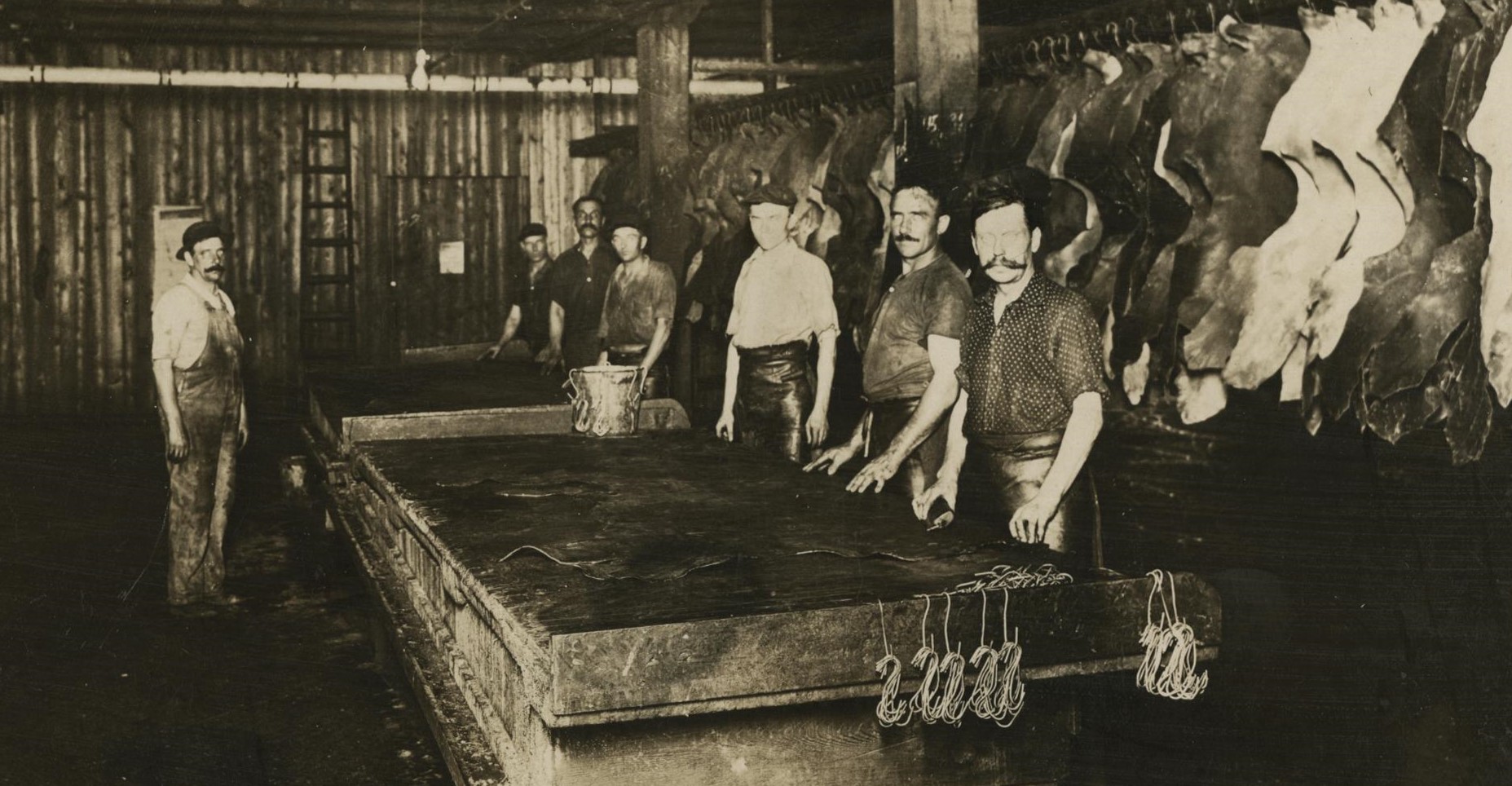
A look at the bloody, lost, 1909 strike of 1500, largely Polish immigrant, workers against the massive tannery of N.R. Allen’s Sons Co.
‘Socialists Lead Kenosha Strike’ from The Chicago Daily Socialist. Vol. 3 No. 227. July 24, 1909.
(BY A STAFF CORRESPONDENT) Kenosha, July 24. Blood being shed and waded through in order that the big industrial monopolies of the country may continue in their oppression of the ignorant, unorganized, helpless foreign laborer! This is the story of the strike and massacre at the tanneries of the N.R. Allen’s Sons company.
The Allen company is but one of the score or more plants of the leather trust scattered throughout the country. Like the Pressed Steel Car company of McKees Rocks, Pa., it is merely grinding out the labor of its employes at the least possible cost to itself.
See Citizens Fall Dying
That is why peaceful Kenosha, that was never troubled with any problems bigger than the style of bathing suits to be used in summer, heard the shots of rifles and revolvers, yesterday, and saw its citizens fall dying in its streets while the octopus hands of the leather trust were smeared with a little more of the working man’s blood as its tentacles reached out to crush the last spirit of opposition from its wage slaves.
The sentiment against the tannery officials is keen. Mayor Scholey denounces them and has taken side with the strikers. The mayor is unanimously supported by the city council and is heartily joining with prominent local Socialists in an exert to bring the leather trust to terms.
The trouble first started when Rudolph Schneider, foreman at the tannery, was transferred from his own department to one where the hides in the big vats are taken care of. This is the most difficult work in the big plant and requires the hardest kind of work and the greatest care.
Foreman a Slave Driver
Schneider started out to make a record for himself in that department by discharging ten men and compelling the remainder to do as much work as had been done before. He introduced the pace-making methods familiar to the stock yards. It was against these methods that the men protested and on account of which they walked out.
John H. Wells, a prominent Socialist, who is manager of the largest department store of Kenosha, went to Max Werve, head superintendent of the company, in an effort to have the trouble adjusted Wednesday morning.
“I can’t do anything about it,” said Werve, who has been in the leather business for the last fifty-two years and is well acquainted with the trust methods.
Thinks Strike a Circus
Mr. Wells then went to “Charley” Allen, one of the proprietors, and told him of the grievances of the workmen.
“I can do nothing for them,” said Allen and he refused to transfer Schneider back to his old department. “If the men want to have a strike why I’m not going to prevent them. It’s up to them if they want to have a little circus.
With this answer Mr. Wells left the plant and the workmen unanimously quit their work.
There are 1,500 men employed at the plant of the leather trust in Kenosha which covers seven city blocks with Its monster, grayish, dead-looking buildings. The only thing that distinguishes one building from another is a big number painted on the sides of each in black and white paint.
Work 13 Hours Daily
Out of the 1,500 men employed, 1,400 are foreigners, Poles, Lithuanians, Slavs and Italians. They receive on an average of from $9 to $10 a week for ten, twelve or thirteen hours work a day as the case may be. The men have no organization. In this respect being in a position similar to that held by the striking steel workers at McKees Rocks.
It is but an example of the position being taken by all industrial monopolies at the present time. They have imported the cheapest labor possible from Europe, kept them from organizing and as a result, held the whip hand over them at every crook and turn of industrial progress.
“This is another case of where the wage slave has been driven by the industrial master until he could endure the conditions no longer,” said a Kenosha merchant.
Order Socialist Thrown Out
While leaving the works with some of the strikers Mr. Wells was recognized by some of the officials of the plant and the police were ordered to throw him out. The police, however, refused to do this saving they knew Mr. Wells personally and that there would be no cause for such action. The first day of the strike came to an end with a monster mass meeting last night at which a committee was chosen to confer with the company officials.
Nathan Allen, president of the leather trust. who had come here from the east personally assured Mayor Scholey that he had no objections to the demands of the men being granted. This was the state of affairs when the representatives of the strikers and the officials met at the tannery yesterday morning to settle the difficulties. The men decided to demand an increase in wages of from 50 cents to $1 a week. In addition to having Schneider returned to his original department.
Shots Break Up Conference
This matter was being amicably discussed with a hope of settlement in sight while the strikers were gathered outside of the plant waiting to hear the results, while the conference was being held in a peaceful manner. Suddenly a shot was fired, then more shots. The peaceful gathering suddenly became a struggling, fighting, riotous multitude. The first shot was fired by Mr. Call, a relative of the Allens and a high official In the Kenosha plant. He was standing at the entrance to the plant when a striker came up to him with the request that he be permitted to enter the building to get some tools that he had left there. Other workmen had returned to the plant for the same purpose and there was nothing unusual about it Mr. Call, however, brushed the man aside and fired a shot to emphasize authority.
Tony Monkon was the victim of the bullet, receiving the shot through the right hip, the bullet piercing to the groin. His condition is serious. The fight became one of steel bullets against rocks and other missiles that were available. The bullets won out, the strikers being scattered to their homes.
Officials Plead Innocence
The officials claimed that the men were shot by their own comrades in the melee. So far as could be learned the strikers had no guns. The reports that the strikers are importing arms and ammunition from Racine and Chicago were found to be untrue.
Charles Clemm, a striker, was shot in the leg, while Peter Soboccobie was also seriously injured. Several police officers were injured, but the majority of the casualties were among the workmen
When the shooting began “Charley” Allen, the manager of the Kenosha plant and one of the proprietors, as if he had been expecting the trouble all along, ordered Sheriff Gunter to call upon Governor Davidson for the state militia.
Deputies Sworn In
This is the first time that any strike trouble of the serious nature of the present trouble has occurred in Kenosha, and as a result Sheriff Gunter was at a loss as to how to handle the situation. Allen and the other tannery officials know how to do it, though. Scores of deputies were sworn in and armed with clubs. Telegrams were sent to Madison, and when Governor Davidson could not be located there he was finally reached at Camp Douglas.
“We’ll pay the cost of a special train to get the troops here from Milwaukee,” was Allen’s message,
By the time Sheriff Gunter got his second wind, however. and General Otto H. Falk. representing Governor Davidson, had come to Kenosha to look the situation over, it was decided that the strikers were acting peaceably and that the troops were not needed. The special is being held in readiness, nevertheless, at Milwaukee, to get the troops to the scene of the trouble at a moment’s notice.
Mayor Conducts Negotiations
Mayor Scholey has assumed entire responsibility for the negotiations between the strikers and the tannery officials. In the afternoon he called on “Charley” Allen to get the company’s side of the trouble. He also drew up a list of the demands of the workmen in the twelve different departments of the plant.
In order to get in closer contact with the men he rented a hall last night, paid for it out of his own pocket and called upon the men to hold a mass meeting. Over a thousand crowded into the hall and remained for several hours while the situation was discussed.
“I believe that every demand that you have made is just and fair,” said Mayor Scholey to the strikers, “and I’m going to stand by you and see that you get what is coming to you! You are certainly not getting what you should receive at the present time, know that you are getting too little and I have told “Charley” Allen so.”
Will Stand With Workers
“I want you to thoroughly understand that I’m going to stand by the working people and not by the corporation. I have no sympathy with them at all. I stand with the people and with the working man, and I’m going to do all I can for you in order to help you get fair wages for what you do. I’ll guarantee to you all that you get your jobs back.”
This was translated into the various languages of the strikers by the Socialists who are helping Mayor Scholey to settle the trouble peacefully. Mr. Wells spoke to the Lithuanians. Joseph Benezinski, a druggist and prominent business man, to the Poles, and Michael Kovalski to the Slavs.
Twelve to Represent Strikers
The meeting was then turned over to the strikers and they chose their own chairman and selected a committee of twelve to represent them in the negotiation with the tannery people.
This committee will be accompanied by Mayor Scholey, Aldermen Pirsch, Safget and Wade, Mr. Wells and Mr. Beneznaki They held a meeting at the Fischer hotel today to draw up a list of demands made by the men, which it is hoped will result in the drawing up of a contract for two years between the strikers and their employers.
Alderman Supports Toilers
“I do not believe that the trouble should have occurred at all this morning,” said Alderman Pirsch to Dally Socialist reporter, at the mass meeting last night. “Shooting is the last thing that ought to be resorted to by the police, and I could see no reason for it this morning. We feel keenly the position we are in, but it is our intention to see that the workmen get everything that is coming to them.”
“There is a Socialist who works over in the factory of the Rambler Automobile company,” said Mr. Wells to Mayor Scholey as the strikers were holding their own meeting.
“Is that so?” said the mayor.
“I’m Socialist, too,” said Mr. Wells, and pointing to the representative of the Daily Socialist, he said, “This man is also a Socialist.”
Mayor Scholey a Socialist
“Well, I guess I’m a Socialist, too,” said Mayor Scholey. “You people are certainly a great aid to me. You know how to handle a situation of this kind. It’s a wonder the working man doesn’t appreciate it more.”
“Old Man Allen,” the father of Charley Allen, started out to tan hides many years ago in a little place of his own at Kenosha. The business grew, as did the several sons of “Old Man Allen.” At the time the tanners were organized in a skilled union workers receiving between from $4 to $5 a day. “Old Allen” was discarded by his sons. Machinery gradually invented to do the skilled work, foreigners imported by the thousands, the union broken, and now the unorganized foreigners are working for about $1.50 a day. The Allen brothers are the dominating factor in the leather trust, which is dominated to a great extent by the beef trust.
Living Twice as High
The meager wages of the strikers will be all the more appreciated when it is known that the cost of living at Kenosha is about twice as high as it is in Chicago.
During the day yesterday Wells called up Father Beinarer of the Polish Catholic church on the telephone several times in an effort to have him exert what influence he could for his parishioners who were in trouble. When the priest heard what was wanted he hung up the receiver. He did this repeatedly, refusing to have anything to do with the strike. Another priest hurriedly walked past the scene of the trouble and back to his church, claiming that he wanted to have nothing to do with the strike. The strikers belong to the Polish Catholic church, Irish Catholic church, German Catholic church, German Lutheran church and Lithuanian Catholic church. In all of these churches membership in the Socialist party means religious ostracism.
Seven in County Jail
Seven men are in the county jail as a result of the trouble yesterday. Several strikers went to the jail last night asking for the release of the prisoners but were met by Sheriff Gunter with a double-barreled shot gun. This was one of the grievances of the men at the mass meeting. Mayor Scholey said that he would investigate every arrest as soon as possible. They will probably be taken up and the men released today.
Say The Will Close Plant
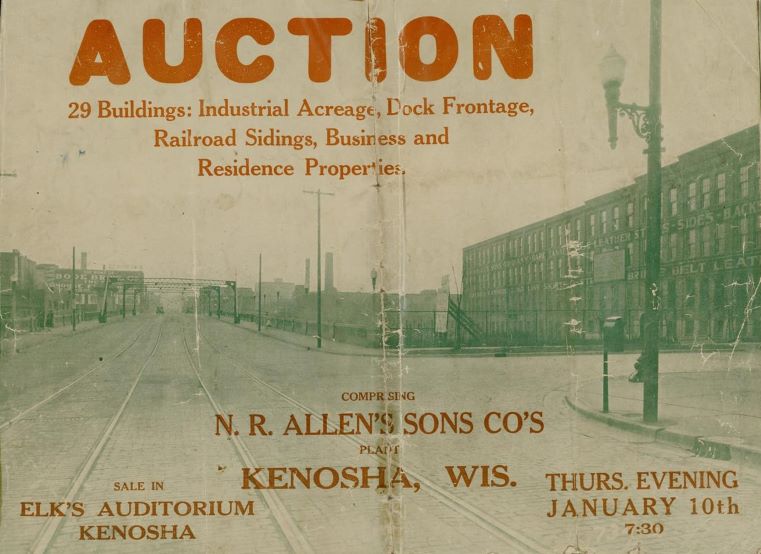
Kenosha, Wis., July 24. The officials of the N.R. Allen Sons company today declared that they would not meet the demands of the striking tanners. This will probably mean the closing of the plant.
The demands call for an increase in wages of from 50 cents to $1 a week, which Mayor Scholey declares to be no more than just.
The Chicago Socialist, sometimes daily sometimes weekly, was published from 1902 until 1912 as the paper of the Chicago Socialist Party. The roots of the paper lie with Workers Call, published from 1899 as a Socialist Labor Party publication, becoming a voice of the Springfield Social Democratic Party after splitting with De Leon in July, 1901. It became the Chicago Socialist Party paper with the SDP’s adherence and changed its name to the Chicago Socialist in March, 1902. In 1906 it became a daily and published until 1912 by Local Cook County of the Socialist Party and was edited by A.M. Simons if the International Socialist Review. A cornucopia of historical information on the Chicago workers movements lies within its pages.
PDF of full issue: https://www.marxists.org/history/usa/pubs/chicago-daily-socialist/1909/090724-chicagodailysocialist-v03n227.pdf
 Revolution's Newsstand