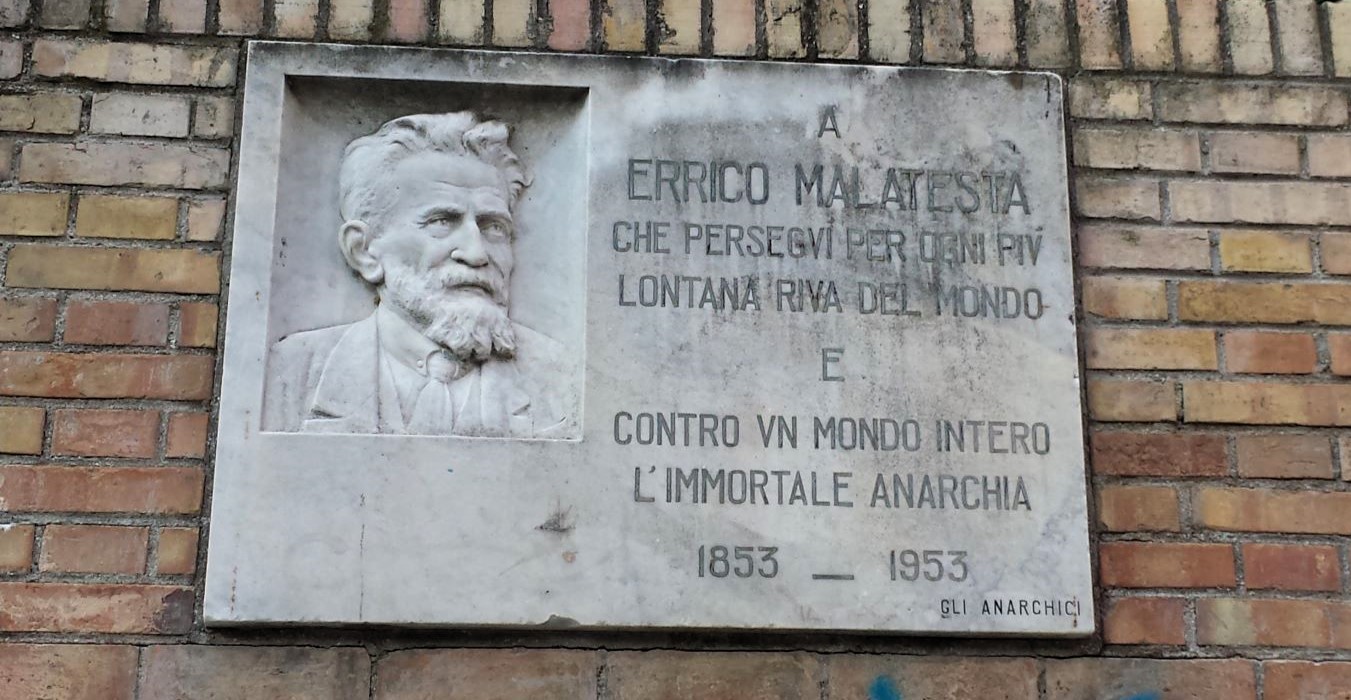
Norman Matson’s report on the Italian anarchist movement in the immediate aftermath of the Biennio Rosso contains a now-famous letter from Enrico Malatesta on the dictatorship of the proletariat.
‘The Anarchists of Italy’ by Norman Matson from The Liberator. Vol. 4 No. 9. September, 1921.
THE Italian Anarchist movement is powerful. It is numerically powerful; ideologically, it is virile, pervasive. The party, naturally, has no membership list. Lacking this, it may be noted that the Umanita Nova, daily organ of the movement, had 50,000 paid subscribers. (Had, because after the bombing of the Diana theatre in Milan in April, the establishment was smashed by a mob, and the journal, having moved to Rome, has not yet resumed publication.) The influence of the party spreads far beyond its avowed followers. Its psychology, its steadfast faith in the infinite capabilities of the masses, its unwavering confidence that the present is always the best time to act, flavor the entire working class movement of Italy. Your Italian temperament, avid of liberty, impatient of delay and discipline, turns readily to an anarchistic way of thinking. In Italy the masses are always more radical than their leaders. This is hackneyed but a truth, nevertheless, that continually makes itself vividly manifest. Events, seen and read, confirm it; and the leaders, themselves, from Turati to Serrati, to Amedeo Bordiga will tell it you. The Italian rank and file is hard to lead. The anarchists care less about leading than stimulating it. In a word, the anarchists will play no little part when the revolution comes to Italy. They will be in the vanguard of the onslaught that overthrows the capitalist state. And after that they will not cease to function as the Extreme Left; powerful in numbers, powerful in their leaders, powerful in their propaganda. What, then, is the attitude of the party now; more especially, what will it be after the colpo di stato? Has it or will it undergo a “realistic” orientation in so far as its theory and the actuality of that dictatorship of the revolutionary state accepted in anticipation as necessary, are concerned?
Theoretically it is intransigent. At present it is “realistic,” practical, striking hands for purposes of immediate strategy with those who are, philosophically, its mortal enemies–those builders of the new, more powerful State–the Socialists. It avows, in its press and in its infrequent manifestoes that this tactic of alliance with those who will one day be an enemy–to overthrow those who are now their enemy will be continued until the latter, the capitaistic state, is definitely overthrown.
After the war, during those tense months when Italy teetered on the verge of a tremendous mass revolution, a period that reached its crisis in September, 1920, with the occupation of the factories, and when, as the Government now officially admits, the Government did not have enough dependable troops to guard those factories, the anarchists met with the Socialists, the Syndicalists, the Communists, the railroad and seamen’s unions, and agreed to participate in the formation of a single front. The pact stood about six months. At the meetings of this inter-allied committee there were seldom representatives of all the groups, so that it could not act effectively. The Socialist apathy in the face of the arrest of Malatesta, and the retreat from the factories smashed the formal concord. Only the Committee Ordine Nuova cried out prophetically to the great Socialist party that the reaction would strike the Communists next and then the Socialists, and even the reformists among them. The concord dead, the anarchists continue to co-operate with any and every movement tending toward the “catastrophic” revolution. They fight white guards shoulder to shoulder with right socialists, communists, and to coin a fearful but illuminating adjective with the Nonpartisan-league-type Catholic union men. In general and naturally they have cooperated with the Syndicalists and Communists, but to these latter they are less close today than yesterday, when directing elements of the Communists were abstentionists. The Communists, seeing eye to eye with Moscow, now send men to Parliament; and the Anarchist press says Rome will ruin the Communists, also.
The Syndicalist union (syndico-anarchistic; its strength centers among the workers of the mines and common laborers like the I.W.W.; it claims 300,000 members) is affiliated with the Third International. The Anarchists, as a Party, of course are not, but the adhesion of the syndicalists, among whom are so many true anarchists, constitutes something very near to representation for them.
The present attitude of the party as to Russia is one of suspended judgment. Of its many weeklies, one, L’Avvenire Anarchico of Pisa, openly attacked the regime of the proletarian dictatorship and constantly published so-called accounts from Russia that equalled in bitterness and resembled in phraseology the familiar Helsingfors dispatches. But the editor responsible–a Virgilia Mazzoni–resigned a few weeks ago under a storm of criticism to make way for Souvarin, whose policy is the party’s policy–suspended judgment. Mazzoni, among other things, was accused of being paid by certain bourgeois interests. Avowedly, inevitably opposed to the dictatorship of the proletariat, the anarchist press, the anarchist leaders, have no wish to swell the critical chorus of the bourgeois press; and if they wished, they could not, in the face of a following that sees Russia first and above all as the one land in which capitalism has been overthrown. L’Avvenire proved that.
But the Party is a unit in suspecting and fearing the dictatorship of the proletariat. It agrees that after the colpo di stato there will be a period of confusion, of consolidating gains before further advance, a period in which a dictatorship of a minority violently speeds the work of destroying the last vestiges of capitalism–and directs the defence of the revolution against outside aggression. (An anarchist leader said to me: “Perhaps, here in Italy a dictatorship of the anarchists!”) But at the first signs that this dictatorship is crystalizing into anything that looks like a political, centralized state the Italian anarchists will pass to an opposition as bitter as that toward the present regime. Amedeo Bordiga and the other theoreticians of the Communist Party are saying that the reorganization of industry necessarily will be of long duration–many years perhaps. During the process there will have to be, for sake of efficiency, a political dictatorship. As in Russia. The Italian Communist leaders are first of all scientific productionists. They preach with cold frankness that the true revolution will be a long, hard exercise in applied science. Such statements as that paraphrase of Bordiga and the written attack upon Lenin published by Malatesta before he was incarcerated six months ago, in which he bitterly denounced the Soviet leader as a destroyer of liberty, supporting his argument on classic anarchist grounds, illustrate the fundamental differences. Obviously.
The “single front” cracked at the first impact of concrete, revolutionary realities. It seems certain, if anything in the future is certain, that the anarchist’s judgment as to where to mark that dead-line upon which the last vestige of the capitalist State will have expired will differ from the Communist judgment of the same. The cool acceptance by the Communist productionists of a political dictatorship of long duration is a veritable challenge to the Anarchists. That there will be a post-revolution struggle between the two is accepted by both.
Malatesta’s program for the period following the colpo di stato differs from Lenin’s precisely as Proudhon differed from Marx: production and distribution in the hands of free co-operatives, decentralization, no Red army but an “armed working class.” Neither the executive committee of the I.W.W. nor the Soviet of Moscow. Decentralization. Not in the dim future but then, immediately after the white guards are crushed and the land and the factories are physically in the hands of those who work them. Decentralization for reasons of fundamental philosophy, but also because Italy is a loose federation of clearly defined, traditionally and economically autonomous districts. But this itemized intransigence is tempered by d realism born largely from a study of Russia which accepts the theory of the necessity of a brief period in which a dictatorship of a minority will function.
All this is vague. But so is the conscious tendency of the movement. It shades off by imperceptible degrees into the syndicalists; its press in general refrains from criticism of Russia, but this phenomenon must be considered in relation to the fact that in Italy as in no other land is Russia loved, sung to, all but prayed to; Malatesta is acclaimed by gigantic crowds of workers in the great cities, and the government can slap him into the complete silence of prison in the very period that it dared not use its troops to protect the private property that the workers decided they wanted-and the protests are impressively impotent; the Anarchist members of the Syndicalist Union are represented in the Third International, and proud of it; but the party in all its written pronouncements opposes the dictatorship of the proletariat on grounds of fundamental philosophy. The truth is that there are two wings of the party-one, the most powerful just now, tolerant of Leninist measures, but only tolerant; the other bitterly opposed. It was a leader of the former tendency, however, that said to the writer: “The Soviet I fear has solidified into an enduring State…I said to Bordiga, we will fight your enduring political dictatorship, and he replied: ‘Aye, we will fight.’
LUIGI FABRI writes from Corticella:
The comrades of the “Guerra di Classe” have turned over to me your note, because they know of the close personal friendship between Malatesta and me.
Enrico Malatesta is radically adverse to the Dictatorship of the Proletariat; he has remained so and will be so always. I am enclosing a letter that he wrote me from London in 1919 that will explain his thoughts. But he has also written diverse articles against the Dictatorship of the Proletariat in the Umanita Nova of Milano, and an opuscolo, “Le Due Vie,” which I am sorry I have not here now.
I have just published a book (Dictatura e Rivoluzione, edit. G. Bitelli, Anconax), in which I examine the question from the same point of view as Malatesta. Malatesta wrote me from prison authorizing me to preface this book with the letter which I enclose.
Carissimo Fabbri:
Upon the question that so occupies your mind, that of the Dictatorship of the Proletariat, it seems to me that we are fundamentally in accord.
Upon this question it seems to me that there can be no doubt among anarchists, and in fact there was none prior to the Bolshevist revolution. Anarchy signifies “non-government,” and therefore for a greater reason “non-dictatorship,” which is an absolute government without control and without constitutional limitations.
But when the Bolshevist revolution broke several of our friends confused that which was the revolution against the pre-existent government and that which was the new government came to superimpose itself upon the revolution so as to split it and direct it to the particular ends of a party…and little by little they themselves became bolshevists.
Now, the bolshevists are simply marxists, having a difference with their masters and models–the Guesdes, the Plekanoffs, the Hyndmans, the Scheidemanns, the Noskes, who finished as you know. We respect their sincerity, we admire their energy, but as we have not been in accord with them on the terrene of theory, we cannot affiliate with them when from theory they pass to action.
But perhaps the truth is simply this, that our Bolshevized friends intend with the expression dictatorship of the proletariat merely the revolutionary act of the workers in taking possession of the land and of the instruments of labor and trying to constitute a society for organizing a mode of life in which there would be no place for a class that exploited and oppressed the producers.
Understood so the dictatorship of the proletariat would be the effective power of all the workers intent on breaking down capitalist society, and which would become “l’anarchia” immediately upon the cessation of reactionary resistance, and no one would attempt by force to make the masses obey him and work for him.
And then our dissent would have to do only with words…”Dictatorship of the Proletariat” should signify dictatorship of all which certainly does not mean dictatorship, as a government of all is no longer a government, in the authoritative, historic, practical sense of the word.
But the true partisans of the dictatorship of the proletariat do not understand the words so, as they have clearly shown in Russia. The “proletariat” naturally enters as the “popolo” enters into democratic regimes, that is to say, simply for the purpose of concealing the true essence of things. In reality one sees a dictatorship of a party, or rather of the heads of a party; and it is a true dictatorship, with its decrees, its penal laws, its executive agents and above all with its armed force that serves today “also” to defend the revolution for its external enemies, but that will serve tomorrow to impose upon the workers the will of the dictators, to arrest the revolution, consolidate the new interests and finally defend a new privileged class against the masses.
Bonaparte also served to defend the French revolution against the European reaction, but in defending it he killed it. Lenin, Trotsky and their companions are certainly sincere revolutionaries–as they understand the revolution, and they will not betray it; but they prepare governmental methods (quadri governativi–governmental pictures, literally) that will serve those that will come, who will profit from the revolution and kill it. They will be the first victims of their method, and with them, I fear, will fall the revolution. And history will repeat itself; mutatis mutandis, it was the dictatorship of Robespierre that brought Robespierre to the guillotine and prepared the way for Napoleon.
These are my general ideas upon things in Russia. Inasmuch as the news we get from Russia is too contradictory to base upon it a judgment, it is probable that many things that seem bad are the fruit of the situation, and that in the peculiar circumstances in Russia it was impossible to do otherwise than was done. It is better to wait, much more so in that whatever we might say would have no influence upon the developments in Russia, and to seem to echo the interested calumnies of the reaction would be illy interpreted.
The important thing is what we must do. I am far away, and it is impossible for me to do my part.
ENRICO MALATESTA.
The Liberator was published monthly from 1918, first established by Max Eastman and his sister Crystal Eastman continuing The Masses which was shut down by the US Government during World War One. Like The Masses, The Liberator contained some of the best radical journalism of its, or any, day. It combined political coverage with the arts, culture, and a commitment to revolutionary politics ay a pivotal time in Left history. The writings by John Reed from and about the Russian Revolution were hugely influential in popularizing and explaining that events to U.S. workers and activists. Increasingly, The Liberator oriented to the Communist movement and by late 1922 was a de facto publication of the Party and was sold to the Party by Eastman. In 1924, The Liberator merged with Labor Herald and Soviet Russia Pictorial into Workers Monthly. The Liberator is an essential magazine of the US left.
PDF of full issue: https://www.marxists.org/history/usa/culture/pubs/liberator/1921/09/v04n09-w42-sep-1921-liberator-hr.pdf
 Revolution's Newsstand