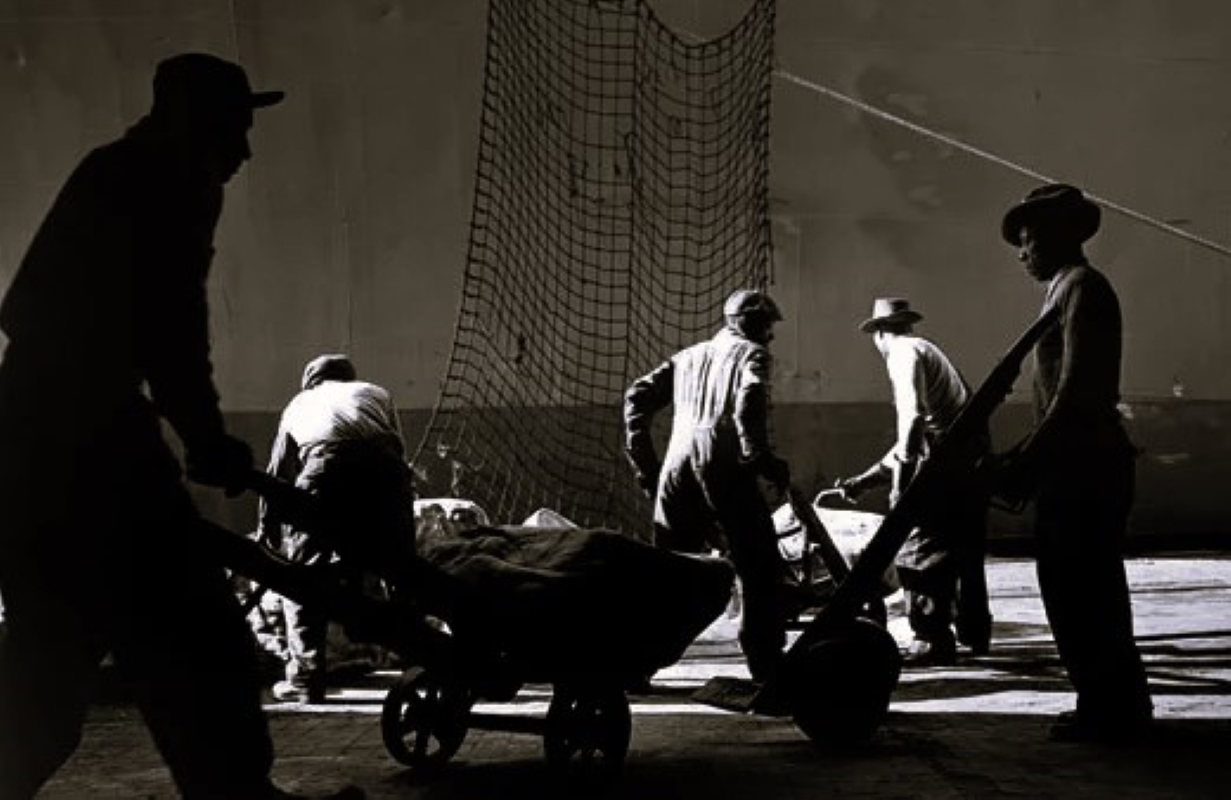
In the aftermath of the great West Coast strike of 1934, a delegated East Coast conference of the C.P.’s Marine Workers Industrial Union and Rank-and-File Action Committee of the International Longshoremen’s Association met in Baltimore to plan strategy for upcoming strike action, organizational unity, and sets of demands. Solidarity.
‘Unity of Rank-and-File Dock Workers Sought at Baltimore Convention’ by Harry Raymond from the Daily Worker. Vol. 11 No. 209. August 31, 1934.
A North Atlantic Marine Workers Conference, with delegates from the ships and docks from several unions, will convene in Baltimore, Md., on Saturday, Sept. 1, and will be in session for two days, to work out a plan of action for the Atlantic seaports and prepare for a strike for union conditions in the marine industry on the East Coast.
Initiated by the Marine Workers Industrial Union, the conference will aim to unite the rank-and-file seamen and longshoremen, regardless of union affiliation, around a program of struggle against the shipowners. Supporting the unity move is the Rank-and-File Action Committee of the International Longshoremen’s Association, headed by Howard Farmer, and the Radio Telegraphists Association, a union of ship’s radio operators.
Proposals and resolutions, prepared by various groups to be presented, discussed and used as bases for the unity program, include a plan of struggle for the 1929 wage scale for seamen, firemen, cooks and stewards, for the abolition of the two watch (12 hour a day) system, for $1 an hour wage scale on all docks and $1.50 for overtime.
Seamen delegates, elected by crews on the ships, will also urge that the proposition of carrying on a fight in all ports for a centralized shipping bureau controlled by the rank and file seamen shall be incorporated into the program Delegates from the docks will demand that all hiring shall be done through union halls and that a rotary system of hiring shall be established. Larger gangs, smaller loads, abolition of the speed-up and union recognition will be among the major points proposed for the fighting program by the longshore delegates. A number of the delegates have indicated that they have been instructed to support the Workers Unemployment Insurance Bill.
Thirty-two delegates will leave New York this morning and will arrive at Baltimore tonight where they will be greeted at the headquarters of the Marine Workers Industrial Union, 720 South Broadway, by a mass reception committee from the ships and docks in the Chesapeake Bay region. Delegates are also on their way to the conference from Boston, Philadelphia and Norfolk. Among the delegates from the port of New York, twenty are seamen, eighteen of whom will represent the crews of forty ships. One thousand unemployed seamen will send two delegates. The radio operators will be represented by two delegates. Ten longshoremen, representing 3,000 dock workers, will bring the proposals of the New York I dock workers to the conference. “The eyes of the seamen in ports throughout the world are on this conference,” said Roy Hudson, national secretary of the Marine Workers Industrial Union, who will leave for Baltimore today as a delegate. “It aims to establish that unity in struggle that the men on the ships have been fighting for years. The longshoremen consider the conference as the greatest step ever made on the east coast to unite all maritime trades in a solid, fighting front against the shipowners and against the agents of the ship- owners, Mr. Joseph P. Ryan and his understrappers, who helped to betray the great West Coast strike.”
‘Demands for Longshoremen’ from the Daily Worker. Vol. 11 No. 231. September 26, 1934.
Following is the list of demands for longshoremen, adopted at the Baltimore United Action Conference, Sept. 1, and approved by the National Rank and File Committee of the International Longshoremen’s Association and the Marine Workers Industrial Union:
HOURS
1. Six hours of work shall constitute a day’s work. The day shall be between 6 a.m. and 6 p.m. The working week shall be from Monday to Friday.
2. While 30 hours shall constitute a week’s work, there must be a guarantee of 20 hours work a week, 40 weeks a year. The government and Industry shall guarantee this minimum of 40 weeks. All workers getting less than 40 weeks shall receive the difference between their actual earnings and the minimum wage from the Unemployment Insurance funds, which shall be raised by 1 per cent tax on every 100 pounds of cargo and from funds appropriated for the Jones-White act. The foregoing minimum shall be so guaranteed until the passage of the Workers’ Unemployment Insurance Bill. H.R. 7598. which bill has the endorsement of the U.A.C.
WAGES
3. The wage shall be $1 per hour for general cargo and $1.50 overtime. All work on offensive and dangerous cargo, hides, explosives, sulphur, barbed wire, damaged cargo, etc., wages for such cargo shall be $1.25 an hour and $1.87’ 2 overtime. Explosives are to be plainly marked as such. Wages are to be adjusted regularly as prices rise, so that there will be no lowering of the standard of living due to inflation.
HIRING
4. The gang system of hiring shall be discontinued and a rotary system instituted, to be controlled by the longshoremen. There shall be no discrimination against race, creed or color in giving out jobs. There shall be no checkerboard gangs. Negro workers are to be given equal opportunity for any job on the dock.
5. When men are called out and no work is provided, the men shall receive three hours pay at the prevailing rate. After six hours, the men shall receive time and a half, meal times to be double straight time.
6. There shall be no overtime after six hours. A new gang is to be shaped up. All Saturday and Sunday work is to be paid at overtime rates, time and a half. Double straight time shall be paid for the following holidays: New Year’s Day, Independence day, Labor day, Columbus day, Armistice day, and Christmas. When these holidays fall on Sunday, the overtime rate shall be paid on the following day. All workers to be given time off with pay to vote on election days.
7. Under no conditions shall seamen do longshoremen’s work, such as driving winches, etc.
8. No deduction shall be allowed for shifting.
9. Transportation shall be furnished to the men working in the stream from the time they leave the docks until they return to the docks. All work at outside points, the men shall be paid travelling time and transportation. Time is to start from the time they leave the starting point until they return.
MINIMUM GANGS
10. In order to create more jobs, the minimum gang for general cargoes shall be 22 men, with corresponding increases for all other types of cargo. The union local and dock committees shall determine the size of the gangs.
11. Compensation shall be $20 a week, payable at once, upon injury. All expenses incurred, such as doctors, etc. to be paid by shipowners and compensation. Workers to have the right to any doctor they want.
12. The above and wage scale shall apply to all men employed in the business of loading or discharging of all vessels and the assembling of all cargoes, all checking, all cargo repairman, all longshoremen on deep water and coastwise docks.
RECOGNITION
13. The longshoremen shall have the right to join any union they see fit; the right to strike when their demands are not otherwise granted; recognition of the elected dock committees for the enforcement of wages and labor conditions contained in these demands and in any other problems that may arise. In all conferences longshoremen shall be represented by committees elected by ranks and from the of the longshoremen. There shall be no discrimination on account of union activities.
The Daily Worker began in 1924 and was published in New York City by the Communist Party US and its predecessor organizations. Among the most long-lasting and important left publications in US history, it had a circulation of 35,000 at its peak. The Daily Worker came from The Ohio Socialist, published by the Left Wing-dominated Socialist Party of Ohio in Cleveland from 1917 to November 1919, when it became became The Toiler, paper of the Communist Labor Party. In December 1921 the above-ground Workers Party of America merged the Toiler with the paper Workers Council to found The Worker, which became The Daily Worker beginning January 13, 1924.
PDF of full issue: https://www.marxists.org/history/usa/pubs/dailyworker/1934/v11-n209-aug-31-1934-DW-LOC.pdf
PDF of full issue 2: https://www.marxists.org/history/usa/pubs/dailyworker/1934/v11-n231-sep-26-1934-DW-LOC.pdf
 Revolution's Newsstand