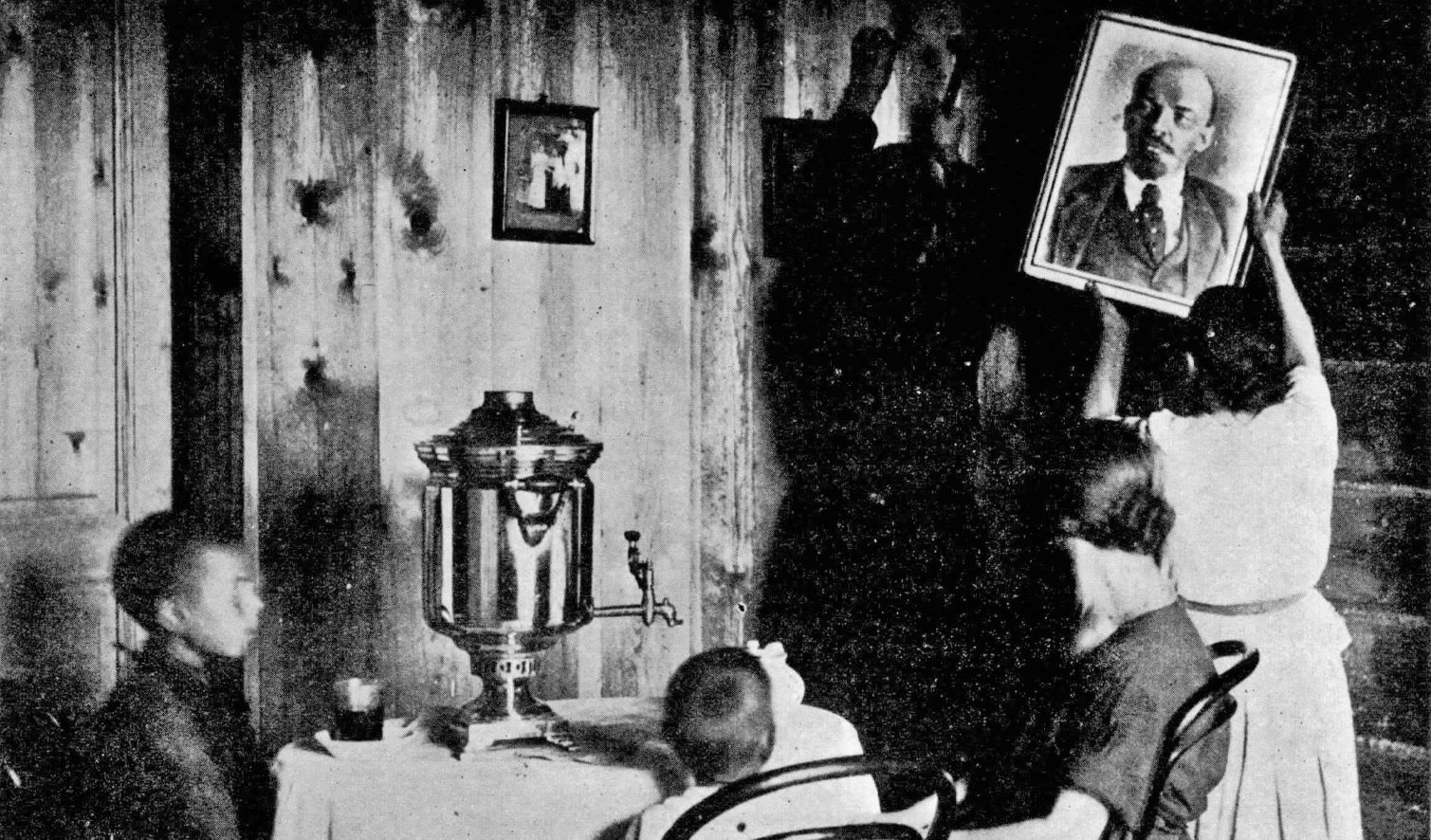
After his friend John Reed, Albert Rhys Williams was the most important English-language chronicler of the Russian Revolution. A witness-participant, and a marvelous writer, Rhys would spend much of the 20s in the Soviet Union. In this essay Williams travels deep into the Soviet countryside to report on life ten years after October.
‘October Reaches the Village’ by Albert Rhys Williams from New Masses. Vol. 2 No. 6. April, 1927.
Blessed is he who visited this world
In moments of its fateful needs;
The highest gods invited him to come,
A guest, with them to sit at feast,
And be a witness of their mighty spectacle.
Tutchev.
I count myself blessed. For together with another American, John Reed, I was an eyewitness of the great events of October, 1917.
Now I am twice blessed. I have seen something as tremendous and thrilling as the beginning of the Revolution. I have been an eyewitness of the march of the Revolution into the villages, into the far off steppes and forests of Russia.
For three years I have been out among the people, riding lumberrafts down the Pinega, and camel caravans bringing wheat across the frozen Volga, climbing over the mountain roads of the Caucasus, fighting smoke and cockroaches in the black izbas of the Archangel forests, swinging a scythe with the mowers of Kostrova, eating out of a common bowl with the peasants of Tver and Tula. I have lived with the Tartars of Crimea and Kazan, the Goddaubers of Vladimir and the Khokhli of Gogol’s Dikanka— and now am back after a year in the villages around Kvalinsk.
In these three years I have seen things as wondrous, heart-moving, dramatic as any I saw in the streets of Petrograd, Moscow, Kiev or Vladivostok in 1917-18.
I recall the all-day all-night session of the 2nd Congress of Soviets on November 7th, Smolny roaring like a gigantic factory — the cry of orators, machine guns rumbling across the cement floors, mud-spattered couriers bringing greetings from the trenches, crashing choruses of revolutionary songs, thundering ovation for Lenin emerging from the underground, the steady boom of cannon from the Aurora firing over the Winter Palace — tolling the death of the old order, saluting the new. And as the red dawn breaks in the east the declaration that the Provisional Government is dead, that the Soviets assume the power, assuring the free transfer of lands to the peasants, etc. An unforgettable night!
Now in the villages I have lived through as unforgettable all-day, all-night sessions of the Mir . The Soviet hall white with fog from the close packed steaming bodies of the mujiks, the air electric with tensity of feeling — agronoms delivering impassioned addresses, koolaks and poor peasants shaking their fists at each other, big bearded chairmen pounding the gavel for order. And out of this clash of. wills and strife of tongues — the resolution declaring the ancient far-field, cross-field and three-field system dead, declaring a six or nine or twelve-field the system for the future.
These decisions record a break with the old grandfather agricultural system of the past as sharp and significant as October was a break with the old political and social system of the past. They mark a new red date in the history of the villages, as November 7th marks a new date in the history of mankind.
That all-night session as Smolny was the precursor of the all-night sessions in Nikolsk, Ivanovka and tens of thousands of villages. The former transferring the land into the hands of the peasant, the latter decreeing the rational use of the land. Each a part of one continuous revolutionary process.
Dramatic comment when Krylenko ended his passionate speech to the armored car battalion in the Mikhailovsky Menage with the cry, “For Kerensky to the right! For the Soviets to the left!” The grey masses of soldiers surging left. The loud shouts of triumph. The chauffeurs climbing into the cars, the explosion of motors and out into the streets lumbered the great steel devils, blue barrels ready to spray bullets into the Counter-Revolution.
This winter I witnessed a spectacle dramatic as that. It was by the Volga, now a great highway macadamized by ice reaching 5000 versts into the heart of the Russian land, and hung with pink and purple mists by the sun rising from the steppe. The frosty air suddenly echoes to a distant rat-tat-tat, like a machine gun. Out on the great ice road sweeping up from the south, appears a black spot. Bigger and louder it grows. It climbs the high bank and swings down through the long row of izbas. It is a tractor entering the village. Eyes that never saw an engine grow big with wonder, gazing at the strange clanking, manywheeled monster. Horses rear on their hind legs, prancing. Old babas cross themselves fervently, murmuring, “It is the Antichrist!”
But it comes as a deliverer. It digs down two vershoka deeper than the wooden plow, turning up in broad, black furrows, the loam that for ages never saw the sun, into which the cereals may run deep their moisturesucking roots. It makes the fields hitherto producing fifty poods, bring forth a hundred and fifty. It thrashes in a day as much grain as the whole family, with the back-breaking flail, thrashed in a month. It draws together (fuses) several households (dvori) into a tractor oriel teaching them to own and to work collectively.
The thousands of tractors swinging into the villages today are the lineal succession to those armored cars swinging out of the Mikhailovsky Menage in 1917. The latter cleared the way for the former. But no more revolutionary. The one is a organic a part of October as the other — and as thrilling.
Heroes of October! I knew personally a score of these zealots thrown up out of the mass to be its leaders. Volodarsky, who, when I chided him for inhumanely working twenty hours a day, replied: “What of it? Why, I have packed more joy into these three months than a man ordinarily has in all his life.” Woskov, off to the front enjoining his wife: “If I am killed, make my boy understand his father died a Communist fighting for the workers.” Sockanov, after Czecho-Slovaks had overthrown the Vladivostok Soviet, standing on a high platform, crying: “The Soviets are dead. Long live the Soviets!” Taking a pledge from 10,000 workers with uplifted hands to fight or die for the Revolution.
Neibut, Yanishev, Mehikov, Otkin…all men of the rank and file. Flowers of the Revolution. The incarnation of its dynamic spirit. I bow to the memory of these names. For they are all gone now. Killed by typhus, bayonetted by White Guards, clubbed to death in prisons. They are all dead.
But the revolutionary spirit that burned in them is not dead. It passed on to the youth of today — hundreds of whom I have seen like torches flaming in the darkness of the villages. I begin with the last I knew:
Stephanov, the mild-eyed, unassuming Red Armyist now on the ring route that runs out from Khvalinsk with the post, bringing Moscow a month nearer to the snowbound villages in the hinterland. Into the village his sled sweeps with jangling bells calling everybody to the Soviet. Shaking the snow from his tooloop, he plunges into the crowd, shouting greetings in Chuvash, Mordvian, Tartar, distributing letters and money from the peasants working in the towns, taking subscriptions for the peasant paper, hearing complaints— answering questions — when he can’t, writing them down in a book and on the next trip bringing the answers back from the volost centre. Raging blizzards, thermometer 30 degrees below freezing, hungry wolf-packs, his child dies, but he never misses a trip, never loses patience and good humor. A marvel of pluck and endurance, realizing the smichka with the village.
Popov, the little feldsher in the Archangel woods, all day dealing with fractures, hysteria, fevers, in a province as big as a European kingdom. Now a smallpox epidemic, long lines of bare-armed lumbermen pour into his log cabin where He stands late into the night scruffing away the skin with a lancet, laying in the antitoxin.
Rodeonov and Kobilev, with clenched fists before a portrait of Marx, dedicating themselves to Communism; dragging a sledge from izba to izba gathering gifts of rye, potatoes and cabbages for a Red Corner; entering the Keli (posadilki) all-night girls’ parties to drive out the drinking and hooliganism with games and reading and revolutionary songs…Serious, but not taking themselves too seriously, winning their way with laughter and song.
But why prolong the list? Anyone who knows the villages can fill pages with stories of these red izbaches, selkors, teachers and agronoms. At once dreamers and hard workers, idealists and stern realists. No drums or banners to cheer them, but fighting against the dead weight of tradition, against customs entrenched for centuries — as valorously as the youth of 1917, fought against the Counter-Revolution and the armies of the imperialists.
But so few!
Scarcely a village without one at least, and in most villages from two to twenty. For every one who raised the revolutionary torch on the barricades of October, there are fifty today carrying that torch flaming into the steppes and forests and far-off places of the Soviet Union.
That hectic night in November with the alarm that Kerensky and the wild division was moving up on Petrograd. The factory whistles shrieking the tocsin to war. Out of the shops and slums march long lines of slanting bayonets, women with rifles, boys with picks and spades. Freezing slush oozes into their shoes, winds from the Baltic chill their bones. But in their veins burns a crusading fire and they push on to the front. They plunge forward into the black copse against hidden foes. They stand up to the charging Cossacks and tear them from their horses. Into the ears of their dying comrades they whisper, “Peace is coming! Power is ours!” Magnificent the rise of the poor and exploited with arms in their hands fighting for power and winning it.
Now in the villages a sight not less magnificent — the poor and exploited using the power that was won.
One sees the poor mujik, one time serf of the landlord, plowing with his own horses the land he once ploughed for the landlord, reaping for himself the fields he once reaped for another.
One sees illiterates with joy-illumined faces making the once also-mysterious books yield up their secrets to them. “The Tsar only wanted us to plow and pay taxes. He but bandages on bur eyes. The Soviet took them off and now we can see!”
One sees the batrak now rising to self-esteem, a member of a union writing contracts. This is from a batrak’s letter to me: “In the old days when we came to the koolak for work, we had to kneel with caps off and often got only a kick. If he said ‘come tomorrow!’ we thought it great luck. If he lent me one pood of rye we had to pay him two. Then we were the blackbone and we didn’t dare open our mouths to the whitebone. Now we can speak to anyone and go anywhere into any hall or building. So I say the Revolution has pulled us poor peasants and batraks out of the grave. We are just born anew and we know it.” To see the batrak rising to the consciousness that he has a government of his own; the poor peasant rising in economic status; the illiterate rising with pens in their hands — is that less impressive than to see the masses in 1917 rising with guns in their hands? Only the hopelessly childish will think so. Only the romantic will fail to see the Revolution in the processes now at work in the villages.
It is still October. Only with new implements and new strategy, to meet the new situation. Then, thrusting guns into the hands of the masses; now, books and papers. Then, enlisting the masses into regiments and Red Guards; now, in cooperatives and unions and machine artels. Then working with armored cars; now with tractors. Then with the soviets chiefly as political forums; now as organs of economic reconstruction. Then with the slogan, “Take over the land!” now, “Organize the land! Plow it deep!” Then destroying the old order; now building the new society. Then initiating the revolution; now deepening, widening, extending, consolidating it, everywhere.
Everywhere! That is what makes the experience of these three years so impressive. The astounding universality of the new phenomena. I have not entered a mountain aoul or Cossack stantsis or a forest hamlet, or straggle of houses on a far off river without feeling the pulse of the Revolution. In the “deafest” village, in the furtherest flung outpost on the distant frontiers, it is at work.
“Stop!” says someone, “what about the blots on the Revolution? The other side of the village!”
Well, in these three years, I have seen that, too! Samogon makers, the blue smoke curling up from their stills in the forests of Vladimir and half the village rolling, singing drunk in honor of the Saint (the Altar holiday). Tumble-down schoolhouses — so cold that the ink freezes in the bottle, so rundown that the blackboards have become whiteboards on which the teacher writes with charcoal instead of chalk. Sabotaging koolaks — while the Soviet secretary goes tapping windows telling the mujiks to come to election, they follow behind whispering to the mujiks not to come, no use in coming, nobody is coming. Murderous koolaks — out of the bushes at night, like wolves, leaping on the village correspondent who had exposed them. Wily mujiks— loud in cursing taxes and high prices and city products, but silent, never a word, about doubling and tripling their holdings in land. Renegade ex-Communists — who fought gloriously against bandits and hunger, but like Alexander of Macedon, having conquered the world, unable to conquer themselves —now succumbing to drink and trading. Superstition-stricken babas, with spells and conjurations seeking for their lost cows, and the cure of all diseases from toothache to Siberian swell.
All these evils I have seen in the villages.
But did I not see similar evils in the glorious blood-stirring gusty days of 1917?
Did I not see soldiers breaking into the wine cellars and lying dead drunk all over the streets of Petrograd? Trade unions declaring for Kerensky. Commissar careerists mouthing the shibboleths of the Revolution and bent on nothing but bribes and plunder. Peasants whose sole idea of the Revolution was to loot and burn the landlord’s estates. Workmen whose sole contribution to the Revolution was to loaf and spit sunflower seeds on the pavement or peddle rubbers, cigarettes and gewgaws. Masses of the unconscious enlisting under the banners of the Counter-Revolution.
But despite these evils and handicaps and despite the faint-hearted who quailed before them, October was the most stupendous elemental social revolution of the masses in the history of the world.
And today, despite all the glaring evils and shortcomings and despite the shortsighted who throw up their hands in despair, October continues to be the most powerful creative force in the world, inspiring the masses, educating, disciplining, transforming, socializing, revolutionizing them.
One who cannot see the evils rampant in the villages today, cannot see the five fingers on his own hand. But one who sees only these things, or sees them large or significantly, cannot see beyond his own hand. He is blind. In Russia there are many such. Many Communists even.
In some, this blindness comes from fatigue, their energies so sapped by overwork that the vision is dulled, blurred. Their attraction focuses on the evil that confronts them — drunkenness, bribery, bureaucracy — and like a cataract on the eye, it blots out everything else.
In others this blindness is due to that negative trait in the Russian character — a gloomy delight in being pessimistic on general principle. In their determination not to be accused of looking through rose-colored glasses, many writers put on black glasses, see only the dark and dismal in the villages and call it realism.

But primarily, it seems to me, many workers inside the Soviet Union are blind to the great achievements of the Revolution because they are too close to it. They cannot see the forest on account of the trees. It is not an accident that the labor delegations produce such enthusiastic reports. It is not because they are naive or misguided. It is because fresh from the outside, free from harassing cares and petty details, they see the Revolution more objectively. They see it in proper perspective.
Without perspective the greatest picture in the world is meaningless. Standing close to the canvas one sees only daubs of paint on coarse cloth. Any square foot of it in itself may be ugly, inane. But stand off a bit, and the jarring parts resolve themselves together into a unified whole, into a wonderful picture, inspiring the spectator with awe, wonder and enthusiasm.
So with the picture spread on this stupendous canvas, the Soviet Union, covering one sixth the surface of the earth. One must stand back a bit to comprehend the tremendous sweep and reach of the Revolution. One must have perspective to grasp the monumental achievements it has wrought in a decade — from the standpoint of history, in the twinkling of an eye.
Millions of poor and oppressed rising up in knowledge and power into the consciousness that they have a government of their own. Millions of superstition-stricken mediaeval minds becoming modern and rational, beginning to think scientifically and collectively. Millions in artels, in cooperatives and communes, learning to own and to work collectively. Millions of the toil-driven beginning to lay their burdens on the iron shoulders of the machine.
Any of these achievements is tremendous in itself. Together they blend into a gigantic spectacle of advancing and triumphing Revolution. October using new implements and strategy, but October with the old spirit busy at the task of building up Socialism in the Soviet Union and in the world.
The New Masses was the continuation of Workers Monthly which began publishing in 1924 as a merger of the ‘Liberator’, the Trade Union Educational League magazine ‘Labor Herald’, and Friends of Soviet Russia’s monthly ‘Soviet Russia Pictorial’ as an explicitly Communist Party publication, but drawing in a wide range of contributors and sympathizers. In 1927 Workers Monthly ceased and The New Masses began. A major left cultural magazine of the late 1920s and early 1940s, the early editors of The New Masses included Hugo Gellert, John F. Sloan, Max Eastman, Mike Gold, and Joseph Freeman. Writers included William Carlos Williams, Theodore Dreiser, John Dos Passos, Upton Sinclair, Richard Wright, Ralph Ellison, Dorothy Parker, Dorothy Day, John Breecher, Langston Hughes, Eugene O’Neill, Rex Stout and Ernest Hemingway. Artists included Hugo Gellert, Stuart Davis, Boardman Robinson, Wanda Gag, William Gropper and Otto Soglow. Over time, the New Masses became narrower politically and the articles more commentary than comment. However, particularly in it first years, New Masses was the epitome of the era’s finest revolutionary cultural and artistic traditions.
For PDF of full issue: https://www.marxists.org/history/usa/pubs/new-masses/1927/v02n06-apr-1927-New-Masses.pdf
 Revolution's Newsstand