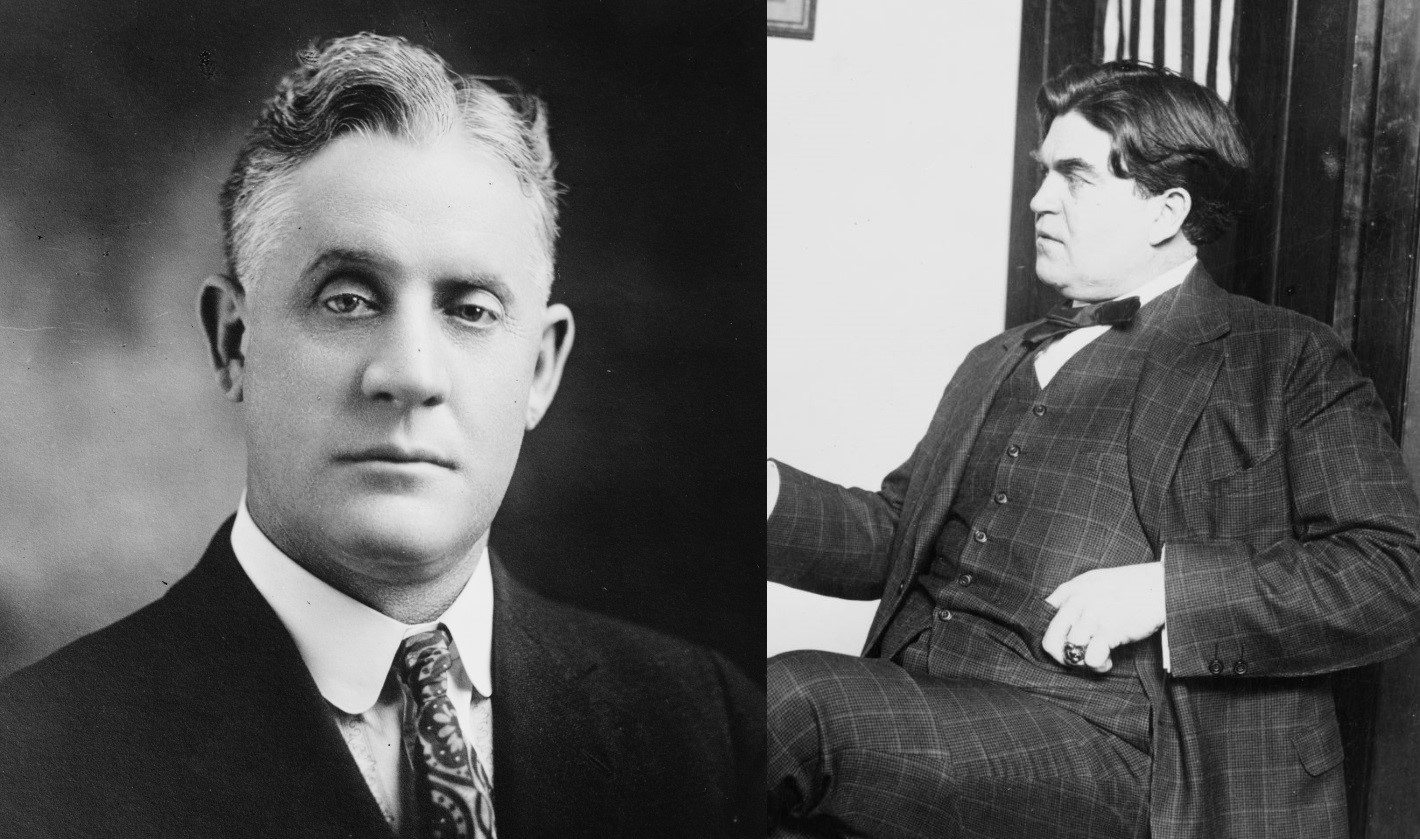
Though barely remembered today, Alexander Howat, the Scottish-born Kansas miners’ leader, was among the outstanding labor leaders of his generation. Long an advocate of democratic, progressive unions he was a constant thorn in the side of the U.M.W.A.’s corrupt leadership including John L. Lewis, who had this loyal union stalwart expelled from the U.M.W. and ‘blacklisted’ from the labor movement. Howat’s career stills casts a favorable shadow over the labor movement today. Another leading workers’ activist largely lost to history, Dublin-born Joseph Manley, gives the context for Howat’s heroism.
‘Why Alex Howat is Popular’ by Joseph Manley from the Daily Worker. Vol. 2 No. 60. May 27, 1924.
RECENTLY while in Pittsburgh. I learned at first hand the basic reason for the tremendous popularity of Alex Howat amongst the rank and file of the miners’ union, particularly in the Kansas district–his home.
While walking on the streets of Pittsburgh with him I noticed that he was greeted on all sides by miners and their wives and children who invariably hollered, cheerily, “Hello, Alec!” And this familiarity was not confined to Pittsburgh, because later in Kansas City I observed the same treatment towards him.
Always Fought for Radicals.
The basic reason for this popularity of the leader of the Kansas miners, is due to the fact that he has at all times fought to protect with the full weight of the miners’ union, the militants amongst the miners (who are invariably radicals) who had the courage to act as spokesmen for their fellow workers in the various disputes arising out of the attempts of the coal companies to infringe on the working conditions won by the union.
This is the explanation, as to why Howat retains his following, and why, on the other hand, the name of John L. Lewis is reviled because he has betrayed the rank and file by driving out of the organization their leader, and then putting over an “employers’ agreement” which provides for arbitration in place of the right to strike.
Taming the Missouri Pacific.
To bear out this contention it is well, at this moment, to recall the battles won by Howat and the Kansas miners nine years ago. At that time coal companies–who were becoming well organized–used to select a mine where militants were voicing the grievances of the miners; shut down the mine completely, starve out the men and blame the trouble on the “agitators.”
Howat decided to take counter action against the biggest company in his district, the Missouri Pacific, which had just shut down a large mine throwing three hundred miners and their families out of work. Howat and the District Executive Board went to Kansas City and served notice on Mr. Jenkins, the head of the company. Said Howat to Jenkins:
“That mine was down six months last year; now it is down again, and our people get hungry in summer as well as in winter, and must have work. We insist that all the mines owned by your company work at least part time so as to give an equal share of the work to all.” Jenkins replied: “I want you to understand, Howat, that we Own these mines, and we don’t propose to let you dictate to us when we shall open them up or shut them down. We cannot look out for the miners; they must look out for themselves, and stick together thruout Kansas.”
Strike Was Howat’s Answer.
Howat and the Executive Board returned to Pittsburgh and called 3,500 miners employed by the Missouri Pacific, out on a strike that lasted two months and ended by the company agreeing to open up all their mines, including the one in dispute. Since that time and until Howat was deposed by Lewis, no company, has dared to shut down a mine with the purpose of terrorizing the workers or the radicals amongst them.
Today in District 14, of Kansas, there are 10,000 miners, barely 3,000 of whom are at work-in spite of the fact that Lewis signed an agreement a few weeks ago which was supposed to put them all back to work.
An Unblushing Traitor.
District 14 went on strike April 1st. Three weeks ago John L. Lewis came to Kansas City to make an agreement with the operators. After having been closeted with the representatives of the operators for some time, Lewis appeared before the miners’ wage conference. It is reported that he informed them that he hadn’t given anything away, and that, “you still have a better contract than they have in other parts of the country. I must congratulate myself on what I have accomplished; I got along better than I expected. Arbitration ensures peace in the industry. Three hundred and fifty thousand men are working under arbitration, and you are no better than they.” Lewis’ inanities, coupled with the support of his “tool,” the district president who has superseded Alex Howat, influenced the wage conference into accepting the three-year “employers agreement.” With the acceptance later by the district organization controlled by the machine, were sacrificed all the better working conditions that had been gained by years of struggle.
Lewis at His Worst.
This is one of the worst pieces of treachery that Lewis has yet been guilty of. And it is typical of the complete degeneration that is coming upon our trade union “leaders.” Lewis seeks to exterminate the radicals from the organization, both locally and nationally, so that he can consummate “employers” agreements” that strip the organization of its militancy and the better working conditions it has striven for, and makes of it a co-operating instrument in the service of the coal operators for greater efficiency of “their” workers competing with the non-union fields. That is the real goal of Lewis and his kind to make of “their” organizations more efficient mediums for the exploitation of the workers than the present “company unions” which have sprung up in some of America’s giant industries.
Canker of Employers’ Agreements.
The canker of “employers’ agreements,” has for many years poisoned the labor unions–notably in the building trades. But today this malignant growth is spreading to the rest of the small proportion of the organized industries. And the poison of such agreements is now being used against the workers. The radicals and militants who built the unions are now often discriminated against thru expulsion and loss of their jobs thru some closed shop clause in an agreement, that the workers never could realize would be so used against them.
Like the Landis Award.
The Landis Award in the building trades, the B. and O. agreement on the railroads, the Brockton agreement in the shoe industry, are but a few of the whole series of “employers’ agreement” that have led up to that last betrayal of real trade unionism, just consummated by John L. Lewis.
In his persecution of the militants and desire to co-operate with the employers to the detriment of the rank and file, Lewis first removed Howat, and now with the completion of this scandalous agreement and in order to make it thoroly effective Lewis brings with him to Kansas City, his henchman, John P. White (former president of the miners’ union and “dollar a year” man during the war) whose “organizing campaign” in Kentucky and Tennessee, under the direction of Lewis, has been a miserable failure. And White, thru the influence of his friend, Lewis, has been appointed “Arbitrator” in the Kansas district for the three-year period of the “agreement” at a fat salary.
This is the same White who said in former years, when speaking of arbitration: “It puts too much power in the hands of one man.” And now he has the power that goes with starving men into submission, to weed out the rebels in the Kansas fields, and to force upon the remaining miners conditions equaled only in the non-union fields which he so recently failed to organize–while drawing a salary from the miners’ union of $5,000 per year and an expense account in pro portion.
Howat Scrapped Industrial Court.
Is it any wonder that Alex Howat is the most popular man in the miners’ union, on the basis of his record in the Kansas field? Howat fought to protect the working conditions of the miners, and with the aid of the militant union men–the kind whom Lewis afterwards expelled–built an organization that the entire power of the state failed to crush.
This attempt, made thru the Allen Industrial Court Law, was not successful because Howat, Dorchy and the others on the District Board had the guts to defy the law and go to jail and suffer persecution. And that law is now a dead letter–not alone in Kansas, but nationally. The originator of this law, former Governor Allen, is on the political scrapheap.
Union Will Live Despite Lewis.
When the power of the state failed to crush the miners’ union or Howat–now comes Lewis and his aide-de camp, White, with an effort to tie up the Kansas organization with a three year “employers’ agreement.” In spite of Lewis’ false promises and glib arguments about “stabilizing the industry,” seven thousand Kansas miners are still out of work. And it there is still a union in existence in Kansas at the end of three years, it will be in spite of the efforts of Lewis and because of the confidence of the rank and file in the honest fighting character of Alex Howat.
The Daily Worker began in 1924 and was published in New York City by the Communist Party US and its predecessor organizations. Among the most long-lasting and important left publications in US history, it had a circulation of 35,000 at its peak. The Daily Worker came from The Ohio Socialist, published by the Left Wing-dominated Socialist Party of Ohio in Cleveland from 1917 to November 1919, when it became became The Toiler, paper of the Communist Labor Party. In December 1921 the above-ground Workers Party of America merged the Toiler with the paper Workers Council to found The Worker, which became The Daily Worker beginning January 13, 1924.
PDF of full issue: https://www.marxists.org/history/usa/pubs/dailyworker/1924/v02a-n060-may-27-1924-DW-LOC.pdf
 Revolution's Newsstand