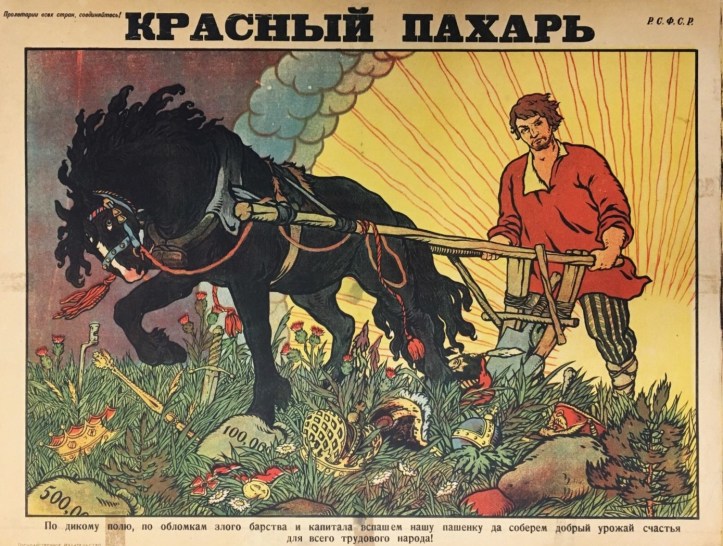
Ossinsky, here writing as Deputy People’s Commissar for Agriculture, explains the recently inaugurated New Economic Policy’s management of land. Valerian Ossinsky (Obolensky) was a leading early Soviet economist and Left Communist, later ‘Democratic Centralist,’ in the years after the Revolution. One of the signatories of the The Platform of the 46, he was a lead voice of the Opposition on economic matters in the debates of 1923-1924. Like a number of Oppositionists, Ossisnsky was moved to the diplomatic corp, becoming ambassador to Sweden. Breaking with the Opposition in 1925, he was elected to the Central Committee with much of his work with Gosplan and in agricultural planning. He aligned himself with Bukharin in the collectivization debate, but retained his membership in the Party, with academic work largely replacing Party and state activities. Arrested in October, 1937 during the Purges, Ossinsky was a witness in the trial of Bukharin and Rykov. He was executed on September 1, 1938 as an ‘agent of fascism’ who had plotted with Bukharin and others to kill Lenin, Stalin, and Sverdlov in 1918.
‘Our New Land Policy’ by N. Ossinsky from International Press Correspondence. Vol. 2 No. 1. January 3, 1922.
Deputy People’s Commissar for Agriculture.
The point of departure for our new economic policy was, as known, the replacement of requisitions and the monopoly of wheat by a tax in kind and by a free commerce in agriculture products. All the rest follows as a result. Upon this basis, what will the new village–different certainly from that of the ancient regime and from that of the requisition period–be like?
Certain comrades imagine that it will be characterized by a rapid bourgeois development. The communes, they say, will fall to pieces; the peasants will become bourgeois; and we shall allow them a free hand and confine ourselves to organizing the semi-proletariat and the proletariat of the villages for the class-struggle.
These comrades jump too quickly at conclusions. A rapid differentiation of classes is impossible in our villages. First of all, the peasants will need several years to recover from the effects of the civil war. Besides, it must be kept in mind that the dictatorship of the proletariat, contrary to all other governments, will do nothing to favor the development of the filler of the land into a bourgeois. And as to results otherwise, we think that it is not the parceling of the land or the bourgeois development of agriculture that will bring him the greatest yield but rather the development of a close network of land lots, cultivated on a small scale, closely connected among themselves by cooperation. Small scale cultivation will disappear by itself when mechanical tractors and electric tools take the place of the day laborer and his horse, i.e., when industry will in its turn come to the aid of agriculture. And the road can be made easier for it only by an extension of peasant cooperation.
Thus we do not think that the Russian village of tomorrow will be distinguished by the parceling of the land and the rapid differentiation between bourgeoisie and proletariat. To be sure, these results will also follow, but on the whole our villages will remain on a certain average level much below this extreme and that is all we need wish.
Will we retain the peasant within his village, will we prohibit wage labor in agriculture, and subleasing of land?
Our rules will be:
1. To allow the peasant the possibility of developing normally a petty-bourgeois economy.
2. Not to favor by any special measure the growth of large privately owned estates.
3. To aid, with all our power, the development of peasant economic cooperation associations.
We shall permit wage labor under certain conditions– for the busy season, on those farms that lack manual labor (Farms of widows, wives of soldiers in the Red Army, etc.) and on model farms. The trade-unions, the cooperatives, or other organizations, will help us to settle these questions.
The subleasing of the soil from peasant to peasant will be permitted with great restriction only when fully justified. (In the same cases as the employment of manual wage labor.) In principle this is not desirable. At any rate, it must be said quite unequivocally that there can be no question of denationalizing the soil or of restoring private property. The usufruct of the soil will not be less durable and less defined. But no one will be allowed to buy, sell, or mortgage any land. We shall thus be insured against the reappearance of land ownership.
In no case may the usufruct from the soil serve as “social insurance”: the peasant incapable of cultivating his plot may neither rent it out nor keep it while working at something else. If he cannot truly do his work as a peasant, he will have to transfer his land to someone else.
The parceling of the soil neither frightens nor seduces us. We confront if with the sole condition that it create an immediately increased productive force. We see prospects for the improvement of agriculture only in a better agronomic education of the masses, which will result in each peasant’s interest in and knowledge of his land, in the passing from old forms of communal work to superior forms and in the inviolability of the principle of land nationalization.
But what will be the function of the large, cultivated Soviet estates in the new village? They will have numerous very important functions to perform. In the first place, they will furnish the peasant with improved seed and cattle. Improvement of seed and cattle raising were formerly tasks of large private estates, which they fulfilled quite inadequately. Henceforth all agricultural cultivation devoted to these tasks will be in the hands of the State or will be submitted to the rigorous control of the cooperatives.
Other Soviet estates will serve as model agricultural establishments. These, too, will remain in the hands of the State. Their managers will have about the same freedom of action in the market as a good steward had in former days.
A third kind of agricultural cultivation may be qualified as “consumers’ farms”. The latter will be ceded not to individuals, but to factories, to consumers’ cooperatives, and even to good peasant cooperatives.
On the borders of Russia where uncultivated lands abound, big agricultural concessions may be made on the condition that modern machine labor be introduced there. Big land grants may be made there to farmers working under the control of the State according to the plans of production approved by it.
To recapitulate: in the agricultural domain we are going neither in the direction of old capitalism nor in the direction of a revival of the old social relations we are going toward an order in which a certain capitalism of the proletarian state bearing within it the first elements of socialism, exists side by side with petty bourgeois customs and relations being gradually transformed by the development of superior economic forms.
International Press Correspondence, widely known as”Inprecorr” was published by the Executive Committee of the Communist International (ECCI) regularly in German and English, occasionally in many other languages, beginning in 1921 and lasting in English until 1938. Inprecorr’s role was to supply translated articles to the English-speaking press of the International from the Comintern’s different sections, as well as news and statements from the ECCI. Many ‘Daily Worker’ and ‘Communist’ articles originated in Inprecorr, and it also published articles by American comrades for use in other countries. It was published at least weekly, and often thrice weekly. Inprecorr is an invaluable English-language source on the history of the Communist International and its sections.
PDF of issue: https://www.marxists.org/history/international/comintern/inprecor/1922/v02n001-jan-03-1922-inprecor.pdf
 Revolution's Newsstand